Agentic AI: The Next Evolution of Business Automation Is Already Here
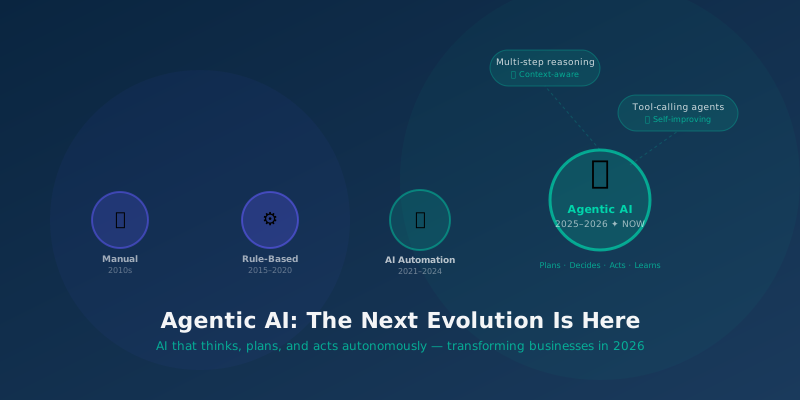
If you have been following the world of AI automation over the past few years, you have watched an extraordinary acceleration unfold. First came simple chatbots that could answer basic FAQs. Then came workflow automation tools that could trigger actions based on predefined rules. Then came large language models that could understand nuanced language and generate sophisticated responses. Each step felt like a leap forward.
But what is happening right now — in early 2026 — makes all of that look like a warm-up act. Agentic AI has arrived. And for business owners who understand what it is and how to harness it, it represents the most transformative technology shift since the internet itself.
This is not hype. This is a technical reality that forward-thinking businesses are deploying today. Let us break down exactly what agentic AI is, how it differs from everything that came before it, and — most importantly — what it means for your business right now.
Key Takeaway
Agentic AI systems can plan multi-step tasks, use tools and APIs autonomously, reason about complex problems, and self-correct when they encounter obstacles — without human intervention at each step. For businesses, this means entire workflows that previously required constant human oversight can now run completely on autopilot.
The Evolution of Business AI: A Brief History
To understand why agentic AI is such a breakthrough, it helps to trace the lineage of AI tools that businesses have used over the past decade.
Rule-Based Automation (2010–2018)
Tools like Zapier and simple chatbots operated on rigid "if X, then Y" logic. Powerful for highly predictable workflows, completely useless the moment something unexpected happened. Every exception required human intervention.
Intelligent Workflow Automation (2018–2022)
Platforms like Make.com and n8n added conditional logic, multi-step workflows, and some machine learning. Still fundamentally rule-based, but with more sophisticated branching and data processing capabilities.
Conversational AI and LLMs (2022–2024)
Large language models like GPT-4 could understand nuanced language, generate human-quality text, and respond intelligently to complex queries. But they were reactive — they responded to inputs but could not initiate actions, plan ahead, or use external tools autonomously.
Agentic AI (2025–Present)
AI systems that can set goals, break them into subtasks, use tools (search engines, APIs, databases, email, calendars) to accomplish those subtasks, evaluate their own progress, and self-correct when results do not match expectations — all without human prompting at each step.
What Makes an AI System "Agentic"?
The term "agentic" refers to AI systems that exhibit agency — the ability to act independently toward goals. A truly agentic AI system has four defining characteristics that distinguish it from all previous automation approaches:
1. Goal-Directed Reasoning
Instead of following a predefined script, an agentic AI receives a high-level goal ("Research the top 5 competitors in our market and prepare a comparison report") and independently figures out how to accomplish it. It breaks the goal into subtasks, executes them in the right sequence, and synthesizes the results — all without being told exactly what steps to take.
2. Tool Use and API Integration
Agentic AI systems can use external tools the same way a human employee would — searching the web, reading documents, sending emails, updating databases, making API calls to third-party services, running calculations, and more. This is what separates agents from chatbots: agents do not just talk about doing things. They actually do them.
3. Memory and Context Persistence
Unlike earlier AI systems that treated every interaction as isolated, agentic AI systems maintain context across time. They remember what they have done, what the outcomes were, what the user's preferences are, and what the current state of ongoing tasks is. This enables long-running, multi-day workflows that previous AI could not sustain.
4. Self-Evaluation and Error Correction
When an agentic AI encounters an unexpected result, it does not fail silently or produce a wrong answer with false confidence. It recognizes that something is off, diagnoses the problem, and tries an alternative approach. This built-in self-correction dramatically increases reliability for complex real-world tasks.
What Agentic AI Looks Like in a Real Business
Abstract definitions only go so far. Let us look at what agentic AI actually does inside a business context.
Sales Prospecting Agent
You give the agent a target customer profile: "Find 20 manufacturing SMBs in Maharashtra with 50–200 employees that are not currently using ERP software." The agent searches LinkedIn, business databases, and news sources, qualifies each company against your criteria, finds the decision-maker's contact information, drafts a personalized first-contact email for each prospect, and delivers a ready-to-send outreach list — a task that would take a human researcher 2–3 full days.
Customer Success Agent
The agent monitors your customer base for health signals — login frequency, feature usage, support tickets, payment behavior. When it detects a customer trending toward churn, it autonomously identifies the root cause (has not used Feature X, which drives retention), sends a targeted educational resource, books a check-in call with the account manager's calendar, and logs all actions in the CRM — without anyone asking it to do any of this.
Financial Reconciliation Agent
At the end of every month, the agent pulls transaction data from your payment processor, cross-references it with your invoicing system, identifies discrepancies, investigates the source of each discrepancy (duplicate charges, uncaptured payments, refund mismatches), resolves the ones it can autonomously, and escalates the ones requiring human judgment — with a full explanation of the issue and recommended resolution.
Content and Marketing Agent
You tell the agent: "We are launching a new service targeting logistics companies. Create a 30-day content plan, write the first week's content across blog, email, and LinkedIn, and schedule it." The agent researches the logistics industry, identifies key pain points, generates a strategic content calendar, writes 7 pieces of original content tailored to logistics decision-makers, and publishes or schedules them across your platforms.
"We asked our AI agent to handle our monthly competitor analysis. It searches 40+ data sources, updates our competitive intelligence database, highlights new threats and opportunities, and sends our team a strategic briefing every first Monday of the month. What used to take a junior analyst 12 hours now happens automatically, consistently, and at a quality our team could not match manually." — Strategy Director, B2B SaaS company, Hyderabad
Agentic AI vs Traditional Automation: The Key Differences
| Capability | Traditional Automation | Agentic AI |
|---|---|---|
| Handles unexpected situations | Fails, requires human intervention | Self-corrects, tries alternatives |
| Task complexity | Simple, predefined steps only | Multi-step, dynamic, open-ended |
| Tool usage | Fixed integrations | Uses any API or tool dynamically |
| Learning over time | Static | Improves from feedback and outcomes |
| Context awareness | None (each trigger is isolated) | Full memory across sessions and time |
| Business value | Eliminates routine tasks | Replaces entire job functions |
The Business Case: Why Now Matters
The interesting thing about agentic AI is not just what it can do — it is the timing. For the past 18 months, this technology has been available primarily to large enterprises with dedicated AI research teams and multimillion-dollar technology budgets. That is changing rapidly.
In 2026, the democratization of agentic AI is well underway. The underlying models are more accessible. The infrastructure to deploy agents reliably has matured. And specialized AI partners like Jogi AI have developed the expertise to implement agentic workflows for SMBs at a cost and timeline that makes commercial sense.
What this creates is a window of opportunity. Businesses that deploy agentic AI in 2026 gain a compounding operational advantage over competitors who wait. Every month of delay is a month of compound advantage your competition is accumulating.
What Agentic AI Is Not
Before you get too excited — or too worried — let us address some important realities about what agentic AI is not, as of today:
- It is not autonomous business decision-making. Agentic AI excels at executing well-defined tasks and researching structured problems. High-stakes strategic decisions still require human judgment and accountability.
- It is not infallible. Even the best agentic AI systems make mistakes, especially on highly ambiguous tasks. Human-in-the-loop review remains important for consequential outputs.
- It is not a replacement for human creativity and relationship-building. AI agents are exceptional at information processing, communication at scale, and process execution. They do not replicate the intuition, empathy, and creative insight that define human excellence.
- It is not "plug and play" out of the box. Effective agentic AI deployment requires understanding your specific workflows, careful prompt engineering, integration work, and ongoing optimization. This is where an experienced implementation partner makes all the difference.
Key Takeaway
Agentic AI is not science fiction and it is not a complete replacement for human intelligence. It is a powerful, practical tool that — when deployed thoughtfully — can execute entire categories of business work that previously required dedicated human staff. The businesses that figure this out in 2026 will have an operational advantage that proves very difficult for late adopters to close.
How to Prepare Your Business for Agentic AI
The transition from traditional automation to agentic AI does not require a complete overhaul of your business. It is an evolution, and the best way to approach it is step by step:
- Document your high-complexity workflows. Agentic AI delivers the most value on tasks that are too complex for simple automation but not complex enough to require constant senior human attention. Map out where your business has these kinds of workflows.
- Start with a well-bounded pilot. Choose one specific, measurable task for your first agentic AI deployment. Define success criteria clearly before you start. Run it for 30 days and evaluate.
- Build in human oversight at critical decision points. Even as your AI handles more autonomously, identify the moments where a human should review output before it takes effect — especially in customer-facing communications and financial transactions.
- Treat AI agents like new team members. They need onboarding — context about your business, your tone of voice, your customers, your constraints. The more context you provide upfront, the better they perform.
- Partner with implementation specialists. The learning curve for effective agentic AI deployment is steep. Working with a team that has already built and optimized multiple agentic workflows saves months of experimentation and dramatically improves outcomes.
The World Is Dividing Into Two Kinds of Businesses
Over the next two to three years, a clear divide will emerge between businesses that have embraced agentic AI and those that have not. The former will have operational leverage that the latter cannot match at any headcount. A team of 10 people augmented by agentic AI will consistently outperform a team of 25 doing the same work manually — on cost, speed, consistency, and scalability.
This is not a prediction. The early evidence is already visible in the businesses implementing these systems today. The question for any business owner reading this is a simple one:
Which side of that divide do you want to be on?
Agentic AI is no longer a technology of the future. It is a technology of right now — available, accessible, and waiting to be deployed in your business. The next move is yours.