Top 10 AI Automation Trends for Small Businesses in 2026
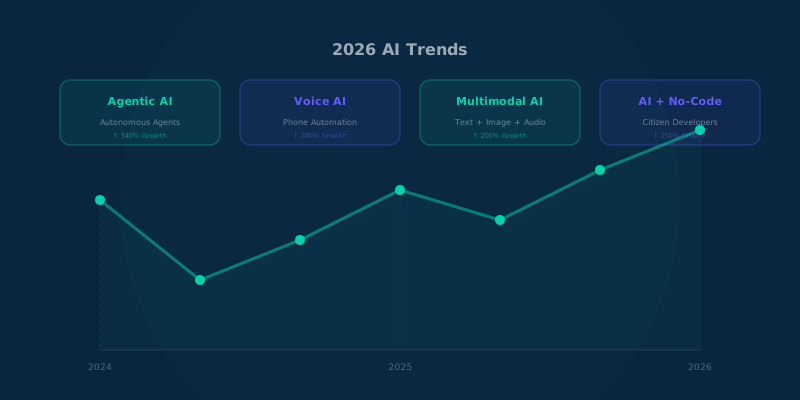
AI automation is no longer a luxury reserved for large enterprises. In 2026, small businesses across India and the world are adopting AI tools at an unprecedented rate -- and for good reason. The technology has become more affordable, more accessible, and dramatically more capable than even a year ago.
Here are the 10 trends that will shape how small businesses operate this year. Understanding these trends gives you a competitive advantage -- you can adopt early and reap the benefits while your competitors are still figuring things out.
1. Agentic AI: From Automation to Autonomy
The biggest shift in 2026 is the rise of AI agents -- systems that do not just follow predefined rules but can reason, plan, and take action on their own. Unlike traditional automation (if X happens, do Y), AI agents can:
- Understand context and make decisions based on multiple factors
- Handle exceptions and edge cases that would break rule-based systems
- Learn from outcomes and improve their performance over time
- Coordinate multiple tasks across different tools and platforms
What this means for small businesses: Instead of building 50 separate automations for every scenario, you deploy an AI agent that understands your business process and handles the entire workflow -- including the 20% of edge cases that traditional automation cannot manage.
Key Takeaway
AI agents are the biggest leap forward since the smartphone. For small businesses, they represent the ability to have a tireless, intelligent team member who handles complex tasks around the clock -- at a fraction of the cost of hiring.
2. WhatsApp-First Business Communication
In India, WhatsApp is not just a messaging app -- it is the primary business communication channel. In 2026, AI-powered WhatsApp automation is becoming the standard for small businesses:
- AI chatbots on WhatsApp: Handle customer inquiries, take orders, and book appointments 24/7
- Automated broadcasts: Send promotions, updates, and reminders to segmented customer lists
- Payment integration: Collect payments directly through WhatsApp conversations
- Catalog browsing: Let customers browse and order products without leaving the chat
Why this matters: WhatsApp messages have a 98% open rate compared to 20-30% for email. Businesses that meet customers on WhatsApp convert at 3-5x the rate of those relying solely on email or phone.
3. Voice AI and Conversational Interfaces
Voice-based AI is reaching a tipping point in 2026. Natural-sounding AI voice agents can now:
- Answer phone calls and handle common inquiries without human intervention
- Schedule appointments through natural conversation
- Qualify leads by asking questions and understanding responses
- Handle multilingual conversations (critical for the Indian market)
- Transfer to a human agent seamlessly when the conversation requires it
For small businesses: You no longer need a receptionist or call center to provide professional phone support. An AI voice agent handles the 70-80% of calls that are routine (appointment booking, business hours, pricing inquiries), while routing complex calls to your team.
4. Hyper-Personalization at Scale
AI makes it possible to deliver a personalized experience to every customer -- something previously only possible for businesses with massive marketing teams. In 2026, small businesses are using AI to:
- Send different follow-up messages based on each customer's behavior and preferences
- Recommend products or services based on purchase history and browsing patterns
- Adjust pricing and offers dynamically based on customer segments
- Create personalized content (emails, WhatsApp messages, landing pages) for different audiences
The impact: Personalized communications convert 2-3x better than generic ones. AI lets a 5-person business deliver the same personalized experience that used to require a 50-person marketing department.
5. No-Code and Low-Code AI Tools
The barrier to entry for AI automation has dropped dramatically. In 2026, you do not need to be a developer to build powerful AI systems:
- Visual workflow builders: Platforms like Make.com and n8n let you create complex automations by dragging and connecting blocks
- Pre-built templates: Industry-specific automation templates that you can deploy in minutes
- Natural language configuration: Some tools now let you describe what you want in plain English, and the AI builds the automation for you
- AI-assisted debugging: When something goes wrong, AI helps you identify and fix the issue
What is changing: The time to deploy a full business automation has dropped from weeks to days, and the cost has fallen by 60-80%. This makes AI automation financially viable even for micro-businesses and solo entrepreneurs.
6. Predictive Analytics for Small Businesses
AI-powered prediction is no longer limited to companies with data science teams. In 2026, accessible AI tools can help small businesses:
- Predict customer churn: Identify at-risk customers before they leave and trigger retention campaigns automatically
- Forecast demand: Predict inventory needs, staffing requirements, and revenue with surprising accuracy
- Optimize pricing: AI analyzes market conditions and customer behavior to suggest optimal pricing
- Lead scoring: Predict which leads are most likely to convert, so your sales team focuses on the right prospects
Real-world example: A restaurant using AI demand forecasting reduces food waste by 30% and ensures they never run out of popular items during peak hours.
7. AI-Powered Content Creation
Content marketing is essential for small businesses, but creating quality content consistently is time-consuming. AI content tools in 2026 are sophisticated enough to:
- Draft blog posts, social media captions, and email campaigns in your brand voice
- Generate product descriptions and marketing copy
- Create and edit images for social media and advertisements
- Repurpose content across platforms (turn a blog post into social media posts, an email, and a WhatsApp broadcast)
The nuance: AI does not replace human creativity -- it amplifies it. You provide the strategy and ideas; AI handles the execution. A task that took 4 hours (writing, formatting, scheduling) now takes 30 minutes.
8. Integrated AI Ecosystems
The days of disconnected tools are ending. In 2026, AI is the glue that connects all your business systems into one cohesive ecosystem:
- CRM + Communication + Invoicing: A new lead comes in via WhatsApp, gets added to your CRM, receives a welcome sequence, books a meeting, and gets invoiced -- all automatically, all connected
- Cross-platform data sync: Information flows seamlessly between your website, social media, CRM, accounting software, and communication channels
- Unified customer view: See every interaction a customer has had across all channels in one place
Why this matters: Disconnected systems create data silos, duplicate work, and customer experience gaps. An integrated AI ecosystem eliminates all three, making your small business operate with the efficiency of a much larger organization.
9. AI for Compliance and Documentation
Regulatory compliance and documentation are often the most dreaded tasks for small business owners. AI is making this dramatically easier:
- Automated record-keeping: Every customer interaction, transaction, and communication is automatically logged and organized
- GST and tax compliance: AI tracks transactions and generates compliant invoices and returns
- Contract management: AI drafts, tracks, and alerts you about contract renewals and deadlines
- Data privacy compliance: Automated systems ensure customer data handling meets regulatory requirements
The benefit: Small businesses that struggle with compliance due to limited resources can now maintain the same standards as large corporations -- without hiring specialized staff.
10. AI-Driven Customer Retention
Acquiring a new customer costs 5-7x more than retaining an existing one. In 2026, AI is transforming how small businesses keep their customers:
- Automated loyalty programs: AI tracks customer behavior and automatically rewards loyalty with personalized offers
- Proactive support: AI detects when a customer might be having an issue (e.g., unusual inactivity, abandoned tasks) and reaches out before they complain
- Re-engagement campaigns: Automatically identifies inactive customers and triggers personalized win-back sequences
- Sentiment analysis: AI monitors customer communications for satisfaction signals and flags potential issues early
The result: Businesses using AI-powered retention strategies see 20-40% improvement in customer lifetime value. For a small business, this can mean lakhs in additional annual revenue from existing customers alone.
Key Takeaway
The common thread across all 10 trends is this: AI is making enterprise-grade capabilities available to businesses of every size. You do not need a large team, a massive budget, or technical expertise to benefit. The businesses that adopt these trends early will have a significant competitive advantage -- not just in efficiency, but in the customer experience they deliver.
How to Stay Ahead
You do not need to adopt all 10 trends at once. Here is a practical approach:
- Start with your biggest pain point: Is it lead management? Customer follow-ups? Manual data entry? Pick the trend that addresses your most pressing challenge.
- Implement one automation per month: Consistent, incremental progress beats a massive overhaul. Each automation you add compounds the efficiency gains.
- Measure results: Track the time saved, leads converted, and revenue generated by each automation. This data drives smarter decisions about what to automate next.
- Work with experts: An AI automation specialist can help you prioritize, implement, and optimize -- saving you months of trial and error.
The future of small business is automated, intelligent, and always-on. The only question is whether you will lead the charge or play catch-up. 2026 is the year to start.