AI in Real Estate: From Lead Capture to Deal Closure in 2026
A buyer finds your property listing at 10pm on a Tuesday. They have questions about the floor plan, the payment schedule, and whether the 3BHK unit is still available. They open WhatsApp and send a message.
No one replies until Thursday morning. By then, they have already visited a competitor's site, chatted with their agent on WhatsApp, scheduled a viewing, and provisionally booked.
You spent money getting that lead. You lost it not to a better property — but to a faster response.
This is the most expensive problem in real estate today. Not a shortage of leads — a shortage of speed, consistency, and follow-through. And it is the problem that AI for real estate was built to solve.
How AI Is Changing Real Estate Operations
The traditional real estate sales process has a fundamental flaw: it is entirely dependent on agent availability. Leads come in around the clock — from property portals, social media, website forms, and WhatsApp — but agents are only available during business hours. By the time Monday morning arrives, weekend leads are cold. By the time an agent finishes with one client, the next enquiry has moved on.
AI in real estate does not replace agents. It eliminates the gaps between them — ensuring every lead is captured, qualified, informed, and nurtured, regardless of when they reach out or how busy the team is.
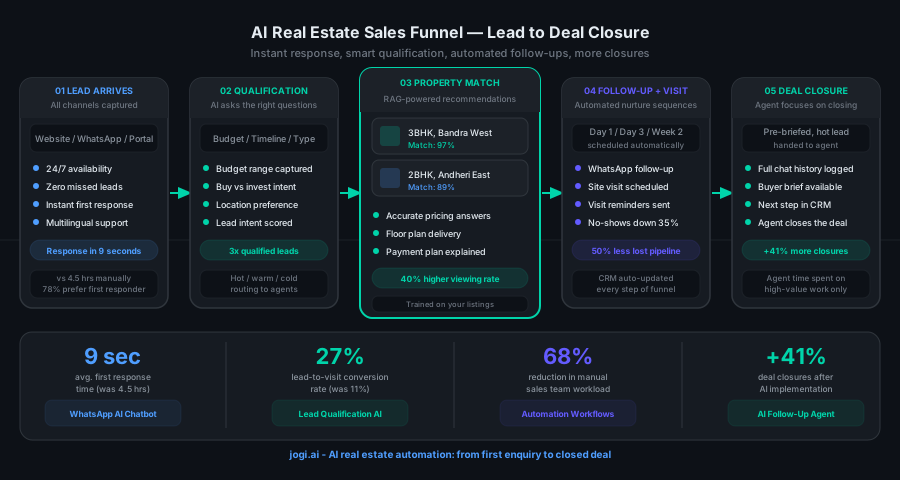
Modern AI real estate systems are built on three layers working together: a property chatbot for instant, accurate responses; an automation layer for follow-ups, scheduling, and CRM updates; and a RAG knowledge base trained on your actual listings, pricing, and FAQs — so the AI gives real answers, not generic ones.
Five Areas Where AI Delivers the Biggest Impact
Not every enquiry is a serious buyer. An AI qualification agent engages every incoming lead — on your website, WhatsApp, or property portal — with a structured conversation: What is your budget? Are you looking to buy or invest? What timeline are you working to? What location or configuration do you need? Within minutes, the AI has separated serious, ready-to-buy leads from early-stage browsers — and your agents only spend time on the former.
3x more qualified leads from the same ad spendA WhatsApp chatbot for real estate is one of the highest-ROI investments any property business can make. WhatsApp is where Indian property buyers communicate — with each other, with their brokers, with builders. Deploying an AI assistant on your WhatsApp Business number means every enquiry gets an instant, accurate reply — at any hour. The chatbot answers questions about available units, pricing, amenities, and payment plans. It never sleeps, never misses a message, and never gives an outdated answer.
Response time: hours to secondsOnce a buyer's requirements are known — budget, location, configuration, investment vs end-use — an AI system can immediately surface the most relevant options from your portfolio. Rather than sending a static brochure, the chatbot delivers a curated shortlist of matching properties with relevant specs, floor plans, and pricing. Buyers feel understood. The gap between "I have a lead" and "I have a viewing booked" collapses.
40% higher viewing-to-enquiry ratioThe majority of real estate deals are not closed on first contact. A buyer who enquires today may need six weeks, six conversations, and several nudges before they are ready to commit. An AI sales assistant automates this entire nurture sequence — sending follow-up messages at optimal intervals, sharing relevant project updates, offering new units as they become available, and checking in on buying timelines. Every lead in your pipeline is followed up consistently, whether the team is busy or not.
50% reduction in lost pipeline valueCoordinating a site visit between a buyer, an agent, and a developer sales team is a scheduling problem that costs far more in time than it should. An AI scheduling agent handles the entire coordination: queries availability, proposes time slots, sends confirmation messages, delivers pre-visit property information to the buyer, and sends reminders the day before. The agent arrives at a visit where the buyer is already briefed, already engaged, and already serious — not confused about what they are there to see.
Site visit no-shows reduced by 35%The Compounding Effect
Each of these five areas improves your conversion rate independently. But the real power is how they compound: faster response increases the number of leads that stay in the funnel; better qualification means agents focus on the right ones; consistent follow-up ensures none are lost; smart scheduling converts intent into viewings. Together, they can double conversion rates from the same lead volume — without adding headcount.
Real-World Case Studies
Case Study 1 — Real Estate Agency: WhatsApp Chatbot Doubles Lead Conversion
Mumbai-Based Agency, 8 Agents, 3 Active Projects
The problem: The agency was generating 600–800 WhatsApp enquiries per month from paid advertising on housing portals and Meta campaigns. With eight agents handling everything manually, average first response time was 4.5 hours. Weekend enquiries routinely waited until Monday. Lead-to-site-visit conversion was sitting at 11%.
What was built: A WhatsApp AI assistant trained on all three project listings — unit configurations, pricing, floor plans, payment schedules, RERA details, and common buyer FAQs. The chatbot handled first response, qualification questions, property recommendations, and site visit booking. Qualified leads were tagged and pushed to the CRM automatically, with the agent notified when a buyer crossed the "high-intent" threshold.
Result after 90 days:
Case Study 2 — Property Builder: Automated Inquiry Handling at Scale
Pune Developer, New Launch Phase — 1,200+ Enquiries in 30 Days
The problem: A Pune-based builder launched a new residential project and ran a 30-day paid campaign across Google, Meta, and housing portals. The campaign generated 1,240 enquiries — far more than the four-person sales team could handle. Within the first week, the team was overwhelmed, response times had collapsed, and potential buyers were slipping away unanswered.
What was built: An AI-powered inquiry automation system — a property chatbot on the project website and a WhatsApp assistant on the sales number — trained on the full project knowledge base: unit types, pricing matrix, floor plans, location benefits, construction timeline, and payment plan options. The system engaged every incoming lead within seconds, completed a qualification survey, shortlisted units matching the buyer's criteria, and auto-scheduled site visits for high-intent leads. The sales team only stepped in for site visits and negotiations.
Result:
Case Study 3 — Independent Broker: AI Follow-Ups Close More Deals
Bangalore Broker, Secondary Market Residential and Commercial
The problem: A Bangalore broker with a 200-lead pipeline was closing 6–8 deals per month. Post-analysis showed that 70+ leads per month were labelled "not interested" after just one or two touchpoints — when in reality many of them were simply not ready yet, not uninterested. The broker had no systematic way to keep in touch with slower-moving leads without it consuming all their time.
What was built: An AI-powered follow-up automation system integrated with the broker's existing CRM. Leads were segmented by intent score and buying timeline. High-intent leads received a fast-track follow-up sequence. Medium-intent leads entered a 90-day nurture sequence — regular WhatsApp messages with relevant new listings, market updates, and check-in prompts — all sent by the AI agent, personalised by the lead's stated preferences. Leads that re-engaged were automatically flagged for human follow-up.
Result after 4 months:
How Real Estate Businesses Can Start Using AI Today
You do not need to overhaul your entire operation. Most real estate businesses can implement AI in phases, starting with the highest-impact area — which is almost always the lead response and follow-up problem.
- Audit your lead response time. Track how long it currently takes to respond to a new enquiry on average. If it is more than 30 minutes, that is where your biggest revenue leak is — and where AI delivers the fastest return.
- Build your property knowledge base. Compile your listings into a clean, structured document: unit types, pricing, floor plans, location highlights, amenities, payment plans, and FAQs. This becomes the foundation for your AI chatbot's accuracy.
- Deploy a WhatsApp AI assistant first. WhatsApp is where your buyers already are. An AI assistant on your WhatsApp Business number handles first response, qualification, and property information — 24/7, at scale.
- Connect to your CRM. Every lead captured by the AI should flow directly into your CRM with qualification data attached. Agents should receive hot-lead alerts in real time — so they know exactly when to pick up the phone.
- Set up automated follow-up sequences. For leads that do not convert immediately, build a multi-week nurture workflow that keeps your brand top-of-mind until they are ready to buy.
- Add site visit scheduling automation. Let the AI handle the coordination — reducing no-shows and freeing your agents to focus on the visits themselves.
The Technical Architecture: What Connects to What
A complete real estate automation system for a property business typically includes these components:
- RAG Knowledge Base — Your property listings, pricing matrices, floor plans, location docs, and FAQs — embedded into a vector database so the AI retrieves accurate, property-specific answers to every buyer question. No hallucinations. No outdated information.
- WhatsApp Business API Integration — The AI chatbot connects to your WhatsApp Business number via the official API, handling all incoming enquiries automatically. High-intent leads are escalated to an agent with a full conversation summary.
- Website Chat Widget — A matching AI assistant on your property website for buyers who find you via Google or portals — same knowledge base, same qualification flow, different channel.
- CRM Integration — Every captured lead is pushed to your CRM (HubSpot, Salesforce, Zoho, or any equivalent) with qualification data: budget, timeline, preferred unit type, intent score. Agents see a pre-qualified, pre-briefed lead, not a raw contact.
- Automated Follow-Up Workflows — Scheduled WhatsApp and email sequences triggered by lead intent score and time-in-pipeline. Personalised with property recommendations based on stated preferences.
- Calendar and Scheduling Integration — The AI books site visits directly into agent calendars — syncing with Google or Outlook — and sends buyer reminders 24 hours and 2 hours before each visit.
Future Trends: Where AI in Real Estate Is Heading
The current generation of AI tools is already delivering measurable improvements. The next wave will transform the experience further:
- AI Property Advisors. Beyond answering questions about specific listings, AI assistants will act as consultants — advising buyers on locality growth trends, rental yield projections, and investment suitability based on their profile and goals. The AI becomes a trusted advisor, not just an information delivery system.
- Hyper-Personalised Property Recommendations. AI systems that learn each buyer's preferences across multiple interactions and proactively surface new listings the moment they become available — before the buyer even asks. First-mover advantage on new inventory becomes an AI advantage.
- Fully Autonomous Sales Funnels. End-to-end automation from first enquiry through to booking — with the AI handling qualification, recommendations, negotiations on standard terms, document collection, and final confirmation. Agents manage exceptions and relationships; AI manages the process.
- Virtual Property Tours on Demand. AI-guided 3D virtual tours triggered through WhatsApp or chat — where the AI narrates and answers questions in real time as a buyer explores a virtual unit — reducing the need for in-person site visits at the early interest stage.
The Competitive Reality
Real estate is intensely competitive. Two agencies with similar inventory, similar pricing, and similar locations will achieve very different outcomes based on one variable: how fast and how consistently they follow up. AI levels the playing field for smaller agencies and creates a decisive advantage for those who adopt it first. The window to be an early mover is still open — but it is closing.
Your Real Estate Business Can Start Converting More Leads This Week
The three case studies above are representative of what happens when a real estate business stops relying on agent availability and starts relying on AI consistency. The leads are already there. The advertising spend is already happening. The gap is in what occurs between a buyer hitting "send" on WhatsApp and a qualified, prepared buyer walking into your showroom.
AI fills that gap — at every hour, for every lead, without missing a single follow-up.
At Jogi AI, we build custom AI real estate automation systems tailored to your specific projects, channels, and team. From a RAG-powered property chatbot on WhatsApp and your website to a full lead-to-closure automation pipeline — we handle the architecture, the integrations, and the deployment.
Your next buyer is already asking a question. The only question is whether your AI is there to answer it.