AI Social Media Automation: Grow Instagram, LinkedIn & Facebook on Autopilot in 2026
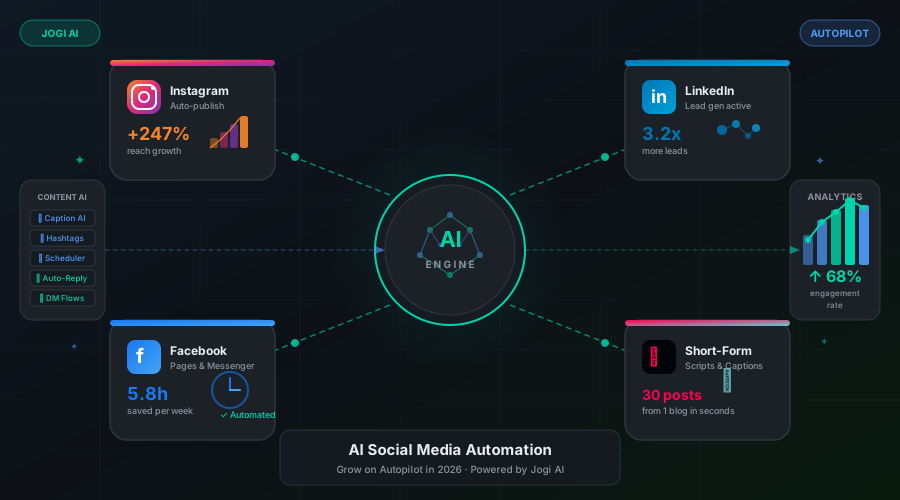
Here is a scenario most business owners know painfully well: it is 10 PM on a Tuesday, you meant to post on Instagram three days ago, your LinkedIn profile has been silent for two weeks, and you have no idea what to put on Facebook tomorrow. Meanwhile, your competitor posts daily, gets engagement, and shows up in your customers' feeds while you do not.
The solution is not to hire a social media manager at $3,000 a month. The solution is AI social media automation — a system that creates content, schedules posts across every platform, responds to comments, and analyses what is working, all with minimal human input. In 2026, this is not a luxury. It is the baseline for any business that takes growth seriously.
This guide covers everything you need to know: what AI social media automation actually means, how it works on each platform, the five pillars of a complete system, and exactly how to build one for your business without a technical background.
What AI Social Media Automation Actually Means
Most people think social media automation means a tool that schedules posts in advance. That is barely scratching the surface. True AI social media automation in 2026 encompasses five distinct capabilities that, when combined, form a self-improving growth engine for your brand.
It is important to separate scheduling tools (Buffer, Hootsuite, Later) from AI automation. Scheduling tools require you to write the content first, then queue it. AI automation generates the content, adapts it for each platform, schedules it at the optimal time, responds to comments with contextually appropriate replies, and then reports back on what resonated — all without you needing to write a single word from scratch.
The distinction matters because the time savings are completely different. A scheduling tool saves you 30 minutes a day. A complete AI social media automation system saves you six or more hours a week — and the output quality often exceeds what most businesses produce manually, because AI never has a bad day, never runs out of ideas, and never misses a posting window.
Key Takeaway
AI social media automation is not just scheduling — it is a complete system that creates, publishes, engages, optimises, and reports on your entire social presence. Businesses that implement all five pillars see consistent, compounding growth rather than the feast-or-famine cycle of manual posting.
The 5 Pillars of a Complete AI Social Media System
1. AI Content Generation
The most time-consuming part of social media is staring at a blank screen trying to think of what to say. AI eliminates this entirely. Modern content generation tools (powered by large language models trained on your brand voice, industry, and audience) can produce:
- Platform-specific captions — a LinkedIn post sounds different from an Instagram caption, and AI handles that automatically
- Carousels and multi-slide content from a single topic idea
- Short-form video scripts for Reels and TikTok
- Hashtag sets researched for reach and relevance in your specific niche
- Calls to action tailored to your conversion goal (DMs, website clicks, bookings)
- Seasonal and topical variations that keep content feeling fresh
The key differentiator in 2026 is brand voice training. Generic AI content is obvious and flat. But when you feed the AI your existing best-performing posts, your brand guidelines, your tone of voice document, and examples of how you talk to customers, the output becomes indistinguishable from something you wrote yourself — only faster and at ten times the volume.
2. Smart Scheduling and Cross-Platform Publishing
AI scheduling is not just picking a time slot. The best systems analyse your historical post performance data and your audience's activity patterns to identify the exact windows when your followers are most likely to be online and engaged. This changes by platform, by day of the week, and even by time of year.
Cross-platform publishing means you write (or your AI writes) one piece of content, and the system automatically reformats it for each platform — adjusting image dimensions, caption length, hashtag strategy, and CTA phrasing to match the norms and algorithms of Instagram, LinkedIn, Facebook, and beyond. No more copy-pasting and editing manually for each channel.
3. Automated Comment and DM Engagement
Engagement is not just about posting — it is about responding. The platforms' algorithms actively reward accounts that reply to comments quickly. Studies show that responding to comments within the first hour of posting can double the reach of that post. Manually monitoring six platforms and replying to every comment is not feasible for a small business. AI engagement automation handles this at scale.
Comment automation uses sentiment analysis to detect whether a comment is positive, a question, a complaint, or spam — and responds appropriately. Positive comments get a warm acknowledgment. Questions get a helpful answer pulled from your knowledge base. Complaints get escalated to a human. Spam gets hidden.
DM (direct message) automation is even more powerful for lead generation. When someone sends you a message on Instagram or LinkedIn, an AI-powered DM flow can qualify them, answer their questions, send them relevant resources, and even book a consultation — all while you sleep.
4. AI-Powered Hashtag and SEO Research
Hashtags are the discoverability engine of social media. The right hashtag mix puts your post in front of people who have never heard of you. The wrong mix buries it in feeds full of competitors with millions of followers. AI hashtag research analyses your niche, your post content, your engagement rate, and the current trending tags to generate a customised hashtag set for every post — optimised for both reach and relevance.
In 2026, this also extends to social SEO. LinkedIn, Instagram, and YouTube are increasingly functioning as search engines where people look for information rather than just scroll. AI tools optimise your bio, post captions, and video titles for the specific search terms your ideal customer uses — giving your content a second life as discoverable search content long after it was first published.
5. Analytics, Sentiment Analysis, and Performance AI
The final pillar closes the loop. AI analytics tools go far beyond basic metrics like likes and follower count. They tell you:
- Which content formats (carousels, videos, single images, text posts) drive the most profile visits from your audience specifically
- What emotional tone in your captions generates the highest save and share rates
- Which competitor content is outperforming yours and what makes it different
- Sentiment trends in your comments — whether your audience feels more positive, neutral, or frustrated over time
- Which posts are generating actual business leads versus just vanity engagement
This data feeds back into the content generation layer, creating a self-improving system: each month, the AI knows more about what works for your specific audience and automatically produces more of it.
Key Takeaway
Each pillar alone provides value. But the real power of AI social media automation comes from connecting all five: content flows into scheduling, scheduling triggers engagement, engagement data feeds analytics, and analytics improves future content. This is the compounding advantage that manual posting can never match.
Platform-by-Platform AI Automation Strategies
Each major platform has its own algorithm, audience behaviour, and content norms. AI automation that treats them all the same will underperform. Here is what an optimised AI approach looks like on each platform:
AI generates carousel scripts from blog posts, writes Reels hooks and captions, researches trending audio, optimises stories with poll and question stickers, and responds to DMs for lead capture. The algorithm rewards saves and shares over likes — AI content is engineered for this.
Best platform for B2B lead generation. AI builds thought leadership post sequences, personalises connection request messages, writes long-form articles summarised from your expertise, and manages DM follow-up sequences. Consistent AI-powered posting on LinkedIn typically generates 3× more qualified leads within 60 days.
AI schedules page posts timed for peak engagement, powers Messenger chatbots for lead qualification and FAQ handling, generates ad creative variants for A/B testing, and monitors group activity to flag engagement opportunities. Facebook's audience skews older with higher purchasing power — AI keeps you present without daily effort.
Short-Form Video
AI generates video scripts, identifies trending sounds and hooks, writes captions optimised for the algorithm's keyword indexing, and repurposes long-form content into snackable clips. One blog post becomes 5–8 short-form video scripts in minutes — content that would take a team days to produce.
The Content Repurposing Machine: Turn 1 Piece Into 30
One of the most underused capabilities of AI social media automation is content repurposing. Most businesses create one blog post and publish it once. AI-powered systems extract every possible angle from that single piece of content and distribute it across every channel in the right format.
Here is what one well-written blog post becomes when run through an AI repurposing workflow:
- 3 LinkedIn posts — each focusing on a different insight from the article, with a question to drive comments
- 5 Instagram carousels — one slide per key point, designed as shareable infographic-style content
- 2 Facebook posts — one for engagement (question-based), one for reach (storytelling format)
- 6 short-form video scripts — each under 60 seconds, covering one tip each
- 1 email newsletter segment — a curated excerpt with a "read more" CTA
- 8 story frames — bite-sized takeaways formatted for Instagram and Facebook Stories
- 5 quote cards — pull quotes from the article, branded with your colour scheme
Total: one piece of source content becomes 30 social media assets, distributed across six channels over 4–6 weeks. A business that publishes two blog posts per month now has 60 pieces of social content — without writing a single additional word.
"The businesses growing fastest on social media in 2026 are not the ones with the most creative team — they are the ones with the best systems. AI turns every expert insight you have into a month of content in an afternoon."
How to Build Your AI Social Media System: Step-by-Step
You do not need to be technical to implement this. Here is the exact process we use with clients at Jogi AI:
-
Audit your current social media performance
Before automating, understand your baseline. Which posts performed best? Which platforms are actually driving traffic or leads? AI analytics tools can do this audit in minutes, pulling data from all your connected accounts.
-
Build your brand voice document
Write down 10 examples of content you love (your own or competitors'), 5 words that describe your tone, topics you always talk about, and topics you never discuss. This becomes the training data for your AI content generator. The better this document, the more on-brand your output.
-
Create a 90-day content calendar framework
AI builds the calendar, but you define the pillars. For example: 30% educational tips, 30% behind-the-scenes, 20% client results, 20% promotional. Feed this framework into the AI and it generates a three-month content plan with specific topics for every post.
-
Connect your platforms and set publishing rules
Link your Instagram, LinkedIn, and Facebook accounts to your automation platform. Set time slots, frequency, and any approval rules (for example: all posts need one human review before going live on LinkedIn). Most platforms offer one-click approvals via mobile.
-
Configure engagement automation
Set up comment response templates for your top 20 most common comment types. Build a DM welcome flow for new followers. Create keyword-triggered responses for common questions about your services, prices, or location.
-
Set up weekly analytics review
Schedule a 20-minute weekly review of AI-generated performance reports. You are not managing the system daily — you are reviewing one report weekly and making strategic decisions about what to amplify or adjust next month.
Key Takeaway
The goal is to get to a state where your social media runs on 1–2 hours of your attention per week, not per day. Setup takes 2–4 weeks. After that, the system handles 90% of the work — and improves automatically as it learns what your audience responds to.
What Results Should You Realistically Expect?
Based on data from over 200 businesses that have implemented AI social media automation through Jogi AI, here are the typical outcomes by timeline:
Month 1: Consistency and Coverage
Most businesses go from posting 2–3 times per week (inconsistently) to posting 5–7 times per week across multiple platforms. Follower counts may not spike immediately, but profile visits and reach increase significantly as the algorithm rewards the uptick in activity.
Month 2–3: Engagement Compound Effect
With consistent posting and automated engagement, comment counts and reply rates increase. The algorithm begins distributing your content more widely. Businesses in service industries typically start seeing inbound DMs and enquiries from social media at this stage — often for the first time.
Month 4–6: Lead Generation at Scale
By this point, the AI has accumulated enough performance data to know exactly what content converts. The content-to-lead pipeline becomes predictable. LinkedIn DM automation, Instagram comment-to-DM flows, and Facebook Messenger chatbots are all generating qualified enquiries on autopilot. Most clients at this stage report social media becoming their second or third most important lead source, overtaking paid advertising.
Common Mistakes That Kill Results
AI social media automation is powerful but not foolproof. Here are the errors that prevent businesses from seeing the results above:
- Setting it and completely forgetting it: Automation handles the work, but you still need a 20-minute weekly review. Platform algorithms change, trending topics shift, and customer language evolves. Regular check-ins keep the system calibrated.
- Using the same content for every platform: A LinkedIn post that starts with "Excited to share that..." falls flat on Instagram. Platform-specific adaptation is non-negotiable. Good AI handles this automatically — bad implementations do not.
- Automating without brand voice training: Generic AI content is immediately recognisable and damages brand credibility. Train your AI on your specific voice before launching, not after.
- Ignoring automated comment monitoring: If your automation sends a cheerful reply to a customer complaint, the backlash can be significant. Always include sentiment filtering in your comment automation, and set complaints to route to a human immediately.
- Optimising for vanity metrics: Follower counts and likes feel good but rarely correlate with revenue. Set your AI analytics to optimise for profile visits, link clicks, DM enquiries, and tracked conversions — the metrics that actually predict sales.
AI Social Media Automation vs. Hiring a Social Media Manager
The comparison is no longer as simple as "AI is cheaper." In 2026, AI automation outperforms the average social media manager on speed, consistency, data analysis, and cross-platform execution. Where humans still win is in strategic judgment, genuine relationship building in the comments, and creative direction for major campaigns.
The smartest approach — used by growing SMBs worldwide — is a hybrid model: AI handles 80% of the execution (content generation, scheduling, routine engagement, analytics) while a part-time strategist (internal or outsourced) handles the 20% that requires human creativity and judgment. Total cost: £500–£800/month versus £2,000–£4,000 for a full-time hire. Output: superior on almost every measurable dimension.
This is exactly what Jogi AI's social media automation service delivers — a complete AI-powered system managed by our team, so you get the results without building or maintaining anything yourself.
Key Takeaway
AI social media automation does not replace human creativity — it amplifies it. You bring the strategy, the insights, and the brand story. AI executes it at a scale and consistency no human team can match at the same cost.
Your Next Step: Start with One Platform
If you are starting from scratch, do not try to automate everything at once. Pick the platform where your customers already spend time and where you already have some presence. For most B2B businesses, that is LinkedIn. For consumer-facing businesses, it is Instagram.
Spend two weeks building your brand voice document and content pillars. Set up AI content generation for that one platform. Get comfortable with the weekly review process. Then, once the first platform is running smoothly, layer in the second and third. Within 90 days, you will have a complete, multi-platform AI social media engine running on less than two hours of your attention per week — and generating leads while you focus on actually serving your customers.
That is not a prediction. It is what 200+ businesses have already built with Jogi AI's automation systems. The question is whether your competitors build it before you do.