Case Study: Multi-Specialty Clinic Reduced No-Shows by 55% with AI




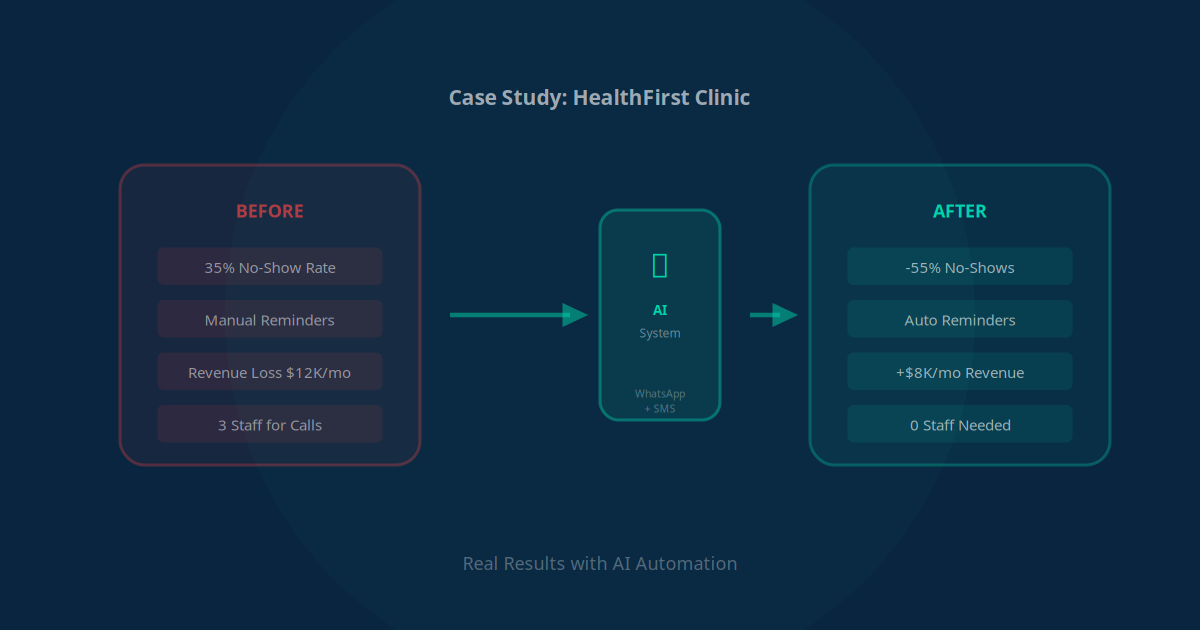
Patient no-shows are one of the most expensive problems in healthcare. For HealthFirst Clinic, a multi-specialty practice with 8 physicians and 32 staff members, no-shows were costing them over $330,000 per year in lost revenue. This is the story of how they used AI automation to cut that number by more than half -- and the practical lessons every clinic can learn from their experience.
The Client: HealthFirst Clinic at a Glance
- Type: Multi-specialty outpatient clinic (internal medicine, dermatology, orthopedics, cardiology)
- Size: 8 physicians, 32 staff members
- Location: Suburban metro area, two locations
- Patient volume: Approximately 1,200 appointments per week across both locations
- EHR system: athenahealth
The Challenge: A No-Show Crisis
When HealthFirst approached us, their no-show rate was sitting at 22% -- meaning roughly 1 in 5 patients simply did not show up for their scheduled appointments. For a clinic scheduling 1,200 appointments per week, that translated to approximately 264 empty appointment slots every single week.
The financial impact was staggering:
- $275 average revenue per appointment across all specialties
- 264 no-shows per week = $72,600 in lost weekly revenue potential
- $330,000+ in annual lost revenue (accounting for some rebooking)
But the problem went beyond revenue. No-shows created a cascade of operational issues:
- Physician idle time: Doctors had unpredictable gaps in their schedules, reducing overall productivity
- Staff frustration: Front desk staff spent hours each day calling patients to confirm appointments -- a task most found tedious and demoralizing
- Patient care gaps: Patients who missed appointments often experienced worsening conditions, leading to more expensive and complex treatments later
- Scheduling inefficiency: The clinic could not accurately predict daily patient volume, making staffing and resource planning a guessing game
HealthFirst had tried basic solutions: a one-call confirmation system where front desk staff called patients the day before their appointment. But with 240+ calls to make daily, staff could only reach about 60% of patients, and the calls consumed 3 to 4 hours of staff time per day across both locations.
Key Takeaway
The average healthcare practice has a no-show rate between 15% and 30%. Even a modest reduction of 10 percentage points can recover tens of thousands of dollars in annual revenue. The key is reaching patients through the right channel, at the right time, with the right message.
The Solution: Multi-Channel AI Reminder System
We designed a comprehensive AI-powered appointment management system for HealthFirst that went far beyond simple reminders. Here is what we built:
1. Intelligent Multi-Channel Reminders
Instead of relying on a single phone call, the system sends reminders through multiple channels based on each patient's communication preferences and behavior:
- SMS text messages: Sent 72 hours, 24 hours, and 2 hours before the appointment
- Email reminders: Sent 5 days and 48 hours before the appointment with appointment details and preparation instructions
- WhatsApp messages: For patients who preferred WhatsApp (about 35% of their patient base)
- Automated phone calls: AI-generated voice calls for patients who did not respond to text or email, using natural-sounding speech
The AI learned which channel each patient was most likely to respond to and prioritized that channel. For example, if a patient consistently confirmed via SMS but never opened emails, the system weighted SMS more heavily and reduced email frequency.
2. Smart Rescheduling Engine
When a patient indicated they could not make their appointment (by replying "cancel" or "reschedule" to any reminder), the system immediately offered alternative time slots. This was not a generic "call us to reschedule" message. The AI:
- Checked the patient's preferred doctor's availability
- Considered the patient's historical scheduling patterns (preferred days and times)
- Offered 3 specific alternative slots via text or WhatsApp
- Allowed the patient to confirm a new appointment with a single reply
This one feature alone recovered 42% of would-be cancellations by making rescheduling effortless. Previously, a patient who could not make an appointment had to call the clinic during business hours, wait on hold, and navigate the scheduling process manually -- which many simply never got around to doing.
3. No-Show Risk Prediction
The AI analyzed historical data to assign a no-show risk score to every appointment. Factors included:
- Patient's history of no-shows and cancellations
- Day of week and time of day (certain slots had higher no-show rates)
- Weather forecast (bad weather correlated with higher no-shows)
- Time since booking (appointments booked far in advance had higher no-show rates)
- Appointment type (new patient visits vs. follow-ups)
High-risk appointments received extra touchpoints: an additional reminder, a personal message from the doctor's office, or a confirmation request that required an active response rather than just passive receipt.
4. Waitlist Management
When a cancellation occurred, the system automatically checked the waitlist and offered the newly available slot to patients waiting for an earlier appointment. This happened within seconds of the cancellation, maximizing the chances of filling the slot.
"The waitlist feature alone was a game-changer. We used to have a paper waitlist that nobody had time to check when cancellations came in. Now slots are automatically offered to waiting patients, and most are filled within an hour." -- HealthFirst Operations Manager
Implementation Timeline
The entire implementation took 6 weeks from kickoff to full deployment:
| Week | Activity | Key Milestone |
|---|---|---|
| Week 1 | Discovery and data analysis | Identified no-show patterns and patient communication preferences |
| Week 2 | System design and EHR integration | Connected with athenahealth API for real-time appointment data |
| Week 3 | Reminder workflow configuration | Set up multi-channel message templates and timing sequences |
| Week 4 | Testing with one department | Piloted with dermatology department (lowest risk, highest no-show rate) |
| Week 5 | Refinement and staff training | Adjusted messaging based on pilot results; trained all front desk staff |
| Week 6 | Full deployment across all departments | Rolled out to all 4 specialties at both locations |
The phased approach was critical. By starting with one department, we could validate the system, fine-tune the messaging, and demonstrate results to the rest of the organization before full rollout. The dermatology department saw a 48% reduction in no-shows within the first two weeks of the pilot, which built confidence across the entire clinic.
The Results: By the Numbers
After 90 days of full operation, the results exceeded expectations:
| Metric | Before AI | After AI (90 Days) | Change |
|---|---|---|---|
| No-show rate | 22% | 9.9% | -55% |
| Weekly no-shows | 264 | 119 | -145 per week |
| Cancellation recovery rate | 12% | 54% | +42 percentage points |
| Staff hours on confirmations | 28 hrs/week | 4 hrs/week | -86% |
| Patient satisfaction (appointment experience) | 3.6/5 | 4.5/5 | +25% |
| Waitlist fill rate | 5% | 38% | +33 percentage points |
Financial Impact
The financial results were substantial and measurable:
- Recovered revenue: 145 fewer no-shows per week x $275 average appointment value = approximately $180,000 in annual recovered revenue
- Staff cost savings: 24 fewer hours per week on phone confirmations = approximately $28,800 per year in freed staff time (reallocated to patient care and check-in efficiency)
- Waitlist revenue: Filling previously empty cancellation slots generated an additional $45,000 per year
- Total annual impact: Approximately $253,800
- System cost: $2,200 per month ($26,400 per year)
- Net ROI: 860% in the first year
Key Takeaway
HealthFirst's AI automation system paid for itself 9.6 times over in the first year. The $26,400 annual investment generated $253,800 in recovered revenue and cost savings -- an ROI that continued to improve as the AI learned patient behavior patterns over time.
What Made the Difference: Key Success Factors
Not every clinic that implements appointment reminders sees results this strong. Here is what set HealthFirst's implementation apart:
- Multi-channel approach: Using SMS, email, WhatsApp, and phone calls together achieved a 94% patient reach rate, compared to 60% with phone-only.
- Personalized timing: The AI learned when each patient was most likely to read and respond to messages. A 7 AM text works for some patients; a 6 PM email works for others.
- Frictionless rescheduling: Making it effortless to reschedule (reply with a number to pick a new slot) converted would-be no-shows into kept appointments.
- Risk-based intervention: Focusing extra effort on high-risk appointments instead of treating all patients the same maximized the impact per touchpoint.
- Staff buy-in: Front desk staff were relieved of their most tedious task (phone confirmations) and became enthusiastic advocates for the system.
Lessons Learned
HealthFirst's experience revealed several important lessons for any clinic considering similar automation:
Start With Data
Before implementing any solution, analyze your no-show patterns. Which departments have the highest rates? Which days and times? Which patient demographics? This data shapes your automation strategy and gives you a baseline to measure against.
Tone Matters
The initial reminder messages were clinical and impersonal. After testing, the clinic found that warm, conversational messages with the doctor's name ("Dr. Patel is looking forward to seeing you tomorrow at 2:30 PM") had a 23% higher confirmation rate than generic messages ("You have an appointment at HealthFirst Clinic tomorrow").
Respect Patient Preferences
Some patients do not want text messages. Others do not check email. The system always respected opt-out preferences and channel choices. Forcing communication through an unwanted channel increases patient frustration and can actually increase no-shows.
Measure Everything
HealthFirst tracked not just the no-show rate, but also response rates by channel, confirmation timing, rescheduling conversion rates, and patient satisfaction scores. This granular data allowed continuous optimization of the system.
"If I could give one piece of advice to other clinic administrators, it is this: do not just send reminders. Build a system that makes it easier for patients to keep their appointments than to miss them. Remove every possible barrier to showing up or rescheduling." -- HealthFirst Clinic Administrator
What Is Next for HealthFirst
Building on the success of the no-show reduction system, HealthFirst is now expanding their AI automation to include:
- Automated patient intake forms: Sent digitally before appointments to reduce check-in time
- Post-visit follow-up sequences: Automated care instructions, medication reminders, and satisfaction surveys
- Billing automation: Streamlining insurance verification and patient billing communications
- Referral management: Tracking and automating communication for specialist referrals between departments
The no-show reduction system was the first domino. Once the clinic saw what AI automation could do for one process, they began identifying opportunities across their entire operation. That is the pattern we see with every client: start with one high-impact problem, prove the ROI, then expand systematically.