AI Is Transforming Healthcare Clinics: Appointments, Billing & Beyond




Healthcare clinics face a paradox that has only intensified over the past decade: patient demand is rising, staff shortages are worsening, and administrative costs keep climbing. The average clinic spends nearly 30% of its revenue on administrative tasks -- scheduling, billing, insurance verification, patient follow-ups, and documentation. For a small to mid-sized clinic, that translates to hundreds of hours per month spent on work that does not directly improve patient care.
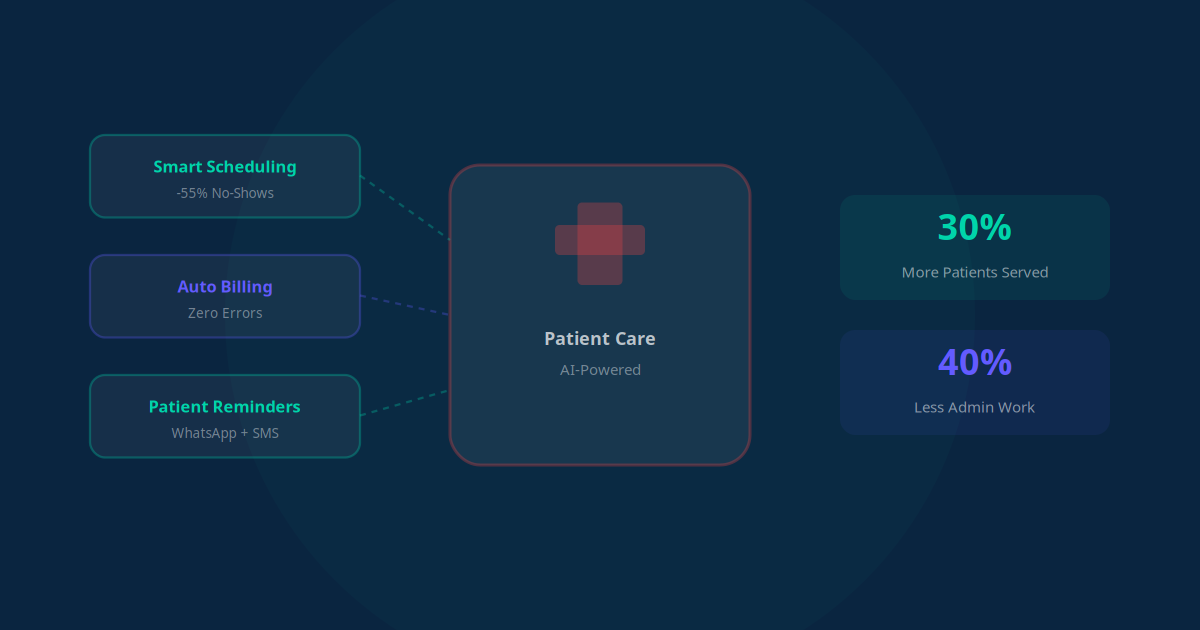
AI automation is changing this equation entirely. Clinics that implement intelligent automation are seeing dramatic results: 30% more patients served with the same or fewer staff, 50-60% reduction in no-show rates, and billing cycle times cut in half. This is not speculative futurism -- these are results being achieved right now by clinics around the world.
In this article, we explore exactly how AI is transforming clinical operations, from the front desk to the back office, and how your clinic can start benefiting today.
The Modern Clinic's Administrative Burden
To understand why AI matters so much for healthcare, consider what a typical day looks like for clinic staff:
- Front desk staff spend 2-3 hours on the phone scheduling, confirming, and rescheduling appointments
- Billing staff manually enter procedure codes, chase insurance pre-authorizations, and follow up on denied claims
- Nurses spend 30-40 minutes per shift on patient intake paperwork and data entry into the EHR system
- Doctors spend an average of 16 minutes per patient on documentation -- often more time than they spend on the actual examination
- Office managers manually compile reports on patient volume, revenue, and operational metrics
Each of these tasks is a candidate for AI automation. Not replacement of humans, but augmentation -- letting technology handle the repetitive, rule-based components so that staff can focus on the parts of their job that require empathy, clinical judgment, and human connection.
AI-Powered Appointment Scheduling
Intelligent appointment scheduling is typically the first automation clinics implement, and for good reason: it delivers immediate, measurable ROI.
How It Works
An AI scheduling system goes far beyond a simple online booking form. Here is what a modern system does:
- 24/7 self-service booking: Patients can book, reschedule, or cancel appointments at any time through a web portal, WhatsApp, SMS, or a phone-based voice AI. No more "Please call during office hours."
- Intelligent slot optimization: The AI considers appointment type, doctor availability, equipment requirements, and average appointment duration to suggest optimal time slots. It can even batch similar appointment types together to reduce room turnover time.
- Waitlist management: When a cancellation occurs, the system automatically offers the slot to patients on the waitlist, prioritized by urgency and convenience. This happens in seconds, not hours.
- Multi-channel confirmation: Appointment confirmations are sent via the patient's preferred channel -- WhatsApp, SMS, email, or app notification -- with a calendar invite attached.
- Insurance pre-check: Before confirming, the system can verify the patient's insurance coverage for the requested service, preventing unpleasant billing surprises.
Key Takeaway
Clinics using AI scheduling typically see a 40-50% reduction in phone call volume related to appointments. This alone can free up 10-15 hours of front desk staff time per week -- time that can be redirected to patient care and in-person service.
Reducing No-Shows with AI Reminders
Patient no-shows are one of the most expensive problems in healthcare. The average no-show rate across clinics is 20-30%, and each missed appointment costs a clinic between $150 and $400 in lost revenue and wasted resources. For a mid-sized clinic seeing 100 patients per day, that is $3,000-$12,000 in daily losses.
The AI Reminder Sequence
AI-powered reminder systems use a multi-touch, multi-channel approach that dramatically outperforms simple text message reminders:
- 7 days before: An initial reminder via the patient's preferred channel with easy options to confirm, reschedule, or cancel.
- 2 days before: A detailed reminder including preparation instructions (fasting requirements, documents to bring, parking information).
- Day of appointment: A morning reminder with the exact time, doctor name, and estimated wait time based on current schedule.
- Smart escalation: If the patient has not confirmed after the first two reminders, the system escalates to a phone call (automated voice or staff).
- No-show follow-up: If a patient misses the appointment, an automated message is sent within the hour offering easy rescheduling options.
Predictive No-Show Modeling
Advanced AI systems go even further by predicting which patients are likely to no-show based on historical patterns. Factors include previous no-show history, appointment lead time, weather conditions, day of week, and time of day. Patients flagged as high-risk receive more aggressive reminder sequences or are double-booked intelligently to optimize the schedule.
"Our no-show rate dropped from 28% to 12% within the first two months of implementing AI reminders. That is like adding an entire extra day of patient capacity every week without hiring anyone new."
Billing Automation and Revenue Cycle Management
Medical billing is complex, error-prone, and enormously time-consuming. AI billing automation addresses every stage of the revenue cycle:
Pre-Visit: Insurance Verification
Before the patient arrives, AI automatically verifies insurance eligibility and coverage for the scheduled service. It checks deductible status, co-pay amounts, and pre-authorization requirements. If there is an issue, the patient and billing team are alerted before the visit -- not after.
During Visit: Automated Coding
AI-assisted coding tools analyze clinical documentation and suggest appropriate CPT and ICD-10 codes. This reduces coding errors (which cause claim denials) by up to 40% and speeds up the coding process from minutes to seconds per encounter.
Post-Visit: Claims Processing
- Automated claim submission: Claims are generated and submitted electronically within hours of the visit, not days.
- Denial management: When claims are denied, AI analyzes the denial reason, suggests corrections, and can automatically resubmit corrected claims.
- Patient billing: Automated patient statements are sent via email, WhatsApp, or mail with clear breakdowns and multiple payment options including online payment links.
- Payment reminders: Overdue balances trigger automated reminder sequences with escalating urgency. This reduces days in accounts receivable by 30-40%.
Key Takeaway
Clinics implementing AI billing automation typically see a 25-35% reduction in claim denials, a 50% faster billing cycle, and a 15-20% improvement in collection rates. For a clinic billing $2 million annually, that can mean $200,000-$400,000 in recovered revenue.
Patient Reminders and Communication
Beyond appointment reminders, AI enables a comprehensive patient communication strategy that keeps patients engaged and improves health outcomes:
- Medication reminders: Automated messages reminding patients to take prescribed medications, with refill reminders before they run out.
- Follow-up care instructions: Post-procedure care instructions sent via WhatsApp or SMS with clickable links to educational resources.
- Lab result notifications: Patients are notified when lab results are available, with a link to view them in the patient portal.
- Preventive care reminders: Annual check-up reminders, vaccination schedules, and screening recommendations based on the patient's age, gender, and medical history.
- Satisfaction surveys: Automated post-visit surveys that capture patient feedback while the experience is fresh, helping clinics identify and address issues quickly.
EHR Integration: The Foundation of Clinical AI
All of these automations become significantly more powerful when they are integrated with your Electronic Health Record (EHR) system. EHR integration creates a single source of truth that all automations can read from and write to.
What EHR Integration Enables
- Contextual scheduling: The scheduling AI knows the patient's history, can check for medication conflicts with proposed appointment times, and can pre-populate intake forms with existing data.
- Automated documentation: AI can generate visit summaries, referral letters, and after-visit notes based on clinical data captured during the encounter.
- Clinical decision support: The system can flag potential drug interactions, overdue screenings, or abnormal lab trends, bringing them to the doctor's attention before the visit.
- Quality reporting: Automated compilation of quality metrics for regulatory compliance (HEDIS, MIPS, etc.) eliminates hours of manual chart review.
- Population health management: AI analyzes patient data across the entire clinic population to identify at-risk groups for targeted outreach and preventive interventions.
Common EHR Systems and Integration Options
Most popular EHR systems -- including Epic, Cerner, athenahealth, eClinicalWorks, and DrChrono -- offer APIs or integration frameworks. Automation platforms like Make.com and n8n can connect to these systems to trigger workflows based on clinical events (new appointment, completed visit, lab result received, etc.).
Real Results: The 30% Patient Capacity Increase
How do clinics actually achieve the 30% increase in patient capacity without adding staff? The math is straightforward:
- No-show reduction (28% to 12%): Recovering 16% of scheduled slots means 16 more patients seen per 100 scheduled. That alone is a 16% capacity increase.
- Faster patient intake: Automated pre-visit forms and insurance verification reduce intake time from 15 minutes to 3 minutes, saving 12 minutes per patient.
- Optimized scheduling: AI-optimized scheduling eliminates gaps and reduces average wait times, allowing 10-15% more appointments per day.
- Reduced administrative hold time: With automated scheduling and reminders, front desk staff handle 40-50% fewer phone calls, allowing them to manage higher patient volumes.
Combined, these improvements yield a 30-40% increase in effective patient capacity -- without hiring additional staff, extending hours, or compromising care quality.
Getting Started: A Phased Approach for Clinics
We recommend a phased approach to implementing AI automation in your clinic:
Phase 1: Quick Wins (Weeks 1-4)
- Implement AI-powered appointment reminders (WhatsApp + SMS)
- Set up online self-service scheduling
- Automate patient satisfaction surveys
Phase 2: Core Automation (Months 2-3)
- Connect scheduling to your EHR system
- Implement automated insurance verification
- Launch billing automation with automated claim submission
Phase 3: Advanced AI (Months 4-6)
- Deploy predictive no-show modeling
- Implement AI-assisted clinical coding
- Launch population health management workflows
Key Takeaway
Start with appointment reminders and scheduling automation -- they deliver the fastest ROI and require the least change management. Each phase builds on the previous one, creating a compounding improvement in efficiency over time.
The healthcare industry is at an inflection point. Clinics that embrace AI automation now will serve more patients, generate more revenue, and create better working conditions for their staff. Those that wait will find themselves falling further behind as patient expectations and competitive pressures continue to rise.
Ready to see what AI can do for your clinic? Schedule a free AI audit and we will analyze your current workflows and show you exactly where automation can make the biggest impact.