E-commerce: Recover 25% of Abandoned Carts Automatically




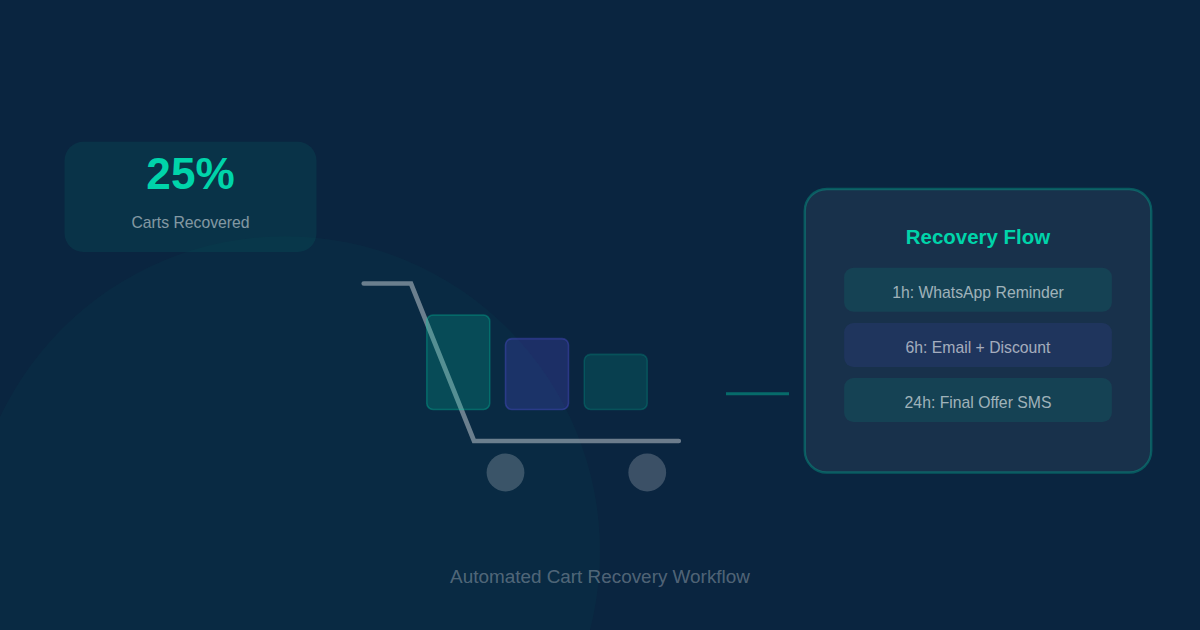
Here is a number that should keep every e-commerce business owner up at night: 70% of online shopping carts are abandoned before checkout. That means for every 10 customers who add products to their cart, 7 of them leave without paying.
For a store doing 10 lakhs per month in revenue, that represents roughly 23 lakhs in lost sales every single month. The good news? With the right automation workflow, you can recover 20-25% of those abandoned carts -- automatically, without lifting a finger. Let us show you exactly how.
Why Customers Abandon Their Carts
Before you can recover abandoned carts, you need to understand why customers leave in the first place. Not all abandonment is the same, and your recovery strategy should address the specific reason behind each case.
| Reason for Abandonment | % of Abandons | Recovery Strategy |
|---|---|---|
| Unexpected shipping costs | 48% | Offer free shipping threshold or discount |
| Just browsing / not ready | 26% | Nurture sequence with social proof |
| Found a better price | 18% | Price match or exclusive discount |
| Complicated checkout | 17% | Simplified checkout link in recovery message |
| Required account creation | 14% | Guest checkout option in recovery |
| Payment security concerns | 12% | Trust badges and security reassurance |
| Delivery time too long | 11% | Express delivery option or estimated date |
| Technical errors | 9% | Alternative checkout link + apology |
Understanding these reasons allows you to craft recovery messages that address the actual objection, not just send a generic "You forgot something!" reminder.
The Multi-Channel Recovery Workflow
The most effective cart recovery does not rely on a single channel. Customers have different communication preferences, and reaching them where they are most active dramatically increases recovery rates.
Here is the proven multi-channel workflow that consistently recovers 20-25% of abandoned carts:
Channel Priority
- WhatsApp (highest open rate): 95%+ open rate, 45-60% click rate. This is your primary recovery channel in India and many other markets.
- SMS (fast delivery): 90%+ open rate, 30-40% click rate. Best for time-sensitive offers.
- Email (rich content): 40-50% open rate, 10-15% click rate. Best for detailed product reminders with images.
- Push notifications (app users): 20-30% open rate. Good as a supplementary channel.
The key insight is do not use all channels at once. Use them in sequence, escalating to the next channel only if the previous one did not get a response.
Key Takeaway
WhatsApp is the most effective cart recovery channel in 2026, with open rates above 95%. If you are only using email for cart recovery, you are leaving significant revenue on the table. A multi-channel approach that starts with WhatsApp and falls back to email can recover 2-3x more carts than email alone.
The Perfect Timing Strategy
When you send your recovery message matters as much as what you say. Too early feels pushy. Too late means they have already moved on. Here is the timing sequence backed by data from thousands of e-commerce stores:
Message 1: The Gentle Reminder (30 minutes after abandonment)
Channel: WhatsApp (primary) or Email (fallback)
This is not a sales pitch. It is a helpful nudge that assumes there might have been a technical issue or distraction. The tone is casual and service-oriented:
"Hi Rahul! We noticed you left some items in your cart. No worries -- your cart is saved and ready when you are. Here is a quick link to complete your order: [one-click checkout link]. Need help with anything? Just reply to this message!"
Recovery rate at this stage: 8-12% of abandoned carts
Message 2: Social Proof + Urgency (4 hours after abandonment)
Channel: WhatsApp or SMS
If they did not respond to the first message, add social proof and gentle urgency. Do not be aggressive -- be informative:
"Just a heads up -- the [Product Name] in your cart is one of our best sellers and stock is limited. 47 other customers bought this item today. Complete your order before it sells out: [checkout link]"
Recovery rate at this stage: 5-8% additional
Message 3: The Incentive (24 hours after abandonment)
Channel: Email (with product images) + WhatsApp
Now is the time to offer a small incentive. But be strategic about it -- not every cart needs a discount. The AI should determine the incentive based on cart value and customer history:
- Cart value above 5,000: Free shipping offer
- Cart value above 10,000: 5-10% discount code
- Repeat customer: Loyalty points bonus
- First-time buyer: Welcome discount + trust reassurance
Recovery rate at this stage: 4-7% additional
Message 4: Last Chance (72 hours after abandonment)
Channel: Email
The final message. Create genuine urgency by letting them know their cart will expire or the offer is ending:
"Your cart with [Product Name] will expire in 24 hours. We have saved your 10% discount -- use code SAVE10 before midnight tonight. After that, we will release these items back to inventory. Shop now: [checkout link]"
Recovery rate at this stage: 2-4% additional
Total Recovery Rate: 19-31%
When executed properly across all four touchpoints, this workflow consistently recovers 20-25% of abandoned carts on average.
Personalization That Actually Works
Generic recovery messages get generic results. AI-powered personalization uses everything you know about the customer to craft messages that feel one-to-one. Here is what smart personalization looks like:
Product-Based Personalization
- Include product images and names in every recovery message -- visual reminders are powerful
- Highlight key product benefits specific to what they were buying (not generic store benefits)
- Show ratings and reviews for the exact products in their cart
- Suggest complementary products that other buyers purchased together
Customer-Based Personalization
- First-time visitors: Focus on trust (return policy, payment security, customer testimonials)
- Returning customers: Reference their past purchases ("You loved [previous product] -- we think you will love these too")
- High-value customers: Offer premium incentives (exclusive discounts, early access, free express shipping)
- Price-sensitive customers: Lead with value propositions and savings rather than features
Behavioral Personalization
- Browsed multiple products before adding one: They were comparing. Highlight why the chosen product is the best option.
- Added items, removed some, then left: They were budget-conscious. Offer a payment plan or smaller cart suggestion.
- Reached the payment page and left: Payment friction. Offer an alternative payment method or simplified checkout.
- Applied a coupon that did not work: Send a working discount code with an apology.
Key Takeaway
The best-performing cart recovery messages address the specific reason the customer left. AI can analyze browsing patterns, cart composition, and customer history to determine the most likely abandonment reason and tailor the message accordingly.
Setting Up the Automation: Step by Step
Here is the technical workflow you need to set up. It works with most e-commerce platforms including Shopify, WooCommerce, Magento, and custom-built stores.
Step 1: Cart Tracking and Trigger
Configure your e-commerce platform to detect cart abandonment. This typically means tracking when a user:
- Adds items to their cart
- Provides their email or phone number (at checkout or via account)
- Leaves the site without completing purchase
- Has been inactive for 30+ minutes with items in cart
Step 2: Data Enrichment
When abandonment is detected, the automation should pull together:
- Cart contents (product names, images, prices, quantities)
- Customer information (name, email, phone, purchase history)
- Session data (time spent, pages visited, device type)
- Checkout progress (did they enter shipping info? Payment info?)
Step 3: Segmentation
Based on the data, the AI segments the abandoner into the right recovery track:
- High intent (reached payment page): Fast recovery with simplified checkout link
- Medium intent (entered shipping info): Standard sequence with product reminders
- Low intent (just added to cart): Nurture sequence with social proof and gentle incentives
Step 4: Message Sequence Execution
The automation sends messages according to the timing strategy outlined above, using the appropriate channel based on available contact information and customer preferences.
Step 5: Conversion Tracking
Track which messages led to recovery, revenue recovered per message, and overall recovery rate by segment. This data feeds back into the AI to continuously optimize messaging and timing.
WhatsApp Recovery: The Game Changer
WhatsApp deserves special attention because it is the single most effective channel for cart recovery in markets like India, Brazil, and Southeast Asia. Here is why and how to use it effectively:
Why WhatsApp Outperforms Email
- Open rates: 95%+ on WhatsApp vs 40-50% on email
- Response time: WhatsApp messages are read within 3 minutes on average. Emails sit unread for hours.
- Conversational: Customers can reply instantly with questions, and the AI can answer them in real time
- Rich media: Send product images, videos, and interactive buttons directly in the chat
- Trust: Messages from a verified WhatsApp Business account feel more personal than marketing emails
WhatsApp Recovery Message Best Practices
- Use the customer's first name -- always
- Include a product image as a visual reminder
- Keep it short -- 2-3 sentences maximum for the first message
- Include a one-click checkout button that takes them directly to payment
- Enable two-way conversation -- let them ask questions and get instant AI-powered answers
- Respect opt-out requests immediately -- compliance is critical for long-term success
"We switched from email-only cart recovery to a WhatsApp-first approach. Our recovery rate jumped from 8% to 23% in the first month. The conversational aspect is huge -- customers reply with questions, and our AI answers them instantly. It is like having a sales team working 24/7." -- D2C fashion brand founder
Advanced Strategies: Beyond Basic Recovery
Once you have the basic recovery workflow running, these advanced strategies can push your recovery rate even higher:
Dynamic Discount Laddering
Instead of offering the same discount to everyone, use AI to determine the minimum incentive needed to convert each customer:
- First recovery attempt: No discount (many customers just needed a reminder)
- Second attempt: Free shipping (low cost to you, high perceived value)
- Third attempt: 5% discount (only if they did not respond to free shipping)
- Final attempt: 10% discount (maximum -- protect your margins)
This approach maximizes revenue by not giving away discounts to customers who would have purchased anyway.
Exit-Intent Prevention
Why wait for abandonment when you can prevent it? Deploy AI-powered exit-intent detection that triggers before the customer leaves:
- Mouse movement toward browser close button: Trigger a popup with a special offer
- Inactivity on checkout page: Display a help widget asking if they need assistance
- Price comparison behavior: If they are switching between tabs, show a price match guarantee
Post-Recovery Upsell
When a customer completes their recovered purchase, immediately trigger a thank-you message with a limited-time upsell. Customers who just bought are in a buying mindset -- capitalize on it with complementary product recommendations.
Measuring Your Cart Recovery ROI
Here is how to calculate the exact ROI of your cart recovery automation:
| Metric | How to Calculate | Industry Benchmark |
|---|---|---|
| Recovery rate | Recovered carts / Total abandoned carts | 15-25% |
| Revenue recovered | Sum of all recovered cart values | 15-25% of abandoned revenue |
| Cost per recovery | Total automation cost / Number of recoveries | Rs 5-50 per recovery |
| ROI | (Revenue recovered - Automation cost) / Automation cost | 10x-50x |
| Incremental revenue | Revenue from customers who would not have returned without the automation | 80-90% of recovered revenue |
Example ROI Calculation
Let us run the numbers for a mid-sized e-commerce store:
- Monthly revenue: 20 lakhs
- Abandoned cart value: ~46 lakhs (70% abandonment rate)
- Recovery rate with automation: 22%
- Revenue recovered: ~10 lakhs per month
- Automation cost: 25,000 per month
- Net additional revenue: 9.75 lakhs per month
- ROI: 39x return on investment
That is nearly 10 lakhs in additional monthly revenue from an automation that runs entirely on autopilot. This is not theoretical -- these are real numbers we see with e-commerce clients.
Key Takeaway
Cart recovery automation typically delivers 10x-50x ROI. Even conservative estimates show that recovering just 15% of abandoned carts can increase monthly revenue by 30-40%. This is one of the highest-ROI automation investments an e-commerce business can make.
Common Mistakes That Kill Recovery Rates
Avoid these pitfalls that we see e-commerce stores make repeatedly:
- Sending only one recovery message: A single email recovers 3-5% at best. The full 4-message sequence recovers 20-25%. Do not stop after one.
- Waiting too long for the first message: If your first recovery message goes out 24 hours after abandonment, you have already lost most recoverable carts. The first 30 minutes are critical.
- Leading with discounts: If every recovery message offers a discount, you train customers to abandon carts on purpose. Start with reminders and only offer incentives as a last resort.
- Ignoring mobile users: Over 70% of e-commerce traffic is mobile. Your recovery messages and checkout links must be mobile-optimized.
- Using only email: Email open rates have been declining for years. WhatsApp and SMS should be your primary recovery channels.
- Not tracking by segment: Aggregate recovery rates hide the details. Track by customer type, cart value, abandonment reason, and channel to optimize each segment.
- Spamming opted-out customers: Respect unsubscribe requests instantly. Violating this kills trust and can get your WhatsApp Business account banned.
Getting Started Today
Cart recovery automation is one of the fastest ways to increase e-commerce revenue. Here is your action plan:
- Week 1: Set up cart abandonment tracking on your e-commerce platform. Identify your current abandonment rate and the revenue at stake.
- Week 2: Implement the first recovery message (WhatsApp, 30 minutes after abandonment). Even this single message will start recovering revenue immediately.
- Week 3: Build out the full 4-message sequence across WhatsApp, SMS, and email with proper timing.
- Week 4: Add personalization and dynamic discounting based on customer segments and cart value.
- Ongoing: Monitor recovery rates by segment, A/B test messages, and continuously optimize timing and incentives.
Every day you wait, you are losing 70% of your potential sales. The automation pays for itself within the first week for most stores. Start recovering those lost carts today.