Manufacturing Automation for SMBs: Purchase Orders to Quality Reports




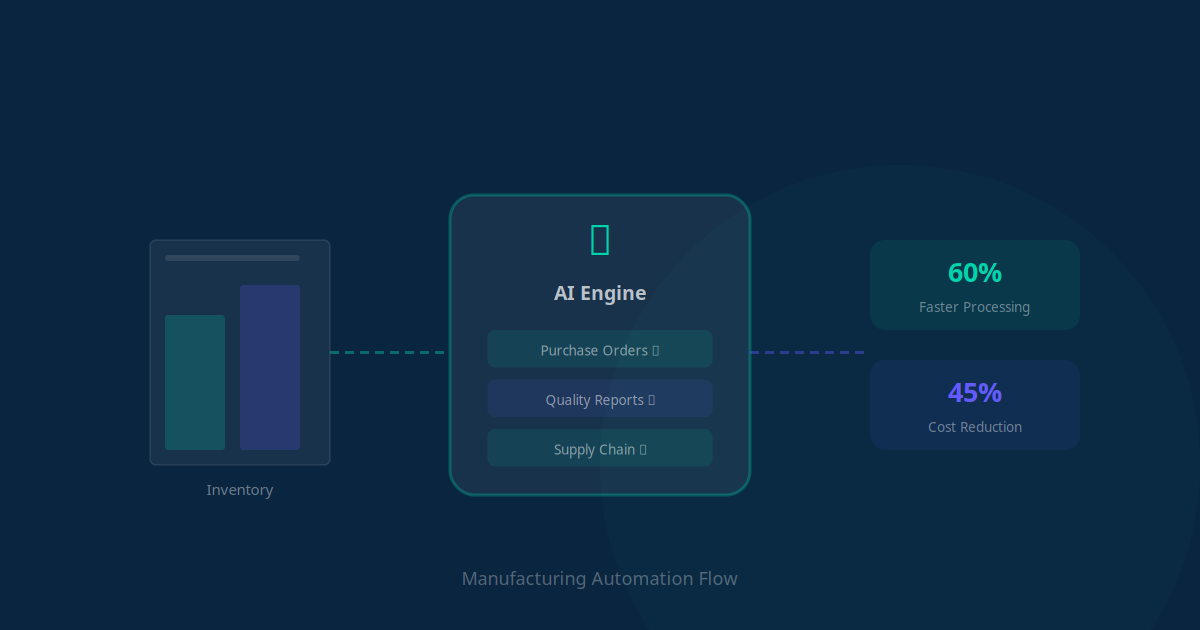
If you run a small or mid-sized manufacturing business, you already know the pain: purchase orders buried in email threads, inventory counts that never match reality, quality reports created in spreadsheets at the last minute, and vendor communication that falls through the cracks. AI automation is changing all of that -- and it is no longer reserved for companies with Fortune 500 budgets.
This guide covers the specific manufacturing processes you can automate today, what results to expect, and how to get started without disrupting your existing operations.
The Current State of Manufacturing Operations
Most SMB manufacturers are running on a patchwork of manual processes, spreadsheets, and disconnected software systems. Here is what the typical operation looks like:
- Purchase orders are created manually in Word or Excel, emailed to vendors, and tracked in yet another spreadsheet
- Inventory is counted by hand or updated in a system that is always a few days behind reality
- Quality control relies on paper checklists and reports typed up after the fact
- Vendor communication happens across email, phone, WhatsApp, and sticky notes -- with no centralized record
- Production scheduling is done in spreadsheets that break whenever someone changes a formula
The result? Wasted time, missed deadlines, excess inventory costs, and quality issues that could have been caught earlier. A typical SMB manufacturer spends 15 to 25 hours per week on administrative tasks that could be automated.
Purchase Order Automation
Purchase order management is one of the highest-impact areas for automation. Here is how AI transforms the process:
Automatic PO Generation
Instead of manually creating purchase orders, AI monitors your inventory levels and production schedule, then automatically generates POs when stock hits reorder points. The system pulls the correct vendor details, pricing (from negotiated contracts), quantities, and delivery requirements.
Smart Approval Workflows
POs below a set threshold (say $5,000) are automatically approved and sent to the vendor. Larger orders get routed to the appropriate manager with all the context they need to approve in one click -- no chasing signatures or printing forms.
Order Tracking and Reconciliation
Once a PO is sent, the system tracks the vendor's confirmation, expected delivery date, and actual receipt. When goods arrive, it automatically reconciles the delivery against the PO and flags any discrepancies -- wrong quantities, missing items, or price changes.
Key Takeaway
Automated purchase ordering typically reduces procurement processing time by 70% and virtually eliminates errors from manual data entry. For most SMB manufacturers, this single automation pays for itself within 60 days.
Inventory Management That Actually Works
Manual inventory management is a losing battle. By the time you count, record, and reconcile, the numbers have already changed. AI-powered inventory management solves this with real-time visibility and predictive intelligence.
Real-Time Stock Visibility
AI integrates with your existing systems -- barcode scanners, ERP, point-of-sale -- to maintain a single source of truth for inventory levels. Every receipt, shipment, and usage event updates the count instantly.
Demand Forecasting
Instead of ordering based on gut feel or last year's numbers, AI analyzes historical data, seasonal patterns, current orders, and market trends to predict what you will need and when. This means:
- Less overstock: Stop tying up cash in materials that sit in your warehouse for months
- Fewer stockouts: Never halt production because a critical component ran out unexpectedly
- Optimized storage: Reduce warehouse space requirements by keeping only what you need
Automatic Reorder Points
The system calculates optimal reorder points for every SKU based on lead times, usage rates, and safety stock requirements. When a material hits its reorder point, the PO automation kicks in automatically.
| Metric | Before Automation | After Automation |
|---|---|---|
| Inventory accuracy | 75-85% | 97-99% |
| Stockout frequency | 3-5 per month | 0-1 per month |
| Excess inventory cost | 15-25% of inventory value | 5-8% of inventory value |
| Time spent on inventory tasks | 10+ hours/week | 2-3 hours/week |
| Reorder lead time | 2-5 days (manual discovery) | Instant (automatic trigger) |
Quality Control and Reporting
Quality is the backbone of manufacturing. AI automation brings consistency, speed, and depth to your quality control processes that manual methods simply cannot match.
Digital Quality Checklists
Replace paper checklists with digital forms that operators complete on tablets or phones. The system enforces completion of every required check, timestamps each entry, and flags any out-of-spec readings immediately.
Automated Quality Reports
Instead of someone spending hours compiling quality data into a report at the end of the week, AI generates reports automatically. These reports include:
- Pass/fail rates by product line, shift, or operator
- Trend analysis showing quality patterns over time
- Root cause analysis linking defects to specific materials, machines, or processes
- Compliance documentation ready for auditors
Predictive Quality Analytics
The most advanced application: AI analyzes historical quality data alongside production parameters (temperature, pressure, speed, material batch) to predict quality issues before they happen. If the system detects that current conditions are trending toward a defect, it alerts operators to adjust before any bad product is made.
"We used to discover quality issues after an entire batch was complete. Now our AI system catches drift in production parameters in real-time. We have cut our scrap rate by 40% and our customer complaints by 60%." -- CNC machining shop owner, 45 employees
Vendor Communication Automation
Managing vendor relationships manually is time-consuming and error-prone. AI automation streamlines every touchpoint:
Automated Order Confirmations
When you send a PO, the system automatically follows up with the vendor for confirmation. If a confirmation is not received within your defined timeframe (say 24 hours), it sends a reminder. If there is still no response, it alerts your procurement team.
Delivery Tracking and Updates
The system monitors expected delivery dates and automatically requests shipping updates from vendors as the delivery date approaches. Your team gets a daily dashboard showing all incoming shipments, their status, and any delays.
Performance Scorecards
AI automatically tracks vendor performance metrics -- on-time delivery rate, quality acceptance rate, price consistency, responsiveness -- and generates scorecards. This gives you objective data for vendor negotiations, renewals, and decisions about alternative suppliers.
- On-time delivery tracking: Automatically logged for every order, no manual entry required
- Quality acceptance rates: Linked to incoming inspection data
- Price variance reports: Flags when a vendor's pricing deviates from contracted rates
- Communication response time: Measures how quickly vendors respond to your requests
Production Scheduling Intelligence
Production scheduling is where small manufacturers often struggle the most. Too many variables, too many constraints, and too little time to optimize manually. AI changes the equation.
Dynamic Schedule Optimization
AI considers all the factors that affect your schedule simultaneously: machine availability, operator skills, material availability, order priorities, setup times, and maintenance windows. It generates optimized schedules that maximize throughput while meeting delivery deadlines.
Real-Time Rescheduling
When something changes -- a machine breaks down, a rush order comes in, a material delivery is delayed -- the system automatically recalculates the schedule and shows you the best alternative. No more scrambling with whiteboards and phone calls.
Capacity Planning
AI projects your capacity requirements weeks or months ahead based on current orders, sales pipeline, and historical patterns. This helps you make informed decisions about overtime, temporary staff, or new equipment before you hit a crisis.
Key Takeaway
AI-powered production scheduling typically improves on-time delivery by 20-35% and increases overall equipment effectiveness (OEE) by 10-15%. For a shop doing $2M in annual revenue, that translates to $200K-$300K in additional throughput without adding machines or staff.
Explore all industry-specific AI automation solutions we offer at Jogi AI.
Cost Savings and ROI
Here is where the rubber meets the road. What can an SMB manufacturer actually expect to save with AI automation?
| Area | Typical Savings | How |
|---|---|---|
| Procurement labor | 15-20 hours/week | Automated PO generation, approval, tracking |
| Inventory carrying costs | 10-20% reduction | Better forecasting, optimized reorder points |
| Quality-related costs | 25-40% reduction | Earlier defect detection, less scrap and rework |
| Production efficiency | 10-15% improvement | Optimized scheduling, less downtime |
| Administrative overhead | 30-50% reduction | Automated reporting, communication, data entry |
For a typical SMB manufacturer with 20 to 100 employees, the combined savings range from $50,000 to $250,000 per year. With most AI automation solutions costing between $500 and $3,000 per month, the ROI is overwhelmingly positive -- usually within 3 to 6 months.
Getting Started: A Practical Roadmap
You do not have to automate everything at once. Here is the recommended approach for SMB manufacturers:
- Month 1-2: Start with purchase order automation. This is the highest-impact, lowest-risk starting point. Digitize your PO process and set up automatic generation for routine reorders.
- Month 2-3: Add inventory visibility. Connect your systems to create a single real-time inventory view. Set up automatic reorder points for your top 20% of SKUs (which usually represent 80% of your spend).
- Month 3-4: Digitize quality control. Replace paper checklists with digital forms and set up automated quality reporting.
- Month 4-6: Layer in vendor management. Automate vendor communication, tracking, and performance scorecards.
- Month 6+: Add production scheduling. Once your data is flowing cleanly from the previous automations, you have the foundation for AI-powered scheduling.
"We started by automating just our purchase orders. Within two months, the time savings were so obvious that our team was asking what we could automate next. Six months later, we had transformed our entire back office." -- Metal fabrication company owner, 35 employees
Common Concerns and How to Address Them
"Our team will resist the change."
Start with the tasks your team hates most -- data entry, manual POs, report compilation. When automation eliminates their most tedious work, they become advocates, not resistors. Involve your team in the selection process and let them see how the tools work before rolling out.
"Our processes are too unique to automate."
Every manufacturer says this, and it is almost never true. While your products are unique, your administrative processes -- ordering, tracking, reporting, communicating -- follow the same patterns as every other manufacturer. Modern AI tools are highly configurable to match your specific workflows.
"We cannot afford the downtime for implementation."
AI automation runs alongside your existing processes during implementation. You do not need to shut anything down. You gradually shift workflows to the automated system as confidence builds, and you only retire the old process when you are fully comfortable with the new one.
The manufacturers who are thriving in 2026 are not the ones with the biggest factories or the most machines. They are the ones who have automated their operations to run leaner, faster, and smarter than their competitors. The tools are affordable, the ROI is proven, and the time to start is now.