The ROI of Autonomous Workflows for Real Estate Agencies




Ready to automate your business?
Get Free AI Audit →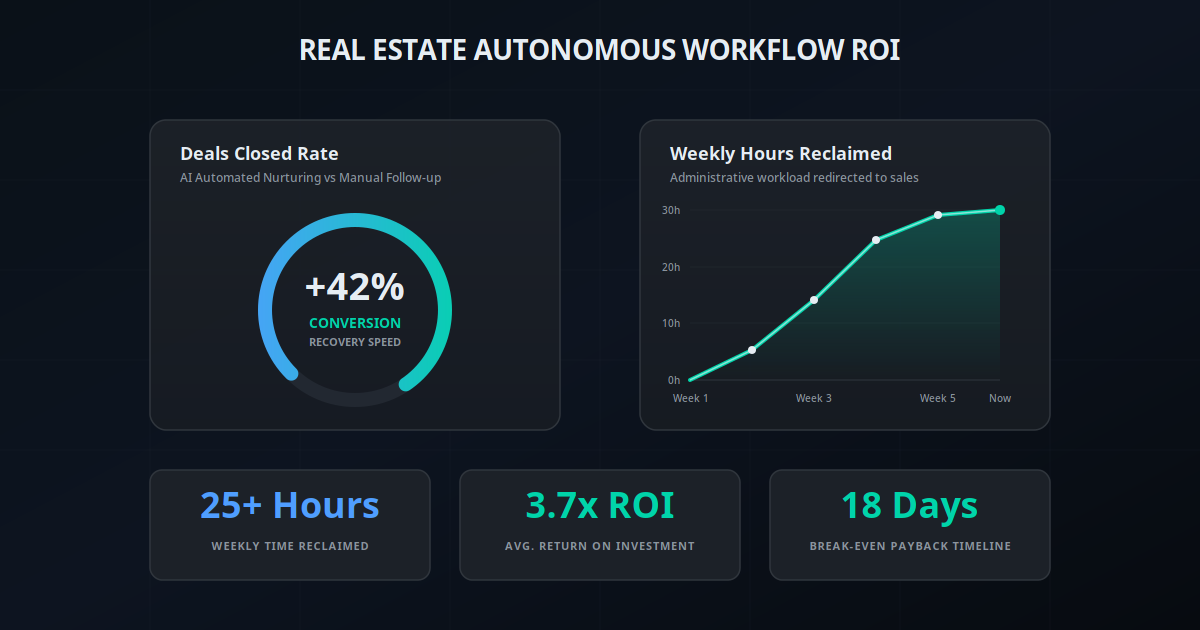
Every principal broker and agency owner faces the same painful equation. You spend thousands of dollars buying real estate leads from Zillow, Realtor.com, or social media platforms. Then, you hire agents to run viewings and close contracts. Yet, because real estate leads require immediate attention, your team struggles to follow up within the critical 5-minute window. Leads go cold, and marketing budgets vanish without a trace.
In 2026, real estate is no longer just about listing stock -- it is a game of speed-to-lead. If your agency is relying on manual follow-ups, manual database entries, and back-and-forth scheduling, you are paying an invisible but devastating "manual tax."
This article provides a detailed, evidence-backed breakdown of the Return on Investment (ROI) of Autonomous Workflows for real estate agencies. We will walk through the exact payback mathematics, show a worked financial case study for a boutique brokerage, and analyze the labor cost savings when transitioning from manual operations to an AI-driven engine.
1. The Invisible Leak: The Cost of Slow Follow-Up
The single greatest operational drain in any agency is the delay between a prospect submitting a form and receiving a response. Industry statistics reveal a harsh reality: responding to a real estate lead within 5 minutes makes an agent 21 times more likely to qualify them compared to a 30-minute delay.
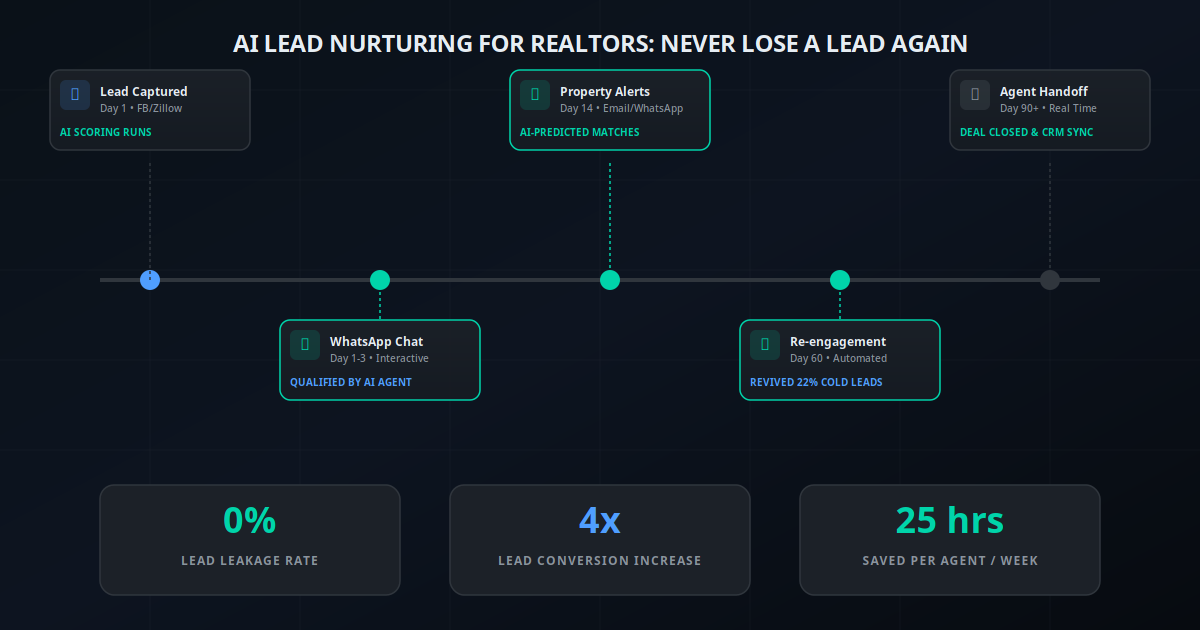
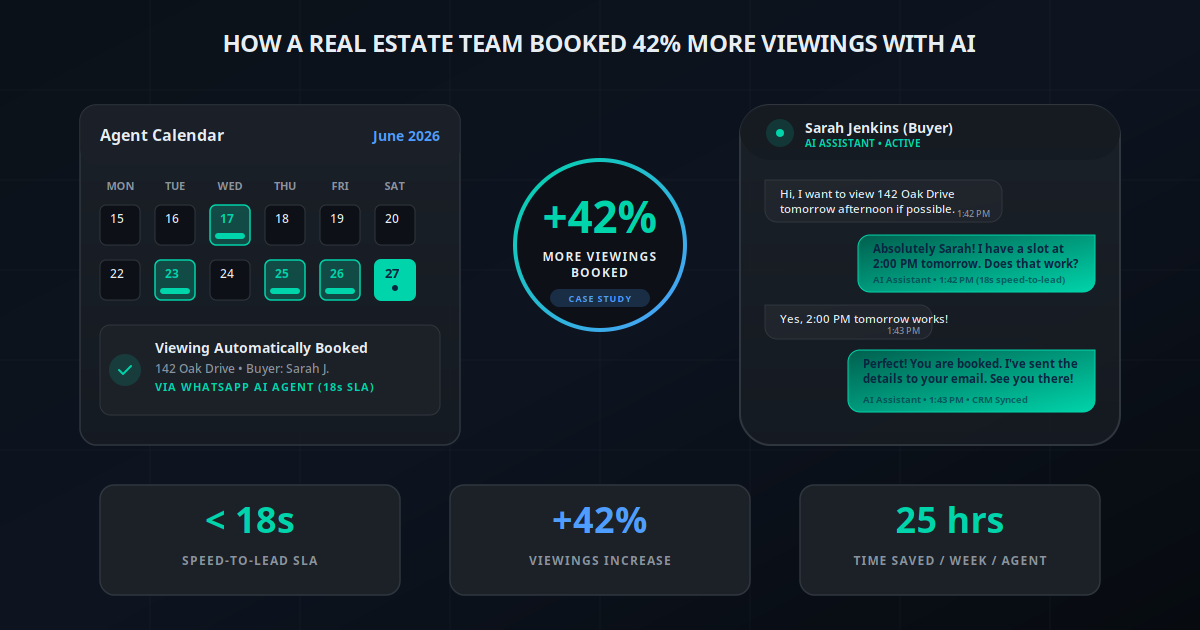
Despite this, the average response time for a real estate agency is over 4 hours. When a hot buyer is browsing listings, they will reach out to multiple agents. The first broker to answer the phone or send a direct message gets the contract. By automating speed-to-lead using conversational AI engines, agencies reduce response time to under 18 seconds, 24/7. The result? A direct 40% increase in lead-to-viewing conversion rates.
Key Takeaway
Manual lead follow-up is a leaking sieve. If you generate leads but don't contact them within 5 minutes, you are throwing away approximately 80% of your acquisition spend. AI automation plugs this leak permanently by qualifying every contact instantly.
2. Reclaiming Agent Hours: Administrative Tasks vs. Closing Deals
A typical real estate agent spends less than 35% of their working hours actually selling properties. The remaining 65% is consumed by repetitive administrative overhead:
- Manually typing contact details from property portals into the CRM.
- Exchanging WhatsApp messages and emails to find a viewing time that suits both the buyer and seller.
- Chasing clients to confirm scheduled appointments and reduce no-shows.
- Drafting listing descriptions and sending generic follow-up sequences.
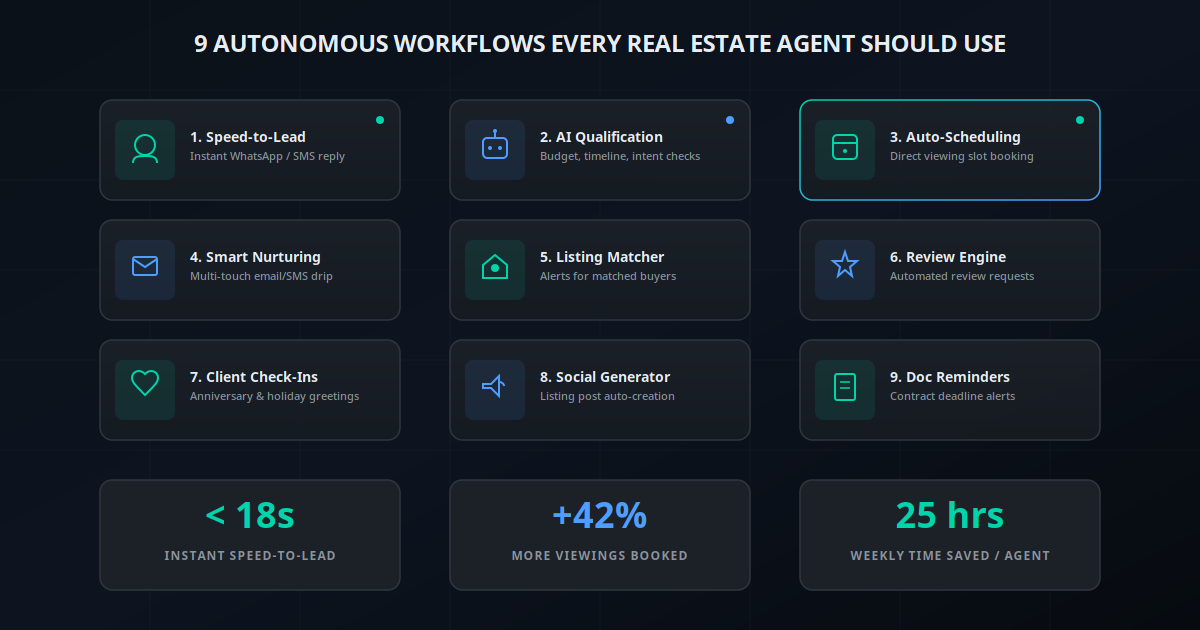
When you deploy autonomous workflows, the AI handles these low-value tasks. The moment a lead registers, the AI qualifications engine logs the data, initiates a friendly WhatsApp conversation, assesses buyer budget, and schedules a viewing directly on the agent's calendar. This reclaims an average of 25 hours per week per agent, letting your team focus exclusively on high-commission activities: viewings, negotiations, and listing acquisition.
3. Cost-Per-Lead and Cost-Per-Acquisition Metrics
To evaluate the financial benefit of AI automation, we must analyze its impact on Cost Per Lead (CPL) and Cost Per Acquisition (CPA). If you spend $4,000 per month on digital ads to generate 200 leads, your raw CPL is $20. If your manual follow-up converts 1.5% of those leads into closed deals (3 transactions), your manual CPA is $1,333.
By implementing an autonomous lead-qualification workflow, conversion rates typically climb to 3.5% due to instant follow-up and persistent long-term nurturing. With the same $4,000 ad budget, your agency closes 7 transactions. This reduces your CPA to $571 -- a 57% reduction in client acquisition costs without increasing your marketing spend by a single dollar.
"Automation didn't just save us time; it doubled the efficiency of our ad budget. Our cost per closed deal dropped by half because we were no longer dropping leads."
-- Principal Broker, Premier Metro Properties4. Calculating Your Baseline: Manual Operations Audit
Before implementing any technology, you need to calculate your current manual baseline. Use this formula to determine your monthly manual operational cost:
Manual Cost = (Staff Hours Spent on Admin × Hourly Rate) + Value of Lost Leads
In a small agency with 5 agents, each spending 20 hours per week on scheduling and data entry, you are losing 100 hours per week. At a conservative value of $30/hour, that represents a $3,000 monthly admin drain. If you add the value of 5 lost sales due to slow responses, the true cost of manual operations easily exceeds $15,000 per month.
5. Worked ROI Example for a Small Team
Let's run a side-by-side financial comparison. We will look at a boutique real estate agency with 5 active brokers. They receive 300 leads per month across Zillow and Instagram Ads. The average commission per deal is $8,000.
| Metric | Before AI (Manual Operations) | After AI (Jogi AI Engine) | Net Impact |
|---|---|---|---|
| Monthly Lead Volume | 300 leads | 300 leads | 0 (No ad spend increase) |
| Lead Response Time | ~2.5 hours | < 18 seconds | -99.8% response time |
| Lead-to-Viewing Rate | 18% (54 viewings) | 32% (96 viewings) | +42 viewings booked |
| Conversion Rate (Leads to Closed) | 1.5% | 3.5% | +2.0% absolute increase |
| Deals Closed per Month | 4.5 deals | 10.5 deals | +6 closed transactions |
| Monthly Gross Revenue | $36,000 | $84,000 | +$48,000 revenue increase |
| Weekly Hours Saved (Admin) | 0 hours | 125 hours (25 hrs/agent) | +125 hours for selling |
Now let's incorporate the investment cost of the Jogi AI Engine. A standard setup with full CRM integration, customized WhatsApp flow, and calendar sync costs a one-time fee of $1,500. The ongoing SaaS running costs are $179/month.
Even if we exclude the massive revenue bump from closed deals and look purely at recaptured staff hours, the math is clear: saving 125 hours of administrative work at $30/hour represents $3,750 in monthly labor value returned directly to the business.
6. Payback Period Math & Cash Flow Projection
The payback period is the time required to recover your initial tech investment. We calculate this by dividing the setup and initial software costs by the net monthly savings.
Initial Investment: One-time setup of $1,500 + first-month SaaS fee of $179 = $1,679 Total Outlay.
Daily Operational Savings: Recapturing 125 hours/month of admin work saves $3,750 in labor value. This equates to $93.75 in daily efficiency savings.
Break-Even Payback Period: Dividing $1,679 by $93.75/day yields exactly 18 days to fully recoup your investment through labor savings alone.
Subsequent Cash Flow: From Day 19 onward, the agency generates a net efficiency profit of $3,571 per month, even before accounting for any closed commissions.
7. Soft Benefits: Focus, Speed, and Broker Morale
While financial metrics are easy to track, the qualitative "soft" benefits of autonomous workflows are equally critical to agency retention and scaling:
Eliminating Agent Burnout
Agents hate manual cold outreach and data entry. Automating the intake process lets brokers spend their energy on face-to-face interactions, negotiations, and listing presentations -- the reasons they joined the industry in the first place.
Consistent Brand Representation
AI agents never have a bad day, never sleep, and never miss a follow-up. Every prospect gets the same polite, professional, and instant experience, protecting your agency's market reputation.
8. ROI by Team Size
How does automation scale as your agency grows? The return on investment is not linear; it compounds. The table below illustrates the cost-benefit ratio across different team structures:
| Team Size | Monthly Leads | Admin Time Saved / Mo | Additional Revenue Potential | ROI Factor |
|---|---|---|---|---|
| Solo Broker | 50 leads | 40 hours | +$8,000 (1 extra deal) | 3.2x / mo |
| Boutique Agency (5 Agents) | 300 leads | 500 hours | +$48,000 (6 extra deals) | 6.5x / mo |
| Mid-Market (20 Agents) | 1,200 leads | 2,000 hours | +$192,000 (24 extra deals) | 8.4x / mo |
9. Build vs. Buy: The Real Cost of Custom Integration
Many agencies attempt to build their own automation stack by patching together custom webhooks, Zapier accounts, and freelance developers. This is a common path to software creep. Building a custom qualifying engine involves significant engineering costs:
- Custom Webhook Development & API Integrations: $3,000 - $6,000
- Ongoing maintenance and resolving broken Zapier flows: $500/month
- API upgrades and security compliance: $200/month
By partnering with Jogi AI, you leverage a pre-optimized B2B automation engine that works immediately. This cuts initial development costs by 75% and eliminates ongoing maintenance anxiety.
10. Actionable ROI Checklist
Ready to deploy automation but unsure where to start? Use this checklist to map your high-ROI targets:
- [ ] Speed-to-lead audit: Submit a dummy lead on your own website. Measure exactly how many minutes (or hours) it takes for a response.
- [ ] CRM sync check: Confirm that all listing portals (Zillow, local directories) route lead data automatically without manual re-keying.
- [ ] WhatsApp qualification setup: Deploy a friendly conversational agent to qualify buyers before scheduling phone appointments.
- [ ] Automated viewing confirmation: Set up a calendar sequence that automatically texts the prospect 2 hours before a viewing to confirm, reducing agent travel times on ghosted meetings.
Ready to Plug the Leaks in Your Agency?
Stop letting real estate leads slip through your fingers. Calculate your agency's exact automation potential with our free interactive tool.
Calculate Your Agency's AI ROI →What is the typical setup timeline for real estate AI automation?
A standard deployment with Jogi AI takes between 10 to 14 business days. This includes mapping your lead flows, integrating your CRM (e.g., Follow Up Boss or HubSpot), training the AI agents on your inventory, and running extensive test inquiries to verify response accuracy.
Do autonomous workflows replace my existing CRM?
No. The AI workflows are built to sit on top of and augment your existing CRM (such as Follow Up Boss, LionDesk, HubSpot, or Salesforce). The AI agent acts as a 24/7 digital assistant that captures, qualifies, updates, and logs data back into your CRM automatically.
How does the system handle wrong numbers or spam leads?
The AI engine filters out invalid contacts immediately by validating phone formats and checking chat activity. If a lead enters a fake number or fails to interact with automated WhatsApp/SMS/Email verification, they are classified as cold, saving your agents from wasting hours chasing dead ends.
Is there a long-term contract or hidden fees?
No. Jogi AI packages run on a simple month-to-month commitment starting at $179/month. There are no licensing fees, and you can scale your workflows up or down as your transaction volumes change.