AI-Powered HR Automation: How Modern Businesses Transform Hiring, Onboarding, and Employee Support




Ask any HR manager what their week looks like. Sorting through 200 CVs for a single role. Sending the same interview confirmation email for the fifteenth time this month. Chasing a new hire's paperwork on day three because the onboarding checklist lives in someone's inbox. Answering "what is the leave policy?" — again — at 4pm on a Friday.
This is not what HR professionals trained for. Yet across businesses of every size, HR teams spend an estimated 40% of their working hours on administrative tasks that are repetitive, rules-based, and — critically — automatable.
The opportunity is not just efficiency. It is about what your HR team can do when they are not buried in scheduling coordination, CV triaging, and FAQ responses. Strategic hiring. Culture building. Retention programmes. The work that actually shapes a company.
AI HR automation does not replace your HR team. It eliminates the administrative layer that prevents your HR team from doing their real job.
What HR Automation Actually Means in 2026
HR automation in 2026 is not the clunky applicant tracking systems of five years ago. It is not a rigid rule engine that breaks the moment a process deviates from a script. Modern AI in HR means intelligent agents that understand context, communicate naturally, adapt to each candidate or employee, and connect seamlessly with the tools your team already uses — your ATS, your HRIS, your calendar, your communication platforms.
The core distinction to understand: traditional HR software records HR processes. Modern AI HR automation executes them. The difference is significant. A traditional ATS tells you where a candidate is in your pipeline. An AI-powered recruitment workflow moves the candidate through the pipeline — screening, communicating, scheduling, updating — without anyone manually doing it.
The question is not whether your HR processes can be automated. Virtually all of them can. The question is which ones to automate first to get the fastest return.
Five HR Processes That AI Automates Best
Not all HR tasks are equal candidates for automation. These five deliver the highest return in the shortest time.
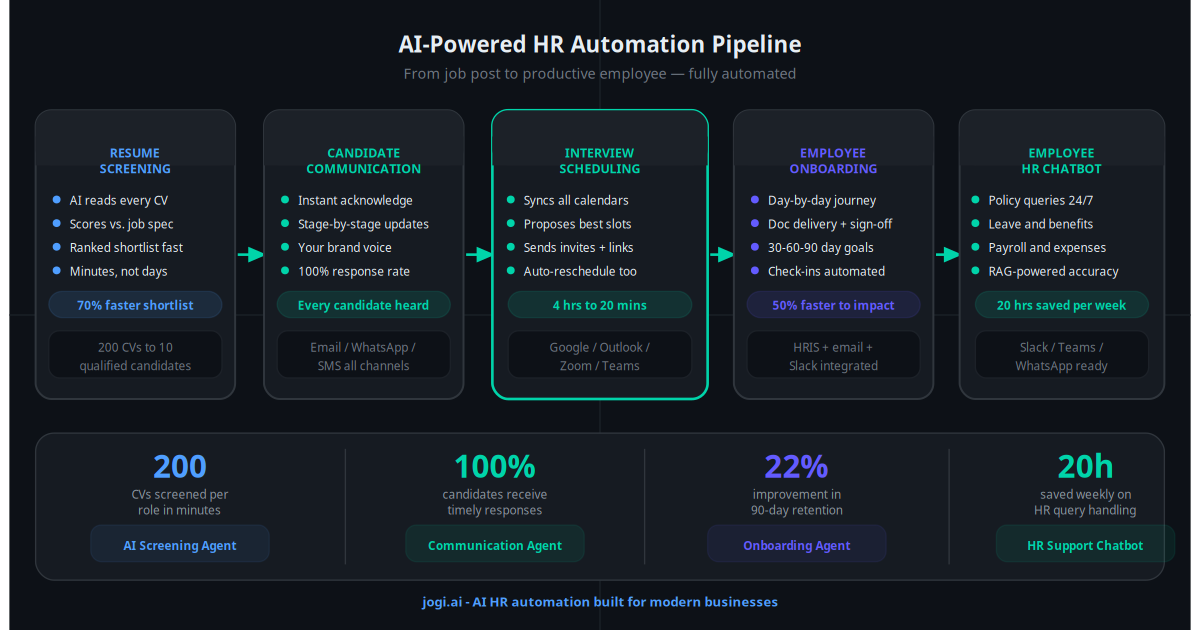
An AI screening agent reads every incoming CV against the job specification — not just for keyword matches, but for contextual relevance. It evaluates experience depth, career trajectory, role alignment, and red flags — and produces a ranked shortlist with an assessment summary for each candidate. A hiring manager receives ten qualified candidates, not 200 raw applications. What previously took 6–8 hours per role now takes minutes.
Avg. time saved: 6 hrs per open roleEvery candidate who applies deserves a response. Most businesses cannot manage it at scale — leading to silent rejections that damage employer brand. An AI communication agent sends personalised acknowledgements on application, status updates at each stage, rejection messages with constructive framing, and interview invitations — all automatically, all in your company's voice. Candidate experience scores improve dramatically. Your employer brand on job review platforms improves with them.
100% of candidates receive timely responsesCoordinating three interviewers, a hiring manager, and a candidate across different time zones — while trying to fit into a two-week window before the candidate accepts another offer — is a genuinely painful scheduling problem. An AI scheduling agent queries all calendars in real time, proposes slots that work for everyone, sends calendar invitations with joining details, and handles rescheduling requests without human involvement. The round-trip time from "let's interview this person" to "interview confirmed" drops from days to hours.
Avg. scheduling time: 4 hrs → 20 minsThe first two weeks at a new job involve a remarkable amount of paperwork, system access requests, policy acknowledgements, and orientation tasks. Most businesses handle this with a shared document, a checklist in someone's inbox, and a new hire who is too polite to say they have no idea what they are supposed to do next. An AI onboarding agent delivers a structured day-by-day onboarding journey: pre-start paperwork workflows, equipment and access provisioning reminders, policy document delivery, 30-60-90 day goal setting, and a check-in sequence that surfaces problems before they become retention risks.
New hire productivity up 50% fasterThe most underestimated time drain in HR is answering the same questions repeatedly. Leave balances. Holiday entitlement. Expense claim processes. Parental leave policies. Payroll deadlines. Promotion criteria. A RAG-powered employee support chatbot — trained on your actual HR policies, employee handbook, and internal FAQs — answers all of these instantly, 24/7, in plain language. HR teams at companies using AI support chatbots report saving 12–20 hours per week previously spent on internal query handling.
12–20 hrs saved per week in HR queriesThe Pattern Worth Noting
Every one of these processes shares the same characteristic: they are high-volume, rules-based, and deeply important for employee and candidate experience — yet they consume disproportionate amounts of skilled HR time. Automating them does not lower the quality of HR. It raises it, because your HR team can now focus on the judgement-intensive work that AI cannot replace.
The Role of AI Chatbots and AI Agents in HR
Two distinct AI tools power modern HR automation, and it is worth understanding each:
AI HR Chatbots — The Employee-Facing Layer
An AI HR chatbot is the interface that employees and candidates interact with directly. It answers questions, delivers information, collects inputs, and escalates to a human when needed. A well-built HR chatbot uses RAG — Retrieval-Augmented Generation — to retrieve answers from your actual HR documentation rather than generating generic responses from training data. This means it gives your employees the correct, current, company-specific answer to every policy question — not a plausible guess.
Deploy it on Slack, Microsoft Teams, WhatsApp, or your intranet. Employees ask their question wherever they already work. The chatbot answers from your policy documents, your benefits guides, your employee handbook — instantly.
AI HR Agents — The Process Execution Layer
AI agents go beyond answering questions. They take actions. An AI recruitment agent does not just tell a hiring manager which candidates are shortlisted — it emails the candidates, books the interviews, sends the calendar invites, and updates your ATS. An AI onboarding agent does not just list what a new hire needs to do — it triggers each step automatically, follows up when items are overdue, and flags completion to the HR team.
The distinction matters because it determines ROI. Chatbots save time by giving fast answers. Agents save time by eliminating the human steps in a workflow entirely.
Real-World Use Cases
🚀 Startup Hiring at Scale
A 40-person tech startup is hiring for 12 roles simultaneously with a two-person HR function. Before AI: the HR team is drowning in CVs, candidates wait 10 days for a response, and half the open roles have no shortlist after three weeks. After deploying an AI recruitment agent: every CV is screened and scored within 4 hours of submission, shortlists are ready the same day, candidates receive acknowledgement within minutes, and interviews are scheduled automatically. The two-person HR team now manages 12 active pipelines comfortably — without any additional headcount.
🏢 Enterprise HR Operations
A 600-person manufacturing company has an HR team of eight handling everything from recruitment to payroll queries. Their biggest pain point: employees across three shifts contacting HR with the same leave, expense, and policy questions — often outside business hours. They deploy a RAG-powered employee support chatbot trained on their HR manual, benefits guide, and collective agreement. Within 30 days: 78% of internal HR queries are resolved by the chatbot without human involvement. HR staff reclaim an estimated 18 hours per week, which they redirect to a retention improvement programme that reduces churn by 14% over the following six months.
🎓 Remote Team Onboarding
A fully remote SaaS business hires globally and struggles with inconsistent onboarding — some new hires get thorough attention, others fall through the cracks depending on who is available. They implement an AI onboarding agent that delivers a standardised 30-day onboarding journey to every new hire: day one welcome and system access steps, week one policy reading assignments with acknowledgement tracking, two-week check-in message, 30-day performance goal setting session prompt. New hire satisfaction scores increase from 6.2 to 8.7 out of 10. 90-day retention improves by 22%.
Benefits of AI HR Automation — The Numbers
The benefits of HR workflow automation are not abstract. They translate directly to measurable outcomes:
- Faster time-to-hire. AI screening and scheduling compress the recruitment cycle by 50–70%, reducing the risk of losing top candidates to faster-moving competitors.
- Lower cost-per-hire. Automating sourcing communication and initial screening reduces dependency on recruitment agencies — typically saving 15–20% of a role's annual salary per placement.
- Better candidate experience. Timely, personalised communication throughout the hiring process improves offer acceptance rates and strengthens employer brand.
- Reduced onboarding attrition. Structured, consistent onboarding reduces early employee churn — one of the most expensive HR failures, given that replacing a hire costs 50–200% of their annual salary.
- Freed HR capacity. HR professionals redirected from admin to strategic work report significantly higher job satisfaction — a factor that itself improves HR retention.
- 24/7 employee support. An always-on HR chatbot means employees get answers at 11pm as reliably as at 11am — particularly valuable for shift-based or globally distributed teams.
Common Mistakes in HR Automation
The value is clear. But implementation errors consistently undermine it. These are the mistakes we see most often:
- Automating a broken process. If your onboarding workflow is disorganised, an AI agent will execute that disorganisation at scale. Fix the process first, then automate it. Automation amplifies whatever it touches.
- Building a chatbot without a proper knowledge base. Deploying an employee support chatbot trained on outdated, incomplete, or contradictory HR documents produces wrong answers delivered confidently. Your HR policy documents need to be accurate and current before they become an AI knowledge base.
- Forgetting the escalation path. AI handles the routine well. It handles the unusual poorly. Every AI HR system needs a clear path to a human — especially for sensitive situations like disciplinary issues, mental health queries, or anything legally complex.
- No change management. Employees and hiring managers who do not understand how the AI system works will distrust it, work around it, and blame it for errors. Brief your team. Show them how it helps them specifically.
- Treating it as a one-time deployment. Policies change. Roles change. Benefits packages change. An AI HR chatbot trained on last year's handbook is a liability. Build a process for regular knowledge base updates from day one.
How to Start Automating Your HR — Practical Steps
The right implementation sequence depends on your biggest pain point. But for most businesses, this order delivers the fastest return:
- Step 1 — Audit your HR time. For one week, log every HR task and how long it takes. You will quickly identify your highest-volume, lowest-value activities — these are your first automation targets.
- Step 2 — Map the process before building the automation. Document each process clearly: what triggers it, what steps it involves, what inputs it needs, what the output should be. This becomes the specification for the AI workflow.
- Step 3 — Build your HR knowledge base. Compile your employee handbook, HR policies, benefits documentation, and FAQ responses into a clean, current document set. This is the foundation for your employee support chatbot.
- Step 4 — Deploy the employee support chatbot first. This delivers the fastest visible return — immediate HR capacity freed, immediate improvement in employee experience. It also demonstrates AI value to your team before tackling more complex recruitment automation.
- Step 5 — Automate recruitment screening and communication. Connect your job postings to an AI screening agent. Define your scoring criteria. Set up automated candidate communication sequences. This is typically where the largest ROI sits for growing businesses.
- Step 6 — Build the onboarding automation. Map your onboarding journey task by task, then automate the sequencing, delivery, and follow-up. Integrate with your HRIS for clean data flow.
- Step 7 — Measure, iterate, expand. Track resolution rates on the chatbot, time-to-hire, candidate satisfaction, and new hire feedback. Use the data to identify the next automation opportunity.
The Practical Architecture: How It All Connects
A complete AI HR automation system is a connected set of components, not a single tool:
| Component | What It Does | Connects To |
|---|---|---|
| AI Screening Agent | Reads CVs, scores candidates, produces shortlists | Job boards, ATS, hiring manager dashboard |
| Candidate Communication Agent | Sends acknowledgements, updates, invitations, rejections | Email, WhatsApp, SMS, ATS |
| Interview Scheduling Agent | Syncs calendars, proposes slots, sends invites | Google Calendar, Outlook, Zoom, Teams |
| Onboarding Workflow Agent | Delivers tasks, collects documents, checks completion | HRIS, email, Slack, document management |
| Employee Support Chatbot (RAG) | Answers HR queries from policy knowledge base | Slack, Teams, WhatsApp, intranet |
| HR Analytics Layer | Tracks pipeline metrics, resolution rates, engagement | Dashboard, reporting tools, HRIS |
Each component works independently. But together, they create an HR function that operates at a fundamentally different level of speed and scale — without proportionally more headcount.
Future Trends: Where AI HR Is Heading
The current generation of AI HR tools is already a significant capability jump. The next wave will push further:
- Fully autonomous hiring pipelines. End-to-end recruitment where AI manages the entire process from job posting through to offer letter — with humans reviewing decisions at key gates rather than executing every step.
- Predictive retention analytics. AI systems that identify flight-risk employees before they resign, based on engagement signals, performance patterns, and benchmarked indicators — enabling proactive retention conversations.
- Personalised AI career assistants. An internal AI for each employee that tracks their skills, recommends internal opportunities, suggests development resources, and helps them navigate the organisation — improving engagement and internal mobility simultaneously.
- AI HR assistants for managers. Not just tools for HR teams, but tools for every line manager — AI that helps them prepare for performance reviews, draft development plans, identify team engagement risks, and handle people management situations with better guidance.
Businesses building their AI HR infrastructure now are not just solving today's admin problem. They are building the foundation for the people operations that will define the most attractive employers over the next decade.
The Right Frame for HR Automation
The goal of AI in HR is not to remove the human from human resources. It is to remove the administrative burden that prevents HR professionals from doing what they are actually valuable for: attracting great people, building strong cultures, and retaining the talent that drives the business. AI does the admin. Humans do the strategy.
Your HR Automation Starts Here
The most common response we hear when businesses first see a modern AI HR system in action is: "I had no idea it could do that." The gap between what most HR teams experience today and what is already possible with current AI tools is remarkably large — and closing it is not a 12-month transformation project. It is a 4–6 week implementation.
Whether your priority is faster hiring, a more consistent onboarding experience, or an employee support chatbot that frees your HR team from repetitive queries — the technology exists, it works, and it is accessible to businesses of any size.
At Jogi AI, we build custom AI HR automation systems tailored to your specific processes, tools, and team. From RAG-powered employee support chatbots to fully automated recruitment pipelines, we handle the architecture — so your HR team handles the people.
The 40% of HR time currently spent on admin is not a fixed cost. It is an opportunity. The question is when you are ready to reclaim it.