AI Employee Retention: Cut Staff Turnover by 40% With HR Automation




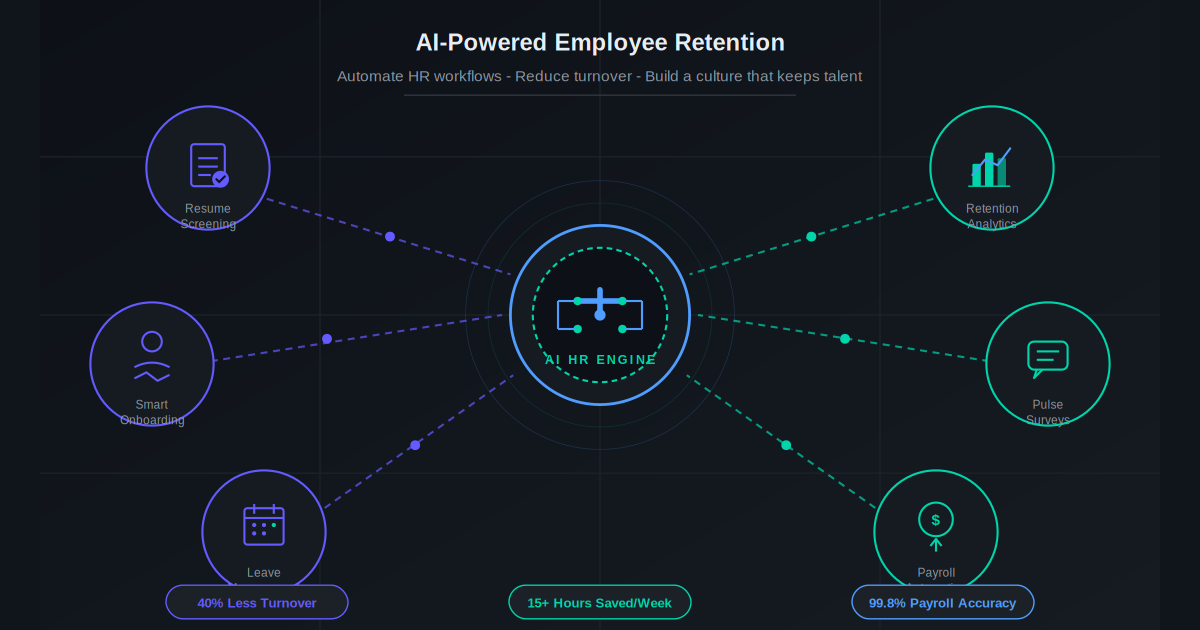
Replacing one employee costs between 50% and 200% of their annual salary — once you account for recruitment fees, interviewing time, onboarding, lost productivity, and the institutional knowledge that walks out the door with them. For a small or mid-sized business, a single unexpected resignation can disrupt operations for months. And yet most businesses treat employee turnover as an unavoidable cost of doing business.
It is not. In 2026, AI-powered HR automation is giving forward-thinking businesses the tools to detect disengagement early, respond before it becomes a resignation, and build the kind of consistent employee experience that makes people want to stay. Businesses using these systems are reporting turnover reductions of 35–45% within the first year — not by paying more, but by getting smarter about how they manage their people.
Key Takeaway
Employee turnover is a data problem as much as a culture problem. AI automation gives you the real-time signals and automated workflows to catch disengagement before it becomes a resignation — and create a workplace where your best people choose to stay.
Why Good Employees Really Leave — And What the Data Shows
Most exit interviews are unreliable. Employees who are leaving often soften their real reasons — citing "better opportunity" when the actual cause was a micromanaging team lead, unacknowledged extra effort, or a confusing onboarding that made them feel lost from day one. By the time they are sitting in an exit interview, the decision has been made for weeks or months.
Research consistently shows the top five real reasons employees leave are:
- Lack of recognition and appreciation — feeling invisible despite strong performance
- No clear career growth path — stagnation and uncertainty about the future
- Poor management communication — not knowing how they are performing or what is expected
- Onboarding failure — a chaotic first 30 days that never fully recovers
- Overwork without support — workload imbalance that compounds silently until a breaking point
Every single one of these is detectable — and addressable — before it leads to a resignation. That is exactly what AI-powered HR automation is designed to do.
The 6 AI Automation Systems That Drive Retention
1. Intelligent Onboarding Sequences
The first 90 days of employment are the most critical for long-term retention. Research from the Society for Human Resource Management (SHRM) shows that employees who experience a structured, engaging onboarding are 58% more likely to still be with the company three years later. Yet most small businesses onboard through informal tribal knowledge and improvisation.
AI-powered onboarding automation changes this completely. The moment a hire is confirmed, a structured sequence launches automatically — no HR manager needs to remember to send anything:
- Pre-boarding email with first-day logistics, team introductions, and culture reading material sent three days before the start date
- Day-one welcome automation with a personalized schedule, tool access links, and manager introduction
- First-week check-in at Day 5 asking three targeted questions: What is confusing? What do you need? How is the team?
- 30-day structured survey covering role clarity, team integration, and any blockers
- 90-day performance alignment check synced with the manager's calendar
Businesses that implement this sequence see new-hire satisfaction scores increase by an average of 40 points and first-90-day attrition drop by over 30%.
2. AI-Powered Pulse Surveys and Sentiment Analysis
Annual performance reviews are a relic. A disengaged employee who is thinking about leaving does not wait until December to feel that way — the warning signs appear in March, April, and May. By the time the annual review catches it, they have already accepted another offer.
Pulse surveys — short, frequent check-ins sent automatically every 3–4 weeks — capture sentiment in real time. The key is keeping them brief: five questions or fewer, taking under two minutes to complete. Automated delivery and AI-driven analysis means you can run these across your entire team without any manual effort.
The AI does not just collect responses — it analyzes patterns across time:
- A team member's satisfaction score dropping three points across two consecutive surveys triggers a manager alert
- A team where 60% of members rate "workload" as a concern flags a resourcing issue before anyone burns out
- A spike in negative responses about "recognition" after a restructure surfaces the cultural impact of the change
"We used to only find out someone was unhappy when they handed in their notice. Now the AI flags potential issues weeks in advance and our managers actually have time to have a genuine conversation. We have prevented at least four resignations in the last six months that we would never have seen coming." — HR Lead, tech services firm, Bengaluru
3. Automated Recognition and Milestone Workflows
Recognition is the most underrated retention tool — and one of the easiest to automate. Feeling unseen is the number one driver of quiet quitting. Yet most managers, stretched across multiple responsibilities, simply forget to acknowledge anniversaries, achievements, and milestones.
AI automation ensures no milestone is ever missed. The system monitors your HR data and triggers personalized recognition automatically:
- Work anniversaries: Personalized email from the founder + team shoutout in the company channel
- Project completion: Automated congratulations message referencing the specific project outcome
- Peer nominations: A simple weekly peer-recognition workflow where any team member can nominate a colleague in 30 seconds — results compiled and shared every Friday
- Performance streaks: AI detects three consecutive high-performance months and triggers a manager prompt to have a growth conversation
Research by Gallup shows employees who receive regular recognition are 3.6 times more likely to be engaged at work. Automating recognition does not make it less meaningful — it makes it consistent, which is what matters.
4. Proactive Leave and Workload Management
Burnout is one of the most expensive HR problems a business can face — and one of the most preventable. The warning signs are usually present weeks before an employee starts searching for other jobs. They are working late consistently, skipping breaks, not using annual leave, and scoring lower on energy-related pulse survey questions.
AI-powered leave management does far more than process time-off requests. It actively monitors utilization patterns and flags risks:
- An employee who has not taken any leave in four months receives an automated wellness nudge — plus a prompt to their manager to check in
- A team with consistently high overtime hours triggers a resourcing alert to the operations lead
- Leave requests are approved automatically for pre-approved windows, and conflicts are flagged without HR involvement
- Year-end leave balances are tracked proactively to prevent the December rush that disrupts operations
Key Takeaway
Burnout is not sudden — it builds over weeks. AI monitoring of leave patterns, overtime data, and pulse survey energy scores gives you the early warning system to intervene before an exhausted employee starts scrolling job boards.
5. Transparent Career Development Tracking
The most common reason high performers leave is not money — it is the absence of a visible future. When employees cannot see a clear path from where they are to where they want to be, ambiguity fills the gap. And ambiguity is where competing job offers gain traction.
AI-powered career development automation creates structure and visibility:
- Each employee has a documented development plan stored in the system with quarterly milestones
- Automated reminders prompt managers to schedule development check-ins every 60 days
- Skill gap analysis runs automatically, suggesting learning resources tied to the employee's stated career goals
- Goal completion is tracked and acknowledged automatically — employees see their own progress in real time
- Internal role openings are automatically matched and surfaced to employees whose skill profiles align
Businesses that implement transparent, automated career development see a 25% reduction in voluntary turnover among high performers within the first year — the exact segment most costly to lose.
6. Exit Interview Automation and Retention Intelligence
Even with the best systems in place, some attrition is inevitable. What matters is learning from every departure to prevent the next one. Traditional exit interviews are inconsistent — some managers conduct thorough, structured conversations while others skip them entirely or receive softened responses.
AI-automated exit interviews solve this. When a resignation is submitted, the system immediately triggers a structured digital exit survey — completed anonymously before the final day. The format removes social awkwardness and typically generates far more candid responses than face-to-face interviews.
The AI then analyzes patterns across all exit responses over time, surfacing systemic insights: which teams have the highest attrition, which managers consistently appear in negative feedback, which benefits or policies are cited as uncompetitive. These insights feed directly back into HR policy and hiring decisions — creating a continuous improvement loop that compounds over time.
Building Your AI Retention Stack: Where to Start
The temptation is to implement everything at once. Resist it. A phased approach delivers faster results and avoids overwhelming your team with simultaneous changes. Here is the sequencing that works:
- Month 1 — Onboarding automation first. This has the highest immediate impact on the newest, most vulnerable segment of your workforce. A single prevented first-90-day resignation pays for months of automation costs.
- Month 2 — Deploy pulse surveys. Start with your existing team. Even a single round of structured pulse data will surface insights you did not have before. Keep surveys short: five questions, anonymous, every four weeks.
- Month 3 — Activate recognition workflows. Connect your HR system to your communication tools (Slack, Teams, email) and set up anniversary and milestone triggers. This requires almost no ongoing effort once configured.
- Month 4 — Implement leave monitoring and workload alerts. Configure thresholds for leave utilization and overtime that trigger manager prompts automatically.
- Month 5 — Career development tracking. Begin with your top performers. Create a digital development plan for each and set up quarterly check-in reminders.
- Ongoing — Exit interview automation and retention analytics. The data this generates compounds over time into your most valuable HR intelligence asset.
The Real ROI of Reducing Turnover by 40%
Let us run the numbers for a business with 20 employees and an average salary of ₹6 lakh per year:
- Industry average voluntary turnover: 20% annually = 4 employees leaving per year
- Cost per replacement: approximately ₹3–6 lakh (recruitment, training, lost productivity)
- Total annual turnover cost: ₹12–24 lakh
A 40% reduction in turnover — bringing departures from 4 to 2.4 per year — saves between ₹4.8 lakh and ₹9.6 lakh annually. The AI automation system that delivers this costs a fraction of that. The payback period is typically measured in weeks, not months.
But the financial savings are only part of the story. Every time a key employee stays, you retain their relationships, their institutional knowledge, and their contribution to team morale. You preserve continuity for your customers. You keep the momentum of your best projects. These compounding benefits are real, but they resist easy quantification — which is exactly why they are undervalued until a key resignation makes them suddenly, painfully visible.
What "Culture" Actually Means in an Automated HR World
A common objection to HR automation is that it feels impersonal. That introducing systems and algorithms into people management will strip out the human connection that culture depends on. This concern is understandable — and it is backwards.
The businesses with the strongest cultures are not the ones where managers have the most good intentions. They are the ones where good intentions are reliably executed. A manager who genuinely wants to recognize every team member's anniversary is still going to forget some of them when business gets busy. The AI does not forget.
Automation handles the administrative layer of people management — the reminders, the scheduling, the data collection, the alerts — so that your managers are freed to do the one thing AI cannot: have a real, human conversation at exactly the right moment. The AI surfaces that a team member's satisfaction scores have dropped. The manager reaches out. That conversation is more human, more timely, and more effective than it would ever have been without the AI flagging the issue.
The best AI-powered HR systems do not replace human judgment — they give it better information and better timing. And that combination is what retention is actually made of.
Getting Started: Your 30-Day Action Plan
If you are ready to reduce turnover and build a more stable, engaged team, here is your practical first step checklist:
- Audit your current onboarding process — map every touchpoint a new hire experiences in their first 30 days
- Calculate your actual turnover cost using the 50–200% of salary formula for your most recent departures
- Choose one pulse survey tool (many integrate directly with Slack, email, or WhatsApp) and send your first survey within the next two weeks
- Set up automated anniversary and milestone notifications in your calendar or HR system this week — it takes 30 minutes
- Have a conversation with your top three performers about their career goals and document what you learn
- Book a free AI audit with Jogi AI to map which retention workflows will have the highest ROI for your specific team size and industry
Employee retention is not a soft, feel-good HR goal. It is one of the highest-leverage financial decisions a business owner can make. And in 2026, the tools to do it systematically, affordably, and at scale are accessible to any business willing to take the first step.
Your best people have choices. Give them every reason to choose you.