AI for Property Management: Automating Tenants, Maintenance & Rent
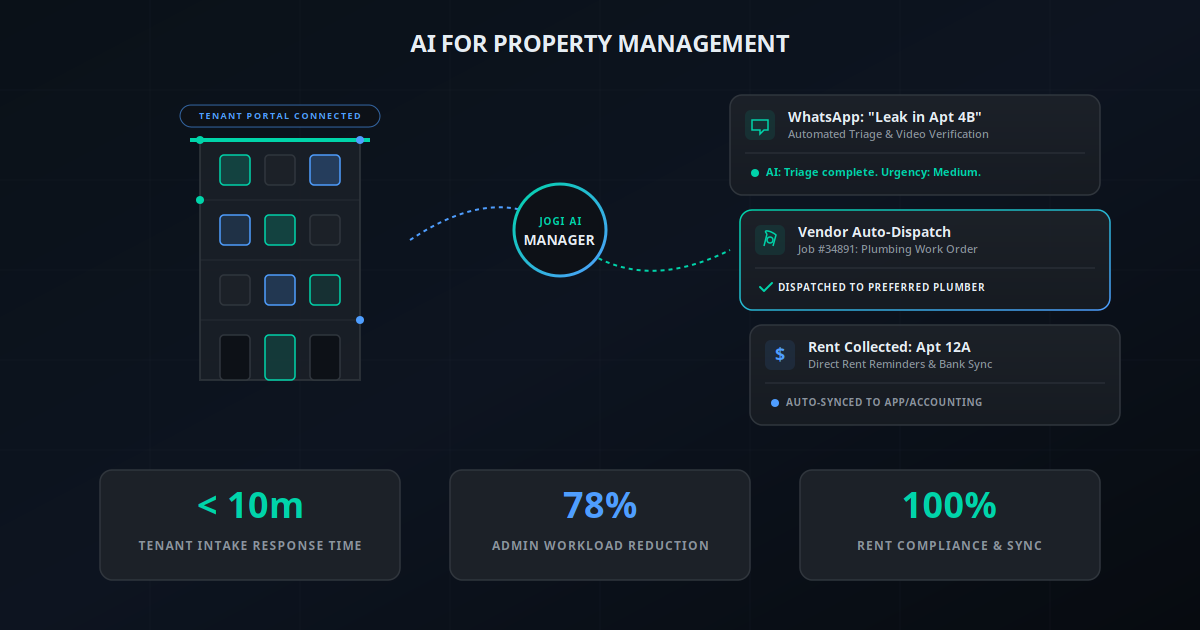
Managing real estate portfolios is a notoriously high-overhead business. Between chasing rent payments, answering the same tenant questions hundreds of times, and triaging late-night plumbing emergencies, property managers are constantly put in a reactive posture. Most managers spend up to 78% of their week on repetitive, manual administration rather than focusing on property acquisition, inspections, and owner relationships.
But in 2026, the industry is shifting from manual management to autonomous workflows. By deploying AI agents connected directly to messaging channels, Property Management Systems (PMS), and vendor databases, landlords and agency managers are scaling their portfolios without adding headcount. In this playbook, we break down how AI automates the three primary pillars of property management: tenant communication, maintenance intake, and rent collection.
AI property management automation does not replace the human touch—it automates the repetitive, manual tasks like tenant intake, screening, late-payment reminders, and repair triage. This allows one property manager to comfortably handle 3x more units while dropping tenant response times under 10 minutes.
Where Property Managers Lose Time
Traditional property management is plagued by friction. A typical manager's day is fragmented by unstructured messages across WhatsApp, email, portals, and phone calls. Let's look at the primary bottlenecks that drain productivity:
- Tenant Communication: Answering basic questions about gate codes, lease terms, trash collection, and Wi-Fi networks.
- Leasing & Lead Intake: Responding to dozens of unqualified rental listing inquiries from platforms like Zillow or Apartments.com.
- Rent Chasing: Manually reviewing bank accounts and writing individual, awkward emails or messages to late tenants.
- Maintenance Coordination: Getting incomplete maintenance details (e.g., "the heater is broken" without model numbers or photos), calling multiple handymen to get quotes, and coordinating calendar invites.
By mapping out these bottlenecks, we can construct an automated system that addresses each stage of the tenant lifecycle.
The Tenant Lifecycle Automation Map
An autonomous property management system operates across the entire tenant lifecycle. Instead of treating tasks in isolation, AI links every event back to your core software in real-time. Here is how the tenant lifecycle shifts from manual to autopilot:
| Lifecycle Stage | Manual Process | AI Autonomous Workflow |
|---|---|---|
| Lead Intake & Leasing | Manually replying to emails, sorting through unqualified leads, back-and-forth scheduling. | AI agent responds in <60s, qualifies candidates, and books viewings on calendar. |
| Tenant Onboarding | Emailing PDFs, chasing signatures, manually copying contact info to PMS. | Automated onboarding sequence sends lease, logs deposit, and registers portal access. |
| Day-to-Day Requests | Reviewing emails, answering phone calls, manually triaging simple queries. | 24/7 RAG FAQ bot answers tenant questions instantly over WhatsApp or SMS. |
| Maintenance Intake | Logging tickets, calling vendors, coordinates schedule between tenant and handyman. | WhatsApp AI triages urgency with video, logs ticket in PMS, and dispatches preferred vendor. |
| Rent Collection | Verifying deposits, typing emails, sending late reminders manually. | Automated pre-reminders and late escalation triggers over SMS with direct payment links. |
| Lease Renewals | Tracking dates on spreadsheets, drafting renewal offers manually. | AI tracks renewal date, drafts updated contract with market-rate increase, and emails tenant. |
1. Automated Tenant Inquiry and Applicant Screening
The leasing funnel is a massive time sink. When a property goes live, managers are hit with a wave of inquiries. Many of these prospects fail to read the listing criteria (e.g., credit requirements, pet policies, or move-in dates).
An inquiry autonomous workflow connects your listing platforms to an AI conversational agent. The moment a prospect submits an inquiry:
- The AI agent immediately follows up via WhatsApp or SMS (when response time is <60s, booking rates increase by 391%).
- The AI converses naturally, asking pre-qualification questions: "What is your target move-in date? Do you have any pets? Is your household income at least 3x the monthly rent?"
- Unqualified leads are politely filtered out, while qualified candidates are sent a personalized booking link linked to the manager's calendar.
- All candidate details are automatically pushed to your CRM or Property Management System (PMS) under the candidate's profile.
"Automating the screening process has cut our leasing vacancy times by 41%. The AI agent handles 95% of the qualifying chat before my team ever steps in to show the property."
2. Maintenance Triage & Vendor Auto-Dispatch
Coordinating repairs is one of the most frustrating aspects of property management. Tenants often submit vague requests, leading to multiple follow-up calls just to understand the problem. Furthermore, dispatching vendors usually requires manual phone tag.
An automated maintenance workflow turns maintenance intake into a structured, self-operating system:
Step A: Intake & Diagnostic Triage
The tenant opens a chat on WhatsApp or SMS and types: "There's water leaking under the sink." The AI agent logs the conversation and requests: "Could you please upload a quick 5-second video of the leak? This helps us send the right parts." Once uploaded, the AI uses multimodal computer vision to inspect the video, identifying the leak severity.
Step B: Urgency Classification
The system classifies the issue based on pre-defined safety rules. A burst pipe is instantly marked Urgent. A squeaky door is marked Low Priority. Urgent issues automatically bypass standard loops, immediately calling the property manager and sending an automated text alert to the tenant with instructions on how to shut off the water valve.
Step C: Work Order Creation & Vendor Dispatch
The AI automatically logs a work order in AppFolio, Yardi, or Buildium, uploading the description, video, and unit details. Simultaneously, the workflow looks up your pre-approved vendor database. It sends a message to your preferred plumber: "New plumbing job at Apt 4B. Rate: $120/hr. Reply 'ACCEPT' to confirm booking for today between 2-4 PM." Once accepted, the tenant is notified, and a calendar invite is sent to both parties.
3. Automated Rent Reminders and Accounting Sync
Chasing rent is uncomfortable and time-consuming. However, cash flow is the lifeblood of real estate investing. Automating this process ensures consistent cash flow while maintaining professional relationships with tenants.
The rent collection autonomous workflow coordinates reminders, late fees, and PMS updates:
- Friendly Pre-reminders: 3 days before rent is due, the system sends a automated WhatsApp with a direct payment link: "Hi Sarah, this is a friendly reminder that rent for Apt 4B is due on the 1st. Click here to review your invoice and pay: [Link]."
- Grace Period Reminders: If rent isn't paid by the due date, a soft reminder goes out on the 2nd.
- Late Follow-up and Late Fee Automation: On the 5th (or whenever the grace period ends), the AI agent sends a formal notice, automatically calculates and applies the late fee in the PMS, and updates the invoice.
- Auto-reconciliation: Once paid via Stripe, ACH, or your PMS portal, the system matches the transaction, reconciles the invoice, logs it in QuickBooks, and sends a receipt automatically.
4. 24/7 Tenant Support and Handbook RAG
Tenants ask the same logistical questions repeatedly: "Where is the trash chute? What is the guest parking policy? How do I reset the Wi-Fi?" Answering these manually is a waste of human capacity.
By utilizing Retrieval-Augmented Generation (RAG), you can upload your property handbooks, HOA rules, and lease terms into a secure database. The AI tenant agent references this specific database to answer questions accurately and instantly over SMS or WhatsApp, deflecting up to 90% of routine inbound volume. If a question falls outside the handbook, the AI states: "I will loop in the manager to help with this," and creates a task in the team's inbox.
How to Get Started: A Crawl-Walk-Run Roadmap
You don't need to automate your entire business overnight. In fact, a staged rollout is much safer and easier to manage. Here is our recommended roadmap:
Phase 1: Crawl
Set up automated rent reminders and an AI FAQ assistant. These require zero technical integration and immediately reclaim 5+ hours per week of manual drafting time.
Phase 2: Walk
Connect your listing platforms (Zillow, MLS) to an AI conversational screening bot. Integrate the bot with a scheduling tool like Calendly to automate viewing bookings.
Phase 3: Run
Deploy the full maintenance triage and vendor dispatch loop. Integrate all pipelines directly with your PMS (AppFolio/Yardi) to maintain a single source of truth.
KPIs to Track Your Automation Success
When measuring the impact of your property management automation, focus on these four core metrics:
- Average Speed-to-Lead: Your response time to listing inquiries. Target: Under 60 seconds.
- Unit-to-Manager Ratio: The number of doors a single property manager can handle. With AI, this typically scales from 120 doors up to 350+ doors.
- Days On Market (DOM): The speed at which vacancies are filled. Target: Cut by 30-40%.
- On-Time Rent Collection: Percentage of rent paid before late fees kick in. Target: Over 98% collection by the 5th of the month.