The SME Leader's AI Systems Playbook: Stop Bleeding Revenue, Start Scaling
Here is an uncomfortable truth most business consultants will not tell you: your biggest competitor is not the company down the road — it is the inefficiency quietly embedded in your own operations. Right now, your team is spending hours each week on tasks that an AI system could handle in minutes. Every manual follow-up email, every spreadsheet updated by hand, every customer query that waits four hours for a response — these are not minor inconveniences. They are compounding revenue leaks.
The businesses that will dominate their markets over the next three to five years are not necessarily the ones with the biggest budgets or the most staff. They are the ones that figured out how to build AI systems into the core of their operations — systems that think, respond, and execute while the founder sleeps. This is not science fiction. It is happening right now, in businesses just like yours, in every sector from professional services to logistics to retail. This playbook is your roadmap to join them.
Why "Good Enough" Is Quietly Destroying Your Competitive Position
Most growing SMEs operate with a patchwork of tools — a CRM here, a spreadsheet there, WhatsApp for customer service, email for invoicing, and a project management tool that half the team actually uses. Each tool works reasonably well in isolation. Together, they create a fragmented operational reality where data is siloed, handoffs are manual, and the business runs on tribal knowledge rather than systems.
This is the "good enough" trap. And it is far more dangerous than it looks. Here is why:
- It scales linearly with headcount. To handle 2x the customers, you need roughly 2x the people — because every additional customer creates a proportionally larger administrative burden. AI-powered operations scale differently: your infrastructure handles 2x the volume with no additional overhead.
- It creates invisible quality inconsistency. When humans manually handle processes, the quality of execution varies based on who does it, when they do it, and how much other work they are juggling. AI systems execute with identical quality every single time — whether it is the first task of the day or the thousandth.
- It makes your best people do your worst work. Talented, expensive employees are regularly pulled into data entry, report formatting, email follow-ups, and status updates that an automated system could handle at a fraction of the cost.
- It creates a widening competitive gap. Every month you stay in "good enough" mode is a month your AI-enabled competitors are compounding their operational advantage. The gap does not stay constant — it accelerates.
"We thought we had a staffing problem. We kept hiring, but the backlog never cleared. It turned out we had a systems problem — we were doing manually what AI could have automated in a fraction of the time. Once we fixed the system, we stopped hiring reactively and started growing intentionally." — Operations Director, B2B logistics firm, Pune
What AI Systems Actually Are — And Are Not
The term "AI" gets thrown around so loosely that it has become almost meaningless. When Jogi AI talks about AI systems, we mean something specific: interconnected, intelligent automation that handles entire business workflows end-to-end — not just individual tasks, but complete processes from trigger to resolution.
This is fundamentally different from the automation tools you may have tried before. Here is the key distinction:
| Traditional Automation | AI Systems (Jogi AI Approach) |
|---|---|
| Triggers fixed actions on fixed conditions | Understands context and adapts responses accordingly |
| Breaks when inputs deviate from expected format | Handles variation, ambiguity, and exceptions gracefully |
| Requires constant human maintenance as business changes | Learns and improves from real-world interactions over time |
| Automates one task at a time | Orchestrates entire workflows across multiple systems |
| Produces the same output regardless of context | Personalises every output based on customer, history, and intent |
| Eliminates one type of manual work | Can replace entire operational job functions |
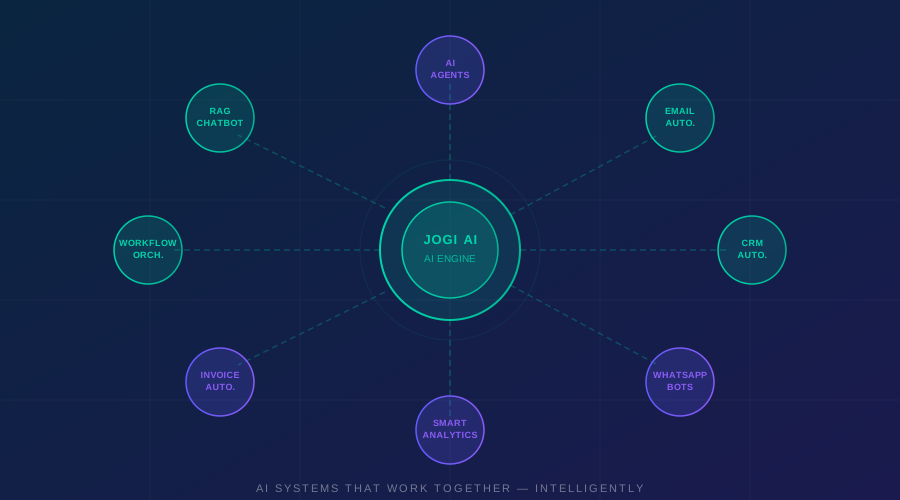
The AI systems we build for clients combine five core capabilities — and it is the combination, not any individual piece, that creates transformative business impact.
The Five Pillars of an AI-Powered Business
1. Intelligent Workflow Automation
Workflows that previously required human coordination — routing, approval, escalation, follow-up — now run autonomously. When a new lead submits an enquiry form, the AI qualifies it, assigns it to the right team member, sends a personalised acknowledgement, schedules a follow-up, and updates your CRM — all before a human even knows the lead arrived. The same logic applies to onboarding, support ticket handling, and order fulfilment.
2. AI Agents for Complex, Multi-Step Tasks
Unlike simple automation that executes a fixed sequence of steps, AI agents can reason, plan, and adapt. Give an AI agent the goal of "prepare a competitive analysis for next week's board meeting" and it will search multiple data sources, synthesise findings, identify strategic implications, and produce a formatted report — autonomously. These agents are now accessible to SMEs, not just enterprise research teams.
3. RAG-Powered Chatbots That Actually Know Your Business
Retrieval-Augmented Generation (RAG) is the technology that makes AI chatbots genuinely useful rather than generically frustrating. A RAG-based chatbot does not just respond with pre-written scripts — it retrieves real-time information from your actual knowledge base, product catalogue, policy documents, and CRM to give precise, contextually accurate answers. For customer support, this means resolving 60–70% of queries instantly, without human intervention, at any hour.
4. CRM and Sales Automation
Your CRM is only as valuable as the data inside it — and most CRMs are full of stale records, missed follow-ups, and uncaptured interactions. AI-powered CRM automation keeps every record current, scores leads automatically based on behaviour, triggers personalised nurture sequences at exactly the right moment, and surfaces high-priority opportunities before your sales team even knows to look. Sales leaders stop chasing their team to update records. They start seeing a CRM that updates itself.
5. Intelligent Analytics and Decision Support
Raw data in a dashboard is not insight. Insight is understanding which customer segments are trending toward churn before they leave. Insight is knowing that your Tuesday morning response time is driving negative reviews. Insight is a weekly AI-generated briefing that surfaces the three operational improvements with the highest projected revenue impact — delivered automatically, every Monday, without anyone having to pull a report.
Real-World AI Systems in Action: Three Mini Case Studies
Problem: Support team drowning in repetitive client queries
The firm's client success team spent 60% of their time answering the same 40 questions — project status, invoice queries, report timelines, process explanations. Each query required checking three different systems and composing a personalised response. The AI system built for them deployed a RAG-powered client portal chatbot trained on project data, billing records, and process documentation. Within 30 days, 68% of client queries were resolved without human involvement. The client success team redirected that time toward proactive account management — and client retention improved by 22% in the following quarter.
Problem: Order management and customer communication eating operations alive
Order confirmation, shipping notifications, delivery follow-ups, return processing, and review requests — each touchpoint was handled manually by a team of three. The AI system automated the entire post-purchase journey via WhatsApp and email, personalised to each customer's order and history. Abandoned cart sequences recovered an additional 24% of lost sales. Returns dropped 18% after AI-powered pre-purchase product guidance reduced mismatched expectations. The operations team of three now manages 3x the order volume they did previously — without any additional headcount.
Problem: Invoicing delays and payment chasing consuming founder time
The founder personally spent 6–8 hours per week generating invoices, sending them, following up on late payments, and reconciling accounts. An AI-powered invoice automation system now generates invoices automatically based on order completion data, sends them via the client's preferred channel, and runs a multi-step payment reminder sequence — escalating tone and channel (email → WhatsApp → phone call flag) based on days overdue. Average payment collection time dropped from 34 days to 18 days. The founder reclaimed a full working day every week.
Key Takeaway
In each case, the AI system did not replace the business — it replaced the manual overhead that was preventing the business from growing. The humans involved shifted from task execution to relationship building, strategic thinking, and high-value client work. This is the real promise of AI systems: not headcount reduction, but capability multiplication.
Your 90-Day Implementation Roadmap
The businesses that fail with AI do so because they try to transform everything at once. The businesses that succeed start focused, prove ROI quickly, and expand from a position of demonstrated success. Here is the phased approach we use at Jogi AI:
AI Audit and Quick Wins
Map your highest-volume, most repetitive workflows. Identify the three processes where manual handling is costing the most time or creating the most customer friction. Deploy fast, high-impact automations in these areas — typically customer acknowledgement sequences, internal routing, and data capture. The goal is to demonstrate measurable time savings within the first 30 days, build internal confidence, and surface the data needed to prioritise Phase 2.
Core Automation Layer
Deploy the primary AI systems that touch the largest portions of your operation: CRM automation, customer communication sequences, invoice and billing automation, and your RAG-based support chatbot. Integrate these systems so data flows between them — your CRM updates when a chatbot interaction occurs; your invoicing triggers when a project milestone is marked complete. This is where fragmented tools become a unified operating system.
AI Agents and Intelligence Layer
Introduce AI agents for your highest-complexity workflows: sales prospecting, competitive intelligence, content generation, and financial reconciliation. Deploy intelligent analytics that deliver automated insights rather than passive dashboards. By week 12, you have a business that generates data, acts on that data, and improves continuously — without manual intervention at each step.
The Early Adopter Advantage Is Real — And It Is Closing Fast
There is a narrow window in any technology cycle where early adopters gain compounding advantages that late adopters cannot easily close. We are inside that window for AI systems right now. The businesses deploying these capabilities in 2026 are not just saving time on individual tasks — they are building operational infrastructure that compounds month over month.
Consider what this means in practice. A business that deploys an AI-powered sales system in March 2026 accumulates eight months of customer interaction data, system optimisation, and refined targeting before their competitor even starts evaluating the same technology in November. By the time a late adopter launches a comparable system, the early mover has a trained, optimised, battle-tested AI layer that delivers results the newcomer will take another six months to approach.
This is not the same as first-mover advantage in social media or e-commerce. Those advantages faded because the underlying technology was accessible to anyone. AI systems built on deep integration with your specific business data, processes, and customer relationships create advantages that are genuinely hard to replicate — because they are built on proprietary operational knowledge that only you possess.
"The question is not whether your industry will be transformed by AI. Every credible indicator says it will. The question is whether you will be one of the businesses that shapes that transformation in your market — or one that responds to it after others have already moved." — Jogi AI Strategic Advisory
What Makes Jogi AI Different from Off-the-Shelf Solutions
There is no shortage of SaaS tools that promise AI automation. Most of them deliver point solutions — a chatbot here, a workflow trigger there. What distinguishes a strategic AI partner from a tool provider is the difference between a collection of instruments and a functioning orchestra.
At Jogi AI, every engagement begins with understanding your business — your revenue model, your customer journey, your operational constraints, your team's actual workflow. We do not sell you a template and wish you luck. We build interconnected AI systems designed around your specific commercial objectives, deploy them with your team's input, and optimise them based on real performance data.
We have automated workflows for over 200 businesses across professional services, retail, healthcare, logistics, and manufacturing. That breadth of implementation experience means we bring proven patterns to every new engagement — and we know exactly which approaches produce fast, measurable ROI and which create technical debt that costs more than it saves.
We are not here to sell you AI. We are here to build the AI infrastructure that makes your business materially better — faster to serve customers, cheaper to operate, and more valuable to own.
Your Action Items
- Identify your top three highest-volume, most repetitive workflows — these are your first automation candidates.
- Calculate the fully-loaded time cost of those workflows per week (hours × average hourly cost of the person doing the work).
- Ask honestly: are your smartest people spending meaningful time on tasks that do not require their intelligence?
- Set a 90-day target: which specific, measurable outcome would prove to you that an AI system is delivering real value?
- Book a free AI audit — bring your answers to the above questions, and we will show you exactly what a phased AI implementation would look like for your business.
The businesses that thrive in the next decade will not be the ones that worked harder. They will be the ones that built smarter systems. The technology exists. The implementation expertise exists. The only question is whether you are ready to use it.
Your competitors are asking the same question. The only difference is when each of you answers it.