How AI Chatbots Are Transforming Hotel Booking and Guest Support




A guest messages your hotel at 11 PM asking about room availability for the long weekend. Nobody is at the front desk. The message goes unanswered. By morning, they have booked somewhere else.
This happens dozens of times every week at properties that still rely on manual responses. The lost revenue is invisible — you never see the booking that did not happen. But it is very real.
AI chatbots for hotels solve this problem completely. They respond in seconds, handle reservations end-to-end, answer guest questions in multiple languages, and work around the clock — without adding headcount. In 2026, they are no longer a luxury for large hotel chains. They are a straightforward business decision for any property that wants to stop losing bookings.
This guide explains exactly how hotel chatbot automation works, what it can handle, and how your property can implement it without technical complexity.
Key Takeaway
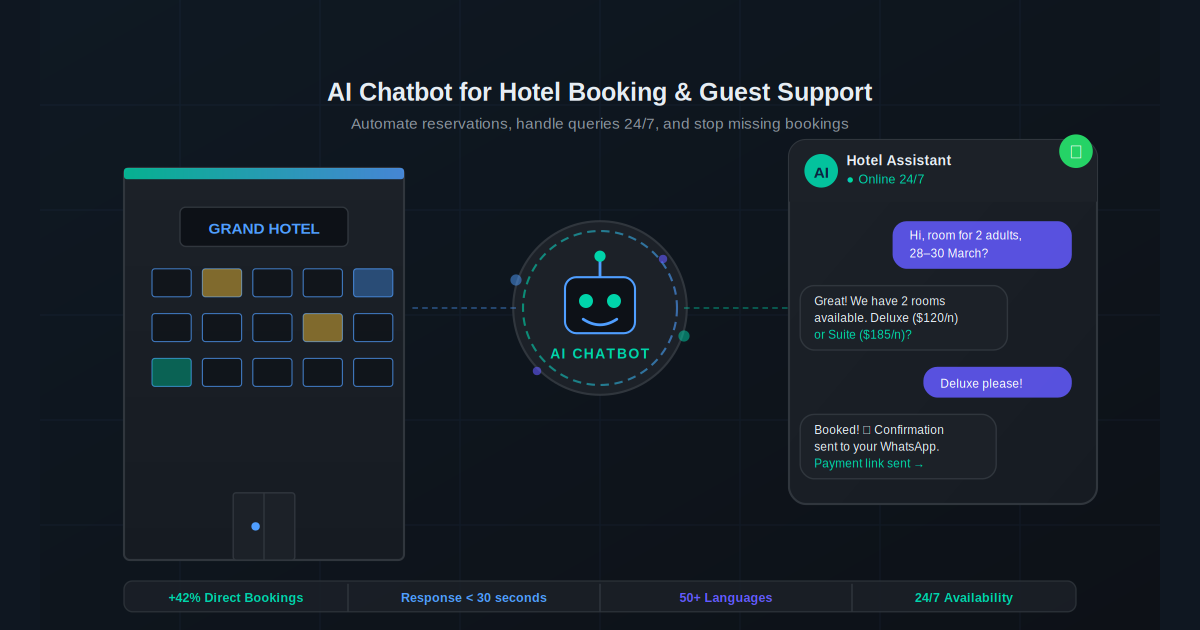
Hotels using AI chatbots report a 35–50% increase in direct bookings, a 60% reduction in repetitive guest queries handled by staff, and average response times dropping from 4 hours to under 30 seconds — all without hiring additional team members.
The Real Cost of Traditional Hotel Booking Challenges
Most hotel owners understand their operational pain points intuitively. But putting numbers to them makes the case for automation undeniable.
Missed Enquiries = Direct Revenue Loss
Research consistently shows that 60–70% of hotel bookings are abandoned when a guest does not receive a prompt response to their initial enquiry. If your front desk handles 50 booking enquiries per week and misses even 15 of them — through after-hours messages, busy phone lines, or delayed email replies — that is 780 missed bookings per year.
At an average room rate of ₹4,000–₹8,000 per night, the math is painful.
Staff Time Spent on Repetitive Questions
A typical hotel front desk team spends 3–4 hours every day answering the same questions: check-in time, check-out time, breakfast included or not, parking availability, directions to the property, cancellation policy. These are valuable staff hours that could be spent on actual guest service.
Language Barriers With International Guests
For hotels in tourist destinations, international guests often struggle to communicate their needs clearly. A guest asking about room types in broken English may not get the information they need, and may choose a competitor whose booking process felt less frustrating. A multilingual AI chatbot eliminates this friction entirely.
What Is an AI Chatbot for Hotels?
An AI chatbot for hotels is an automated conversational system that handles guest enquiries, room reservations, check-in instructions, and support requests — on your website, WhatsApp, or both — 24 hours a day, without staff involvement. It understands natural language, responds in seconds, supports multiple languages, and can process bookings end-to-end.
Unlike a basic FAQ bot that matches keywords to pre-written answers, a modern hotel AI chatbot understands context, handles multi-turn conversations (where the guest asks follow-up questions), and connects to your booking system to check live availability and confirm reservations.
Types of Hotel Chatbots
| Type | Where It Runs | Best For |
|---|---|---|
| Website chatbot | Embedded on hotel website | Direct booking capture, FAQs, room queries |
| WhatsApp chatbot | WhatsApp Business API | Conversational bookings, pre-arrival support |
| AI voice agent | Phone line / IVR | Handling inbound calls, reservation changes |
| Instagram / Facebook bot | Social media DMs | Enquiries from social campaigns |
Most hotels start with a website chatbot and WhatsApp chatbot, as these two channels cover the vast majority of guest enquiries.
How AI Chatbots Handle Hotel Reservations
The reservation flow is where chatbot automation delivers the most immediate and measurable return. Here is exactly how it works from the guest's perspective.
A guest lands on your hotel website at 10:30 PM. They see a chat widget in the corner. They type: "Do you have a room available for 2 people, 22 to 25 March?"
The chatbot immediately:
- Recognises the dates and guest count from the natural language message
- Queries your booking system for available room types in that window
- Presents 2–3 options with names, descriptions, inclusions, and prices
- Asks the guest to select a room type
- Collects name, email, and phone number
- Asks about any special requests (early check-in, dietary requirements, etc.)
- Confirms the booking and sends a confirmation via email and WhatsApp
- Adds the reservation directly to your property management system
- Sends a payment link if advance payment is required
The entire process takes 3–5 minutes. No staff involvement required. The booking is in your system by the time your team arrives the next morning.
"Before the chatbot, our front desk manager would come in each morning and check overnight emails and WhatsApp messages — sometimes finding 8–10 missed enquiries that had already booked elsewhere. Three months after implementing AI automation, our direct bookings increased by 42% and those morning missed-enquiry sessions simply stopped happening." — Operations Manager, boutique hotel, Goa
24/7 Guest Support Automation
Beyond reservations, the majority of guest interactions are support queries. Guests want information fast, and they want it on the channel they are already using — usually WhatsApp.
What the Chatbot Handles Automatically
- Check-in / check-out times: Instant answer, every time
- Directions and parking: Sends a map link and parking instructions
- Amenities enquiries: Pool hours, gym availability, spa bookings, restaurant menu
- Cancellation and modification requests: Processes within policy rules automatically
- Room service requests: Relays to the relevant department in real time
- Complaint intake: Logs the issue and escalates to staff with urgency flagging
- Late check-out requests: Checks availability and confirms or offers alternatives
- Pre-arrival information: Automatically sent 24 hours before check-in
Smart Escalation to Human Staff
A well-configured hotel chatbot does not try to handle everything itself. When a guest has a genuinely complex request, an emergency, or expresses dissatisfaction, the bot immediately escalates to a live team member — passing the full conversation history so the staff member has complete context without asking the guest to repeat themselves.
This means your team focuses on moments that genuinely require human attention, rather than fielding repetitive questions all day.
WhatsApp & Website Chatbot Integration
WhatsApp is where the majority of hotel guests — especially in India, Southeast Asia, the Middle East, and Europe — prefer to communicate. A WhatsApp chatbot for hotels connects to your official WhatsApp Business number and handles the full booking and support workflow inside the app the guest already has on their phone.
Key WhatsApp Use Cases for Hotels
- Booking via WhatsApp: Guest sends a message → chatbot qualifies dates and preferences → confirms booking → sends payment link — all within WhatsApp
- Pre-arrival sequence: Automated messages sent 48 hours and 24 hours before check-in with directions, check-in instructions, and upgrade offers
- In-stay support: Guest messages from their room requesting housekeeping, towels, or room service — routed to staff instantly
- Post-stay review request: Automated message sent 2 hours after check-out with a Google Review link and feedback form
- Re-engagement campaigns: Guests who stayed 60+ days ago receive a personalized offer to return
Website Chatbot Integration
On your hotel website, a chatbot widget sits on every page — including room listing pages, the booking page, and the contact page. It intercepts guests who are browsing but have not committed to booking, answering last-minute questions and guiding them to confirm.
Tools like Make.com connect the chatbot to your booking system (Booking.com extranet, Google Hotel Ads, or a direct PMS like Cloudbeds or Little Hotelier) so availability checks happen in real time without manual updates.
Multilingual Chatbot for Global Guests
International hotels and resorts serve guests from dozens of countries in a single season. A chatbot that only communicates in English is leaving a significant portion of those guests underserved.
Modern AI hotel chatbots detect the guest's language from their first message and respond in kind — automatically. No configuration required per guest. No language selection menus.
Languages Supported
Leading hotel AI systems support 50+ languages including English, Hindi, Arabic, Spanish, French, German, Russian, Japanese, Mandarin Chinese, Korean, Portuguese, and Italian. For international resorts and heritage hotels targeting global tourists, this capability directly translates to higher booking conversion from non-English-speaking markets.
Key Takeaway
Hotels in tourist destinations that deploy multilingual chatbots see an average 18% increase in international direct bookings within the first 90 days, as guests from non-English-speaking markets no longer drop off due to communication friction.
Chatbot Workflow Example: End-to-End Booking Flow
Here is a complete real-world automation flow for a hotel booking via WhatsApp, powered by AI:
Guest messages on WhatsApp: "Hi, I'd like to book a room for 2 adults, 28–30 March."
Chatbot responds instantly: Greets the guest, confirms dates, and asks for room type preference (Deluxe, Suite, Sea View, etc.).
Availability check: Bot queries the live PMS or booking system and returns available options with prices and inclusions.
Guest selects a room: Bot confirms selection and collects guest name, email address, and any special requests.
Booking confirmation: Bot creates the reservation in the PMS, sends a confirmation message on WhatsApp with booking reference, and sends an email confirmation.
Payment link sent: If advance deposit is required, bot sends a secure payment link. On payment completion, the reservation is marked as confirmed.
Pre-arrival sequence triggered: 48 hours before check-in, bot sends directions, parking info, and check-in time. 24 hours before, it sends a reminder with the booking reference and any upgrade offers.
Post-stay follow-up: 2 hours after check-out, the bot sends a thank-you message with a Google Review link and a return-stay discount for the next booking.
Zero staff involvement at any stage. The entire journey — from first message to review request — runs on autopilot.
Benefits of Hotel Chatbot Automation
Increase Direct Bookings
- Capture enquiries that arrive outside business hours (30–40% of all hotel enquiries)
- Convert browsers to bookers with instant answers to last-minute questions
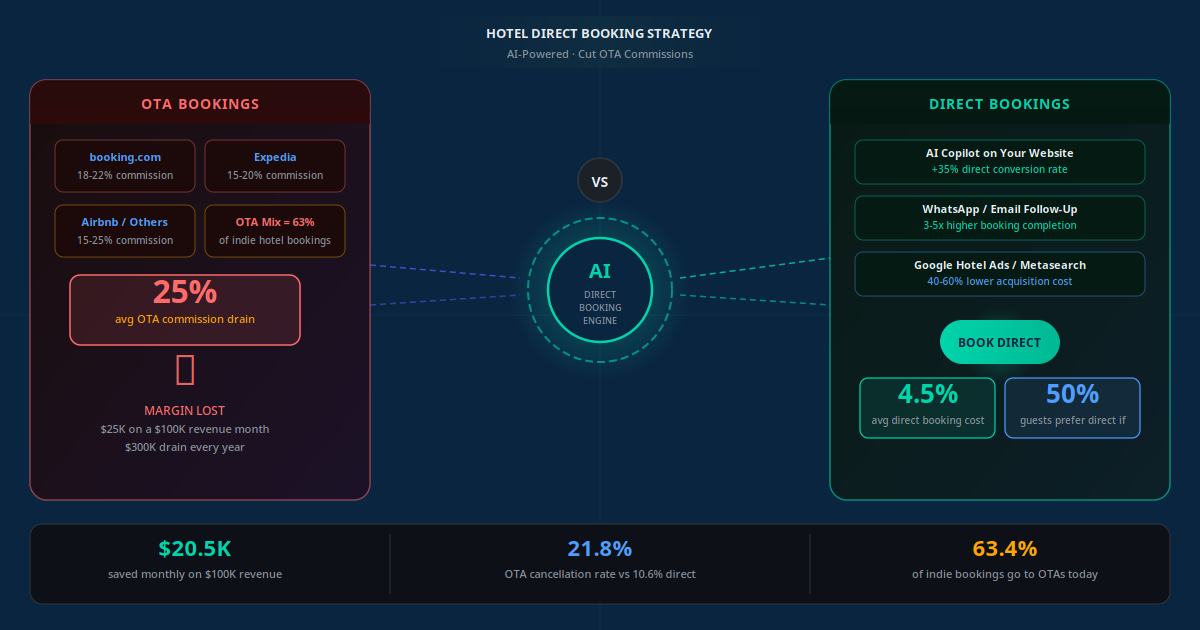
- Reduce dependency on OTA platforms (Booking.com, Expedia) and their 15–25% commission fees
- Upsell room upgrades, early check-in, and breakfast during the booking conversation
Reduce Operational Costs
- Free front desk staff from 3–4 hours of daily repetitive query handling
- Eliminate missed-booking costs from after-hours gaps
- Reduce call centre costs by deflecting routine calls to the chatbot
- Automate pre-arrival and post-stay communication that would otherwise require manual effort
Improve Guest Experience
- Guests receive responses in seconds rather than hours
- Communication happens on their preferred channel (WhatsApp, website, social)
- Multilingual support removes friction for international guests
- Automated pre-arrival information reduces check-in confusion and wait times
- Personalised return-stay offers make guests feel valued rather than forgotten
How to Implement a Chatbot in Your Hotel
You do not need a technical team or months of development time. Here is a practical roadmap any hotel can follow.
Step 1: Define Your Chatbot's Scope
Start by listing the top 20 questions your front desk answers every day. These become the chatbot's initial knowledge base. Add your booking flow (dates, room types, pricing, payment) and your key policies (cancellation, check-in, pets, parking).
Step 2: Choose Your Channels
For most hotels, starting with WhatsApp + website covers 80–90% of enquiries. Connect your existing WhatsApp Business number via the WhatsApp Business API. Add the website widget to your homepage and booking page.
Step 3: Connect Your Booking System
Integrate the chatbot with your property management system (PMS) or channel manager using a tool like Make.com or direct API. This enables live availability checks and automatic reservation creation without double-entry.
Step 4: Set Up Escalation Rules
Define the triggers that hand off to a human — complaints, urgent requests, VIP guests, queries the bot cannot confidently answer. Test these flows before going live.
Step 5: Configure Automated Sequences
Set up your pre-arrival messages (48h and 24h before check-in), in-stay support triggers, and post-stay review requests. These run automatically for every new booking from day one.
Step 6: Go Live and Monitor
Launch with a soft rollout — monitor conversations daily for the first two weeks to catch any gaps in the knowledge base. Refine responses based on real guest interactions. After 30 days, the chatbot typically handles 80–85% of all enquiries without any human involvement.
For hotels without an internal tech team, partnering with an AI automation specialist like Jogi AI covers the full setup — from chatbot configuration and PMS integration to WhatsApp Business API onboarding and ongoing optimisation.
You can also read our guide on AI agents vs traditional automation to understand which approach suits your property best, and our WhatsApp Business automation guide for a deeper look at the channel that drives the most hotel bookings in 2026.