AI-Powered Direct Booking: How Hotels Cut OTA Commissions




The OTA Commission Problem Is Bigger Than You Think
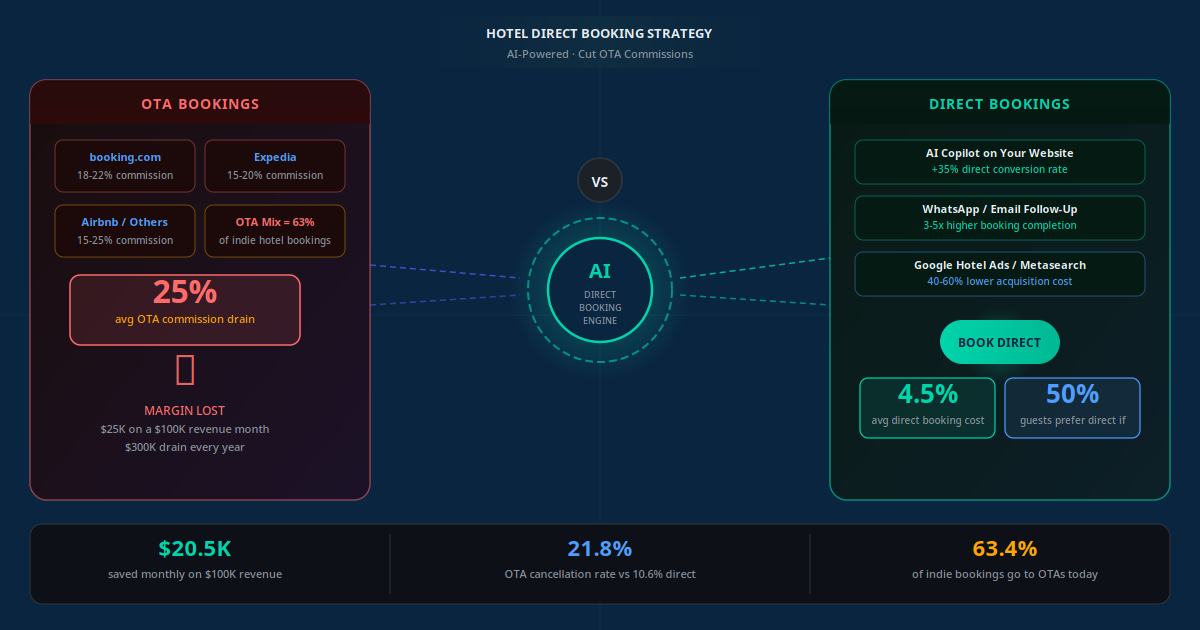
Every time a guest books your hotel through Booking.com or Expedia, you hand between 15 and 25 percent of that booking straight back to the platform. On a $200 room night, that is $30 to $50 gone before you have paid a single staff member or turned on a single light. On a $100,000 monthly revenue figure — modest for even a mid-size independent hotel — OTA commissions alone drain $15,000 to $25,000 every month. That is $180,000 to $300,000 a year flowing to platforms that own the customer relationship and, crucially, will sell your competitors to that same guest next time.
The scale of OTA dependency across independent hotels is striking. According to recent hospitality research, OTAs now account for 63.4 percent of all bookings at independent hotels. Chains can negotiate lower rates and push loyalty programme direct bookings; independents rarely can. And the problem compounds: OTA-sourced guests also cancel at nearly twice the rate of direct bookers — 21.8 percent cancellation rate versus 10.6 percent for guests who booked directly.
I work with independent hotel owners across hospitality markets, and this is consistently the number one margin leak I find when we audit their revenue stack. The fix is not to abandon OTAs — they provide real discovery value — but to shift the mix. Even moving from 70 percent OTA to 55 percent OTA while growing total occupancy is a transformative improvement to your bottom line.
Key Takeaway
OTA commissions of 15–25% on 63% of independent hotel bookings represent the single largest controllable cost in most hotel P&Ls — and AI tools now make shifting that mix genuinely achievable for properties of any size.
Why Direct Bookings Protect Your Margin
The cost comparison is stark. A direct booking — processed through your own booking engine, payment gateway, and website — costs roughly 4.5 percent all-in, versus the 15 to 25 percent OTA takes. On that same $200 room night, the difference between direct and OTA is $21 to $41 of pure margin per booking. At 100 room nights per month, shifting 30 of those from OTA to direct saves $630 to $1,230 monthly, or $7,560 to $14,760 annually — from a property that size.
Direct guests are also more valuable in ways that don't show on the commission line. They cancel less, spend more on ancillaries when they feel a direct relationship with the property, and are significantly more likely to return and leave a review. A guest who booked via Booking.com considers themselves Booking.com's customer. A guest who booked your website is yours.
Research shows that 50% of travellers will happily book directly if prices match — the barrier is not preference, it is friction and uncertainty on your own website.
This is the insight that makes the AI strategy actionable. Most guests are not loyal to OTAs out of passion. They use them because OTAs answer questions instantly, feel trustworthy, and make the booking path frictionless. Your job is to replicate that experience — or beat it — on your own channels. AI tools have made this achievable without hiring a reservations team.
| Channel | Avg. Cost to Hotel | Cancellation Rate | Guest Owns Relationship? |
|---|---|---|---|
| Booking.com / Expedia | 18–25% | 21.8% | No — OTA does |
| Airbnb / Niche OTAs | 15–20% | ~18% | No — platform does |
| Direct (website/WhatsApp) | ~4.5% | 10.6% | Yes — you do |
| Google Hotel Ads (metasearch) | 8–14% | ~12% | Yes — drives to your site |
Capture Guests Before They Reach the OTA
The fundamental dynamic you are working against is this: when a traveller searches "boutique hotel in [your city]," OTAs appear prominently in paid and organic results because they spend heavily on SEO and ads. Your property's own website often appears below them. By the time a potential guest reaches Booking.com, that platform is already going to earn its commission if a booking happens.
The interception opportunity is earlier in the funnel. Guests who find your website — through Instagram, Google My Business, a TripAdvisor profile with your URL, a recommendation from a friend — land on your site with intent. They are considering you specifically. The question is whether your site converts them or sends them to the OTA to feel more confident.
There are three interception points that matter most:
- Your Google My Business profile: Every review response, photo update, and direct booking link here is free marketing that keeps guests in your ecosystem rather than pushing them to an OTA search.
- Your website's first 10 seconds: If a visitor cannot immediately answer "can I get the dates I want?" and "is this the right fit for my trip?", they leave. Speed and clarity are conversion fundamentals.
- WhatsApp and direct messaging: Many guests — especially in markets across Asia, the Middle East, and Latin America — prefer to ask a question on WhatsApp before committing. If you are not reachable there, they find the answer on an OTA instead.
The hotel autonomous workflow stack addresses all three interception points by connecting your Google Business profile, website chat, and WhatsApp into a single AI-managed inquiry layer that responds in seconds — at any hour.
How AI Converts Website Visitors to Direct Bookings
The number one reason guests abandon a direct booking attempt and go to an OTA is uncertainty. They have a specific question — is the pool heated in April? Do you offer airport transfers? Can I get a late checkout? — and your static FAQ either does not answer it or buries it. An OTA listing has 300 reviews answering those exact questions. Your website does not.
An AI Copilot on your website changes this equation completely. It answers questions from your specific property knowledge base — room configurations, amenity details, cancellation policy, parking, F&B — instantly, at any hour, in the guest's own phrasing. Properties using AI conversational tools see a 35% relative increase in direct booking conversion rates compared to a static website. Here is how AI-powered direct booking looks in practice across four scenarios:
Boutique City Hotel: The "Is This Right For Me?" Visitor
A couple searches for a romantic hotel for an anniversary stay. They land on your site at 11 PM. They have questions about room types, included breakfast, and whether you can arrange a cake. Your AI Copilot answers all three in under 30 seconds, upsells the Deluxe Suite with the view, and guides them to the booking engine. Without the AI, they would have opened Booking.com to read guest reviews — and booked there.
Resort Property: The Abandoned Booking Recovery
A guest started a booking on your website, reached the payment screen, then dropped off. Your WhatsApp automation fires a personalised follow-up 45 minutes later: "Still interested in your stay from 18–21 July? I noticed you didn't complete the booking — any questions I can answer?" Three out of ten abandoned bookings at one Goa resort are recovered this way, with an average booking value of ₹18,000.
Heritage Property: The Price-Match Question
A guest asks your AI Copilot: "I see you on Booking.com for £180 but your website shows £185. Can you match?" Your AI is trained to respond with the direct booking value offer — complimentary breakfast included only for direct bookings, flexible cancellation policy, and the assurance of booking directly with the property. The guest books direct at £185 because the value is clearly higher. No commission lost.
Business Hotel: The Repeat Corporate Guest
A guest who stayed six months ago emails to ask about availability for an upcoming conference. Your email automation workflow recognises the prior guest, sends a personalised reply with a direct booking link and a returning-guest rate, and routes the inquiry to a human if it becomes complex. The guest books direct without the reservation ever touching an OTA.
The Automated Follow-Up Engine
Most hotels treat a guest's first inquiry as one chance to convert. If the guest does not book immediately, the hotel's follow-up is either a generic automated email or silence. OTAs, by contrast, have sophisticated retargeting: a guest who viewed your listing on Booking.com gets remarketed to for days across Google, Instagram, and email.
Your direct booking follow-up engine needs to match that persistence — but with the warmth and personalisation that OTAs structurally cannot offer. In our implementations with hotel clients, a three-touch automated follow-up sequence consistently outperforms one-time follow-up by 60 to 80 percent on conversion.
The sequence looks like this for a guest who inquired but did not book:
- Touch 1 (within 1 hour): WhatsApp or email with a direct booking link, key property highlights, and an open question — "Any questions about your stay I can help with?"
- Touch 2 (48 hours later): A personalised follow-up referencing the specific dates they asked about: "Hi [Name], just checking — the dates you mentioned (15–18 Aug) still have availability. Shall I hold a room for you?" This works because it feels like a person remembered them, not a system.
- Touch 3 (7 days later): A soft close with a direct-booking incentive: complimentary early check-in, a room upgrade subject to availability, or a dining credit. Frame it as exclusive to direct guests — which it genuinely is.
WhatsApp booking conversations complete at 3 to 5 times the rate of email for hotel inquiries in markets where WhatsApp is the primary communication channel. If your follow-up is email-only, you are leaving significant conversion on the table. The AI-powered messaging layer handles both channels from a single workflow.
Personalised Offers and Loyalty Nudges
The most reliable source of direct bookings is a past guest. Someone who has stayed with you, had a positive experience, and remembers your property is far more likely to book direct on their next visit — if you stay in front of them with relevant, personalised communication.
Most hotels let past guests go cold. The OTA owns the email address from the first booking; the hotel may not even have it. Building your own direct guest database is foundational to a long-term direct booking strategy. Every direct booking, every check-in, and every in-stay interaction is an opportunity to capture contact details and consent for future communication.
"The hotel that owns the guest relationship owns the repeat booking. OTAs can discover a guest for you — but every guest who leaves without opting in to your own communication is one you will pay commission for again next time."
— Chirag Jogi, Jogi AIOnce you have that database, personalised offer automation runs on its own. The autonomous workflow can trigger:
- Anniversary stays: A message sent 11 months after a guest's last visit — "It's almost a year since you stayed with us for your anniversary — ready to make it a tradition?"
- Seasonal offers: Guests who stayed during summer receive an early-access winter rate offer three weeks before public release.
- Lapsed-guest win-back: Guests who have not returned in 18 months receive a tailored offer acknowledging the gap and providing a tangible reason to rebook direct.
- Upsell sequences pre-arrival: Every confirmed direct booking triggers a pre-arrival message three days out offering room upgrades, dining reservations, and experience add-ons — generating ancillary revenue that an OTA booking would never have surfaced.
These sequences cost almost nothing to run once set up. They require no staff to execute. And because they reference real stay history, they feel personal in a way that mass-market OTA remarketing structurally cannot.
Connecting to Metasearch: Google Hotel Ads Basics
Google Hotel Ads (now part of Google's Travel Search) is the most underleveraged direct booking channel for independent hotels. When a guest searches your hotel by name — or searches for hotels in your area — Google surfaces a price comparison widget showing rates across Booking.com, Expedia, and direct. If your direct rate is visible there and competitive, you intercept the guest before they ever click through to an OTA.
The economics are compelling. Google Hotel Ads delivers direct bookings at 40 to 60 percent lower acquisition cost than equivalent OTA commission spend when properly optimised. The key requirements are:
- Rate parity: Your direct rate must match or beat OTA rates. If Booking.com shows £160 and your direct rate shows £175, guests will book via Booking.com every time.
- Connected booking engine: Your booking engine must integrate with a Google Hotel Ads feed provider (most modern booking engines support this natively — Cloudbeds, Mews, SiteMinder all do).
- Bidding strategy: Start with Commission-Per-Acquisition (CPA) bidding — you only pay when a direct booking completes. Once you have data, consider Cost-Per-Click (CPC) for higher volume but requires active management.
For independent hotels, I recommend claiming Google Hotel Ads before any paid social or display spend. It targets guests who are already searching for you or your category — intent is as high as it gets. A small property spending £300/month on Google Hotel Ads will consistently outperform a £300/month Facebook campaign for direct booking ROI.
The hotel chatbot integration matters here too: a guest who clicks your direct price in Google Hotel Ads and lands on your website still needs to convert. If your booking engine is slow or your website cannot answer their last-minute questions, that click goes to waste. The AI Copilot on your site is the conversion layer that makes your metasearch spend pay off.
Building Your Direct Booking Stack Step by Step
The full direct booking stack does not need to be built in one sprint. The sequencing below is what I use when working with hotel clients — each phase builds on the last, and the return from Phase 1 typically funds the rest.
Audit your current channel mix. Pull the last 90 days of booking data by source. Quantify exactly how much OTA commission you paid and identify your direct booking percentage. This number becomes your baseline and your business case.
Establish rate parity across channels. Check your rates on all major OTAs against your direct booking engine. Any channel showing a lower rate than your website will siphon direct traffic. Fix this before investing in any direct booking tools.
Deploy an AI Copilot on your website. Connect it to your property knowledge base — room types, amenities, policies, FAQs, dining options. The goal is to answer any guest question instantly and guide them to your booking engine. Start here: this is your highest-ROI single action.
Activate WhatsApp as a direct booking channel. Set up a WhatsApp Business automated workflow that handles inquiries, sends direct booking links, and runs the three-touch follow-up sequence for guests who don't immediately convert. This is particularly high-impact for Asian, Middle Eastern, and Latin American guests.
Build your direct guest database. Add a lightweight opt-in to your booking confirmation process, check-in flow, and post-stay review request. Even capturing 30% of guests into your own CRM creates a compounding asset over time.
Connect Google Hotel Ads. Verify your Google Business Profile, connect your booking engine to a Hotel Ads feed, and start with CPA bidding. Budget £200–£500/month to start and review performance after 60 days.
The typical timeline is: Phase 1 (steps 1–3) in week one, Phase 2 (steps 4–5) by end of month one, Phase 3 (step 6) by month two. Most hotels see measurable direct booking increases within 60 to 90 days of completing all six steps. The CRM automation layer and lead follow-up sequences are the engine room that makes this sustainable at scale.
| Direct Booking Tool | Typical Setup Time | Est. Monthly Cost | Expected Impact |
|---|---|---|---|
| AI Copilot (website chat) | 1–3 days | $50–$150 | +35% conversion rate |
| WhatsApp follow-up automation | 2–5 days | $30–$80 | +3–5x completion rate |
| Google Hotel Ads | 3–7 days | $200–$500 ad spend | 40–60% lower CPA vs OTA |
| Email re-engagement sequences | 2–4 days | $20–$60 | +15–25% repeat bookings |
| Abandoned booking recovery | 1–2 days | Included in WhatsApp | +30% recovery rate |
Making the Shift Stick
The OTA commission problem is not going to solve itself. As long as your property has no direct booking infrastructure — no AI Copilot to answer questions, no WhatsApp follow-up, no abandoned booking recovery, no Google Hotel Ads presence — guests will default to the path of least resistance, which is an OTA. That 63 percent OTA dependency figure across independent hotels is not a reflection of guest preference. It is a reflection of how much easier OTAs have made the booking process compared to most hotel websites.
The good news is that the gap is closable. The tools that make OTA platforms compelling — instant answers, frictionless booking, automated follow-up — are now available to independent hotels at a fraction of what the OTA commission costs in a single month. A $300 monthly investment in AI Copilot and WhatsApp automation can realistically recover $2,000 to $5,000 in monthly commission savings for a hotel doing $80,000 to $120,000 in monthly revenue.
The strategy does not require abandoning OTAs or fighting their SEO dominance. It requires capturing the guests who already found you and are ready to book directly — and giving them a reason, a path, and an experience that makes the direct channel their obvious choice. Use the AI Business Twin to map exactly where your current booking funnel leaks and what your direct booking opportunity looks like in concrete monthly numbers.
Frequently Asked Questions
How much commission do OTAs charge hotels?
OTA commissions typically range from 15 to 25 percent of the booking value. Booking.com generally charges 18 to 22 percent, while Expedia runs at 15 to 20 percent. When hotels opt into visibility-boosting promotional programmes on these platforms, the effective rate can reach 25 to 30 percent. Direct bookings, by contrast, cost hotels roughly 4.5 percent once you factor in payment processing and any booking engine subscription fees.
What is the best way for a small hotel to get more direct bookings?
The highest-ROI moves for smaller properties are: deploying an AI Copilot on your website that answers questions and guides visitors to book directly, running automated WhatsApp or email follow-up sequences for guests who started but did not complete a booking, maintaining rate parity so your direct price matches OTA pricing, and claiming your Google Hotel Ads listing so you appear in metasearch results. These four steps together can shift a meaningful share of bookings to your direct channel within 60 to 90 days.
Why do guests book through OTAs even when direct rates are the same?
The main reason is uncertainty. Guests use OTAs because they feel confident in the reviews, the familiar interface, and the perceived safety of the platform. When a guest visits your hotel website and has an unanswered question — about room types, breakfast, cancellation policy, parking — and cannot get an immediate answer, they leave and book via an OTA instead. An AI Copilot on your website eliminates that uncertainty gap by answering questions instantly, which research shows increases direct conversion rates by around 35 percent relative to a static website.
Does Google Hotel Ads actually work for independent hotels?
Yes, and it is often the most cost-efficient paid channel available to independent hotels. When set up correctly, Google Hotel Ads delivers direct bookings at 40 to 60 percent lower acquisition cost than comparable OTA commission spend. The key is maintaining rate parity so your direct price matches what OTAs display — otherwise guests will click through to your booking page and then go back to the OTA. Hotels typically see an 8:1 return on ad spend when targeting the right rate strategy.
What is rate parity and why does it matter for direct bookings?
Rate parity means your direct booking rate is the same as or lower than the rate displayed on OTAs. It matters because 50 percent of travellers will happily book directly if prices match, according to industry research. If your hotel website shows a higher price than Booking.com, guests will go to the OTA every time. Many OTA contracts actually require parity as a condition of listing, but you can typically offer direct-only perks — free breakfast, early check-in, or loyalty points — to make the direct offer more compelling without technically undercutting the OTA rate.
How long does it take to see results from a direct booking AI strategy?
Most hotels see measurable shifts within 60 to 90 days of deploying an AI Copilot and automated follow-up sequences. Quick wins like abandoned booking recovery and WhatsApp follow-up typically generate results within the first two to three weeks. A meaningful shift in the OTA-to-direct booking mix — moving from 25 percent direct to 35 to 40 percent direct — generally takes three to six months as the system learns guest intent patterns and your Google Hotel Ads campaigns optimise.