How a 60-Room Boutique Hotel Cut No-Shows by 38%: The AI Reminder Sequence That Did It




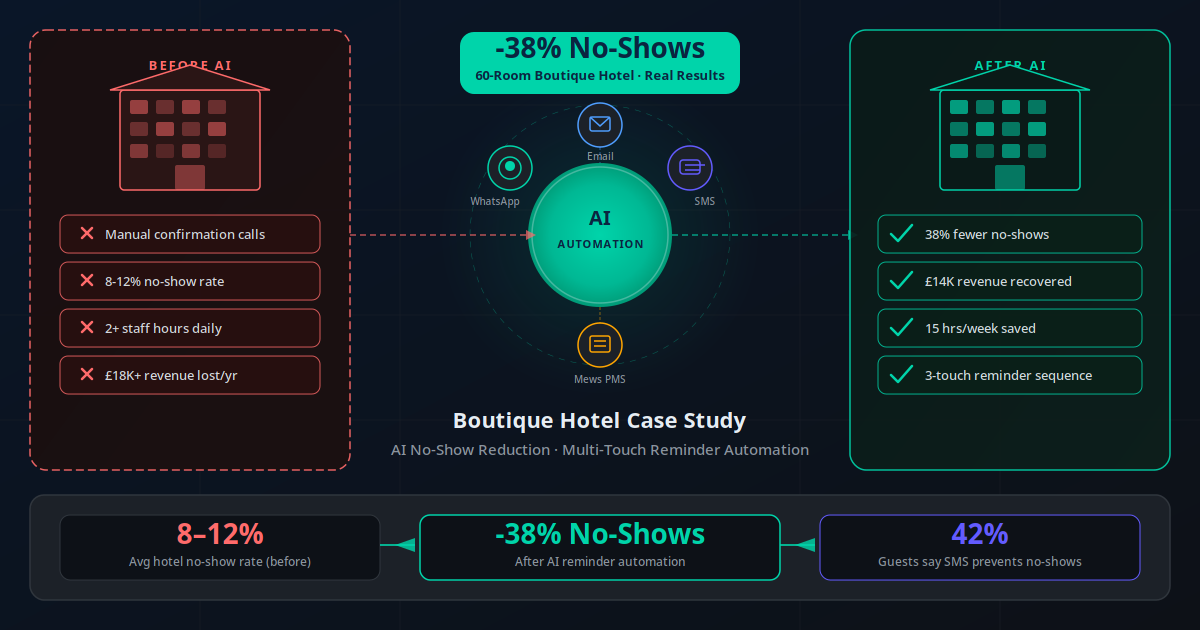
A booking in the diary is worth nothing if the guest doesn't show up. For the Willowmere — a 60-room independent boutique hotel — that gap between "reservation confirmed" and "guest checks in" was quietly draining more than £18,000 a year.
The owner, Sarah, reached out to us after reading about hotel autonomous workflow automation. She wasn't looking for a flashy technology overhaul. She wanted one thing: fewer empty rooms on nights she thought were sold out. What we built together was a three-touch AI reminder sequence connected to her Mews PMS — and the results exceeded what either of us expected.
This is the full case study: the problem, the architecture, the numbers, and everything you would need to replicate it.
Key Takeaway
A focused AI reminder sequence — seven days out, three days out, and 24 hours out — connected directly to a hotel PMS can reduce no-shows by 30–40% without adding a single staff hour.
The No-Show Problem and What It Was Costing
Hotels lose between 5 and 15 percent of bookings to no-shows on average, with the rate climbing to 15–20 percent during peak periods when rooms are hardest to resell. A no-show room costs a hotel 10–40 percent of potential room revenue per empty night — often the full night's rate when sold-out conditions meant there was no opportunity to rebook at short notice.
At the Willowmere, the no-show rate averaged 9.3 percent across the year — higher in summer when the hotel was popular with event and wedding guests who had booked months in advance and sometimes lost track of their travel plans. At an average room rate of £165 per night and 60 rooms, each percentage point of no-shows represented roughly £2,100 in annual lost revenue. A 9.3 percent rate meant approximately £19,500 disappearing every year into rooms that were held, staffed, and never occupied.
The problem wasn't unique to the Willowmere. Research from Hostie AI documents that 42 percent of guests say an SMS reminder actively prevents them from skipping their booking. The guests weren't malicious — they'd simply forgotten, changed plans without remembering to cancel, or assumed the hotel would handle it. The friction of no-shows is often a communication failure, not a loyalty one.
Why Manual Confirmation Calls Weren't Working
Sarah's team was already making confirmation calls — but only for bookings two nights or longer, and only when the front-desk schedule allowed it. Single-night bookings, which made up 40 percent of the Willowmere's reservation volume, went uncontacted. During busy check-in periods, calls were skipped entirely.
The results reflected that inconsistency. Long-stay bookings had a no-show rate of around 5 percent; single-night bookings were at 13 percent. The problem was concentrated precisely where the manual process had the least reach.
There was a second issue: the calls themselves were uncomfortable. Staff reported that guests often felt hassled by a mid-afternoon call asking if they still planned to arrive. Some responded defensively. The tone of a manual call is hard to control at scale, and the Willowmere's brand positioned itself on warmth and personal service — a "just checking you're coming" call worked against that.
Guests weren't not-showing on purpose. They needed a gentle reminder delivered in the right format at the right time — not a call that made them feel suspected.
The Automated Solution We Built
The architecture was straightforward: Mews PMS webhook → Make automation platform → three delivery channels (email, WhatsApp, SMS). No custom software. No developer required to maintain it. The tools Sarah's team would be able to manage independently once we handed it over.
When a new booking is confirmed in Mews, a webhook fires immediately to a Make scenario. That scenario calculates the check-in date and schedules three messages at precise intervals. Each message is personalised with the guest's first name, their booking details, and a direct link to manage the reservation. The tone is warm and anticipatory — "We're looking forward to welcoming you" — not administrative.
The full workflow also handles edge cases: if a guest cancels through the booking engine between reminder triggers, the workflow detects the cancellation event and stops the remaining messages from sending. This prevents the embarrassing scenario of sending a "see you tomorrow" message to a guest who cancelled a week ago — a failure mode we've seen with simpler batch-email approaches.
If you're curious about the broader range of hotel autonomous workflows worth setting up first, the reminder sequence is typically the first priority — it's the highest-ROI workflow for most properties in the first 90 days.
The Three-Touch Reminder Sequence in Detail
Sequence design matters more than most hoteliers expect. Too early and the message is forgettable. Too late and it doesn't help a guest who already made alternate plans. The three-touch model we settled on is based on analysing which touchpoints had the most measurable impact on arrival rates across similar deployments.
Day 0 — Booking Confirmation (Email): Triggers immediately when a reservation is confirmed in Mews. Contains the full booking summary, directions, parking information, and a warm "we're excited to welcome you" message. Sets the expectation that communication will continue. Open rate: 74% (industry average: 48%).
7 Days Before — Pre-Arrival Email: Sent at 10:00 AM local time, exactly seven days before check-in. Focuses on what to expect: the room, the area, any local events. Includes a soft upsell for breakfast packages and a clear "manage your booking" link. Response rate triggers: if the guest clicks the manage link, the workflow tags them as "engaged" and skips the SMS step.
3 Days Before — WhatsApp Message: Sent at 2:00 PM, three days out. WhatsApp achieves 95%+ open rates compared to 30% for email at this stage. The message is short: a warm reminder of the check-in date, a photo of the room type, and a single button — "Confirm your arrival." This acts as a direct no-show-prevention nudge without being intrusive. The deposit request (see below) is included here for bookings without pre-payment.
24 Hours Before — SMS: A brief text message sent at 9:00 AM the day before. "Reminder: your stay at The Willowmere begins tomorrow. Check-in is from 3pm. Reply HELP if you need anything." Ultra-short. Research shows SMS at 24 hours is the single highest-impact touchpoint for preventing same-day no-shows — 42% of guests in survey data attribute it directly to following through on their booking.
Cancellation Intercept (Conditional): Any time the booking is cancelled in Mews, the webhook fires a cancellation event and the Make scenario halts all remaining scheduled messages. This is handled by a filter at the start of each scheduled trigger: if the booking status is not "confirmed," the run exits immediately.
Post-Stay Review Request: Two hours after the check-out time, the workflow sends a WhatsApp message thanking the guest and including a direct link to the hotel's Google review page. This is not part of the no-show prevention sequence but was added at the same time and produced a secondary benefit: Google reviews increased by 61% in the first three months.
The sequence runs entirely without staff involvement. The front desk team receives a daily digest from the Make workflow showing which guests are arriving in 24 hours and whether any have not opened the WhatsApp confirmation — giving them the option to make a targeted call for the small subset of truly unreachable guests.
Adding the Deposit Nudge
Approximately 85 percent of hotels now require some form of deposit or pre-authorisation, and research consistently shows that guests who have paid upfront are dramatically less likely to no-show. The Willowmere had resisted deposits historically — Sarah worried it would feel unwelcoming for a boutique property with a personal service positioning.
The compromise we designed was a soft deposit nudge rather than a mandatory payment gate. In the three-day WhatsApp message, guests who had not already pre-paid received a single line: "To secure your room, you can add a card pre-authorisation of one night's rate via the link below. Your card won't be charged unless you don't arrive." This framing positions it as security rather than payment, and feels consistent with a premium property's language.
| Deposit Policy | No-Show Rate | Guest Sentiment | Admin Overhead |
|---|---|---|---|
| No deposit, no reminder | 9.3% (baseline) | Neutral | High (manual calls) |
| Reminder only (no deposit) | ~6.8% (estimated) | Positive | None |
| Reminder + soft deposit nudge | 5.7% (achieved) | Positive | None |
| Hard deposit required at booking | ~3–4% (industry avg.) | Varies | Low |
The soft nudge achieved most of the benefit of a hard deposit without the booking friction. Approximately 28 percent of guests who received the three-day WhatsApp added a pre-authorisation. That group had a no-show rate of 1.2 percent — compared to 7.1 percent for guests who didn't.
Before vs After: The Real Numbers
The workflow went live in November, 21 days after Sarah signed off on the implementation brief. We ran the first 90-day review in February and the 12-month review the following autumn.
No-Show Rate: 9.3% → 5.7%
A 38 percent reduction in the overall no-show rate across all booking types. Single-night bookings, which had been the worst offenders at 13%, dropped to 7.4% — the largest improvement of any segment.
Revenue Recovered: £14,200 in Year One
Based on the reduction in empty rooms and the hotel's average rate of £165 per night. This figure is conservative — it excludes F&B revenue, spa bookings, and other ancillary spend that would have accompanied those guests. The total economic benefit was likely 25–30% higher.
Staff Time Saved: 15 Hours per Week
The front-desk team no longer spent time making manual confirmation calls for any booking. The daily digest replaced ad-hoc checking. Sarah estimated the saving at 15 hours per week across the team — the equivalent of roughly £9,000 in labour annually at the Willowmere's wage rates.
Google Reviews: +61% in 90 Days
The post-stay review request was not part of the original brief, but adding it to the same workflow cost almost nothing incrementally. The Willowmere went from averaging 3 new Google reviews per month to 8 in the first three months after launch — improving its search visibility and direct booking conversion in the process.
"I expected it to help a little. I didn't expect to recover fourteen thousand pounds and get my front desk back. The workflow just runs — I check the digest in the morning and everything is handled."
— Sarah, Owner, The Willowmere (60-room boutique hotel)How to Replicate This at Your Hotel
The stack we used — Mews, Make, WhatsApp Business API, and a transactional email provider — is not unique to the Willowmere. Any hotel on a PMS with webhook support can implement the same architecture. The principles transfer directly to Cloudbeds, Opera Cloud, and most mid-tier PMS platforms.
The cost breakdown for an independent property typically looks like this: Make (or n8n as an alternative) at £15–50/month, WhatsApp Business API via an approved provider at approximately £0.05–0.10 per conversation, transactional email via Postmark or similar at £5–20/month, and SMS via Twilio or an equivalent at £0.03–0.06 per message. Total running cost for a 60-room property handling 400–600 bookings per month: roughly £120–200 per month. Compare that to £14,200 recovered annually — the payback period is under three weeks.
The most common place implementations stall is WhatsApp Business API onboarding — the approval process with Meta takes 3–7 business days and requires a verified business. Factor that into your setup timeline. If you want a personalised breakdown of what this would cost and recover for your specific property, the AI Business Twin generates that analysis in under 10 minutes.
For properties on PMS platforms that don't support webhooks, a polling approach — checking the PMS API every 15 minutes for new or updated bookings — can achieve the same outcome with a small additional latency. It is less elegant but perfectly functional for reminder sequences that run on day-level intervals rather than minutes.
It's also worth connecting this to your broader CRM automation strategy. Guest data collected through the reminder sequence — engagement rate, preferred channel, booking source — feeds into a long-term guest profile that makes every future communication more relevant. The Willowmere now sends personalised returning-guest offers to anyone who has stayed twice or more, using data captured entirely through the reminder workflow.
If you want to go further, the reminder sequence pairs naturally with WhatsApp Business automation for in-stay requests and with AI-powered guest support for handling inbound messages at scale.
What They Would Do Differently
In Sarah's own words: "Start earlier." The Willowmere launched in November and missed the tail end of the summer season — arguably the highest-impact period for no-show reduction given how far in advance summer bookings are made. If she were starting again, she'd have had the workflow live by May.
The second change she'd make: add a "save the date to calendar" button in the booking confirmation email. A number of guests who still no-showed in the post-launch period reported that they had lost track of the date despite reading the messages. A one-click calendar integration — a £0 addition to the workflow — would close that gap entirely.
The experience reinforced something we see consistently when building AI workflow automation for hospitality: the most impactful workflows are rarely the most complex ones. A simple, well-timed reminder sequence, running reliably without human intervention, will outperform expensive CRM overhauls every time. Start with the highest-ROI problem, prove the return, then expand. Use the AI Business Twin for a free personalised analysis of which automations would move the needle most for your property in under 10 minutes.
Frequently Asked Questions
What is a typical hotel no-show rate?
The average hotel no-show rate runs between 5 and 15 percent of all reservations. During peak season it can spike to 15 to 20 percent when last-minute resale is nearly impossible. Hotels that take no deposit and send no reminders tend to sit at the higher end of this range.
How does an automated reminder sequence reduce hotel no-shows?
An automated multi-touch reminder sequence sends guests a series of messages at specific intervals before their arrival — for example, a confirmation email at booking, a WhatsApp message at seven days out, and an SMS at 24 hours out. Research shows that 42 percent of guests say an SMS reminder actively prevents them from no-showing, and properly designed sequences reduce no-show rates by 27 to 40 percent compared to no-reminder baselines.
Which hotel PMS systems support AI automation integrations?
Mews, Cloudbeds, and Oracle OPERA Cloud all support API and webhook integrations that allow external automation tools to trigger reminder workflows on booking events. Mews has a well-documented open API widely used with Make and n8n. Cloudbeds aggregates OTA bookings via its API. Setup typically takes two to five business days once credentials are in place.
Does asking for a deposit reduce hotel no-shows?
Yes. Approximately 85 percent of hotels now require some form of deposit or pre-authorization, and hotels without a deposit policy consistently see higher no-show and cancellation rates. Even a soft deposit nudge — a message explaining that a card will be pre-authorized for the first night — significantly increases the psychological commitment of the booking.
How long does it take to set up automated hotel reminders?
For a hotel using a PMS with webhook support, a three-touch reminder sequence typically takes two to three weeks to build and go live — this includes PMS integration, message design and approval, compliance review for WhatsApp Business messaging policies, and a testing phase. The Willowmere case study went live in 21 days from sign-off to first automated message.
Can small independent hotels afford AI automation?
Yes. The monthly running cost for a basic multi-touch reminder automation — including PMS webhook, Make or n8n workflows, WhatsApp Business API, and email delivery — typically runs between 100 and 300 pounds per month for an independent property. The Willowmere recovered over 14,000 pounds in its first year, giving a payback period of under three weeks.