Hotel Autonomous Workflows: The Complete Guide to Automating Every Guest Touchpoint




There is a specific kind of exhaustion that hotel front desk staff know well. By 11 AM, they have already answered "what time is check-in?" fourteen times, confirmed a booking that was emailed last Tuesday, and chased housekeeping about three rooms that checked out two hours ago. None of these tasks require human judgment. All of them consume time that should be going toward genuine guest service.
The data backs this up. 78% of hospitality leaders plan to increase AI investment in the next 12 months (Deloitte, 2025) — not because it is a trend, but because the operational math is becoming impossible to ignore. Hotels that have deployed autonomous workflows are reporting 20–30% reductions in operational costs and, more interestingly, 23% higher guest satisfaction scores compared to properties still running manual front desk operations.
I have spent the last two years building AI systems for hospitality clients — boutique hotels, hotel groups, and serviced apartments. The pattern I see repeatedly is this: the biggest gains do not come from sophisticated AI. They come from removing the 300 identical repetitive tasks that staff handle every week — the confirmations, the reminders, the "how do I get to the hotel?" WhatsApp messages at midnight, the housekeeping update calls that go unanswered. When you automate those, your team can focus on the guest in front of them rather than the inbox behind them.
This guide covers exactly how to do that — the technology, the workflows, the integration approach, the ROI numbers, and the mistakes to avoid. Whether you run a 20-room boutique property or a 200-room hotel group, the principles are the same.
The Hidden Cost of Manual Hotel Operations
Most hoteliers know their labour cost as a percentage of revenue. Fewer have broken down exactly how many hours per week go toward tasks a well-configured AI system could handle. In our implementations, we typically run a process audit before setting up any automation — and the results are consistently striking.
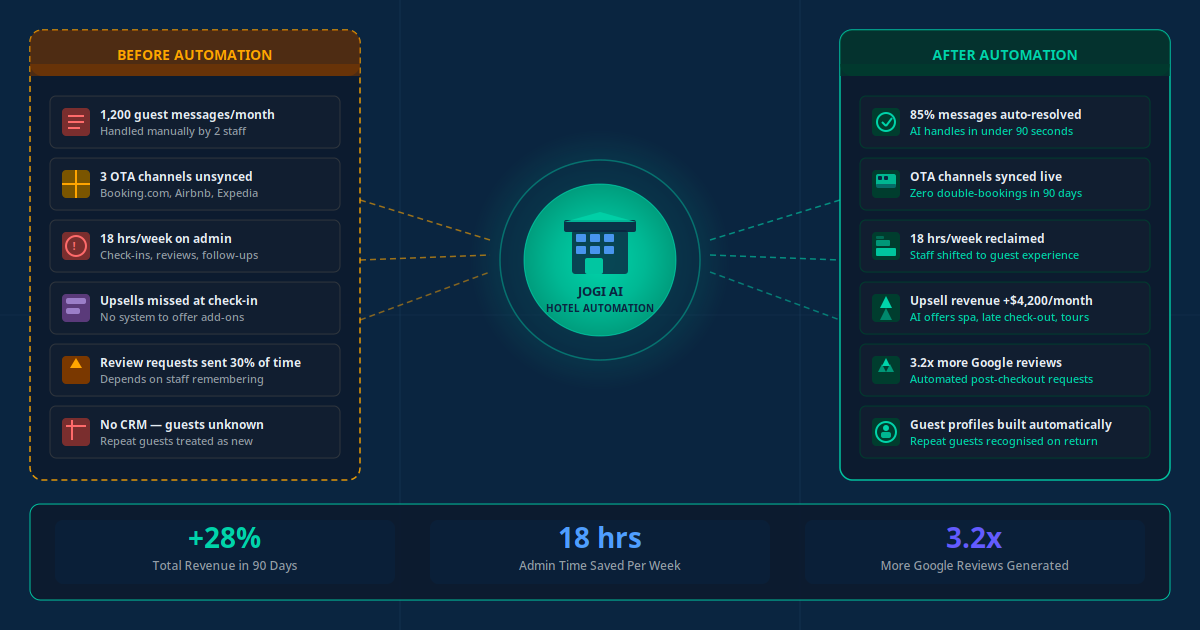
A mid-size hotel with 60 rooms commonly spends 18–22 staff-hours per week on booking confirmations, inquiry responses, pre-arrival messaging, and post-checkout review requests alone. At an average hospitality hourly wage, that is $350–$500 per week — $18,000–$26,000 per year — on communications that follow entirely predictable templates. That figure does not include housekeeping dispatch, no-show management, or upselling, which add another 10–15 hours weekly.
Then there is the revenue cost of slow responses. Research on speed-to-lead consistently shows that inquiry response times above five minutes reduce conversion by 60–80%. At peak demand — a long weekend, a local event, school holiday season — your front desk is handling check-ins while WhatsApp inquiries for future bookings pile up unanswered. Those leads rarely come back. A hotel receiving 40 inquiries per week with a two-hour average response time is losing bookings to competitors who reply in two minutes.
"Before we set up the AI booking assistant, we were losing an estimated 8–12 bookings per week to slow WhatsApp response. Within the first month of automation, our direct booking conversion from messaging improved by 34%." — General Manager, 45-room boutique hotel, Mumbai
No-shows compound the problem. The industry average no-show rate sits at 8–12% of reservations. For a 60-room hotel charging $80/night, that is $3,840–$5,760 in monthly lost revenue from guests who simply did not show up because nobody sent them a well-timed reminder sequence. Automated multi-touch reminder workflows — which we'll cover in detail below — reduce no-show rates by 30–40% in our experience.
What Hotel Autonomous Workflows Actually Mean
The term gets used loosely, so let me be precise. A hotel autonomous workflow is a triggered sequence of automated actions that moves a guest or a task forward without requiring a staff member to initiate or execute each step. The trigger might be a new booking, a WhatsApp message arriving, a checkout time passing, or a housekeeping status update. The actions that follow — replies, confirmations, task assignments, escalations, personalised offers — happen automatically, coordinated by an AI agent with access to your PMS and messaging channels.
This is meaningfully different from a chatbot that answers questions or an email tool that sends a template. Those tools handle one channel in isolation. A true autonomous workflow spans channels and systems: it sees the booking in the PMS, knows the guest's preferences from past stays, sends the WhatsApp pre-arrival message, updates the housekeeping queue when the guest checks out, and triggers the review request 24 hours later — all as a single connected sequence. The AI agent is the orchestration layer that holds this together.
Key Takeaway
Autonomous workflows are not chatbots. They are AI-orchestrated sequences that span your PMS, channel manager, messaging channels, and housekeeping systems — executing end-to-end guest journey tasks without staff involvement at each step.
For a deeper look at how multi-system AI orchestration works in practice, see our guide to AI workflow automation for business processes — the principles map directly to hospitality.
Mapping the Guest Journey: Where AI Steps In
Every hotel guest moves through eight predictable stages, from first inquiry to post-stay review request. Each stage has high-repetition tasks that are currently handled manually by staff and are strong candidates for automation. Here is the full map:
| Guest Stage | Manual Approach (Current) | With Autonomous Workflow |
|---|---|---|
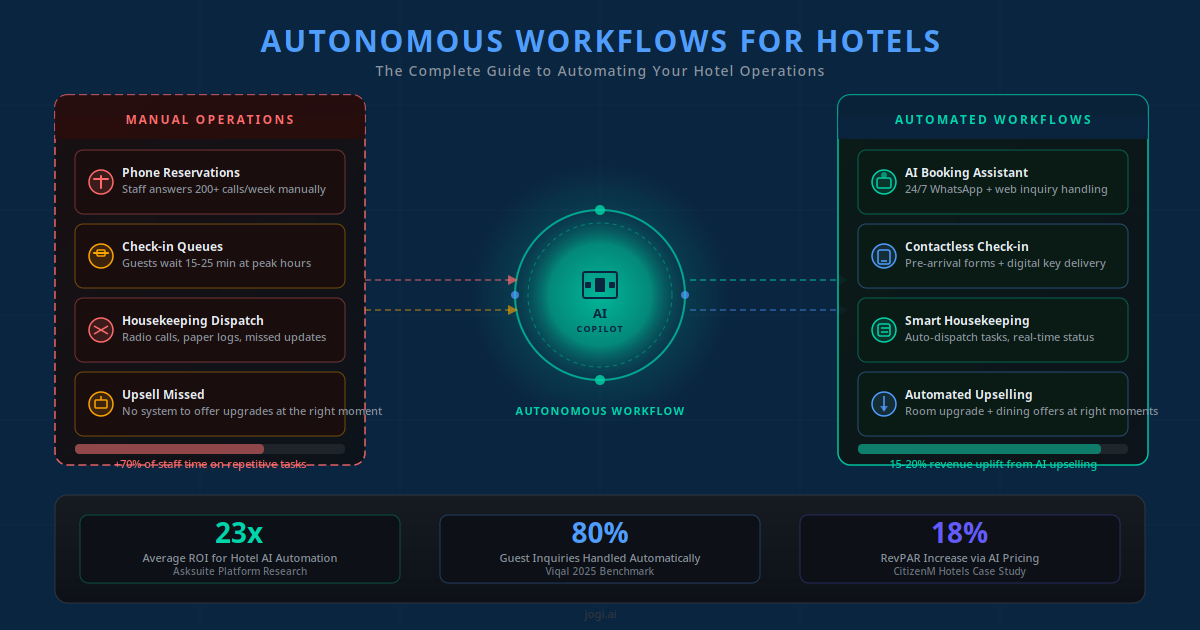
| Inquiry | Staff answers phone / email / WhatsApp during business hours | AI replies instantly 24/7, answers availability questions, qualifies intent |
| Booking | Manual entry into PMS after phone call; booking engine handles online only | AI captures booking via chat and creates reservation directly in PMS |
| Pre-arrival | Generic confirmation email, no follow-up until arrival | Personalised info pack, upsell offers, pre-check-in form, parking/transfer help |
| Check-in | Guest queues at front desk; staff repeats same welcome script | Pre-filled digital form, digital key delivery, room-ready notification |
| In-stay | Guest calls front desk or approaches reception for requests | WhatsApp/chat AI assistant handles requests, routes to appropriate team |
| Housekeeping | Paper log, radio calls, manual status updates on room readiness | Auto-assigned housekeeping tasks, real-time status updates to front desk |
| Checkout | Manual invoice generated, guest queues at desk | Pre-prepared invoice sent the night before, express checkout link |
| Post-stay | Review request sometimes sent manually, often forgotten | Timed review request + loyalty win-back sequence triggered automatically |
Not every hotel needs to automate all eight stages simultaneously. The implementation roadmap in a later section covers which stages to tackle first for the fastest ROI. The key insight is that these workflows are sequential and cumulative — each stage that you automate also feeds data into the next one.
The Five Highest-Impact Hotel Workflows
Across all implementations, five specific workflows deliver the most measurable ROI in the shortest time. These are the right starting points for any hotel — regardless of size or existing tech stack.
1. AI Booking and Inquiry Assistant (Web + WhatsApp)
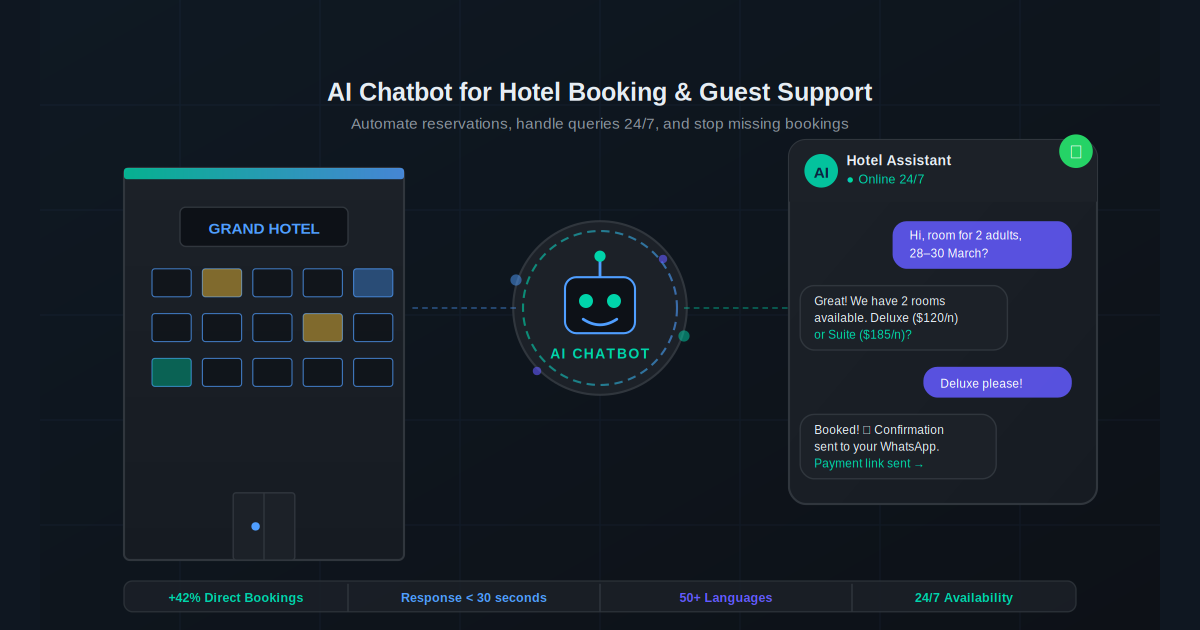
The workflow: a guest sends a WhatsApp message asking about availability for three nights in July. The AI agent queries your PMS in real time, confirms availability, shares rates, answers common questions (is breakfast included? is parking available?), and guides the guest through completing a direct booking — all without staff involvement, at any hour of the day or night. In our hotel implementations, this single workflow recovers an average of 6–10 direct bookings per month that would otherwise have gone to OTAs or been lost to slow response. For more on what a WhatsApp-first booking assistant looks like in practice, see our deep-dive on WhatsApp Business automation.
2. Automated Reservation Confirmations and No-Show Reminders
The workflow: immediately after a booking is created (from any channel — direct, OTA, phone), the system sends a personalised confirmation via the guest's preferred channel. Then, 7 days before arrival, an excitement-building message with local tips. Then, 48 hours before arrival, a reminder with check-in instructions. Then, 4 hours before arrival, a final confirmation. Industry data shows this four-touch sequence reduces no-show rates by 30–38%. At a 60-room hotel, that translates to $2,000–$4,000 in recovered monthly revenue. The system also handles the difficult conversation when a guest cancels last-minute — triggering a cancellation confirmation and a rebooking offer for an alternative date.
3. Contactless Check-in Flow
The workflow: 24 hours before arrival, the guest receives a pre-check-in link via WhatsApp or email. They complete their ID verification, select room preferences, and submit any special requests — all before setting foot in the hotel. On arrival, their room is ready with their preferences applied, and their key (physical or digital) is waiting. Our hotel clients implementing contactless check-in report a 23% increase in guest satisfaction scores and a significant reduction in front desk congestion during peak arrival windows. Staff freed from the check-in queue spend that time on genuine hospitality: greeting guests, answering complex questions, handling VIP arrivals with attention.
4. Housekeeping and Maintenance Task Routing
The workflow: when a guest checks out, the PMS triggers an automatic housekeeping task assigned to the relevant housekeeper via their mobile dashboard. Priority levels are set by checkout time and next check-in time. Maintenance requests submitted by guests via the in-stay AI assistant are instantly routed to the maintenance team with room number, nature of issue, and urgency level. Completion is logged back to the PMS, updating room-ready status for the front desk automatically. This removes the 15–20 radio calls and paper notes that typically flow through a busy housekeeping operation daily — and eliminates the common error of a room being shown as available in the PMS while still in cleaning.
5. Automated Upsell and Room Upgrade Offers
The workflow: at three strategic moments — booking confirmation, pre-arrival, and 2 hours before check-in — the system checks PMS inventory for available upgrades and sends personalised offers to the guest. "Your deluxe suite with harbour view is available for your stay — upgrade for just $45 more." Hotels using automated upselling consistently see 15–20% additional revenue per occupied room compared to properties relying on front desk staff to mention upgrades verbally. The system also identifies guests with past upgrade history and targets them with preferred room types — a level of personalisation that manual operations simply cannot deliver at scale.
Integrating AI with Your PMS and Channel Manager
The most common question I hear from hotel managers when we start a project is: "Do we need to change our PMS?" The answer is almost always no. Modern AI workflow systems are designed to layer on top of your existing property management system and channel manager via API or webhook connections — they read availability, guest profiles, and booking data, and write back confirmations, task updates, and notes.
The major hotel PMS platforms all support API access: Cloudbeds, Opera Cloud, Mews, Little Hotelier, and RMS Cloud all have documented API libraries. Channel managers including SiteMinder, Staah, and Beds24 offer similar connectivity. In a typical integration, the AI layer:
- Reads real-time availability from the channel manager to answer booking inquiries accurately
- Creates or modifies reservations directly in the PMS when a booking is confirmed via chat
- Reads guest profiles and past-stay history to personalise messaging
- Writes back task assignments to a housekeeping module or task management system
- Reads checkout times to trigger the right post-stay review sequence
Webhook-based integrations (where the PMS pushes events to the AI system in real time) are significantly more reliable than polling-based approaches (where the AI system checks the PMS on a schedule). If your PMS supports webhooks for booking creation, modification, and status changes, configure those first — they are the foundation that makes all other workflows responsive and accurate.
For properties where direct PMS API access is complex or restricted, a middleware layer (Make, n8n, or Zapier) can bridge the gap — connecting PMS exports, email confirmations, or spreadsheet syncs to trigger the right AI workflows. It is less elegant than a native integration, but functional for most small and mid-size properties. Our guide to Make vs Zapier vs n8n covers which tool fits which integration complexity level. For more sophisticated multi-system orchestration, see our article on multi-agent AI systems for businesses.
Your Hotel AI Implementation Roadmap
The most common mistake hotels make is trying to automate everything at once. A phased approach — crawl, walk, run — delivers faster ROI, smoother staff adoption, and a more reliable final system. Here is the roadmap we use with our hotel clients:
Audit your highest-volume repetitive touchpoints (Week 1): List every guest communication and operational task your staff handles daily. Count frequency. Identify the top 10 by volume. These are your automation candidates — not the complex ones, but the ones happening 20+ times a week with predictable, templatable responses.
Connect your PMS and channel manager (Week 1–2): Establish API or webhook access to your PMS before building any workflows. Confirm that availability data, booking creation, and guest profiles are readable in real time. Test with a staging booking before configuring live workflows. This is the integration foundation — nothing else works reliably without it.
Deploy the booking inquiry assistant (Week 2–3): Start with the WhatsApp and web chat booking AI. This is your fastest ROI workflow — it recovers direct bookings from slow response immediately. Configure it to handle availability queries, pricing questions, and booking completion. Test with 20 simulated inquiries before going live. Monitor the first week of real conversations daily.
Activate the reservation confirmation and reminder sequence (Week 3–4): Build the four-touch reminder flow — immediate confirmation, 7-day pre-arrival, 48-hour reminder, 4-hour final check-in message. Set up the no-show prevention deposit nudge for properties with flexible cancellation policies. This workflow runs in the background and requires almost no ongoing management once configured.
Launch contactless pre-check-in (Week 4–6): Build the pre-check-in form, connect it to your PMS to update guest profiles, and configure the pre-arrival send trigger. Coordinate with your front desk team on the new arrival flow — they need to know what information guests have already submitted so they do not ask for it again. Guest confidence in contactless check-in builds over the first 4–6 weeks as the process becomes familiar.
Connect housekeeping dispatch (Week 6–8): Integrate checkout triggers with your housekeeping task system. Build in-stay AI assistant for guest requests, with routing rules that direct each request type (maintenance, F&B, additional amenities) to the right team. This requires the most change management internally — brief your housekeeping and maintenance teams on the new task system before going live.
Activate upselling and post-stay sequences (Week 8+): Build the three-moment upsell workflow (booking, pre-arrival, day-of check-in). Configure the post-stay review request sequence with a 24-hour delay and a second nudge at 72 hours. Analyse upsell conversion data monthly and adjust offer timing and copy based on what converts. The review workflow compounds over time — properties that have run it for 12 months typically see a 40–60% increase in review volume.
For email automation components — confirmation sequences, pre-arrival packs, post-stay campaigns — our guide to email automations for every business covers the technical setup in detail. For the AI-driven customer support layer that handles in-stay requests, see our overview of AI-driven customer support workflows.
Data Privacy and Guest Consent
Hospitality is a high-trust industry. Guests share personal details, payment information, passport data for international properties, and behavioural preferences. When you introduce AI into the guest data flow, the privacy and consent obligations do not disappear — they become more visible and more important to get right.
The legal baseline for EU and UK hotels is GDPR. For Indian properties, the Digital Personal Data Protection Act (DPDP) 2023 applies. For properties in multiple markets, the most stringent applicable regulation should set your standard. The practical requirements are:
- WhatsApp and SMS opt-in consent: You cannot initiate automated WhatsApp conversations with guests unless they have opted in. Capture this at booking — a simple checkbox on the booking form is sufficient. Never send WhatsApp messages to guests who did not provide a mobile number in a booking context.
- Marketing vs. transactional communications: Booking confirmations, check-in instructions, and housekeeping updates are transactional — no additional consent required. Upsell offers and win-back campaigns are marketing communications and require explicit marketing opt-in.
- Data retention: Guest profiles and conversation histories should be retained only as long as necessary for the stated purpose. Define a retention policy (typically 24 months for hospitality CRM data) and configure your systems to purge automatically.
- AI disclosure: Best practice — and increasingly a legal requirement in some markets — is to disclose when a guest is interacting with an AI assistant. A brief "You're chatting with our AI assistant — I can help with bookings, questions, and requests. For complex issues, I'll connect you to our team" framing sets expectations correctly and rarely reduces guest satisfaction.
When evaluating AI and automation vendors for your hotel, require written data processing agreements that specify where data is hosted, how long it is retained, and whether it is used to train external AI models. The last point is important — you do not want your guests' personal data contributing to a vendor's general AI training corpus. For an overview of AI safety and data handling frameworks, our guide on AI automation safety covers the key considerations for business owners.
KPIs Every Hotel Should Track
Autonomous workflows generate a level of operational data that manual processes never could. The question is which metrics actually tell you whether the system is working — and which ones are vanity metrics that feel good but do not connect to revenue.
"We went from having no data on our inquiry-to-booking conversion rate to knowing it was 18% — and watching it climb to 31% over four months as we refined the AI responses. That visibility alone changed how our GM thinks about the front of house."
— Operations Manager, 80-room hotel group, Rajasthan| KPI | What It Measures | Target Benchmark |
|---|---|---|
| Inquiry response time | Time from guest message to first AI reply | < 60 seconds, 24/7 |
| Inquiry-to-booking conversion | % of chat inquiries that result in a confirmed reservation | 25–40% (depends on pricing position) |
| No-show rate | % of reservations where guest does not arrive | < 6% (from industry avg of 8–12%) |
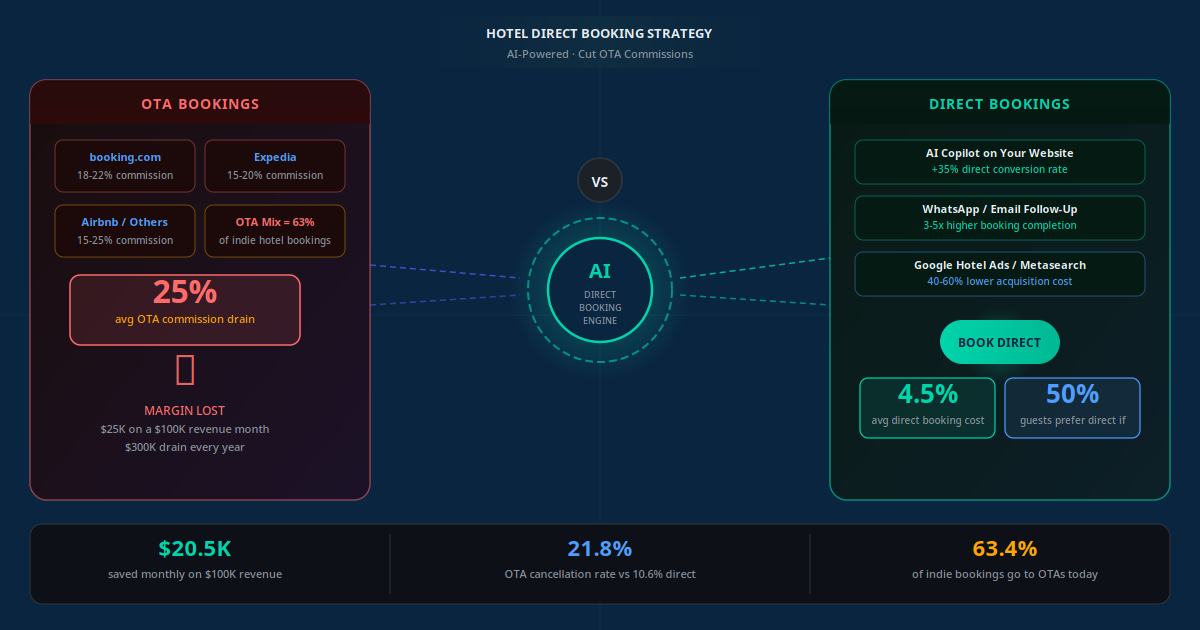
| Direct booking share | % of total bookings via direct channels vs OTAs | Increase of 8–15 percentage points after AI deployment |
| Upsell revenue per room | Average upsell revenue per occupied room night | 15–20% increase vs pre-automation baseline |
| AI containment rate | % of inquiries resolved by AI without human escalation | 70–85% |
| Review request conversion | % of post-stay review requests that result in a published review | 12–20% (vs industry avg of 3–5% without prompting) |
| Staff hours saved per week | Reduction in hours spent on automated tasks | 15–25 hours for a 60-room property |
CitizenM Hotels' deployment of AI-powered revenue management and workflow automation delivered an 18% increase in RevPAR — not because of a single killer feature, but because the compound effect of faster inquiry response, better upselling, and improved no-show management moved all the revenue levers simultaneously. The KPIs above are what you track to see those levers moving in your property. See our article on AI automation ROI calculation to run the numbers specific to your property.
Mistakes Hotels Make When Going Automated
Having implemented hotel autonomous workflows across properties of all sizes, I have seen the same errors come up repeatedly. These are not theoretical — each one represents a real project where the mistake caused a delay, a guest complaint, or a failed rollout.
Automating Before Integrating the PMS
The most common and most costly mistake. A hotel builds an AI booking assistant, goes live, and the agent is answering availability questions based on a spreadsheet that gets updated once a day. A guest books a room that is already sold out. The manual fix takes longer than the automation was supposed to save. The integration with the PMS must be live and tested before any guest-facing automation goes live — not planned, not "coming soon." Tested. This is the non-negotiable foundation.
No Human Escalation Path
AI agents handle 70–85% of hotel interactions well. The remaining 15–30% are complex, emotional, or require judgment — a guest with a medical issue, a complaint about a serious problem, a VIP requesting something genuinely unusual. If the AI has no clear escalation path to a human with full conversation context, these interactions become disasters. Design the escalation as carefully as you design the automation. The guest should never feel like they hit a wall.
Generic Messaging That Feels Like Spam
The pre-arrival message that says "We look forward to your visit! Check-in is at 3 PM" is technically automated but provides almost no value. Effective autonomous workflows use the data you have — the guest's name, their room type, their arrival date, the events happening near the hotel that week, their past stay history — to send messages that feel considered rather than templated. Invest time in the message copy. A poorly written automated message actually damages guest experience more than no message at all.
Skipping the Consent Layer
Hotels that send WhatsApp messages to guests without explicit opt-in get reported and blocked. WhatsApp Business accounts with high block rates lose access to the platform. Building the consent capture into the booking flow before you launch any guest messaging is not bureaucratic overhead — it is protecting the channel that makes the entire workflow valuable. Collect consent at booking and store it against the guest record. Our guide to WhatsApp Business automation covers compliance setup in detail.
The Hotels That Automate Now Will Set the Standard
The hospitality industry is in the middle of a structural shift. 80% of travellers now prefer fully automated front desk interactions for transactional touchpoints — they want speed, accuracy, and the ability to interact on their schedule, not yours. At the same time, they want genuine human warmth for the moments that matter: the welcome, the recommendation, the problem solved with care. Autonomous workflows make both possible — by removing the repetitive burden from staff, they free capacity for exactly those moments.
The economics are clear. A comprehensive hotel autonomous workflow stack — inquiry assistant, reservation automation, contactless check-in, housekeeping dispatch, upselling, review management — typically costs $500–$1,500 per month to run for a mid-size property. The combination of recovered direct bookings, reduced no-shows, upsell revenue, and staff time saved generates $3,000–$8,000 in monthly value for that same property. Most hotels reach full ROI payback within 60–90 days of complete deployment.
The question is not whether to automate, but which workflows to start with and how to sequence the rollout. Use the AI Business Twin to get a personalised analysis of your hotel's automation opportunities, the workflows with the highest ROI for your specific property, and a realistic implementation roadmap — free, in under 10 minutes.
Frequently Asked Questions
What is an autonomous workflow for hotels?
An autonomous workflow for hotels is a sequence of automated actions triggered by a guest journey event — such as a new inquiry, a check-in request, or a post-stay checkout — that completes without manual staff involvement. The workflow connects your PMS, channel manager, and messaging channels through an AI agent that interprets intent, makes decisions, and executes actions such as confirming reservations, dispatching housekeeping tasks, or sending personalised upsell offers at the right moment.
How much does hotel AI workflow automation cost?
Costs vary by scope and platform. A basic setup covering WhatsApp inquiry handling, booking confirmations, and pre-arrival messaging typically starts at $150–$400 per month in platform fees plus a one-time setup investment. A full implementation covering check-in, housekeeping dispatch, upselling, and review management generally ranges from $500–$1,500 per month for a mid-size property. Most hotels reach ROI breakeven within 60–90 days based on reduced no-shows and recovered direct bookings alone.
Does hotel automation require replacing the existing PMS?
No. AI workflow layers integrate with your existing PMS via API or webhook connections — they do not replace it. Popular platforms like Cloudbeds, Opera, Mews, and Little Hotelier all support API integrations. The AI layer sits on top of your existing stack, reading availability and guest data and writing back confirmations, task assignments, and notes. The goal is to augment what you already have, not to force a migration.
What percentage of guest inquiries can a hotel AI agent handle?
Based on current deployments, AI agents handle 70–85% of all guest inquiries end-to-end without human intervention. These include availability questions, booking requests, check-in instructions, in-stay requests such as extra towels or late checkout, and common FAQ-type queries. Complex complaints, special event bookings, and group rate negotiations typically require human handling and should trigger a smooth escalation to staff with full conversation context passed over.
Is guest data safe with hotel AI automation?
Guest data safety depends on vendor selection and system configuration. Key requirements include GDPR-compliant infrastructure, PCI-DSS compliance for payment-adjacent flows, explicit opt-in consent collected before initiating WhatsApp or email automations, and data retention policies that match your jurisdiction. Always review the data processing agreements of any vendor before going live, and ensure guest consent is captured at booking rather than assumed.
How long does it take to set up hotel autonomous workflows?
A basic setup covering booking inquiry handling, confirmation messages, and pre-arrival communication can be live within one to two weeks for most hotels. A comprehensive implementation covering all guest journey touchpoints — including PMS integration, housekeeping dispatch, and upselling workflows — typically takes four to eight weeks. The critical path is API integration with your PMS and thorough testing across real booking scenarios before going live with guests.
Which hotel workflow should I automate first?
Start with the highest-volume, highest-repetition workflows: first, an AI inquiry and booking assistant via WhatsApp and web chat — this immediately captures revenue from missed or slow responses; second, automated reservation confirmations and pre-arrival messaging — this reduces no-shows and front desk workload on check-in day; third, automated post-stay review requests — this compounds your online reputation over time. These three deliver measurable ROI within the first 30 days and create the integration foundation for more complex workflows later.