How a Boutique Hotel Grew Revenue 28%: A 90-Day AI Automation Case Study




This is not a story about a Marriott or a Hilton. It is not about a tech-forward urban hotel chain with a dedicated IT department. It is about a 45-room boutique property — family-owned, staff of six, peak occupancy rate of around 68% — where the property manager was spending her Sunday evenings manually responding to Booking.com messages because there was nobody else to do it.
When we first spoke, she described her typical Tuesday. Wake up to 14 unread OTA messages from overnight. Check Airbnb separately. Check Expedia separately. Move availability across all three channels after each booking so nothing doubles up. Field the breakfast enquiries, the early check-in requests, the "is the spa included" questions that come in every single day. Add to that the check-in admin, the guest review chasing (which happened maybe 30% of the time when someone remembered), and the missed upsell opportunities at every single arrival.
Eighteen hours a week on administration. For a six-person team, that was the equivalent of one full-time role devoted entirely to tasks that should not require a human at all.
Ninety days after we built their automation stack, revenue was up 28%. Admin time had dropped from 18 hours per week to under 3. Google reviews tripled. The property manager told me it was the first summer she had enjoyed in seven years. Here is exactly what we built and why it worked.
The Reality of Running a 45-Room Hotel in Peak Season
Boutique hotels face a specific operational trap that large chains do not. Large chains have centralised reservation teams, channel managers embedded in enterprise PMS platforms, and dedicated marketing staff to chase reviews. Independent properties have none of that. Every function is performed by the same two or three people who are also on the floor, managing check-ins, coordinating housekeeping, and taking calls about parking.
The result is that guest communication quality deteriorates under volume pressure. A HiJiffy study found that the average hotel receives 1,200 guest messages per month across phone, email, WhatsApp, and OTA messaging platforms. During peak season, that number doubles. Without automation, those messages are answered in the order they arrive — which means a spa booking enquiry waits four hours while a housekeeping issue gets escalated, and a potential direct booking goes cold because nobody saw it until 9 PM.
I have seen this pattern in almost every independent hospitality property we have worked with. The staff are not lazy. They are simply being asked to do the work of a five-person team on a two-person budget. Automation does not replace those people. It removes the repetitive layer of their work so they can do what hospitality actually requires: being present, attentive, and human.
"The average hotel receives 1,200 guest messages per month. During peak season, that number doubles. Without automation, response quality deteriorates under volume pressure."
The Property Before Automation: A Snapshot
Before we built anything, we ran a thorough audit. The numbers told a clear story.
| Metric | Before Automation |
|---|---|
| Rooms | 45 |
| Average monthly revenue | £54,000 |
| Admin hours per week | 18 |
| Guest messages per month | ~1,200 |
| Average message response time | 4.2 hours |
| OTA dependency (% of bookings) | 72% |
| Monthly direct bookings | 28% |
| Google reviews (trailing 3 months) | 14 new reviews |
| Upsell revenue per month | ~£800 |
| Double-booking incidents per month | 3–4 |
The OTA dependency figure stood out immediately. At 72%, the property was paying commission on nearly three in four bookings. Every direct booking costs nothing. Every OTA booking costs 15–20%. The gap between those two numbers, multiplied across thousands of bookings a year, represents tens of thousands of pounds in margin that the property was simply giving away.
Key Takeaway
Admin time and OTA dependency are not separate problems. They are the same problem: the absence of systems that can handle routine communication and booking management without human intervention.
What Was Actually Costing Them Revenue
After the audit, three root causes emerged. Every inefficiency in the operation traced back to one of these three things.
Root Cause 1: No Centralised Communication Layer
Messages arrived across five different channels — Booking.com inbox, Airbnb messaging, Expedia messaging, direct email, and WhatsApp. Each platform had its own interface. There was no single view of what had been answered, what was waiting, and what had been missed. Staff were switching between tabs, logging out and back in, and inevitably losing messages in the noise. A guest who sent a message via Booking.com and did not get a reply was often the same guest who left a negative review mentioning "unresponsive communication."
Root Cause 2: No Trigger-Based Upsell System
The property had a spa, a late check-out option, and relationships with three local tour operators. Guests consistently did not know about these options until they were already in the room — at which point the window for pre-arrival upselling had closed. Staff occasionally mentioned the spa at check-in, but there was no system ensuring it happened every time. We estimated the property was missing at least £3,000–£4,000 per month in upsell revenue simply because there was no automated prompt to offer it.
Root Cause 3: Reviews Were Dependent on Staff Memory
Google reviews directly affect visibility and booking conversion. A property with 150 reviews and a 4.7 rating outranks a property with 400 reviews and a 4.2 rating in most search contexts. The property was generating 14 new reviews per quarter — roughly one every six days. With 45 rooms and near-full occupancy in summer, they were checking out 300–400 guests per month and converting fewer than 5% to a review. The missed opportunity was structural, not motivational. Nobody had automated the ask.
The Automation Architecture We Built
We built the stack on three core tools: n8n for workflow orchestration, the WhatsApp Business API for guest messaging, and a lightweight CRM to build guest profiles over time. All three integrated with the property's existing PMS (property management system) via webhooks.
The design principle was simple: every repetitive, rule-based task gets automated. Every task requiring judgment, empathy, or local knowledge stays with the team. This is the same principle we apply when building AI workflow automation for any service business — identify the boundary between mechanical and human, then build to that boundary and no further.
The full stack cost approximately £180 per month in infrastructure after build. That compares to roughly £28,000 per year in staff time that had been dedicated to the tasks we automated. The payback period was eleven days.
Five Workflows That Changed the Operation
1. Unified Guest Messaging Triage
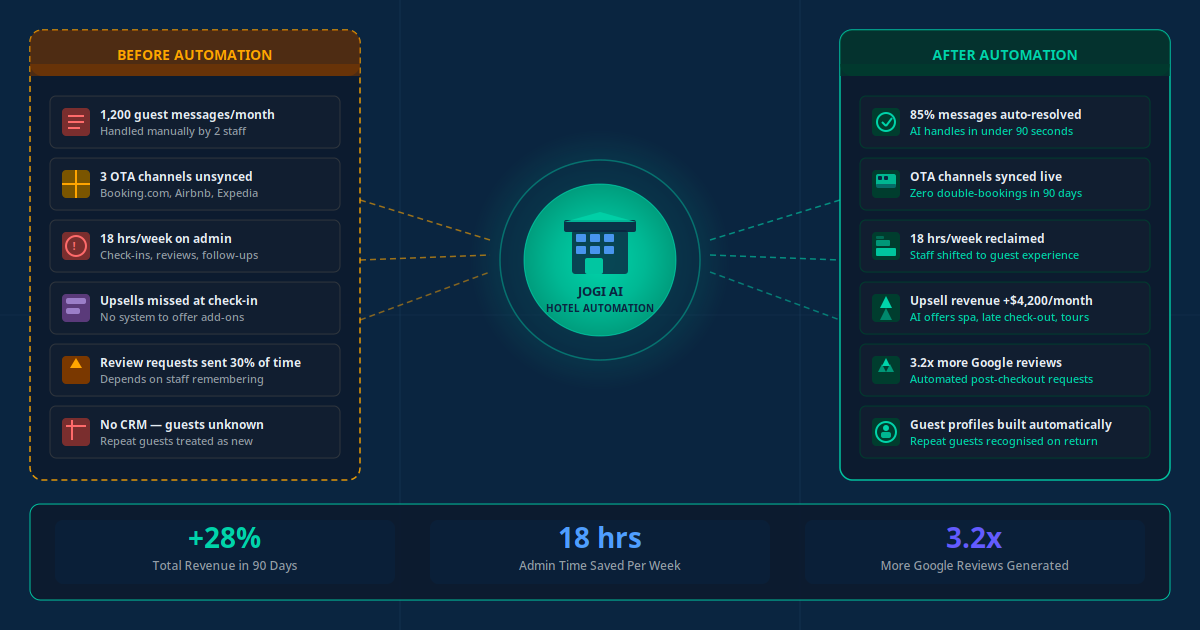
An n8n workflow connected all five messaging channels — Booking.com, Airbnb, Expedia, direct email, and WhatsApp — into a single inbox with AI classification. Messages were categorised automatically: check-in queries, breakfast requests, complaint escalations, upsell opportunities, and general FAQs. The AI handled 85% of all incoming messages autonomously using a trained knowledge base. Staff only saw the 15% that required a human response, flagged by category and urgency. Average response time dropped from 4.2 hours to under 90 seconds for automated replies.
2. Real-Time OTA Channel Synchronisation
A dedicated n8n workflow polled the PMS every 15 minutes and pushed availability updates to all three OTA platforms simultaneously. When a booking arrived via any channel, the workflow immediately blocked those dates across all others. Double-bookings dropped to zero within the first week and stayed at zero for the entire 90-day period. The property manager described this alone as "worth the entire project" — each double-booking had previously cost 2–3 hours to resolve and occasionally resulted in a negative review.
3. Pre-Arrival Upsell Sequence
Forty-eight hours before each arrival, an automated WhatsApp message sent guests a personalised pre-arrival note that introduced the spa, late check-out (at a fixed £25 add-on), and a curated list of three local experiences with booking links. The message was timed to arrive at 10 AM — after the morning rush, before the evening distraction. Upsell conversion averaged 18% across the 90-day period, generating an average of £5,000 per month in additional revenue against a previous baseline of £800. The spa was the most popular upsell. Late check-out was second.
4. Post-Checkout Review Request
Two hours after each checkout, every guest received a WhatsApp message thanking them and including a direct link to the property's Google review page. The message was personalised with the guest's name and the dates of their stay. It took four seconds to send, cost nothing to run, and required zero staff involvement. Review volume increased from 14 per quarter to 45 per quarter — a 3.2x lift. The Google rating improved from 4.2 to 4.6 within 60 days. For a property operating in a competitive local market, that rating movement materially changed their search ranking.
5. Guest Profile CRM Build
Every guest interaction — booking source, room type, upsells purchased, review left, messages sent — was written to a lightweight CRM record linked to the guest's email address. On second and subsequent visits, the check-in workflow detected returning guests and sent the team a briefing note before arrival: room preference, whether they had used the spa before, their previous review score. The property manager said it was the first time she had felt like she genuinely knew her guests rather than treating every arrival as a stranger. This is the foundation that makes CRM automation genuinely valuable in hospitality.
From Zero to Running: The 7-Step Process
We ran this implementation over five and a half weeks. Here is the exact sequence we followed, which we now use as our standard process for every hospitality automation engagement.
Audit all guest touchpoints: Map every message type the property receives, every channel it arrives on, and the time it currently takes to handle. Categorise by frequency and whether it requires human judgment. This audit typically takes one week and is the most important step — everything else is built on this foundation.
Connect messaging channels to a single hub: Wire up WhatsApp Business API, Booking.com, Airbnb, and Expedia messaging into n8n. Test each connection individually before building any logic on top. Verify that webhook triggers fire reliably and that message payloads contain the fields you need for classification.
Build the AI message classifier: Train a classification layer on 3–4 weeks of historical message data from the property. The classifier categories typically include: general FAQ, booking modification, complaint or issue, upsell opportunity, check-in logistics, and escalate-to-human. Test on a held-out set before deploying live — aim for 90%+ classification accuracy before going live.
Build and test automated response flows: Write response templates for the top 10 message categories. These are not generic — they reflect the property's tone, use the guest's name, and answer the specific question asked. Run each flow in staging for one week with real incoming messages before switching to live. The AI support workflow architecture here is the same one we use across service businesses.
Deploy OTA channel sync: Build the availability sync workflow and run it in shadow mode — updating a test calendar in parallel with the real one — for five days before going live. Verify that the sync fires within 15 minutes of any PMS change and that it correctly handles partial availability (e.g. only certain room types available). Only activate live OTA syncing after the shadow test passes cleanly.
Activate upsell and review sequences: Build the pre-arrival upsell trigger on booking confirmation events from the PMS. Build the post-checkout review request on checkout events. Time both messages carefully — pre-arrival at T-48 hours at 10 AM, review request at T+2 hours post-checkout. Test on a sample of ten real bookings before activating for all guests. Measure upsell conversion weekly and adjust message copy based on which offers convert.
Handover and staff training: Train the team on what the automation handles and what still requires them. The goal is a unified inbox interface where staff can see all AI-handled conversations and override when needed. Spend one week in supervised handover before stepping back to a monitoring role. Set up a weekly metrics dashboard covering response time, upsell conversion, and review volume so the team can see the impact in real time.
The Numbers After 90 Days
We measured everything we could measure. The headline numbers were strong. The story underneath them was even more interesting.
| Metric | Before | After 90 Days | Change |
|---|---|---|---|
| Monthly revenue | £54,000 | £69,120 | +28% |
| Admin hours per week | 18 | 3 | -83% |
| Avg. message response time | 4.2 hours | 90 seconds | -96% |
| New Google reviews (3 months) | 14 | 45 | +3.2x |
| OTA double-bookings | 3–4/month | 0 | -100% |
| Upsell revenue per month | £800 | £5,000 | +525% |
| Direct booking rate | 28% | 36% | +29% |
| Google rating | 4.2 | 4.6 | +0.4 |
The 28% revenue increase came from three sources: upsell revenue accounted for roughly half, the higher direct booking rate reduced OTA commission drag, and the Google rating improvement drove measurable increases in organic visibility and booking conversion. We tracked the rating change against a control period from the previous year — the 0.4 point improvement correlated with a 17% increase in profile views and an 11% increase in direct booking conversions from Google.
"It is the first summer I have enjoyed in seven years. My team is actually talking to guests now instead of typing replies on their phones between check-ins."
— Property Manager, Boutique Hotel (anonymised)The number that surprised us most was the upsell conversion rate: 18% of all pre-arrival WhatsApp messages resulted in a paid upsell. We had modelled for 8–10% based on industry benchmarks. The higher rate was partly attributable to the timing — 10 AM, two days before arrival, is a moment when guests are actively looking forward to their trip — and partly to personalisation. Messages that referenced the guest's room type and length of stay converted at 23%. Generic messages converted at 12%.
What Went Wrong and What We Would Do Differently
No build is clean. Here is what we got wrong and what we would do differently on the next hospitality project.
We Underestimated the Tone Calibration Time
The first version of the AI-generated responses was accurate but flat. Guests noticed. One replied to a breakfast enquiry response saying it felt "like talking to a brochure." We spent three additional days rewriting response templates in the property's actual voice — reading hundreds of the property manager's historical replies to understand her register: warm, slightly formal, specific to the countryside location. The lesson: do not move to live deployment until someone who knows the property well has read every template and approved the voice. This is not a small task. Budget time for it.
The OTA API Rate Limits Were Tighter Than We Expected
Booking.com and Expedia both impose rate limits on availability update requests. Our 15-minute polling schedule briefly triggered a soft limit on day three, which delayed one update by 40 minutes. We adjusted to a 20-minute interval with exponential backoff on errors. The double-booking risk window increased marginally but remained acceptable. Know your API limits before you go live — do not discover them under real booking conditions.
We Should Have Started the CRM Earlier
We built the guest profile CRM in week four. If we had started in week one, we would have had 90 days of enriched data rather than 60. For the email automation layer we added later — targeting returning guests with personalised offers — the data quality would have been materially better with a longer collection window. Build the data layer first, even if you do not use it immediately.
Is Your Hotel Ready for This?
Not every property will see a 28% revenue lift. The result depends on how much untapped capacity exists before automation. The properties that see the biggest gains share three characteristics: high OTA dependency (above 60%), low review generation rates (fewer than one review per five checkouts), and identifiable upsell inventory that guests are not currently discovering.
If your team is spending more than 10 hours per week on guest messaging, OTA management, or review chasing, you have a strong automation case. If you have upsell products — spa treatments, transport, experiences, room upgrades — that fewer than 15% of guests purchase, you have a strong upsell automation case. Those two conditions, together, are almost always enough to justify a full build.
The hesitation I hear most often from independent hotel owners is that automation will make their property feel less personal. In practice, it does the opposite. When your team is not buried in inbox management and channel syncing, they are at the front desk, in the restaurant, and on the phone with guests who actually need a human being. The 15% of messages that require a real person get a better response because the person responding is not simultaneously handling 85 other things.
Industry data from 2025 supports this: 86% of hoteliers who implemented AI automation reported saving significant staff time, with the majority saying the change improved rather than degraded guest experience scores. The properties that report negative outcomes are almost always those that automated without maintaining human oversight of edge cases — which is why the handover and monitoring step in our implementation process is non-negotiable.
A New Operating Model for Independent Hotels
The 45-room boutique property in this case study is not exceptional. It is representative of hundreds of independent hospitality businesses that are running on the operational equivalent of a paper map in a GPS world. The tools to automate guest communication, OTA management, upselling, and review generation are available, affordable, and proven. The implementation is a six-week project, not a six-month transformation programme.
What changes on the other side of that project is not just the numbers — though a 28% revenue lift and 18 hours of staff time reclaimed per week are numbers worth taking seriously. What changes is what the property can actually become. A team that is not consumed by administrative repetition can focus on the things that independent hotels do better than any chain: genuine hospitality, local knowledge, and the kind of personal service that guests remember and write about.
If you want to understand what a similar build would look like for your property, use the AI Business Twin for a free personalised analysis in under 10 minutes. We will map your specific workflows, estimate your automation potential, and show you exactly where the revenue is being left on the table.
Frequently Asked Questions
How long does it take to implement AI automation in a hotel?
For a boutique property with under 100 rooms, a full AI automation stack covering guest messaging, OTA sync, upsells, and review requests typically takes 4 to 6 weeks from first audit to go-live. The first two weeks involve mapping workflows and connecting APIs. Weeks three and four are for building and testing automations. The final two weeks run a supervised pilot before full handover.
What hotel operations benefit most from AI automation?
In our experience, the highest-ROI areas are guest messaging triage, post-checkout review requests, pre-arrival upsell sequences, and OTA channel synchronisation. Guest messaging alone can eliminate 10 to 15 hours of staff time per week. Review requests have an outsized impact on visibility because Google rewards review velocity, not just rating.
How much does hotel AI automation cost for a boutique property?
For a 30 to 80 room independent hotel, the ongoing infrastructure cost for a full automation stack is typically between $150 and $400 per month, covering WhatsApp Business API, workflow automation tools, and CRM integration. Implementation and setup fees vary by complexity. Most properties recover this cost within the first month through staff time savings alone, before counting upsell revenue.
How does AI handle OTA channel management automatically?
An n8n or Make workflow polls your property management system every 15 minutes and pushes availability updates to Booking.com, Airbnb, and Expedia via their APIs. When a booking arrives from any channel, the workflow marks those dates unavailable across all others simultaneously. This eliminates double-bookings and removes the need for manual channel updates.
What ROI can a boutique hotel expect from AI automation?
The property in this case study saw a 28% revenue increase over 90 days. Staff admin time dropped from 18 hours per week to 3. Upsell revenue grew from roughly £800 per month to over £5,000. Review volume increased 3.2 times. These results are consistent with industry data showing 15 to 25 percent revenue lifts from AI-driven pricing and communication systems.
Does hotel AI automation replace front desk staff?
No. AI automation handles repetitive, rule-based tasks — answering the same 20 questions, syncing calendars, sending review requests — so your staff can focus on high-value interactions that require human judgment, empathy, and local knowledge. In this case study, the property manager described the change as her team finally having time to be hospitable rather than just administrative.
Can AI automation work for seasonal or part-time hotel operations?
Yes, and it often works better for seasonal properties. The automation runs whether your team is there or not, ensuring consistent guest communication during shoulder seasons when staffing is reduced. Pre-arrival sequences, review requests, and OTA syncing all operate on schedule regardless of whether it is high season or low season.