Restaurant AI in 2026: Menu Engineering, Smart Kitchens & Higher Margins on Autopilot




Most restaurant owners know their food costs are too high. They know some menu items sell far better than others. They know their kitchen has bottlenecks during Friday dinner service that slow every table. But without the right data — and without the right system to act on that data — these problems remain educated guesses treated with instinct, not intelligence.
In 2026, AI changes that equation completely. The same technology that Fortune 500 restaurant chains have quietly used for years to engineer menus, optimize kitchen throughput, and deploy dynamic pricing is now accessible to any restaurant owner — whether you run a single neighbourhood café or a growing chain of ten outlets.
This guide covers the specific AI automation capabilities that move the needle most on restaurant profitability: smarter menus, faster kitchens, reduced food waste, and pricing that responds to real demand.
Key Takeaway
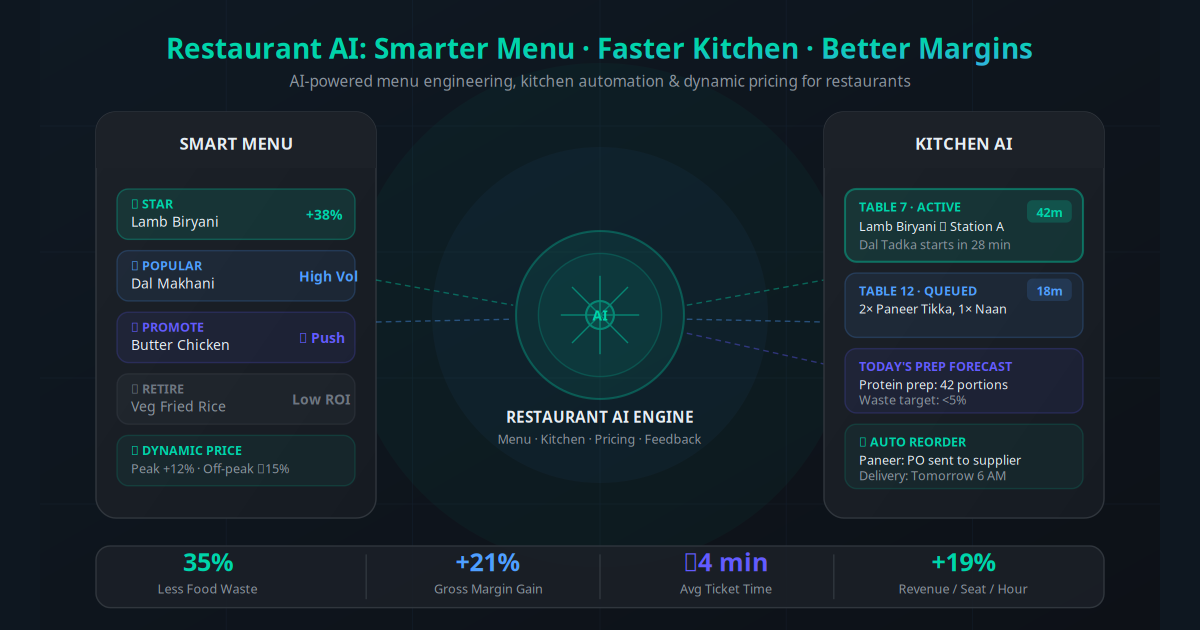
Restaurants that deploy AI-driven menu engineering and kitchen automation report a 35% reduction in food waste, a 18–24% improvement in gross profit margin, and kitchen ticket times that drop by an average of 4 minutes during peak service — without adding a single line cook.
The Margin Crisis Hiding Inside Your Menu
The average independent restaurant operates on a net profit margin of 3–5%. That means for every ₹100 of revenue, only ₹3–₹5 reaches the owner's pocket. The rest disappears into food costs (28–35%), labour (30–35%), rent, utilities, and waste.
What most restaurant owners do not realise is that their menu itself is one of the biggest levers for improving this margin — and it is almost entirely unoptimized. On a menu of 40 items, typically:
- 6–8 items are high-margin, high-popularity "Stars" driving the most profitable orders
- 8–12 items are high-popularity but low-margin "Ploughhorses" — beloved by customers but eating into profit
- 5–8 items are high-margin but rarely ordered "Puzzles" that could become Stars with the right promotion
- 10–15 items are low-margin, low-popularity "Dogs" that cost money to buy, prep, and discard as waste every week
Traditional menu engineering — analysing each dish's contribution margin against its popularity — is something most restaurants do once a year if at all, usually during a slow month when the owner has time. AI does this continuously, in real-time, and recommends specific actions automatically.
AI-Powered Menu Engineering
Real-Time Menu Performance Analysis
Connected to your POS system, an AI menu analytics engine tracks every order in real time. It calculates the true contribution margin for each dish (after ingredient cost, prep time, and waste allocation) and plots it against order frequency. Every week, it surfaces the specific insights your team needs to act on:
- Which dishes should be featured more prominently on your menu or digital ordering interface
- Which high-margin "Puzzle" items need a promotional push or menu repositioning
- Which "Dog" items should be retired, repriced, or reformulated to improve margins
- Which "Ploughhorse" items could sustain a small price increase without impacting order volume
This is not annual menu review. It is weekly menu intelligence that compounds over time.
AI-Driven Menu Layout Optimisation
On digital menus (your website, app, or third-party delivery platforms), AI can A/B test menu layouts, item ordering, imagery, and descriptions to maximise average order value. Research consistently shows that the first 3 items in any menu section receive disproportionately high order rates. AI identifies your most profitable dishes and ensures they occupy those prime positions — automatically, across every ordering platform.
For physical menus, the AI generates data-backed layout recommendations. It identifies which items to feature in the "golden triangle" (the three areas the human eye naturally lands on first when reading a menu), which descriptions to rewrite for higher conversion, and which dishes benefit from photography or callout boxes.
"We ran the AI's menu recommendations for 60 days without changing a single recipe. Just repositioned dishes on our digital menu and retired four low-margin items. Our average order value went from ₹680 to ₹820 — a 20% increase with zero additional cost." — Owner, casual dining restaurant, Bengaluru
Seasonal and Demand-Based Menu Adaptation
AI identifies patterns in your sales data that are invisible to the naked eye. It knows that your lamb curry sells 40% better on cold evenings, that your weekend brunch items have a 3-week lead time in preference before a local festival, and that your mango desserts peak for six specific weeks every summer. It uses this intelligence to automatically update your featured items, trigger timely promotions, and alert your purchasing team to order ahead of demand spikes.
Smart Kitchen Automation
AI Kitchen Display Systems (KDS)
Traditional kitchen display systems show orders in the sequence they are received. AI-powered KDS systems are fundamentally different — they prioritize, sequence, and route orders based on preparation time, cooking station capacity, and the target time every table should be served together.
When Table 7 orders a lamb biryani (45-minute cook), a dal tadka (15 minutes), and two garlic naans (5 minutes), the AI KDS starts the biryani immediately, queues the dal at the 28-minute mark, and queues the naans at the 40-minute mark — so all three items arrive at the pass simultaneously. This sequencing happens automatically for every order, across every table, in real time.
- Average ticket time reduction: 3–6 minutes per order during peak service
- Simultaneous table service rate improvement: from ~60% to ~88%
- Kitchen error rates (wrong dishes, missed modifications): reduced by 40–55%
Prep Volume Forecasting
One of the most expensive problems in any restaurant kitchen is the gap between how much you prep and how much you actually sell. Over-prep creates waste. Under-prep creates 86s (sold-out items) that disappoint customers and create revenue gaps.
AI prep forecasting analyses your historical sales data alongside external signals — day of week, local events, weather, school holidays, nearby competitor closures — to generate a daily prep list that is accurate to within 8–12% of actual demand. Your kitchen team starts each day knowing exactly how much of each component to prepare, reducing food waste dramatically while virtually eliminating the "sorry, we're out of that" conversation during service.
| Prep Area | Before AI Forecasting | After AI Forecasting |
|---|---|---|
| Daily protein waste | 12–18% of prep volume | 4–6% of prep volume |
| Item 86 frequency | 4–7 items per service | 0–1 items per service |
| Emergency re-prep cost | ₹4,000–₹8,000/week | ₹500–₹1,200/week |
| Chef prep time | Estimated, manual | AI-generated, optimised |
Automated Inventory Reordering
AI kitchen automation connects your sales data to your inventory system. As dishes are ordered throughout the day, ingredients are automatically deducted from inventory in real time. When any ingredient approaches its reorder threshold — and crucially, before you run out mid-service — the AI automatically generates and sends a purchase order to your supplier.
For restaurants with multiple locations, the AI also identifies opportunities to transfer stock between locations to prevent waste. If your Andheri location has surplus paneer that is three days from expiry while your Bandra location is running low, the system flags this for a transfer rather than a write-off.
Dynamic Pricing for Restaurant Revenue Optimisation
Dynamic pricing — adjusting prices based on demand, time, and supply — is standard practice in airlines, hotels, and ride-sharing. In 2026, AI is bringing the same capability to restaurants in a way that customers accept and even appreciate when implemented thoughtfully.
Time-Based Pricing
AI analyses your occupancy and order patterns to identify low-demand windows where a targeted discount can drive incremental revenue. A 15% "Early Bird" discount between 5:30 PM and 6:30 PM, applied automatically by the AI when occupancy drops below 40%, fills tables that would otherwise sit empty — and generates revenue that would not have existed at full price.
Conversely, during peak demand windows (Saturday dinner, festival evenings, major sporting events), the AI can apply a modest premium to takeaway and delivery orders — where customers are less price-sensitive than walk-in diners — without affecting the in-restaurant experience.
Delivery Platform Price Optimisation
Restaurants typically list the same prices on Swiggy, Zomato, and their own ordering website. AI pricing tools analyse demand elasticity by platform — the extent to which a price change affects order volume on each channel — and recommend platform-specific pricing that maximises net margin after commission costs.
Since Swiggy and Zomato charge 18–25% commission, your margins on delivery orders can be structurally low even at full price. AI can identify the precise price adjustment on each platform that offsets the commission cost while remaining competitive enough to maintain order volume.
Key Takeaway
Dynamic pricing implemented thoughtfully — with customer-friendly framing like "Happy Hour specials" or "Early Bird offers" — does not damage your brand. Restaurants using AI dynamic pricing report a 14–19% improvement in revenue per available seat hour (RevPASH), the restaurant equivalent of hotel RevPAR.
Explore all industry-specific AI automation solutions we offer at Jogi AI.
AI-Powered Customer Feedback Loop
Menu engineering without customer feedback data is incomplete. AI automation closes this loop by collecting, analysing, and acting on guest feedback automatically — without your team manually reading Google reviews or handling feedback cards.
Automated Post-Visit Feedback Collection
Within 2 hours of a customer's visit (triggered by their reservation check-out or order completion), the AI sends a brief WhatsApp message: "Thanks for dining with us today, [Name]! How was your experience? Reply 1–5 ⭐ and we will take care of the rest." A 5-star response triggers a thank-you and a loyalty point credit. A 1–3 star response triggers an immediate escalation to the manager and a personal follow-up within 24 hours.
Sentiment from all responses is automatically aggregated and categorized. If five customers in one week mention that a specific dish was underseasoned, the AI flags it as a quality issue requiring chef attention — before it shows up on your public Google reviews.
Menu Iteration Based on Feedback Intelligence
When feedback and sales data are combined, the AI's menu recommendations become significantly more powerful. A dish can have strong sales volume but consistently generate 3-star feedback. This pattern — which would take months to detect manually — is immediately surfaced by the AI, triggering a recipe review before the dish becomes a reputational liability.
Implementation Guide: Where to Start
Implementing all of this simultaneously is unnecessary and overwhelming. The right approach is phased, with each stage validated before the next begins.
- Month 1 — Menu intelligence foundation: Connect your POS to an AI analytics system. Run your menu through contribution margin analysis. Identify your Stars, Ploughhorses, Puzzles, and Dogs. Take the top 5 recommended actions: retire 2–3 Dogs, reposition 2 Puzzles, and adjust prices on 2 Ploughhorses.
- Month 2 — Kitchen forecasting: Implement AI prep forecasting. Compare your daily AI-generated prep list against actual sales for 4 weeks to calibrate the model. Measure food waste reduction and 86 frequency.
- Month 3 — KDS and ordering system integration: Deploy AI kitchen display for order sequencing. Measure ticket times and simultaneous-serve rates before and after.
- Month 4 — Dynamic pricing and feedback loop: Roll out time-based pricing on delivery platforms. Launch automated post-visit feedback collection. Begin using feedback data to inform menu iteration.
What AI Cannot Replace
It is worth being direct about the limits of AI in a restaurant context. AI is extraordinarily good at pattern recognition, prediction, and automation of repetitive operational tasks. It is not a chef, a host, or a sommelier.
The creative spark that produces a new signature dish, the intuitive reading of a table's mood that guides a server's approach, the warmth that makes a first-time guest feel like a regular — none of this is automatable. And frankly, none of it should be.
The restaurants winning in 2026 are not replacing human hospitality with AI. They are using AI to handle every operational task that does not require a human — so the humans they have can do what they do best, at the highest level, for every single guest.
"My chefs used to spend 45 minutes before every service estimating prep quantities and arguing about whether we had enough stock. Now the AI tells them exactly what to prep, what to order, and what to feature. They spend that 45 minutes on recipe development instead. The food has genuinely gotten better." — Executive Chef, multi-location restaurant group, Pune
The Compounding Advantage of Starting Now
AI menu and kitchen systems improve with data. The longer you run them, the more accurate their predictions become, the more refined their recommendations get, and the more competitive advantage they create. A restaurant that starts today and runs AI analytics for 12 months will have a substantially smarter system than one that starts in six months — because AI models trained on your specific customer patterns, your seasonal rhythms, and your kitchen's throughput characteristics are genuinely more valuable than generic benchmarks.
The restaurants sitting on the sidelines waiting to see how this plays out are not avoiding risk. They are accumulating a data and intelligence deficit that will become increasingly difficult to close as early movers pull ahead.
The menu is your most powerful profitability lever. The kitchen is your highest-cost operational centre. AI makes both dramatically smarter — automatically, every single day.