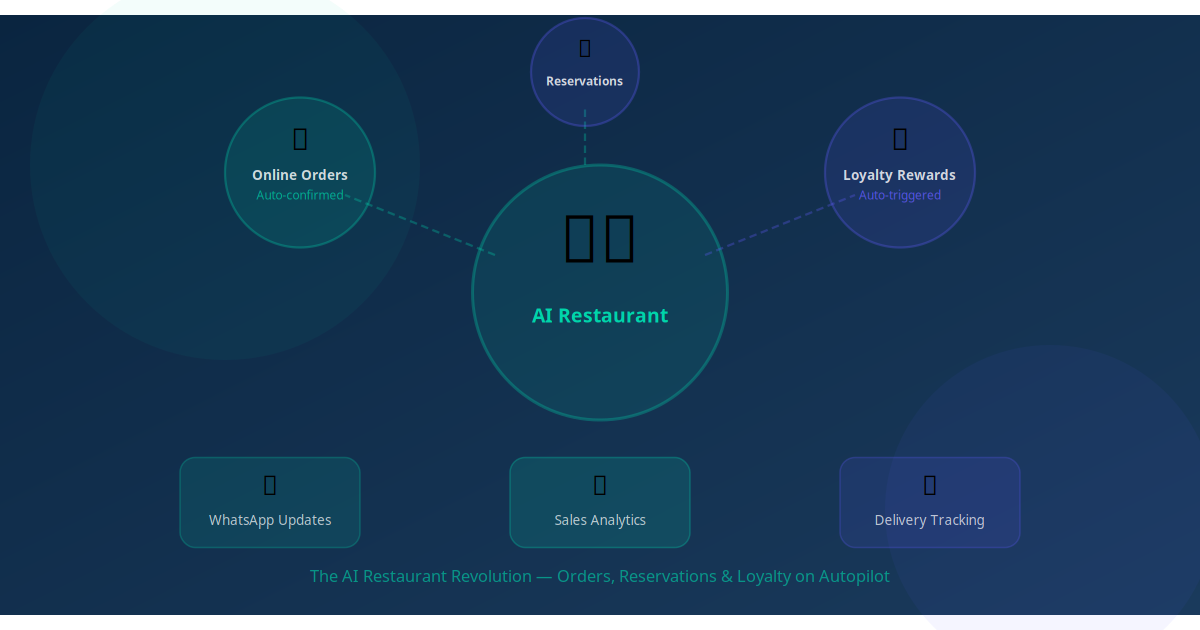
Restaurant Booking Automation: The Complete AI Guide 2026




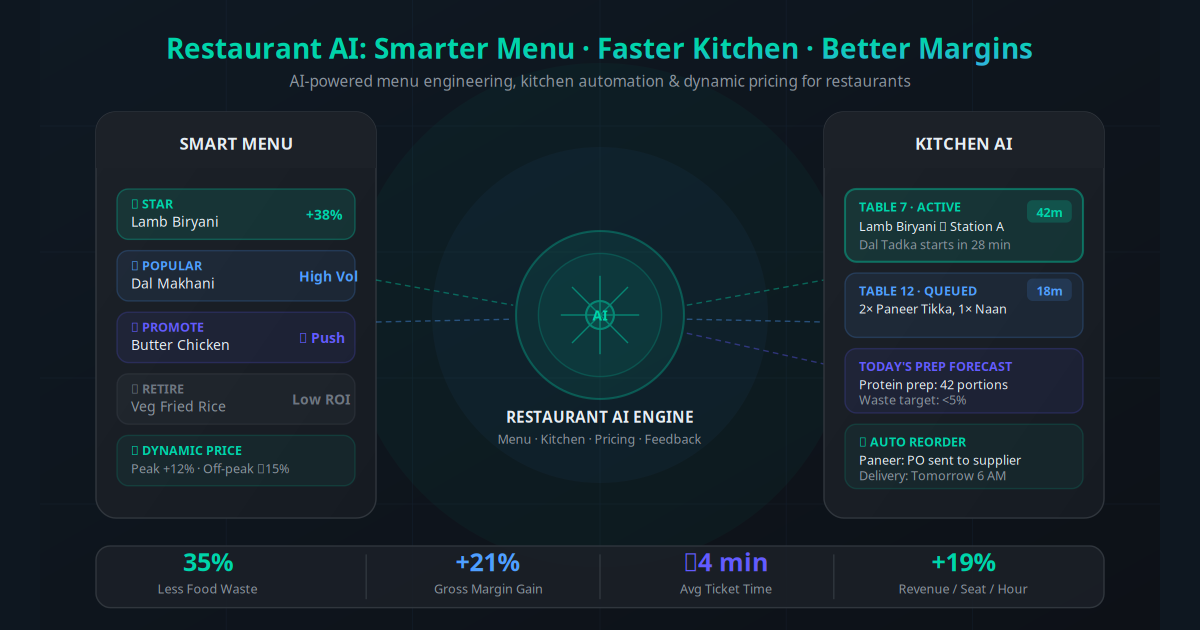
Restaurant booking automation is the use of AI-powered software to handle table reservations, manage waitlists, process orders from multiple channels, and communicate with guests automatically — reducing no-shows by up to 55%, eliminating order errors, and saving restaurant owners 20 or more staff hours every week.
- AI reservation systems accept bookings 24/7, send multi-step reminder sequences, and fill cancelled slots automatically via a real-time waitlist.
- Automated restaurant ordering consolidates dine-in, takeaway, delivery app, and WhatsApp orders into one system — no manual re-entry, no missed tickets.
- AI chatbots for restaurants answer menu questions, confirm bookings, and handle modifications instantly, even outside business hours.
- Restaurants using AI automation report a 40–55% drop in no-shows and a 30–50% reduction in order errors.
- Restaurant automation software is now affordable for independent venues, with returns typically realized within 60–90 days of deployment.
Introduction: Why Restaurant Operations Break Down
Restaurant ownership is a relentless balancing act. You are managing perishable inventory, coordinating kitchen staff across multiple stations, taking reservations by phone while simultaneously serving a full dining room, processing orders from your website, WhatsApp, Swiggy, and Zomato simultaneously, and trying to build guest loyalty — all at once.
The result? Staff burn out. Orders get missed. Reservation no-shows empty your best tables on a Friday night. Guests call to check on their booking and no one picks up. Loyal customers who had a great experience six weeks ago were never re-engaged, and they quietly chose a competitor for their next celebration.
These are not staffing failures. They are systems failures — and they are entirely solvable with the right restaurant AI automation. According to a McKinsey analysis of the hospitality sector, restaurants that deploy automation across their core operations see an average 15–25% improvement in EBITDA margins within 18 months of implementation.
This guide explains exactly how restaurant booking automation, automated restaurant ordering, and AI-powered chatbots work — and how independent restaurants can deploy these tools affordably in 2026.
What is Restaurant Booking Automation?
What is restaurant automation?
Restaurant automation is the use of AI and software to handle repetitive operational tasks — reservations, order taking, customer communication, loyalty tracking, and inventory management — without manual staff intervention. It is not about replacing hospitality; it is about freeing your team to deliver it.
Restaurant booking automation specifically refers to the end-to-end automation of the table reservation lifecycle: accepting bookings from multiple channels, checking real-time table availability, sending confirmation and reminder messages, managing modifications and cancellations, and dynamically filling cancelled slots through an automated waitlist — all without a staff member touching the process.
A fully automated booking system works like this:
- A guest visits your website at 10 PM and books a table for four people on Saturday at 7:30 PM.
- The AI checks real-time table availability and confirms the booking instantly — no phone call required.
- The guest receives a WhatsApp confirmation with booking details and a one-tap cancellation link.
- Forty-eight hours before the reservation, the AI sends an automated reminder: "Looking forward to seeing you this Saturday at 7:30 PM. Reply CANCEL if your plans change."
- Two hours before, a final reminder is sent. The guest cancels at the last minute.
- The AI immediately contacts the next person on the waitlist and offers them the slot.
- The table is filled. Revenue is protected. Zero staff involvement required.
This is not a futuristic concept. It is how the best-run restaurants operate today — and the technology is now accessible to any venue, regardless of size.
How Automated Restaurant Ordering Works
How does AI restaurant ordering work?
An AI restaurant ordering system connects to all your ordering channels — dine-in QR codes, your website, WhatsApp, food delivery apps — via API integrations. When an order comes in from any source, the system automatically validates it, sends an order confirmation to the customer, routes the ticket to the correct kitchen station, tracks preparation status, and triggers delivery or pickup notifications. Staff only see consolidated, clearly formatted tickets — never raw messages from five different apps.
The core problem with restaurant order management in 2026 is channel fragmentation. A single restaurant might receive orders through:
- Dine-in: paper tickets, POS terminal, or QR-code self-ordering at the table
- Takeaway phone orders: staff writing on notepads
- WhatsApp: customers messaging the restaurant directly
- Your own website: integrated ordering widget
- Third-party platforms: Swiggy, Zomato, Uber Eats, or similar
Each channel has a different interface. Staff have to monitor all of them simultaneously, manually enter orders into the KDS (kitchen display system), and hope nothing gets lost in translation. The error rate in this manual workflow is significant — research published in the Harvard Business Review estimates that manual order re-entry errors cost mid-sized restaurants between $15,000 and $40,000 annually in comped meals, refunds, and lost customers.
Automated restaurant ordering solves channel fragmentation by acting as an integration layer that sits above all your ordering channels. Every incoming order — regardless of source — is normalized into a standard format, validated against your menu (flagging out-of-stock items before the customer is told an hour later), confirmed to the customer automatically, routed to the kitchen, and tracked through to fulfillment.
Key Takeaway
Restaurants using a unified automated ordering system report 30–50% fewer order errors, a 22-minute reduction in average order-to-table time, and a measurable increase in customer satisfaction scores — all from fixing the channel fragmentation problem.
Explore all industry-specific AI automation solutions we offer at Jogi AI.
Types of Restaurant AI Automation
AI Reservation Systems
An AI restaurant booking system is purpose-built for the reservation management workflow. The best systems in 2026 offer:
- 24/7 omnichannel booking: Guests can book via your website widget, Google Reserve, WhatsApp, or by messaging your AI chatbot at any hour.
- Real-time availability management: Tables are blocked, confirmed, and released in real time across all channels simultaneously — no double-bookings.
- Automated multi-step communication: Confirmation → 48-hour reminder → 2-hour reminder, with cancellation prompts at each stage.
- Smart waitlist management: Automatic notification and reallocation when cancellations occur.
- No-show prediction: AI models that score each reservation for no-show likelihood based on historical data, allowing intelligent overbooking recommendations.
- CRM integration: Each booking is linked to a guest profile that tracks visit history, preferences, and spending — building a database that powers personalised marketing.
AI Ordering Systems
An AI restaurant ordering system handles the full order lifecycle from the moment a customer browses your menu to the moment their food arrives:
- QR code table ordering: Guests scan a QR code, browse a rich digital menu with photos and allergen information, place their order, and pay — all from their phone, without waiting for a server.
- WhatsApp ordering: Customers send a message and are guided through a conversational ordering flow — selecting dishes, customizing their order, and completing payment via an automated link.
- Cross-channel consolidation: All orders from all sources appear in a single kitchen display, formatted consistently and colour-coded by channel and priority.
- Upsell intelligence: The AI suggests complementary items (a wine pairing, a side dish, a dessert) at the right moment in the ordering flow — typically increasing average order value by 8–15%.
AI Chatbots for Restaurants
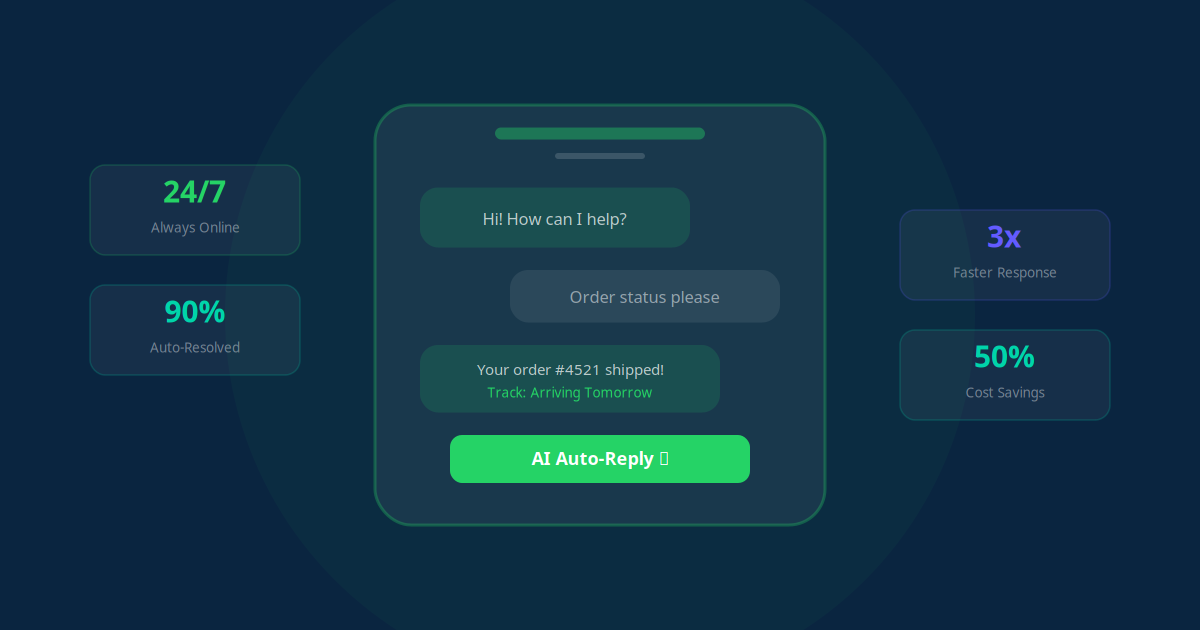
An AI chatbot is the conversational front-end of your restaurant's automation stack. It handles all inbound customer communication — on WhatsApp, your website, and Instagram DMs — and resolves the vast majority of queries without human escalation:
- Menu questions: "Do you have a vegetarian tasting menu?" "What are your gluten-free options?"
- Booking management: "I'd like to book a table for 6 on Friday evening."
- Order status: "Where is my delivery order? It was placed 35 minutes ago."
- Operational queries: "What time do you close?" "Is parking available?"
- Special requests: "We have a guest celebrating a birthday — can you arrange a cake?"
Queries that require genuine human judgment — a large group with a very specific menu brief, a complaint that needs a manager's response — are escalated immediately to the right staff member with full context. The chatbot handles approximately 80% of inbound messages autonomously, according to data from Forbes Technology Council research on AI in hospitality.
Benefits of AI Automation in Restaurants
What are the benefits of restaurant automation?
Restaurant automation reduces operational errors, cuts no-shows, saves staff hours, increases average order values, and enables data-driven decisions. The financial impact is typically felt within the first 60–90 days of deployment.
- 40–55% reduction in reservation no-shows — automated multi-step reminder sequences give guests multiple opportunities to cancel in advance, protecting your peak-hour revenue.
- 30–50% fewer order errors — automated order routing eliminates manual re-entry and miscommunication between front-of-house and kitchen.
- 20+ staff hours saved per week — hours previously spent answering booking calls, re-entering orders, and sending manual confirmations are returned to guest-facing service.
- 8–15% higher average order value — AI-driven upsell suggestions at the point of ordering increase spend per cover consistently.
- 24/7 booking and inquiry handling — your restaurant captures reservations and answers questions even when closed, including the late-night browsing window (10 PM–midnight) when many booking decisions are made.
- Improved guest experience scores — instant responses, accurate orders, and personalized communication drive measurable improvements in Google reviews and repeat visit rates.
- Real-time revenue visibility — dashboards showing covers, revenue, average spend, and channel performance by hour, day, and week — without manual reporting.
- Scalability without proportional staffing costs — a restaurant handling 200 covers per day can double its covers with AI automation without doubling its reservations team.
Traditional Restaurant Operations vs AI Automation
| Operation | Traditional (Manual) | AI Automation |
|---|---|---|
| Table reservations | Phone calls handled by staff during business hours only | 24/7 multi-channel booking via website, WhatsApp, and chat |
| Booking confirmations | Verbal confirmation only; high no-show rate | Automated multi-step reminders; 40–55% no-show reduction |
| Order taking | Separate staff per channel; manual re-entry into POS | Unified order stream; all channels routed to one KDS |
| Customer queries | Staff answer phone/WhatsApp; average response 45–90 min | AI chatbot responds in under 30 seconds, 24/7 |
| Waitlist management | Paper list; guests call back to check availability | Auto-notify waitlist when cancellation occurs; slot filled in <10 min |
| Loyalty tracking | Punch cards; inconsistently applied; frequently forgotten | Automatic point accrual; milestone rewards sent via WhatsApp |
| Revenue reporting | End-of-day manual tallying; data not broken down by channel | Real-time dashboard; revenue, covers, and AOV by channel and time slot |
| Re-engagement | No systematic win-back; lapsed customers are simply lost | Auto-triggered win-back campaigns at 30, 60, and 90 days of inactivity |
| After-hours bookings | Zero — no one available to take reservations | Full booking capability 24/7; peak conversion at 10 PM–midnight |
Real-World Examples of Restaurant Automation
These scenarios reflect typical results from restaurants that have implemented AI automation across their operations.
"We were losing three or four table slots every weekend to no-shows. Now the AI sends reminders on our behalf, and guests who can't make it cancel in advance. Our Friday and Saturday occupancy went from 74% to 91% in eight weeks." — Owner, 80-cover fine dining restaurant, Bengaluru
Case: Multi-branch QSR chain in Mumbai
A six-branch quick service chain was managing orders from Swiggy, Zomato, their own website, and phone calls across each branch separately. Order error rates were running at 8.4%. After deploying a unified AI ordering system, error rates dropped to 1.1%, average order fulfillment time decreased by 18 minutes, and their monthly refund costs fell by 67%.
Case: Family-owned coastal restaurant, Goa
A 60-cover restaurant with two staff members managing front-of-house implemented an AI chatbot for WhatsApp and a booking automation system. Previously, one of the two staff spent approximately 3 hours per day managing booking calls and WhatsApp messages. After automation, that time dropped to under 20 minutes of exception handling. The freed-up capacity was redeployed to floor service, leading to a 0.4-star improvement in their Google rating within three months.
Case: Cloud kitchen operation, Delhi
A cloud kitchen operating four virtual brands from one location deployed an AI ordering integration that consolidated all incoming orders from five delivery platforms into a single KDS screen. Kitchen staff no longer had to monitor multiple tablets. Peak-hour order processing capacity increased by 35% without any additional kitchen staff.
How AI Restaurant Automation Reduces Costs and Improves Customer Experience
The ROI of restaurant automation operates on two dimensions simultaneously: cost reduction and revenue enhancement. Understanding both is important for making the business case.
Direct cost reductions:
- Labour hours: Automating reservations, order taking, and customer communication typically saves 20–30 staff hours per week. At an average hospitality wage, that represents $400–$700 in weekly labour cost savings.
- Order error costs: Each incorrect order costs a restaurant approximately $12–$25 in ingredient waste, remade dishes, discounts, and customer goodwill. Reducing error rates by 40% directly cuts this cost line.
- No-show revenue recovery: At an average table spend of $80 and 4 no-shows per week, restaurants recover $16,640 per year simply by reducing no-shows from an industry average of 15% to under 6%.
Revenue enhancements:
- Higher covers: Filling waitlisted slots when cancellations occur adds 3–8 additional covers per week on average at busy restaurants.
- Increased average order value: AI upsell suggestions during ordering add $6–$14 per order on average — significant when multiplied across hundreds of weekly orders.
- Repeat visit rates: Automated loyalty and win-back campaigns drive a 22–30% increase in lapsed-customer reactivation. Returning customers typically spend 18% more than first-time guests.
Customer experience improvements: The customer-facing impact of automation is equally important. A guest who books a table at 11 PM on your website and receives an instant confirmation has a better experience than one who leaves a voicemail and waits 14 hours for a callback. A guest who gets a WhatsApp message remembering their birthday and their favourite dish feels genuinely known. These are the experiences that generate five-star reviews, social media posts, and word-of-mouth recommendations — the most valuable marketing a restaurant can earn.
Is restaurant automation expensive?
No — not in 2026. Restaurant automation software starts from approximately $179/month for independent venues, which is less than the cost of a part-time employee for a single week. Most restaurants achieve positive ROI within 60–90 days, primarily through recovered no-show revenue and reduced order error costs.
Future of AI in the Restaurant Industry
The trajectory of AI in restaurants is moving rapidly from single-point automation toward fully integrated, predictive restaurant intelligence. Here is what the next two to three years look like:
Predictive demand forecasting: AI systems will analyze booking data, local events, weather, and social media trends to forecast covers 7–14 days ahead with high accuracy — enabling smarter staffing, purchasing, and prep decisions.
Personalised menus: An AI booking system will soon cross-reference a returning guest's order history to suggest a personalised menu section when they arrive — "Welcome back, we've highlighted some new dishes we think you'll love based on your previous visits."
Voice ordering integration: Conversational AI will enable guests to place orders via voice — at a drive-through, over the phone, or via a smart speaker — with the same accuracy as a digital form submission.
Dynamic pricing: Similar to how airlines and hotels manage yield, AI will enable time-based and demand-responsive pricing for reservations — higher prices during peak slots, automated discounts during slow periods to maximize covers.
Fully autonomous supply chain: AI systems will automatically trigger supplier purchase orders when inventory falls below threshold, negotiate delivery timing, and update the kitchen on substitution options when items are unavailable — all without manager intervention.
The restaurants that invest in the foundation of automation now — booking, ordering, and communication — will be positioned to adopt these more advanced capabilities as they become available, compounding their competitive advantage year over year.
How Jogi AI Helps Restaurants Automate Operations
Jogi AI builds custom AI automation workflows for restaurants and food businesses, connecting your existing tools and channels into an intelligent, automated operation.
Our restaurant automation stack covers:
- AI Restaurant Booking System: 24/7 table booking via website, WhatsApp, and chatbot; automated confirmation and multi-step reminder sequences; smart waitlist management; no-show prediction and occupancy optimization.
- Automated Restaurant Ordering: Unified order management across all channels with kitchen routing, real-time status updates to customers, and end-of-day analytics by channel and item.
- WhatsApp AI Chatbot: Handles booking requests, menu queries, order tracking, and special requests around the clock — escalating only what genuinely needs a human.
- Loyalty and Re-engagement Automation: Points-based loyalty program with automated milestone rewards; 30/60/90-day win-back campaigns for lapsed customers; birthday and anniversary offers sent automatically.
- Revenue Intelligence Dashboard: Real-time visibility into covers, revenue, average order value, channel performance, and customer lifetime value — all in one place.
We work with independent restaurants, multi-branch dining groups, cloud kitchens, and QSR chains. Every implementation is tailored to your specific operation — your menu, your channels, your POS system, and your guests.
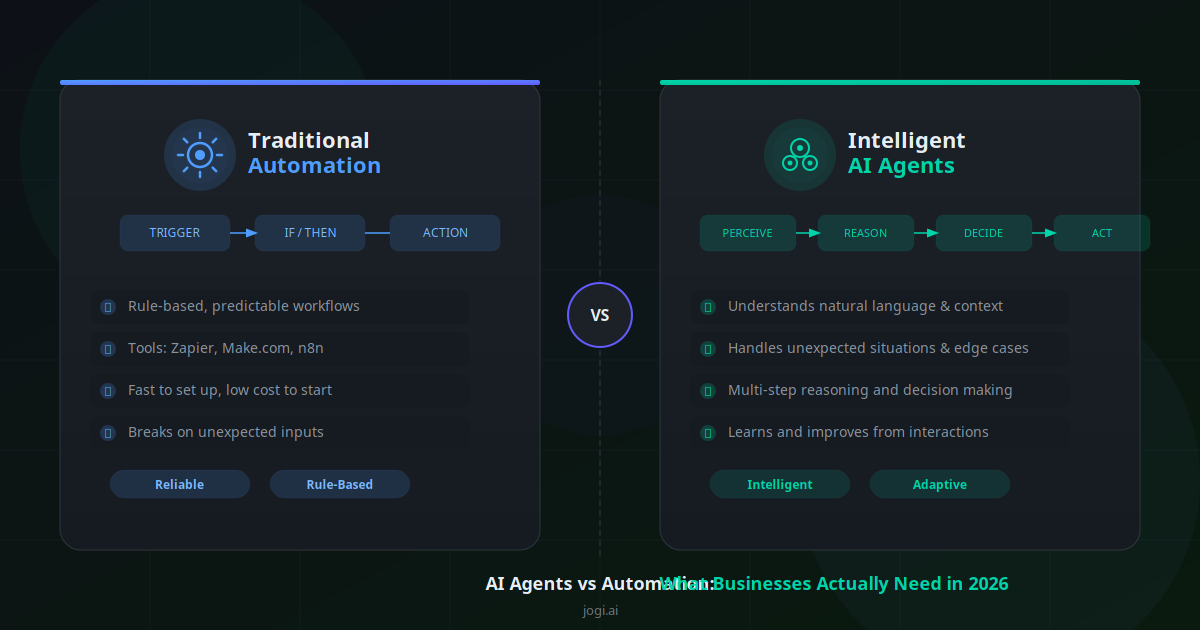
Explore more about how AI automation transforms businesses across industries on our blog, or compare the different approaches in our deep-dive on AI agents vs traditional automation.
Ready to Automate Your Restaurant?
Stop losing revenue to no-shows, order errors, and unanswered booking requests. Book a free AI automation audit with Jogi AI — we will map out exactly which automations will have the biggest impact on your restaurant within 30 days.
Frequently Asked Questions About Restaurant Booking Automation
What is restaurant booking automation?
Restaurant booking automation is the use of AI and software to manage the entire reservation lifecycle without manual staff involvement. It accepts bookings from multiple channels (website, WhatsApp, chat), checks real-time availability, sends automated confirmation and reminder messages, handles cancellations and modifications, and manages a waitlist to fill empty slots automatically. The result is fewer no-shows, more covers, and less staff time spent on phone and messaging management.
How does AI restaurant ordering work?
AI restaurant ordering systems integrate with all your existing order channels via APIs — your website, WhatsApp, QR code menus, and third-party delivery apps. When an order arrives from any source, the AI validates it against your live menu, confirms it to the customer automatically, routes the ticket to the correct kitchen station, and tracks it through to fulfillment. Staff see one unified, clearly formatted order stream rather than monitoring multiple apps. This eliminates manual re-entry errors and gives the kitchen better visibility across all orders simultaneously.
Can AI take restaurant reservations?
Yes — and it does so 24 hours a day, seven days a week. AI reservation systems can accept bookings via website chat widgets, WhatsApp, Google Reserve, and phone voice interfaces. They check real-time table availability across all seating areas, confirm bookings instantly, send multi-step reminders to reduce no-shows, and manage modifications or cancellations — all without any staff involvement. This is particularly valuable during the late-evening booking window (10 PM–midnight) when many diners make plans for the weekend but no staff are available to take calls.
What are the benefits of restaurant automation?
The key benefits are: a 40–55% reduction in reservation no-shows; 30–50% fewer order errors; 20+ staff hours saved per week on administrative tasks; 8–15% higher average order value from automated upselling; 24/7 booking and inquiry handling; improved Google review scores and repeat visit rates; and real-time revenue visibility across all channels. For most restaurants, these benefits collectively represent a positive return on investment within 60–90 days of deploying automation.
Is restaurant automation expensive?
Restaurant automation has become significantly more affordable since 2022. Entry-level AI automation packages for independent restaurants now start from approximately $179 per month — less than the weekly labour cost of a single part-time employee. The typical payback period is 60–90 days, primarily driven by recovered no-show revenue and reduced order error costs. For restaurants doing more than 500 covers per month, the ROI case is strong in virtually every scenario.
Conclusion
Restaurant booking automation, automated ordering, and AI-powered communication are not experimental technologies in 2026 — they are operational necessities for restaurants that want to compete effectively, protect their peak-hour revenue, and deliver a consistently excellent guest experience without burning out their team.
The economics are clear: automating reservations alone recovers thousands of dollars in monthly no-show revenue. Unified order management cuts error costs dramatically. AI chatbots return your staff's time to the floor. And the combination of these automations creates a flywheel — better operations lead to better reviews, which drive more covers, which generates more data for the AI to optimize further.
The restaurants winning in 2026 are not the ones with the biggest teams. They are the ones with the smartest systems — and those systems are now accessible to any venue, at any scale, from a single-location cafe to a multi-branch dining group.
The question is not whether to automate. It is how quickly you can get started.