AI Agents vs Automation: What Businesses Actually Need in 2026
Why Businesses Are Confused About AI Agents vs Automation
Every week, business owners ask some version of the same question: "Do I need AI or automation — and what is actually the difference?" It is one of the most common points of confusion in 2026, and for good reason. Vendors use the terms interchangeably, technology is moving fast, and the costs vary wildly.
The confusion is understandable. Both automation and AI agents help businesses save time, reduce manual work, and scale operations. But underneath the surface, they are fundamentally different technologies that solve fundamentally different problems. Choosing the wrong one is not just a waste of money — it can leave critical business processes broken or under-served.
In this guide, we will cut through the noise. You will learn exactly what each technology does, where it excels, where it falls short, and — most importantly — how the smartest businesses are combining AI workflow automation and intelligent AI agents to build a competitive edge that compounds over time.
What Is Traditional Automation?
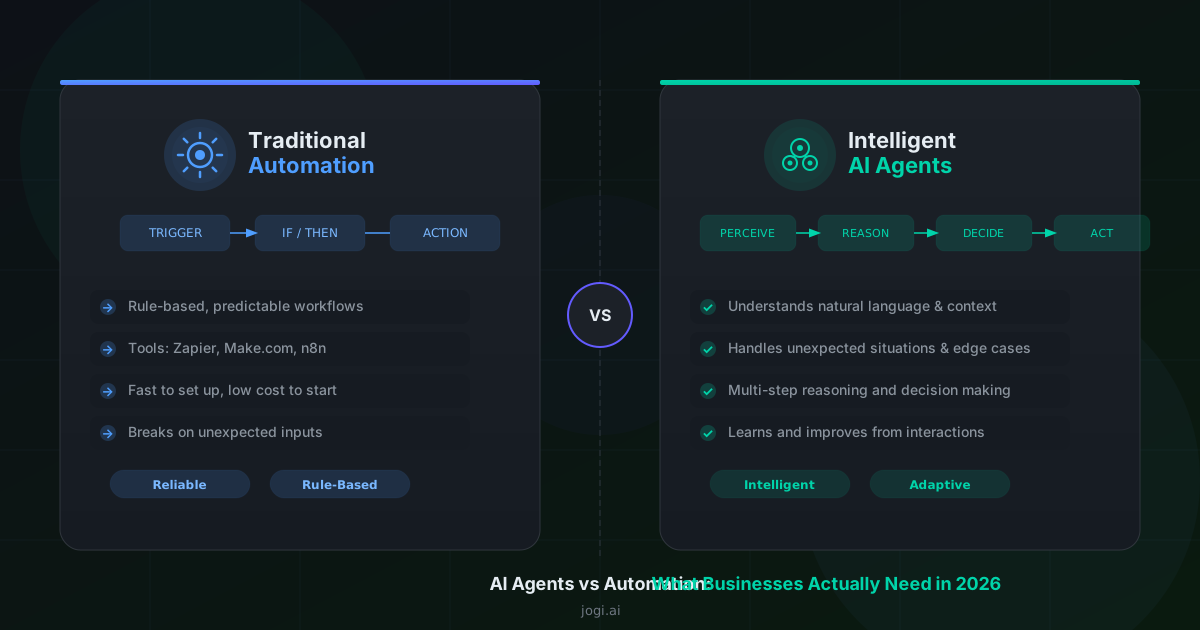
Business automation, at its core, is the practice of defining rules that a system then executes without human involvement. You set the conditions; the software does the repetitive work. This is also called rule-based automation or, in enterprise contexts, RPA (Robotic Process Automation).
The most popular tools for building these workflows are:
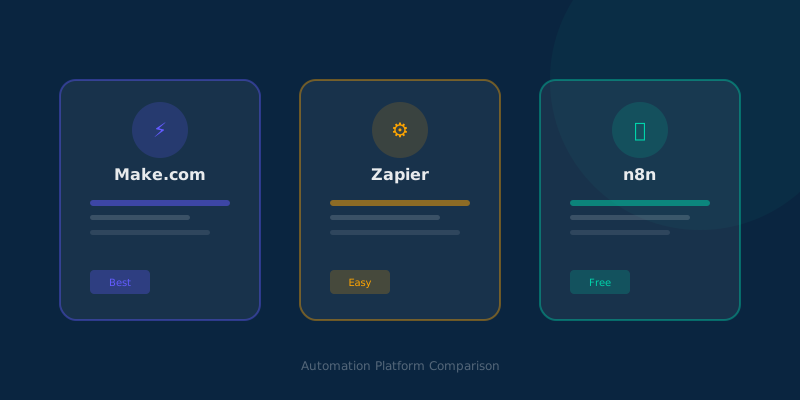
- Make.com (formerly Integromat) — a visual drag-and-drop workflow builder that connects hundreds of apps
- Zapier — the most widely used automation platform for small businesses, renowned for its simplicity
- n8n — an open-source, self-hostable alternative with greater flexibility and no per-task pricing
These platforms operate on a trigger → action logic. When X happens, do Y. For example:
- When a new lead fills out your contact form, add them to your CRM and send a welcome email
- When a payment is received, create an invoice in your accounting software and notify your finance team
- Every Monday at 8 AM, generate last week's sales report and email it to the management team
- When stock drops below 20 units, send a reorder request to your supplier
Strengths of Traditional Automation
- Fast to deploy — most workflows can be set up in hours, not weeks
- Highly reliable — executes exactly the same steps every single time, no variation
- Affordable — most platforms start at $20–$100/month for small business usage
- Easy to audit — every step is visible and predictable, making troubleshooting straightforward
Limitations of Traditional Automation
- Brittle to change — when an app updates its API or a process changes, workflows break and need manual repair
- Cannot handle ambiguity — if an input does not perfectly match a rule, the workflow fails or does the wrong thing
- No language understanding — automation cannot read and comprehend a customer email; it can only match keywords
- Zero judgment — it cannot assess context, tone, or nuance — only binary conditions
"Traditional automation is your most reliable employee — it shows up on time and follows every instruction exactly. But it cannot think for itself. The moment a situation falls outside its script, it is lost."
What Are AI Agents?
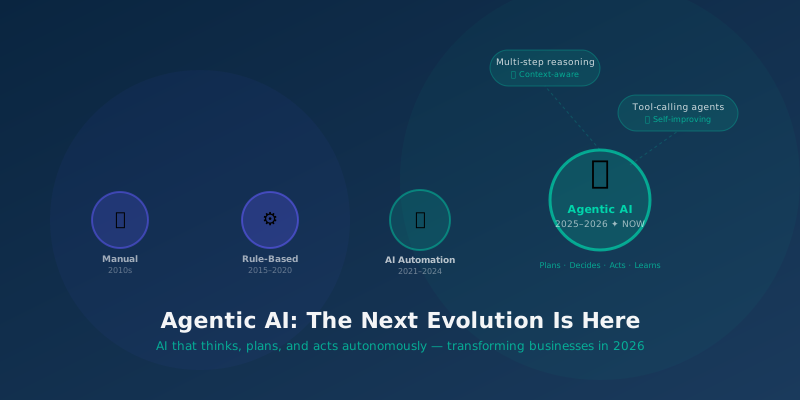
An AI agent is a software system powered by a large language model (LLM) — the same underlying technology behind ChatGPT and Claude — that can perceive information, reason through problems, make decisions, and take actions autonomously to achieve a goal.
Here is the key mental model: if traditional automation is a detailed instruction manual, an AI agent is a capable, experienced employee who understands your business goals and figures out the best course of action — even in situations they have never encountered before.
AI agents are capable of:
- Natural language understanding — reading and genuinely comprehending emails, messages, documents, and customer queries the way a human would
- Multi-step reasoning — breaking a complex request into logical steps, executing them sequentially, and adapting if something goes wrong
- Decision making — weighing context, intent, and available data to choose the best action from multiple options
- Tool and API use — searching the web, querying databases, updating CRM records, sending emails, and interacting with any connected system
- Content generation — drafting personalized emails, proposals, reports, and responses that feel genuinely human
- Learning and improvement — getting better over time through feedback loops and fine-tuning
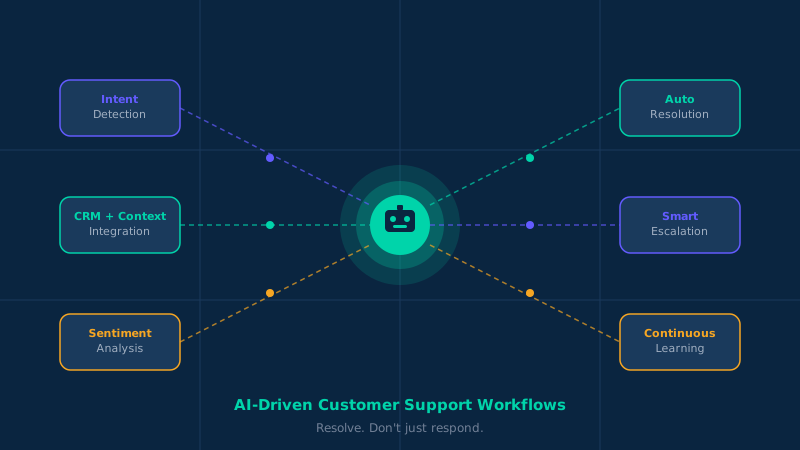
For example, an AI agent handling customer support does not match keywords to canned responses. It reads the customer's message, detects frustration levels, checks their order history in the CRM, determines the most appropriate resolution, writes a personalized reply, processes a refund if warranted, and — if the situation is genuinely complex — escalates to a human agent with a full context summary already prepared.
Key Takeaway
Traditional automation follows rules you set in advance. AI agents understand goals you set and figure out how to achieve them — even when the path forward is unclear. One is not inherently better than the other; they are tools built for different jobs.
Key Differences Between AI Agents and Automation
Here is a detailed side-by-side comparison across the dimensions that matter most to business owners evaluating intelligent automation options:
| Feature | Traditional Automation | AI Agents |
|---|---|---|
| Flexibility | Rigid — works only within defined rules | Highly flexible — adapts to context and edge cases |
| Intelligence | None — executes instructions literally | High — reasons, infers, and understands nuance |
| Decision Making | Binary if-then logic only | Multi-factor judgment based on context and goals |
| Language Understanding | Keyword matching only | Full natural language comprehension |
| Handles Unexpected Inputs | Fails or takes wrong action | Adapts and finds the best available response |
| Content Generation | Cannot — inserts pre-written templates only | Generates unique, personalized content on demand |
| Learning Over Time | None — always follows the same rules | Improves through feedback and fine-tuning |
| Maintenance | Low — update rules when processes change | Moderate — requires prompt tuning and monitoring |
| Setup Complexity | Low to moderate — visual builders, no code | Moderate to high — requires prompt engineering |
| Cost | $20–$500/month (platform fees) | $500–$5,000+/month depending on scope |
| Best For | Predictable, repetitive, structured tasks | Variable, judgment-based, language-heavy tasks |
| Reliability | 100% predictable within defined rules | Highly accurate with proper guardrails |
Real Business Examples: Automation vs AI Agents in Action
Customer Support
With traditional automation: A chatbot matches keywords like "refund" or "broken" to a pre-written response. If a customer writes "my order arrived damaged and I need help urgently," the bot might respond with a generic FAQ link because the exact phrasing does not match any rule — leaving the customer frustrated.
With an AI agent: The agent reads the message, understands the urgency and emotional tone, checks the order record in your system, automatically initiates a replacement shipment for eligible orders, and sends a personalized apology with a tracking number — all without human involvement.
Lead Qualification
With traditional automation: Leads from a pricing page get tagged "high intent" and routed to sales. But a competitor researching your pricing, a student doing homework, and a serious buyer all get the same treatment — wasting sales team time.
With an AI agent: The agent analyses the lead's form responses, company size, website behaviour, and email engagement history to produce a nuanced qualification score. It drafts a tailored first outreach email and routes only genuinely sales-ready leads to your team.
Data Analysis and Reporting
With traditional automation: A scheduled report is generated and emailed every Monday. It always contains the same columns and metrics — regardless of whether something unusual happened last week that warrants deeper investigation.
With an AI agent: The agent analyses the data, identifies anomalies or trends, writes a plain-English summary of what is happening and why, and flags specific items that require management attention — turning raw numbers into actionable insight.
Workflow Automation (Where Traditional Still Wins)
Not every process needs an AI agent. When a new invoice is uploaded, moving it to the right folder, notifying the accounts team, and logging it in your accounting software is a perfect job for traditional automation. It is fast, free of hallucination risk, and needs zero judgment.
"The businesses that will win in 2026 are not the ones who use the most AI — they are the ones who use the right AI for the right job."
— Jogi AI, 2026 Business Automation ReportWhen Should Businesses Use Automation vs AI Agents?
Choose Traditional Automation When:
- The task follows the exact same steps every single time without exception
- The inputs are structured data (numbers, dates, status fields, form values)
- No understanding of language, tone, or context is required
- Speed of implementation and lowest possible cost are the priority
- The task is high-volume and completely predictable (invoice processing, data syncing, scheduled reports)
Choose AI Agents for Business When:
- The task involves reading, understanding, or generating natural language
- Every instance of the task is slightly different (each customer message, each lead, each document)
- Judgment is required — the system needs to weigh options and choose the best action
- You need to scale personalized, human-feeling communication at volume
- Processes involve unstructured data: emails, PDFs, voice transcripts, social media messages
Practical Rule of Thumb
Ask yourself: "Could I write a complete decision tree for this process with no exceptions?" If yes, use automation. If you keep writing "it depends…" — you need an AI agent.
The Hybrid Approach: AI Agents + Automation Working Together
The most sophisticated businesses do not choose between AI agents and automation. They use them as complementary layers: AI agents make decisions; automation executes them reliably.
This hybrid architecture gives you the intelligence of AI where it adds value, and the speed, reliability, and cost-efficiency of rule-based automation for everything else.
Here is how a hybrid lead management workflow looks in practice:
Capture & route: New lead submits your website form. Zapier or Make.com instantly adds them to your CRM, tags the source, and triggers the AI agent workflow.
Qualify & personalise: The AI agent reads the lead's message, researches their company online, scores their intent, and drafts a personalised first outreach email tailored to their industry and pain points.
Send & log: Automation sends the AI-drafted email at the optimal time, logs the activity in the CRM, and schedules a follow-up reminder for the sales team if there is no response within 48 hours.
Monitor & adapt: When the lead replies, the AI agent reads their response, adjusts the qualification score, decides the next best action, and escalates hot leads to your sales team with a full context summary — or continues nurturing cooler leads automatically.
Update & report: All outcomes are automatically logged. Weekly, automation generates a pipeline report showing lead volume, conversion rates by source, and AI agent performance metrics.
This is the power of combining AI workflow automation with intelligent agents: each component handles what it does best, and the result is a system more capable than either approach in isolation.
"We integrated an AI agent into our Make.com workflow for customer support. Response time dropped from 4 hours to under 3 minutes. Customer satisfaction scores went up 28% in the first month. And our support team now focuses entirely on complex, high-value interactions." — E-commerce founder, 2026
Conclusion: AI Agents Are the Next Evolution of Automation
Traditional automation transformed business operations over the past decade. Zapier and Make.com alone have saved countless millions of hours of manual work. But they were always tools for the predictable — for the known, the repeatable, the fully defined.
AI agents represent the next leap: systems that can handle the unpredictable, the nuanced, and the human. They bring genuine intelligence to business processes that were previously too complex to automate — and they do so at a scale and consistency no human team can match.
By the end of 2026, we expect to see:
- AI-native automation platforms that blend both approaches seamlessly in a single interface
- Dramatically lower costs for AI agent deployment as the underlying model costs continue to fall
- Industry-specific AI agents pre-trained on real estate, healthcare, e-commerce, and professional services
- Fully autonomous AI agents managing entire business departments end-to-end with minimal oversight
The businesses building their AI infrastructure today — even starting small — will compound that advantage over every competitor still relying on manual processes. The question is no longer whether to adopt AI for business. It is which processes to automate first, and which deserve an intelligent agent.
Start with your highest-friction, highest-volume processes. Build the automation layer for the predictable work. Then add AI agents where judgment and language matter. And review, measure, and refine continuously.
The edge is not in the technology itself — it is in deploying it earlier, smarter, and more systematically than the business next door.