AI Regulation in 2026: What Every Business Must Know Before Deploying AI
Why AI Regulation Matters Right Now — Not Next Year
For two years, AI regulation was discussed in the abstract. Documents were drafted, committees were formed, and business owners were told they had "time to prepare." That time has now expired.
The EU Artificial Intelligence Act, which entered into full enforcement in 2026, is the most comprehensive AI regulation in the world — and like GDPR before it, it does not just apply to European companies. It applies to any business whose AI systems affect people in the European Union. If you have European customers, partners, or employees, it applies to you.
At the same time, the United States has accumulated a growing patchwork of state-level AI laws — with California, Illinois, Colorado, and Texas all passing meaningful AI legislation in 2025–2026. India's Digital Personal Data Protection Act has provisions affecting AI data processing. The regulatory landscape is no longer a future concern. It is the present operating environment.
Key Takeaway
AI regulation is live and enforceable in 2026. The good news: most business automation AI falls in the lowest risk tier with minimal requirements. The important news: you still need to know which tier you are in and document accordingly.
The EU AI Act: What It Actually Says
The EU AI Act is a risk-based framework. Its most important feature is that it does not regulate AI as a whole — it regulates AI applications based on the risk they pose to fundamental rights, safety, and individual wellbeing. This means most business automation AI faces minimal compliance burden.
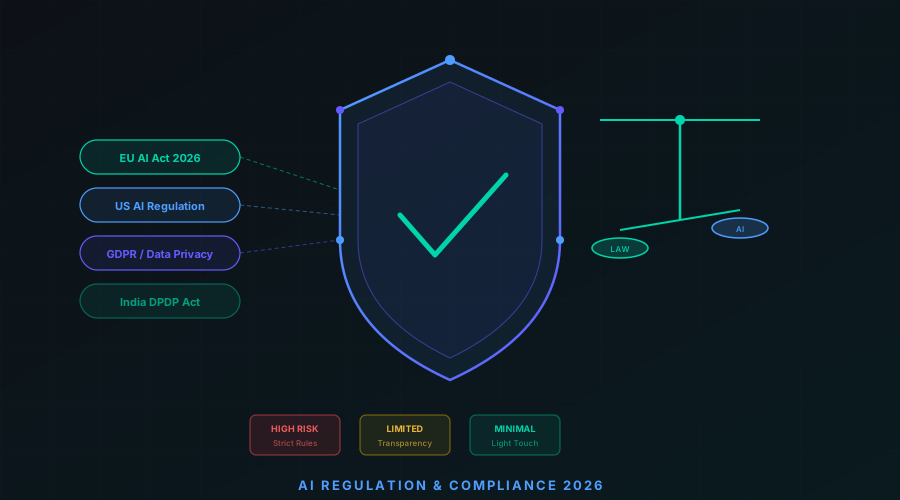
The Act defines four categories of AI risk:
- Unacceptable Risk (Banned): AI that poses a clear threat to safety or fundamental rights. Examples: real-time biometric surveillance in public spaces, social scoring systems, subliminal manipulation. These are prohibited outright.
- High Risk: AI used in consequential decisions about people. Requires registration, risk management, data governance, human oversight, and ongoing monitoring.
- Limited Risk: AI that interacts with humans (chatbots) or generates synthetic content. Requires transparency — users must be told they are interacting with AI.
- Minimal Risk: Everything else — spam filters, recommendation engines, productivity tools, most business automation. No mandatory requirements, though voluntary codes of conduct apply.
Understanding Which Tier Your AI Falls Into
High Risk — Strict Requirements
Examples: AI that screens CVs or ranks job applicants, AI that makes or assists in credit scoring, AI used in educational admissions, AI monitoring employee performance for consequential decisions, AI in safety-critical infrastructure.
Requirements: Mandatory registration in EU database, documented risk management system, data quality standards, detailed technical documentation, human oversight capability, post-market monitoring, incident reporting.
Limited Risk — Transparency Required
Examples: Customer service chatbots, AI-generated marketing content, AI voice assistants, any system where users interact directly with AI.
Requirements: Disclose that the system is AI. Users must be informed they are interacting with an artificial intelligence system. AI-generated content must be labelled as such where practically applicable.
Minimal Risk — No Mandatory Requirements
Examples: Spam filters, AI-powered inventory management, automated invoicing, lead scoring, email automation, marketing personalisation, scheduling automation, most workflow automation.
Requirements: None mandatory. Voluntary adherence to codes of conduct is encouraged but not required.
US AI Regulation: A Patchwork You Need to Track
The United States has not passed federal AI legislation, but the state-level picture is complex and fast-moving. Here are the laws most likely to affect businesses:
| State/Jurisdiction | Key Provisions | Effective Date |
|---|---|---|
| California (AB 2013) | Training data transparency for generative AI systems | Jan 2026 |
| California (SB 1047) | Safety obligations for frontier AI model developers | Signed 2025 |
| Illinois BIPA | Biometric data collection requires explicit consent | Existing law |
| Colorado SB 205 | High-risk AI in consequential decisions — impact assessments required | Feb 2026 |
| Texas AI Act | Transparency and notice requirements for automated decision-making | Mid 2026 |
The common thread in US state laws is transparency in consequential automated decisions. If your AI makes or materially influences a decision about hiring, lending, housing, or insurance — most US state laws require you to disclose that and provide a human review option.
Global AI Regulation: The Picture Beyond EU and US
AI regulation is accelerating globally. Key developments businesses with international operations need to track:
- India DPDP Act 2023 (enforced 2025): Data processing — including by AI systems — requires explicit consent. Automated processing of sensitive personal data requires additional safeguards. Significant financial penalties for non-compliance.
- UK AI Safety Framework: The UK has opted for a principles-based approach rather than prescriptive regulation. Existing regulators (ICO, FCA, CMA) apply their domain-specific rules to AI in their sectors. Less prescriptive than EU but evolving rapidly.
- China AI Regulation: China has specific regulations on generative AI (requiring security assessments), recommendation algorithms (requiring opt-out options for users), and deep synthesis content (watermarking requirements). Businesses operating in China need separate compliance strategies.
- Singapore PDPA AI Guidance: Singapore's Model AI Governance Framework provides detailed, voluntary best-practice guidance that many businesses are adopting as a de facto standard for APAC operations.
What This Means for Your Business Practically
Let us be direct: if your business uses AI for customer service chatbots, marketing automation, email sequencing, invoice processing, scheduling, or general workflow automation — you are almost certainly in the minimal or limited risk category. Your compliance burden is low. The main requirement is transparency: tell users when they are interacting with AI.
Where businesses need to pay closer attention:
HR and Recruitment AI
Any AI that screens, ranks, or scores job applicants is classified as high-risk under the EU AI Act. If you are using AI to filter CVs or rank candidates, you need a documented risk management process, human oversight capability, and in some jurisdictions, registration. This does not mean you cannot use it — it means you need to use it responsibly and document that you are.
Credit and Financial Decision AI
AI that contributes to lending, insurance, or financial decisions about individuals is high-risk. Fintech businesses and any company offering credit terms need specific compliance frameworks.
Customer-Facing AI Interactions
Every customer-facing AI interaction — chatbot, voice assistant, AI email responder — requires you to disclose that the user is interacting with an AI. This is a limited-risk requirement and is straightforward to implement: add "This conversation is handled by AI" to your chatbot interface and email footers.
Your AI Compliance Checklist for 2026
Use this checklist to assess where your business stands today:
Inventory your AI systems. Document every AI tool your business uses, what it does, and what data it processes. You cannot manage what you have not mapped.
Classify each system by risk tier. For each AI tool, determine whether it is minimal, limited, or high risk under the EU AI Act framework.
Add AI disclosure notices. Any customer-facing AI (chatbots, email AI, voice AI) must disclose it is AI. Update your interfaces and email templates now.
Review HR AI tools specifically. If you use AI in any hiring or performance management context, consult with legal counsel about high-risk AI compliance requirements.
Update your Privacy Policy. Explain how AI processes personal data in your systems and what data protection measures are in place.
Verify your AI vendors' compliance. Ask your AI tool providers for their EU AI Act compliance documentation. Reputable providers (OpenAI, Anthropic, Google, Microsoft) have published compliance frameworks.
Establish a human oversight process. For any AI making consequential decisions, define the human review process. Document who reviews, how often, and what triggers escalation.
The Compliance Opportunity: First Movers Win
Here is the strategic insight that most businesses miss: AI compliance is not just a cost centre. Early movers who build responsible AI practices into their operations will have a significant competitive advantage in the next three years.
"AI compliance documentation is fast becoming a vendor selection criterion in enterprise procurement. Businesses that can demonstrate responsible AI practices will win contracts that competitors cannot."
Practically, this means businesses with documented AI governance, human oversight processes, and transparency disclosures will be preferred suppliers to large enterprises and public sector organisations — both of which are increasingly requiring AI compliance evidence from their vendor chains.
Compliance is also a customer trust signal. In an era of growing AI skepticism, businesses that proactively communicate how they use AI responsibly will differentiate themselves from those who remain opaque.
Conclusion: Regulation Is Not a Barrier — It Is a Framework
AI regulation in 2026 does not stop businesses from using AI. It establishes guardrails that, for most businesses, require modest documentation and transparency measures. The businesses that treat compliance as a minimum threshold and then focus on value creation will be the ones that win.
The practical priorities for most SMEs are clear: inventory your AI tools, add transparency disclosures to customer-facing AI, review any HR AI against high-risk requirements, and update your privacy policy. None of these require legal specialists — they require operational discipline.
If you want to explore AI automation for your business in a way that is compliant and effective from day one, the AI Business Twin is designed with compliance best practices built in.
Frequently Asked Questions
Does the EU AI Act apply to businesses outside Europe?
Yes. The EU AI Act has extraterritorial reach similar to GDPR. If your AI system is used by people or organisations in the EU — or if the outputs of your AI affect EU citizens — the Act applies regardless of where your business is based. This affects any business selling to or operating in European markets.
What happens if a business does not comply with the EU AI Act?
Penalties for non-compliance range from €7.5 million or 1.5% of global annual turnover for minor violations, up to €35 million or 7% of global annual turnover for the most serious breaches. The EU also has the authority to order suspension of AI systems pending compliance.
What AI applications are considered high risk under the EU AI Act?
High-risk AI applications include CV screening and HR recruitment tools, credit scoring and loan decisioning, biometric identification, critical infrastructure management, educational admission systems, and AI used in safety-critical functions. Most customer service chatbots, marketing automation, and general business productivity tools fall into the minimal-risk category.
Do small businesses need to worry about AI regulation?
Most small businesses using AI for customer service, marketing, scheduling, or operations are in the minimal-risk category and face minimal compliance requirements — primarily around transparency. Only businesses using AI in HR decisions, credit scoring, or biometric systems face stricter requirements.