Multi-Agent AI Systems: How Businesses Are Building Digital Teams That Run Themselves
Why Single AI Agents Are No Longer Enough
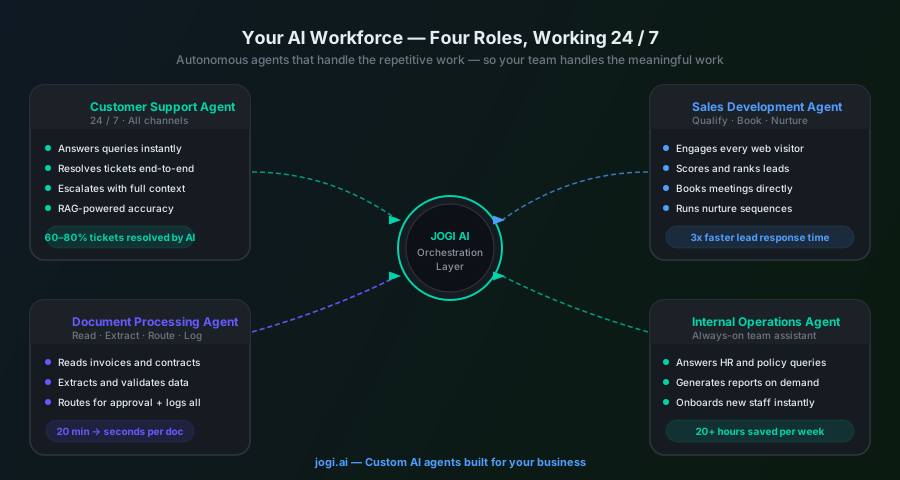
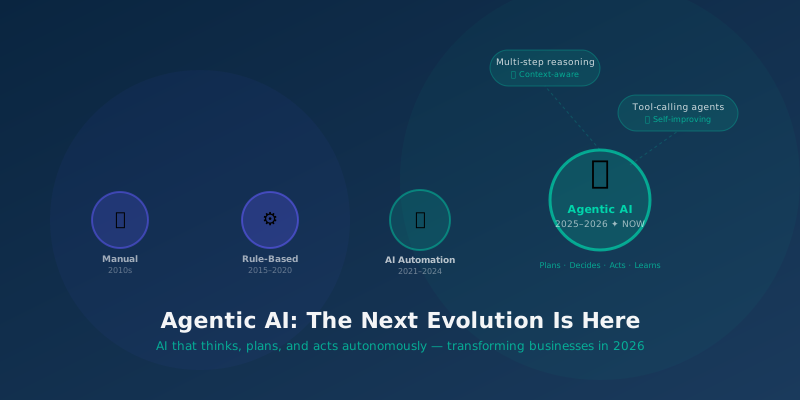
For the past two years, businesses have been deploying single AI agents — a chatbot here, an email responder there — and calling it AI transformation. But the competitive landscape has fundamentally shifted. The businesses pulling ahead in 2026 are not running one AI agent; they are running coordinated networks of AI agents that communicate with each other, divide labour, and complete entire business operations without a human touching any single step.
Think of it this way: a single AI agent is like hiring one highly capable freelancer. A multi-agent system is like running a full department — with a manager, specialists, and coordinators — except none of them need salaries, sleep, or sick days.
The shift from single-agent to multi-agent AI is not just an upgrade. It represents a new paradigm for how businesses will operate at scale. And the window to get ahead is still open — but not for long.
What Is a Multi-Agent AI System?
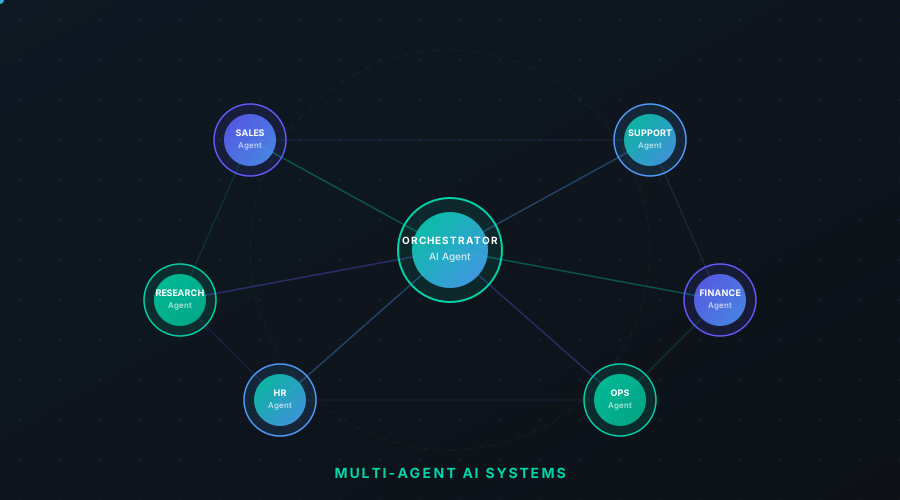
A multi-agent AI system is an architecture where multiple independent AI agents — each with a specific role, toolset, and objective — work together to accomplish a goal that would be too complex for any single agent to handle alone.
Each agent in the network can:
- Perceive inputs (text, data, API responses, file contents)
- Reason about what action to take next
- Execute tools (search the web, query a database, send an email, call an API)
- Pass outputs to other agents in the network
- Report results to an orchestrator that tracks overall progress
The key difference from a single AI model is parallel specialization. Rather than one model trying to be everything — researcher, writer, analyst, and executor — you assign each role to an agent optimized for it. The result is dramatically faster, more accurate, and more reliable output.
Key Takeaway
Multi-agent systems are not just faster AI — they are structurally different. They complete entire workflows autonomously, not just individual tasks. The goal is not to help humans work faster; it is to remove humans from repetitive operational loops entirely.
How Multi-Agent Systems Work: The Architecture
Modern multi-agent systems typically follow one of two architectural patterns:
1. Hierarchical (Orchestrator + Workers)
An orchestrator agent receives the top-level goal and breaks it into subtasks. It delegates each subtask to a specialized worker agent, monitors progress, and assembles final results. This is the most common pattern for business automation because it maps naturally to how teams operate.
2. Collaborative (Peer-to-Peer)
Agents communicate directly with each other, negotiating subtasks without a central coordinator. This pattern is more flexible and handles ambiguous tasks well, but is harder to debug. It is most often used in research-heavy applications like competitive analysis or market intelligence.
In practice, most production systems combine both: a lightweight orchestrator with specialized worker agents that can communicate peer-to-peer within their domain.
"The orchestrator does not do the work — it decides who does the work, in what order, with what inputs. That separation is what makes multi-agent systems scale."
A complete multi-agent workflow for a sales team might look like this:
- Trigger: New lead submits a contact form at 11 PM
- Research Agent: Searches LinkedIn, company website, and news for context
- Qualification Agent: Scores the lead against ICP criteria using gathered data
- CRM Agent: Creates or updates the contact record in HubSpot with all findings
- Outreach Agent: Drafts a personalized first email using the research + qualification data
- Scheduling Agent: Sends the email with a Calendly link and sets a follow-up task if no reply after 48 hours
Total human time involved: zero. Total elapsed time: under 90 seconds.
Real-World Business Use Cases in 2026
E-Commerce: Order Fulfilment Agent Network
An order arrives. One agent checks inventory, flags low stock, and triggers a reorder with the supplier. A second agent generates the packing slip and notifies the warehouse. A third sends a personalised shipping confirmation with upsell recommendations. The whole loop runs without a single human action — from order to dispatch confirmation in under 3 minutes.
Professional Services: Client Onboarding System
A new client signs a contract. An orchestrator spawns agents to: send a welcome sequence, create project folders, assign tasks in the project management tool, schedule onboarding calls, and send a NPS survey after week one. What used to take an ops manager 45 minutes now happens in 60 seconds.
Healthcare: Patient Journey Automation
A patient books an appointment. Agents handle: pre-appointment intake forms, insurance verification, appointment reminders (day 3, day 1, 2 hours before), post-visit follow-up, prescription reminder sequencing, and no-show rebooking offers. One system that used to require a front desk coordinator, a billing admin, and a follow-up caller.
Financial Services: Daily Reporting Pipeline
Every morning at 7 AM, a reporting agent pulls data from five different systems, a summarization agent synthesizes it into a plain-English executive briefing, an alert agent flags anomalies, and a distribution agent sends it to the right people via Slack and email. Zero analyst hours consumed.
The Frameworks Powering Multi-Agent AI in 2026
The multi-agent ecosystem has matured significantly. Here are the tools businesses and developers are actually using:
- CrewAI: The most popular framework for orchestrating role-based agent teams. Extremely readable configuration with built-in memory and tool use. Ideal for business automation tasks.
- Microsoft AutoGen: Built for complex, conversational multi-agent workflows. Strong at task decomposition and agent negotiation. Backed by Microsoft and deeply integrated with Azure.
- LangGraph: A graph-based orchestration framework from LangChain. Best for workflows that need branching logic and conditional agent routing — excellent for approval flows and exception handling.
- OpenAI Assistants API with handoffs: Production-grade agent orchestration from OpenAI. Tight integration with GPT-4o, function calling, and thread management. Simplest option for teams already using OpenAI models.
- n8n + AI nodes: For businesses that want multi-agent capability without writing code. n8n's visual workflow builder now supports multi-step AI agent chains, making it accessible to non-developers.
"We replaced a three-person ops team with a CrewAI system connected to our CRM and project management tools. The system handles everything from lead intake to invoice generation. Our ops person now focuses entirely on exceptions and growth strategy."
— Founder, B2B SaaS company, 12 employeesHow to Build Your First Multi-Agent System
Most businesses should not start with a complex multi-agent architecture. Start with the highest-ROI process in your business and build from there. Here is a practical starting approach:
Step 1: Map Your Most Expensive Manual Process
Identify a workflow that involves 3+ sequential steps, requires information from multiple sources, and is done repeatedly. Lead follow-up, client onboarding, and report generation are the highest-value starting points.
Step 2: Define Agent Roles
For each step in the process, define one agent responsible for it. Give each agent a clear goal, a specific set of tools it can use, and a defined output format that the next agent will receive as input.
Step 3: Choose Your Stack
For non-developers: n8n with AI agent nodes is the fastest path. For developers: CrewAI or LangGraph give you the most control. For enterprise teams: AutoGen or OpenAI Assistants API with a proper orchestration layer.
Step 4: Build the Minimal Viable Agent Team
Start with two or three agents. Run the system on real data. Measure output quality and time. Tune agent prompts and tools before adding more agents. Complexity should be earned, not assumed.
Step 5: Monitor and Improve
Log every agent action and decision. Review edge cases weekly. The biggest risk in multi-agent systems is silent failure — an agent that produces a plausible-looking but incorrect output that gets passed downstream without detection.
What Comes Next: Self-Improving Agent Networks
The current generation of multi-agent systems executes predefined workflows. The next generation — already in research labs — will be capable of self-optimization: agents that review their own output quality, propose new workflow configurations, and update their own prompts based on outcome data.
This is not science fiction. Early versions are already running in controlled environments. The implication for businesses is profound: the agent team you deploy today may be training its own replacement six months from now — a better, faster, cheaper version that you did not have to build.
For business owners, this means two things. First, every day you delay deploying multi-agent systems is a day your competitors' agent networks are getting better. Second, the businesses that build agent infrastructure now will have a structural data advantage that compounds over time — your agents will learn from your specific business context in ways no generic AI product can replicate.
Conclusion: The Team You Build Without Hiring
Multi-agent AI systems represent the most significant operational shift available to businesses in 2026. They are not productivity tools — they are entire operational departments that work 24/7, improve over time, and cost a fraction of the human equivalent.
The technology is production-ready. The frameworks are mature. The only barrier is organizational will — the decision to treat AI agents as infrastructure, not experiments.
Start with one workflow. Build it properly. Measure the results. Then expand. The businesses that do this systematically will have an operational moat that is extremely difficult to close once established.
If you want to see what a multi-agent system could look like for your specific business, the AI Business Twin will model exactly that — no technical knowledge required.
Frequently Asked Questions
What is a multi-agent AI system?
A multi-agent AI system is a network of individual AI agents — each with a specific role and capability — that coordinate with each other to complete complex tasks. An orchestrator agent assigns work, specialist agents execute it, and results flow back automatically without human involvement at each step.
How is multi-agent AI different from a single AI chatbot?
A single AI chatbot handles one conversation at a time with no memory or ability to execute multi-step operations. A multi-agent system deploys several specialized agents simultaneously — one qualifies a lead, another searches your CRM, another drafts an email, another schedules a call — all in seconds, without a human coordinating them.
What tools are used to build multi-agent AI systems?
The most popular frameworks are CrewAI, Microsoft AutoGen, LangGraph, and OpenAI Assistants API. These are paired with automation platforms like n8n or Make.com for action execution and connected to business tools like HubSpot, Slack, or Google Workspace.
Can small businesses use multi-agent AI?
Absolutely. Multi-agent systems are most valuable for small businesses because they let a lean team operate at enterprise scale. A 5-person company can have AI agents handling customer support, lead follow-up, content creation, and financial reporting simultaneously — effectively giving them the operational capacity of a 20-person team.