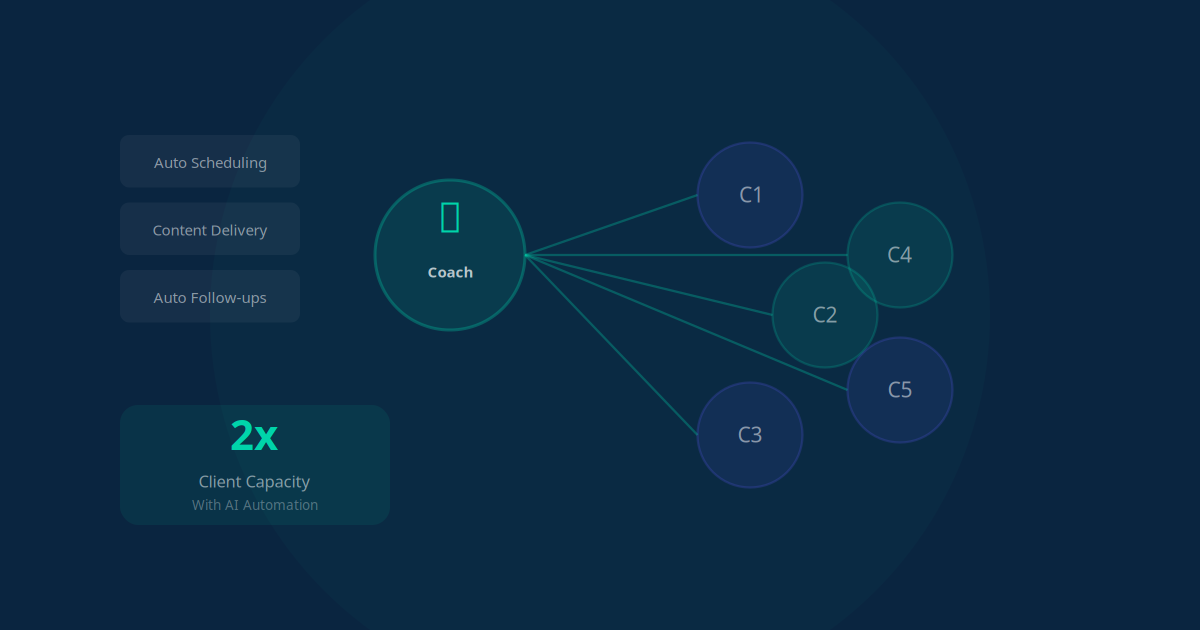
The Revenue Multiplier Effect: How AI Systems Unlock Growth That Manual Operations Simply Cannot Deliver




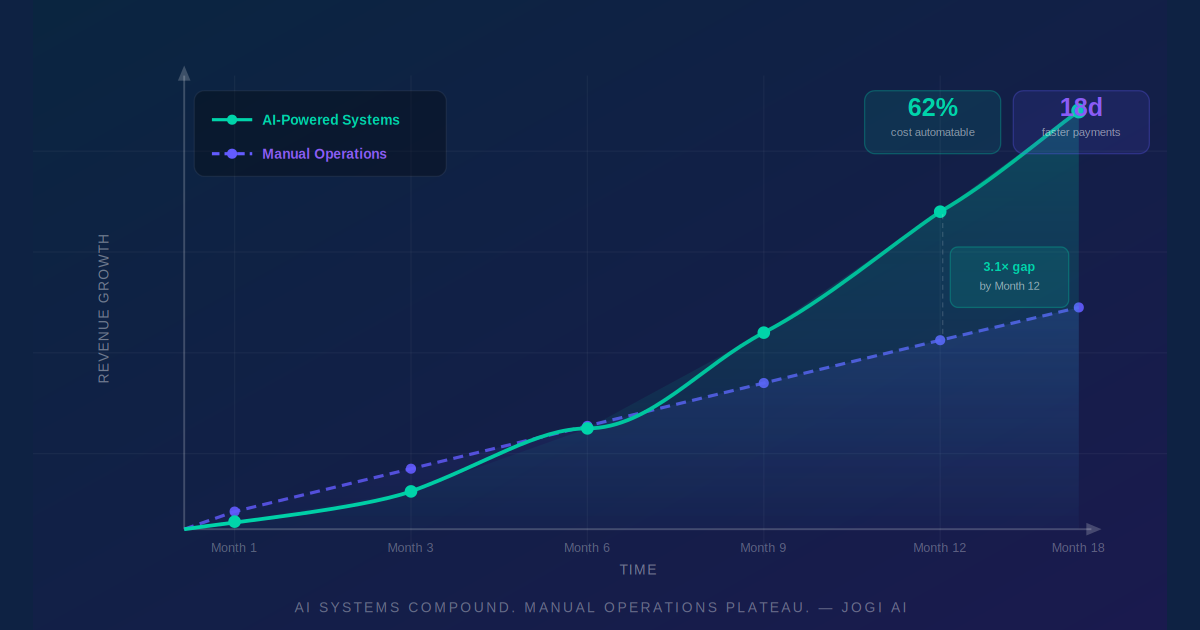
There is a ceiling in your business right now. You probably cannot see it — but it is there. It is built not from a lack of ambition or effort, but from the architecture of how your operations actually run. Every new customer you acquire creates a proportionally larger administrative burden. Every team member you hire brings additional coordination overhead. Every new service you add spawns another manual workflow someone has to manage.
This is the manual operations trap — and it is the single biggest reason why talented, driven founders hit a growth wall at precisely the moment their business should be accelerating.
The good news: this ceiling is not structural. It is not a market constraint or a funding problem. It is a systems problem — and it has a solution. Businesses that deploy AI systems do not just save time on individual tasks. They fundamentally change the relationship between growth and operational cost. They break through the ceiling and enter a growth mode that manual operations categorically cannot support. This is the revenue multiplier effect — and it is available to any SME that decides to build for it.
Why "Working Harder" Has a Diminishing Return — and "Building Smarter" Does Not
Most growing SMEs respond to scaling pressure the same way: hire more people, add more tools, work longer hours. For a while, this works. Then it stops working. Here is why.
Manual operations scale linearly. Double your output, and you typically need to roughly double your input — more people, more time, more oversight. The economics never change. Your revenue ceiling is essentially a function of how many people you can afford to hire and how hard you can push them before quality and morale deteriorate.
AI systems scale differently. Once deployed, an AI workflow handles ten transactions with exactly the same cost, speed, and quality as one transaction. It does not get tired. It does not take lunch breaks. It does not forget to follow up. It does not make the kind of human errors that come from context-switching between twelve different tasks. And critically — as it processes more data, it does not degrade in performance. It improves.
This is the fundamental architectural difference between a manual business and an AI-powered business. One scales linearly with headcount. The other scales exponentially with data and deployment breadth. The compounding advantage this creates is not theoretical — it shows up directly in margin expansion, faster response times, higher customer satisfaction scores, and the capacity to serve markets that would be operationally impossible to reach any other way.
"We were at capacity. Twelve staff, fully loaded, and we were turning away clients because we couldn't handle the volume. Six months after deploying AI automation across our core workflows, we are handling 40% more clients with the same team — and our team is no longer running on empty." — Founder, B2B financial services firm, Mumbai
The Four Places Manual Operations Actively Kill Revenue
Before exploring how AI systems create the multiplier effect, it is worth being specific about where manual operations destroy value — because most business leaders underestimate the true cost.
1. Slow response times that lose deals at the moment of highest intent. Research consistently shows that a lead's likelihood of converting drops by over 80% when response time exceeds five minutes. Yet the average SME takes 12–24 hours to respond to a new enquiry. Every hour of delay is a conversion probability destroyed — and in a competitive market, a slow response is often a permanent loss.
2. Inconsistent follow-up that lets warm leads go cold. Sales pipelines leak at follow-up. A lead expresses interest, gets a call, and then waits three days for a proposal. The momentum is gone. The competitor who followed up the same evening with a personalised message wins the deal. Systematic, intelligent follow-up is one of the highest-ROI applications of AI in any customer-facing business.
3. Support overhead that scales with revenue rather than shrinking. When customer support is entirely manual, your support cost grows in proportion to your customer base. This is a structural margin problem. A well-designed AI support system inverts this relationship — as your knowledge base grows richer and your AI learns from more interactions, the cost per resolved query falls over time. You grow without proportionally growing your support cost.
4. Administrative drag that pulls your highest-value people into your lowest-value tasks. The fully loaded hourly cost of a senior operations manager or account director is significant. When those people are spending hours each week updating CRM records, chasing invoice payments, formatting reports, or scheduling follow-ups — the waste is not just in the hours. It is in the decision-making, relationship-building, and strategic thinking that is not happening because their attention is consumed by work that should not require their intelligence at all.
How AI Systems Create the Revenue Multiplier — Five Specific Levers
Intelligent Lead Capture and Instant Qualification
AI systems capture enquiries from every channel — web forms, WhatsApp, email, Instagram DMs — and immediately qualify, categorise, and route them. A high-intent prospect gets a personalised response within 90 seconds at 2 a.m. on a Sunday. A low-intent enquiry gets appropriately nurtured without consuming a human's time. The result: more leads converted from the same traffic, zero leads lost to response delay.
CRM Automation That Eliminates Pipeline Leakage
AI-powered CRM automation means your pipeline is never stale, your follow-ups never missed, and your highest-priority opportunities never buried. The system scores leads based on real behaviour — email opens, page visits, message sentiment — and triggers the right action at the right moment. Sales leaders stop managing process and start managing relationships. Close rates improve not because your sales team got better, but because the system ensures every opportunity is worked properly.
RAG-Powered Support That Resolves Without Human Involvement
Retrieval-Augmented Generation gives your support AI genuine intelligence about your business — your products, policies, pricing, customer history, and FAQs. It does not give generic responses; it retrieves precise answers from your actual knowledge base. The result is a support system that resolves 60–70% of queries instantly, at any hour, without a human in the loop. The remaining 30–40% that genuinely need human attention are correctly escalated with full context already gathered — so the human's time is used efficiently, not wasted on information retrieval.
Workflow Orchestration That Eliminates Coordination Overhead
The hidden cost in most SMEs is not any single task — it is the coordination between tasks. Who handles this customer query? Has the invoice been sent? Did the follow-up happen? Is the CRM updated? Each handoff between people or tools creates friction, delay, and error risk. AI workflow orchestration automates the handoffs themselves — routing, notifications, approvals, escalations, status updates — so humans focus on decisions and relationships, not coordination.
Intelligent Analytics That Surface Decisions Before They Become Obvious
The difference between a dashboard and an insight is action-readiness. Most business data sits in systems waiting to be interrogated. AI-powered analytics actively surfaces the information you need to act — which customer segments are drifting toward churn, which products are underperforming in specific channels, which operational bottleneck is costing the most revenue right now. Leaders make better decisions because the right information arrives before the moment of crisis, not after.
Three Real Businesses, Three Concrete Results
Problem: Proposal generation consuming senior consultant time; leads going cold during the wait
Each new client proposal required a senior consultant to gather requirements, research the client's industry, structure the engagement scope, and produce a formatted document. Average turnaround: 3–4 days. In competitive pitches, this delay was fatal. The AI system deployed for them combines a client intake workflow (capturing requirements via a structured conversational flow), an AI agent that drafts proposal content against a verified template library, and an automated follow-up sequence. Proposal turnaround dropped to under 4 hours. Competitive win rate improved by 31% in the following quarter — not because the proposals got cheaper, but because they arrived first and were consistently high quality.
Problem: Customer support costs scaling linearly with revenue; team unable to cope with post-launch demand
A product launch drove a 3x spike in customer queries — order tracking, ingredient questions, return requests, and routine "where is my order" enquiries. The support team was overwhelmed within 48 hours, response times ballooned to 36 hours, and negative reviews began accumulating. A RAG-based support AI was deployed within five days, trained on the product catalogue, order data, and return policy. Within two weeks, it was resolving 71% of inbound queries autonomously. Average response time: under 3 minutes. The support team refocused on the 29% of complex queries that genuinely needed human judgement — and customer satisfaction scores recovered to pre-launch levels within a month.
Problem: Project management chaos consuming the creative director's bandwidth; invoices sent late, payments collected late
The creative director was simultaneously managing client briefs, briefing photographers, tracking deliverable deadlines, chasing client feedback, generating invoices, and following up on payments — all manually, across email, WhatsApp, and a half-used project management tool. An AI workflow system connected their project intake form to automatic brief generation, photographer briefing, deadline tracking with automated status updates, invoice generation on delivery, and a multi-step payment reminder sequence. The creative director reclaimed 12 hours per week. Average invoice payment time dropped from 41 days to 19 days. The agency took on three new clients without any additional administrative capacity — because the administrative capacity was now being provided by the system, not by a human.
Key Takeaway
In every case, the core gain is not cost reduction — it is capability multiplication. The same team, the same talent, the same budget, producing materially better outcomes because the AI system removes the friction between their effort and the result. This is the revenue multiplier effect in practice: AI does not replace the humans in these businesses. It removes the work that was preventing those humans from doing their best work.
Your AI Implementation Roadmap: Start Fast, Scale Confidently
The biggest implementation mistake businesses make is trying to automate everything at once. The second biggest is waiting for the "right time" that never arrives. The approach that consistently delivers the best results — fast initial ROI, sustainable long-term growth — is phased deployment built around measurable outcomes.
Identify Your Three Highest-Cost Manual Processes and Automate Them First
Map where the most time is lost and where the most revenue leaks out. For most SMEs, this is some combination of lead response, customer follow-up, and internal status communication. Deploy fast automations in these areas — typically using your existing tools, connected through AI orchestration. The goal is demonstrable time savings and measurable revenue impact within the first month. This builds confidence, surfaces data, and gives you the internal evidence to justify further investment.
Deploy the Primary Systems That Touch the Largest Portions of Your Operation
This is where the major automation layers are built: CRM automation, AI-powered customer communication, invoice and billing automation, and your RAG-based support chatbot. Critically, these systems are integrated — your CRM updates when a support interaction occurs; invoicing triggers when project completion is confirmed; your sales pipeline updates when a WhatsApp conversation reaches a particular intent signal. Fragmented tools become a unified operating system.
Introduce Autonomous Agents for Complex Workflows and Activate Proactive Analytics
AI agents for sales prospecting, content generation, competitive research, and financial reconciliation. Intelligent analytics that deliver weekly automated briefings on operational performance, revenue trends, and risk signals. At this stage, your business generates data, acts on that data, and continuously improves — without manual intervention at each step. This is the compounding advantage that widens the gap between your business and your competitors every month.
Why the Businesses That Move Now Will Be Hardest to Compete With in Three Years
There is a compounding dynamic in AI adoption that is not widely understood. It is not just about the operational advantage you gain on day one of deployment. It is about the data asset your AI systems build over time.
An AI support system deployed today learns from every customer interaction. After three months, it understands your customers' most common objections, their most frequent questions, and the patterns that predict escalation. After twelve months, it is making distinctions that a system deployed tomorrow will take another twelve months to develop. The data moat that accumulates in a well-designed AI system is one of the most durable competitive advantages available to an SME today — because it is built on proprietary knowledge about your specific customers, processes, and market, and it cannot be bought or replicated quickly.
The businesses deploying AI systems in the first half of 2026 are not just gaining an operational advantage. They are building a compounding data advantage that will translate into materially better customer experiences, faster sales cycles, and lower operational costs for years. The window to be an early mover in your industry is not permanently open. In most sectors, it is measured in months, not years.
"AI adoption is not a question of if — every serious indicator says it is a question of when. The only meaningful choice business leaders have is whether they want 'when' to be now, when the advantages are largest, or later, when catching up will cost significantly more." — Jogi AI Strategic Advisory
Why a Strategic AI Partner Matters More Than the Right AI Tool
There is no shortage of AI tools available in 2026. Chatbot platforms, automation suites, CRM add-ons, analytics dashboards — the market is saturated with point solutions that each solve one piece of the puzzle. Most businesses that try to self-assemble an AI stack from individual tools end up with something more complex and less effective than what they started with. They have automation in name but fragmentation in practice.
The distinction between a tool and a system is not semantic. A tool does one thing. A system produces outcomes. At Jogi AI, we do not sell tools — we design and build AI systems that are architecturally integrated, commercially aligned, and operationally maintained. Every engagement begins with a rigorous understanding of your specific revenue model, your customer journey, and your operational constraints. We bring that understanding, combined with implementation experience across 200+ businesses in professional services, retail, healthcare, logistics, and manufacturing, to every system we build.
We know which automation patterns produce rapid ROI and which create technical debt. We know where AI creates genuine leverage in your industry and where off-the-shelf tools are genuinely sufficient. And we build systems designed not just to work on day one, but to improve over the twelve months that follow — because a static AI system is a depreciating asset, and we build to compound.
Your Action Items — Take These Into Your Next Leadership Meeting
- Map your growth ceiling. Where does your operation strain first when you add 30% more customers? That bottleneck is your highest-priority automation candidate.
- Calculate the cost of inaction. If your average lead response time is 12 hours and AI can reduce it to 90 seconds, what is the incremental conversion value of that change at your current enquiry volume?
- Audit your team's time. For one week, track how many hours per person are spent on tasks that require no judgement — data entry, status updates, scheduling, routine follow-up. The total will surprise you.
- Define your 90-day success metric. What single, measurable outcome — faster response time, higher close rate, lower support cost — would prove to your leadership team that AI is delivering real commercial value?
- Book a free AI audit with Jogi AI. Bring your answers. We will map a specific, phased AI implementation for your business and give you a clear, honest view of the ROI you can expect.
The revenue multiplier effect is not a metaphor. It is a measurable, repeatable outcome that businesses are achieving right now — businesses that look exactly like yours, with the same resources, the same team size, and the same market constraints. The only difference is a decision: to stop scaling linearly and start building AI systems that compound.
The ceiling in your business is not permanent. The only question is whether you remove it this quarter — or watch a competitor remove theirs first.