Speed-to-Lead: How AI Responds to Property Inquiries in Seconds




The Lead Is a Race, and Most Agents Are Losing It
A buyer sees a listing they like at 9:40 on a Tuesday night. They fill out the form. They message two more agents from two other listings while they are at it. Now three agents have the same lead, and the buyer is sitting on the couch with their phone in hand, ready to talk.
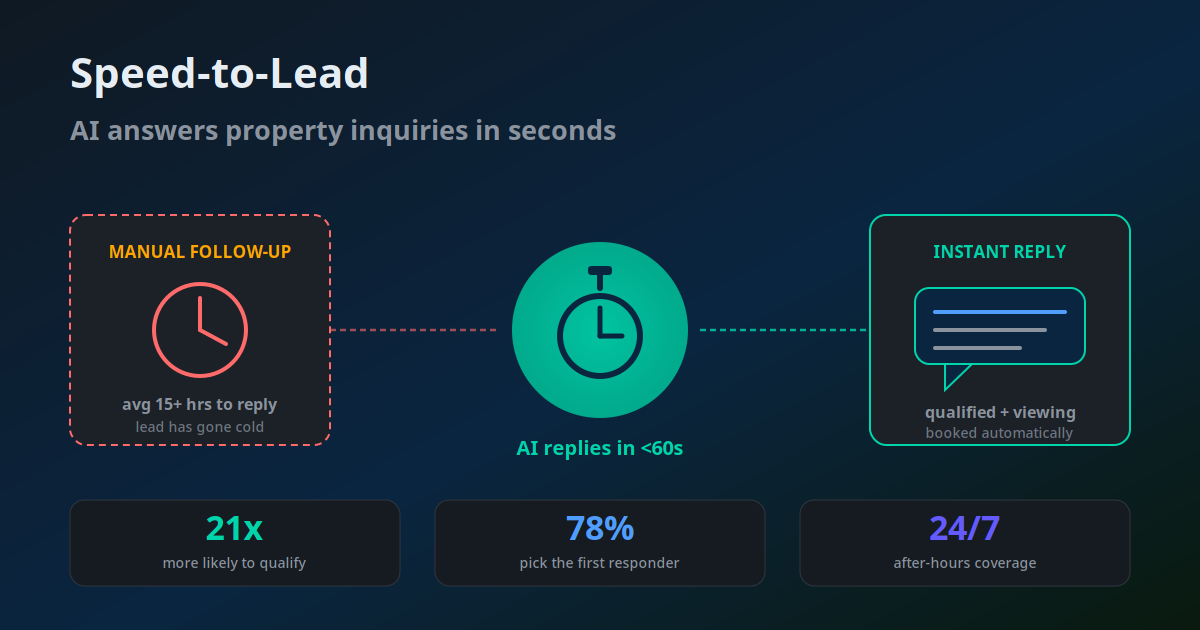
Whoever replies first, wins. Not the agent with the best photos or the lowest fee. The one who answers while the buyer is still paying attention. According to the National Association of Realtors' 2025 buyer data, 78% of homebuyers end up working with the first agent who responds to their inquiry. First contact is most of the game.
Here is the uncomfortable part. A WAV Group study that measured response times across hundreds of US brokerages found the average agent takes 917 minutes — over 15 hours — to reply to a new lead, and nearly half of inquiries got no response at all. By the time that reply lands the next morning, the buyer has already booked a viewing with someone quicker.
This article is about closing that gap with AI, so the buyer on the couch hears back in seconds instead of the next day. I have built these systems for agencies and brokerages, and the pattern is always the same: the technology is easy, the discipline of being first is what agents keep losing. Automation fixes the discipline.
What Speed-to-Lead Actually Means
Speed-to-lead is the time between a person submitting an inquiry and you making first meaningful contact. Not "we logged it in the CRM." Not "an agent will call you back within 24 hours." Actual back-and-forth with a human or an AI that answers their question.
In real estate it is the single metric most correlated with whether a lead ever becomes a client, and it is also the one agents have the least control over, because leads do not arrive on a schedule. They come in during showings, during dinner, at midnight, on the one Sunday you took off. You cannot be at your desk for all of it. That is the whole problem, and it is why AI-driven response changes the math: the assistant is always at the desk.
Key Takeaway
Speed-to-lead is not about working harder or checking your phone more often. It is about guaranteeing that the first reply happens in seconds no matter when the inquiry lands, and only automation can promise that at 100% coverage.
The Numbers Behind the Five-Minute Rule
The "five-minute rule" gets repeated so often it has lost its punch, so it helps to look at the actual research behind it. The numbers are stark, and they have held up across two decades of studies.
| Response window | What the data shows |
|---|---|
| Within 1 minute | Leads convert at roughly 23%, the highest rate measured |
| Within 5 minutes | 21x more likely to qualify the lead than waiting 30 minutes (MIT / InsideSales) |
| At 30 minutes | Conversion drops to under 5% |
| After 1 hour | Qualification odds fall by around 90% |
| Industry average (15+ hrs) | 78% of buyers have already committed to a faster agent |
Read that top row again. A one-minute reply converts almost five times better than a thirty-minute one. The value of a lead is decaying by the minute from the moment it arrives, and most of the drop happens inside the first hour. Every agent knows this. Almost none of them hit it, because being consistently fast by hand is close to impossible once you are showing properties all day.
The best lead is the one you answer while it is still warm. A cold lead answered perfectly still loses to a warm lead answered adequately.
How AI Responds to an Inquiry in Seconds
When a lead comes in, an AI assistant does not wait for anyone to be free. The moment a form is submitted or a message lands, it fires. Here is what sits under the hood, without the jargon.
The inquiry arrives from wherever the buyer is: a portal like Zillow or Rightmove, your website chat, a Facebook lead ad, or a WhatsApp message. A trigger picks it up instantly and hands it to the AI, which reads what the person actually asked. It then writes a reply in your brand's voice that references the specific property, answers the obvious first question, and asks one natural follow-up to keep the conversation moving.
Because it is connected to your listings, calendar, and CRM, it can do more than chat. It checks whether the property is still available, offers two viewing times that are genuinely open, and writes the contact into your system so nothing is lost. If the lead is clearly hot — pre-approved, ready this week — it pings the agent to jump in live. This is the same engine behind broader real estate lead management, pointed at the one moment that matters most: the first reply.
The realtime speech and language models available in 2026 make this feel natural rather than canned. The assistant handles a follow-up question, a change of mind, an odd request, the way a sharp junior agent would. It is not a phone tree, and it is not an autoresponder that says "thanks, we'll be in touch." It holds a real conversation.
Where Instant AI Response Wins
The after-hours portal lead
A buyer messages about a listing at 11 PM. The AI replies within seconds, answers their question about the service charge and parking, confirms the flat is available, and offers Saturday viewing slots. By the time the agent opens their laptop at 8 AM, the viewing is booked and the lead is qualified, instead of sitting cold in an inbox next to fourteen others.
The three-listings-at-once shopper
Serious buyers inquire on several properties in one sitting. The agent who answers first anchors the relationship. An AI assistant that replies to all of them in under a minute means your listing is the one that gets the conversation, not the competitor down the road who checks their leads twice a day.
The Facebook lead ad flood
Ad campaigns can dump 40 leads in an afternoon, and most go stale before anyone calls. The AI qualifies each one on arrival — budget, area, timeline, financing — routes the ready buyers to an agent, and drops the rest into a nurture sequence. Your ad spend stops leaking out the bottom of a slow follow-up funnel.
The weekend open-house inquiry
Saturdays and Sundays are peak inquiry time and peak "everyone is busy" time. While your team is running open houses, the assistant fields new leads, books next-week viewings, and captures details, so Monday starts with a full calendar instead of a pile of missed messages.
The seller looking for a valuation
Speed-to-lead is not only a buyer game. When a homeowner requests a valuation, the AI responds immediately, gathers the address and property details, and books the appraisal appointment — before the seller fills out the same form on three competing agents' sites and picks whoever called back first.
What Happens in the First 60 Seconds
Here is the exact sequence when a lead submits an inquiry on one of your listings. Every step below happens automatically, and the whole thing wraps up faster than a human could open the email.
Inquiry lands: A buyer submits a form on your portal listing or messages your website chat about a two-bed apartment.
Instant trigger: The system detects the new lead within seconds and passes the message and property details to the AI assistant.
First reply sent: "Hi Priya, thanks for asking about the apartment on Oak Street. It is still available at £320,000. Are you looking to buy in the next few months, or just starting to explore?"
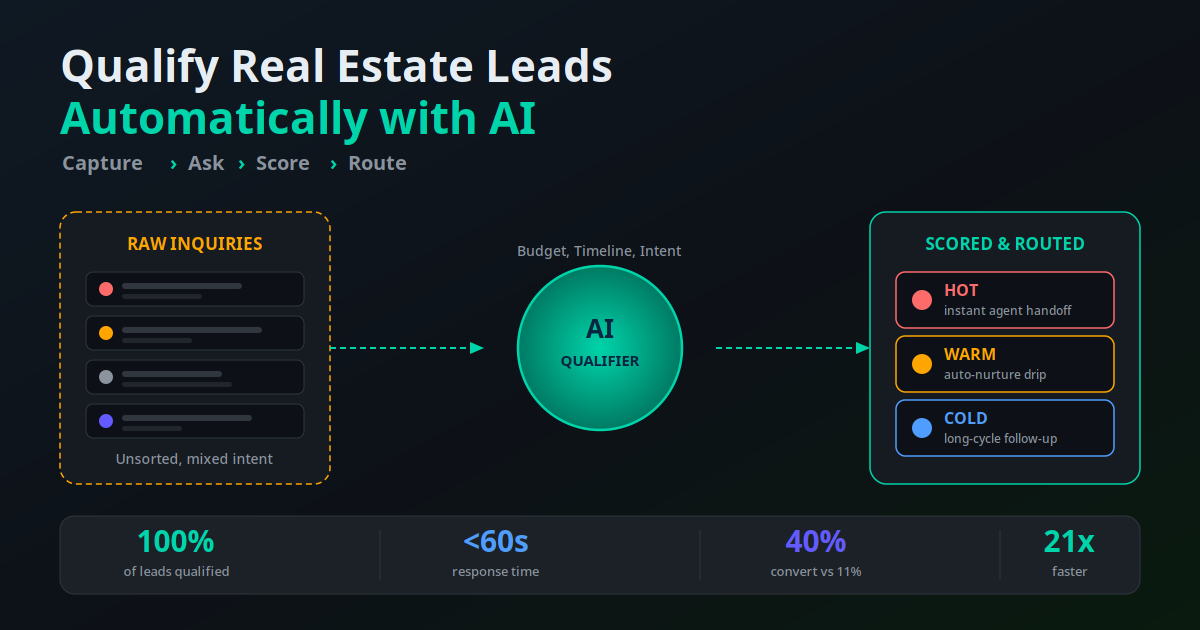
Qualify in conversation: The AI asks about budget, timeline, financing, and whether they need to sell first, naturally, one question at a time, not as a form.
Score and route: Based on the answers, the lead is tagged hot, warm, or cold. Hot leads trigger an instant alert to the agent to take over.
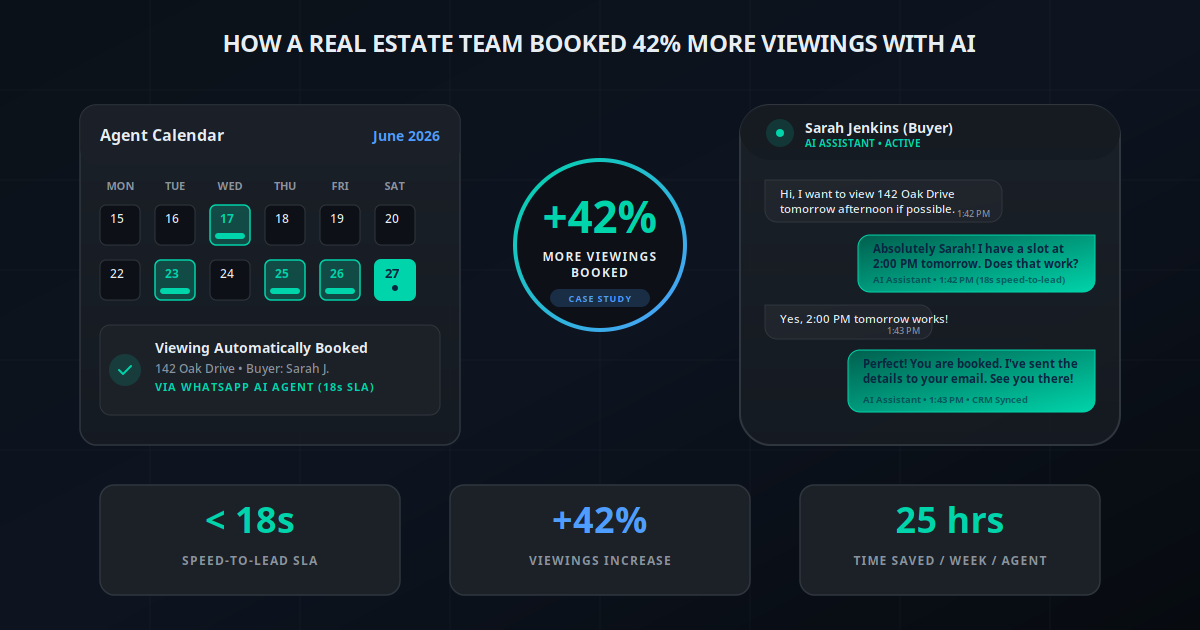
Book the viewing: The assistant checks the agent's live calendar, offers two open slots, and confirms the one the buyer picks.
Record and nurture: Contact and conversation are written to the CRM, a confirmation goes out, and reminder messages are scheduled so the viewing actually happens.
Total elapsed time from inquiry to booked viewing: often under three minutes, at any hour, with zero agent involvement until the moment a human is genuinely needed. If you want to see how the qualifying logic in step 4 is built, we broke it down in our guide to automated real estate lead qualification.
Covering Every Channel a Lead Uses
Leads do not all come from one place, and a serious speed-to-lead system answers every channel with the same urgency. The mistake I see most often is a team that is fast on email but ignores their Facebook messages for a day, or answers WhatsApp quickly but lets portal leads pile up. Buyers do not care which inbox they landed in. They just want an answer.
| Channel | How AI covers it |
|---|---|
| Portal forms (Zillow, Rightmove) | Instant reply plus a follow-up text within the first minute |
| Website chat | Live conversation on the page, qualifies and books before they leave |
| Two-way messaging where most buyers actually prefer to talk | |
| Facebook & Instagram lead ads | Auto-qualifies each ad lead the second it is captured |
| Missed calls | Instant text-back offering to answer questions or book a time |
WhatsApp deserves a special mention because it is where a huge share of buyers now prefer to talk, and reply rates there beat email by a wide margin. If your leads live on messaging, our breakdown of WhatsApp Business automation covers how to set that up properly. The point of pulling every channel into one system is simple: a lead should never win the lottery of "did they message the inbox we happen to be watching today."
The ROI of Replying First
"We turned on instant response and stopped losing weekend leads overnight. The first month it booked eleven viewings we would have completely missed. Two of them closed."
— Director, independent estate agencyThe math on speed-to-lead is unusually clean for a marketing investment, because you can trace it straight to closed deals. Real Trends estimates that a single mishandled real estate lead represents roughly $7,500 or more in lost commission on a median-priced home. You do not need many recovered deals to justify the cost of automation.
Across the teams I have worked with, the consistent gains from instant response look like this:
- Response time: from an industry-average 15+ hours down to under 60 seconds, every time, including nights and weekends
- Lead-to-appointment rate: typically 20–40% higher, purely from being first and booking in the same conversation
- After-hours capture: the ~62% of inquiries that arrive outside business hours stop leaking away
- Agent time reclaimed: hours a week no longer spent chasing cold or unqualified leads by phone
- Cost: a few hundred dollars a month against $7,500+ per recovered deal — payback in weeks, not quarters
The soft benefit matters too. Agents stop feeling guilty about the leads they could not get to, because the leads always get answered. Their energy goes into the buyers actually worth a personal call. If you want the fuller financial picture, our guide to automating the sales funnel walks through where the returns come from at each stage.
Mistakes That Kill Speed-to-Lead
Instant response is powerful, but I have watched teams undo it with a handful of avoidable errors. Steer around these.
Treating the AI as a full stop instead of a first touch
The AI's job is to be first and to qualify, not to replace the agent entirely. Teams that never hand hot leads to a human quickly enough lose the deals that needed a real conversation. Build a clear, fast escalation path and use it.
A robotic, one-size reply
If the assistant sends the same generic "thanks for your interest" to every lead regardless of the property or question, buyers feel it and disengage. The first reply has to reference the actual listing and answer the actual question. Relevance is what makes speed pay off.
Ignoring a channel
Being fast on the website but slow on WhatsApp, or great with portal leads but blind to Facebook, recreates the exact problem you were solving. Cover every channel a lead can reach you on, or the slow one becomes the leak.
No nurture for the warm-but-not-ready
Most buyers are not closing this week. If a lead is not hot, they should drop into an automated follow-up sequence rather than being answered once and forgotten. Speed wins the first touch; nurture wins the ones with a longer timeline.
Skipping the test calls
Going live without stress-testing the flows means real buyers become your QA team. Before launch, submit fake inquiries with odd questions, wrong turns, and edge cases, and tune the assistant until it handles them cleanly.
Conclusion: Be the Agent Who Answers First
Speed-to-lead is the rare edge in real estate that is fully within your control and almost entirely ignored by your competitors. The average agent replies in over 15 hours. The buyer picks whoever gets there first. The gap between those two facts is where deals are won and lost every single day.
AI closes that gap for good. Every inquiry answered in seconds, qualified in conversation, and booked into a calendar, at 11 PM on a Sunday exactly as well as at 11 AM on a Tuesday. Your agents keep the relationships, the negotiations, and the local expertise that no machine can replace. They just stop losing leads to a slow first reply.
The teams doing this now are quietly taking the buyers their slower rivals never got around to answering. That advantage compounds.
To see exactly how instant response would work for your agency — which leads it would catch, how it would qualify them, and what you would recover from faster replies — use the AI Business Twin for a free personalised analysis in under 10 minutes.
Frequently Asked Questions
What is speed-to-lead in real estate?
Speed-to-lead is how long it takes you to make first contact after someone submits a property inquiry. It is measured from the moment a lead fills out a portal form, website chat, or ad response to the moment they hear back from you. In real estate it matters more than almost any other metric, because 78% of buyers work with the first agent who responds, and the average agent takes over 15 hours to reply.
How fast should you respond to a real estate lead?
Aim for under five minutes, and ideally under a minute. Research from MIT and InsideSales found that contacting a lead within five minutes makes you 21 times more likely to qualify them than waiting 30 minutes. Leads reached inside 60 seconds convert at around 23%, while a 30-minute delay drops that to under 5%. Because most inquiries arrive after hours, the only reliable way to hit that window is automation.
Can AI respond to property inquiries without sounding robotic?
Yes. A well-built AI assistant uses your brand tone, references the specific property the lead asked about, and asks natural follow-up questions instead of dumping a canned message. The goal is not to hide that it is AI, but to make the first reply genuinely useful within seconds. Most buyers care far more about a fast, relevant answer than about whether a human typed it at 11 PM.
What can an AI assistant actually do when a lead comes in?
It can reply instantly across the channel the lead used, answer questions about price, location, and availability, ask qualifying questions about budget and timeline, share matching listings, book a viewing directly into an agent's calendar, and create the contact record in your CRM. Hot leads get handed to a human immediately; warmer ones drop into an automated nurture sequence so nothing goes cold.
Does instant AI response work for after-hours and weekend inquiries?
That is exactly where it earns its keep. Roughly 62% of property inquiries are submitted outside business hours, with peaks in the evening and on weekends. A human team cannot cover every one of those moments, but an AI assistant replies at 11 PM on a Sunday the same way it does at 11 AM on a Tuesday, so the lead never sits in an inbox until morning.
Will AI replace real estate agents?
No. AI handles the repetitive first-touch work: replying fast, answering common questions, qualifying, and scheduling. The relationship, negotiation, local expertise, and trust-building stay firmly with the agent. Speed-to-lead automation simply makes sure the agent spends their time on leads worth pursuing instead of chasing cold ones or losing warm ones to a slow reply.
How much does speed-to-lead automation cost for a real estate team?
Most small agencies run instant-response automation for a few hundred dollars a month, covering the AI assistant, messaging channels, and CRM integration. Set against a typical commission of $7,500 or more per closed deal, recovering even one or two extra deals a year from faster response covers the cost many times over. The payback period for most teams is measured in weeks.