AI Follow-Up Automation: Never Lose Another Lead to Silence




The Silence Problem Costing Your Business Real Money
Someone fills out your contact form at 9 PM on a Tuesday. You see it Wednesday morning, reply Thursday. By then, they have already booked with your competitor who replied at 9:04 PM Tuesday — two minutes after the form was submitted — via an automated message.
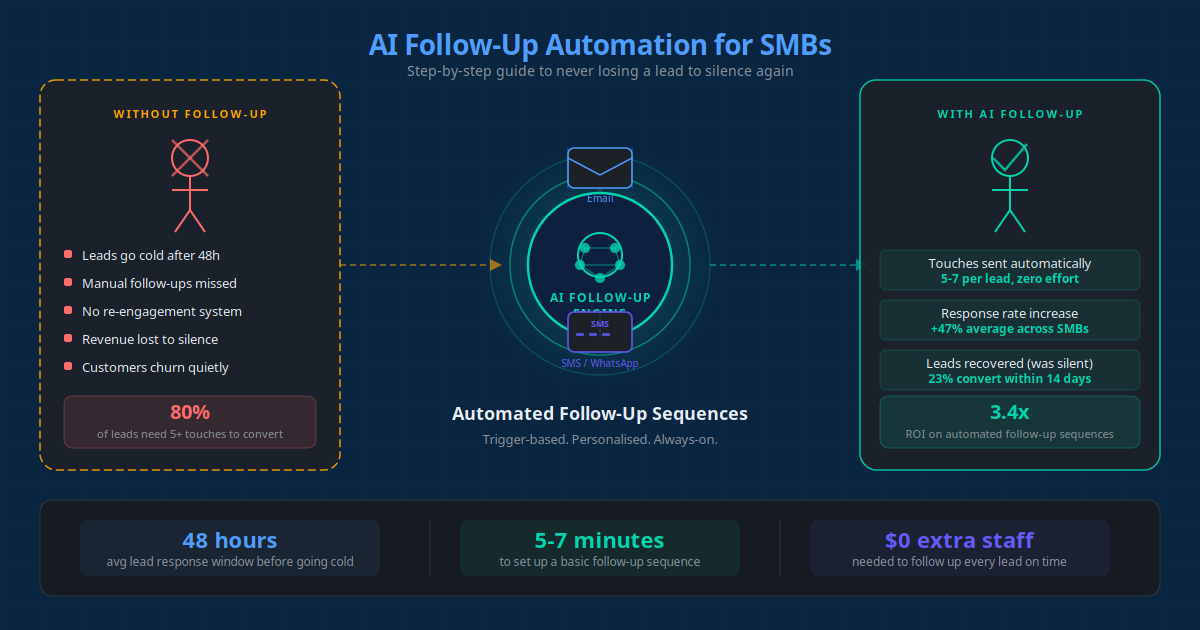
This scenario plays out in every industry, every day. A lead goes cold not because your product is worse, not because your price is higher, but because silence reads as indifference. Buyers in 2026 have more options and less patience than ever. A study from MIT and InsideSales found that the odds of qualifying a lead drop by 80% after 24 hours of no contact. After 5 minutes, that decline has already started.
The frustrating part: most small business owners already know follow-up matters. They just cannot do it consistently. You are running a business. A sale slips, a call comes in, a team issue demands your attention. The follow-up you meant to send today becomes tomorrow, then next week, then never. That is not laziness — it is reality. Manual follow-up does not scale.
AI follow-up automation fixes this at the root. You define the sequence once, connect it to your CRM or form tool, and every lead gets the right message at exactly the right time — regardless of what else is happening in your business. This article walks you through how to build that system, what it costs, and what you can realistically expect it to return.
Key Takeaway
80% of leads need 5+ follow-up touches before they convert, but 44% of salespeople give up after just one attempt. AI follow-up automation bridges that gap by delivering every touch, on time, every time — without requiring a single additional staff member.
What AI Follow-Up Automation Actually Does
Automated follow-up is not a robot sending spam. It is a trigger-based messaging system that fires personalised, contextual messages based on what a contact has done — or stopped doing. Three levels of sophistication exist:
- Basic automation: Time-delayed sequences triggered by a form submission, CRM stage change, or purchase. Pre-written templates with personalisation tokens (first name, enquiry type). This alone recovers a large share of lost leads.
- Intermediate automation: Conditional logic — if a contact opens but does not reply, send a different follow-up than if they never opened. Branch sequences based on link clicks. Dramatically improves message relevance.
- AI-powered automation: Natural language generation that personalises content per contact. Systems that A/B test message variants and reweight sequences based on what converts. Chatbots that respond to replies before escalating to a human.
For most SMBs, starting at the basic level delivers the majority of the ROI. Get the fundamentals running first.
A $29/month automation tool that sends 5 follow-ups per lead will outperform a $299/month AI platform that you never have time to configure properly.
The channels available include email, SMS, WhatsApp Business, and voice calls for high-value leads. Email is the most widely used starting point. SMS adds urgency. WhatsApp dominates in South Asia, Southeast Asia, Latin America, and much of Europe. Choose your channel mix based on where your customers actually are.
The 4 Follow-Up Sequences Every SMB Should Run
1. New Lead Response Sequence
Triggered the moment a lead submits a form, books a demo, or enters your pipeline. Touch 1 fires within 5 minutes: a personalised acknowledgment confirming their enquiry and what happens next. Touch 2 fires 4 hours later with a specific value offer or case study. Touch 3 fires at 24 hours with a question designed to get a reply. This sequence alone converts an extra 15–25% of leads that would otherwise go cold.
2. Post-Quote or Post-Proposal Sequence
You sent a proposal. Three days pass. Silence. A properly structured sequence runs for 10–14 days: check-in at day 2, objection-handling message at day 5, social proof (case study or testimonial) at day 8, and a "last chance" close at day 12. This recovers 20–30% of proposals that would have otherwise been abandoned.
3. Post-Purchase Onboarding and Upsell Sequence
Day 1 confirms purchase and next steps. Day 3 shares a quick-win tip. Day 7 checks in. Day 14 asks for feedback and introduces your next offer. Businesses using post-purchase sequences see 23% higher repeat purchase rates within 90 days.
4. Re-Engagement Sequence for Cold Contacts
Every business has a graveyard of contacts who enquired and went quiet. A quarterly 3-touch sequence over 14 days revives this list: an honest "we have not heard from you" opener, a message on what has changed, and a low-commitment offer. Expect 10–20% to re-engage — revenue you had entirely written off.
Real-World Use Cases Across Industries
Professional Services: Coaching and Consulting
A business coach's inquiry form is connected to an automation platform. Every submission triggers a 6-touch sequence over 10 days. The first message fires within 3 minutes with a personalised welcome and link to book a discovery call. Touches 2–4 share relevant testimonials matched to the prospect's stated challenge. By month 3, the coach's discovery call bookings doubled without changing anything about the website or ad spend.
E-commerce: Abandoned Cart and Post-Purchase
An online homeware brand runs a 3-touch abandoned cart sequence (30 minutes, 24 hours, 72 hours after abandonment) combined with a 5-touch post-purchase sequence for repeat buying. The abandoned cart sequence recovers 18% of abandoned carts. The post-purchase sequence drives a 29% repeat purchase rate within 60 days — up from 11% before automation. Combined, these two sequences add $8,400 monthly revenue from the same customer base.
Healthcare: Appointment Reminders and Re-Booking
A physiotherapy clinic automates three sequences: a booking confirmation with pre-appointment instructions, a 3-touch reminder sequence (48h, 24h, 2h before appointment) that cuts no-shows by 41%, and a post-appointment re-booking sequence that asks for feedback and suggests booking the next session. The re-booking sequence alone fills 60% of follow-up appointments automatically, without the front desk needing to call anyone. For more, see how AI appointment scheduling changes the math on patient retention.
Real Estate: Lead Nurture Over Long Sales Cycles
A real estate agent's CRM triggers a 90-day nurture sequence the moment a new buyer lead enters the database. The sequence delivers market updates, property alerts matching the buyer's stated preferences, and check-in messages at strategic intervals. Instead of burning out on manual follow-up over a months-long cycle, the agent stays present with every buyer automatically. Qualified leads convert at 34% higher rates because they feel guided rather than ignored during the research phase.
How to Set Up Your First Follow-Up Sequence
This is the practical part. Follow these steps to have a working 5-touch lead follow-up sequence running by end of day.
Choose one trigger: Pick the single most important entry point — your contact form, your inquiry chatbot, your CRM pipeline stage, or your e-commerce checkout abandonment. Start with one trigger and one sequence. Do not try to build everything at once. Your most common lead source is the right starting point.
Map 5 message touches: Write out what you want to say at each touch before you configure anything. Touch 1 (within 5 min): acknowledge and set expectations. Touch 2 (4 hours): deliver value, share a relevant resource or result. Touch 3 (day 2): ask one specific question to spark a conversation. Touch 4 (day 5): handle the most common objection for your offer. Touch 5 (day 10): low-pressure "still happy to help" close. Keep each message short — 3–5 sentences maximum.
Connect your trigger source: If your trigger is a web form, most form tools (Typeform, Gravity Forms, native CRM forms) have direct integrations with email automation platforms. If your trigger is a CRM stage, use your CRM's built-in automation or connect via Make, Zapier, or n8n for platforms that do not have native sequence builders.
Add personalisation tokens: At minimum, pull in the contact's first name and the specific thing they enquired about. Most platforms let you reference form field values directly. "Hi [First Name], thanks for your message about [Service/Product]" outperforms "Hi there" by a wide margin on open rate and reply rate.
Set reply detection and exit conditions: Configure your sequence to stop automatically when the contact replies to any message, books a call, or makes a purchase. Continuing to send automated follow-ups to someone who has already responded is one of the fastest ways to damage trust. Every major platform supports this — it takes 30 seconds to configure and prevents awkward double-sends.
Test before you go live: Add yourself as a test contact and trigger the sequence. Verify every message arrives as expected, personalisation fields populate correctly, the unsubscribe link works, and the exit condition fires when you reply. A broken first message can cost you more goodwill than no follow-up at all.
Once your lead sequence is live and running for two weeks, review the data: open rate, reply rate, and conversion rate per touch. The message with the highest open rate tells you what subject lines resonate. The touch with the highest reply rate tells you what question or offer your leads respond to most. Adjust iteratively. Your sequence will compound in effectiveness over time.
Tools That Power Automated Follow-Up
The right tool depends on your channel mix, technical comfort level, and how sophisticated your CRM integration needs to be. The table below covers the most common options for SMBs.
| Tool | Best For | Channels | Starting Price | Ease of Use |
|---|---|---|---|---|
| ActiveCampaign | Deep automation logic, CRM + email | Email, SMS | $29/month | Medium |
| HubSpot Starter | Full CRM pipeline + sequences | Email, in-app | $20/month | Low (easy) |
| Klaviyo | E-commerce (Shopify/WooCommerce) | Email, SMS | Free to 250 contacts | Medium |
| Close CRM | Sales-led teams, outbound cadences | Email, SMS, calls | $49/user/month | Medium |
| Make.com | Custom multi-channel sequences | Any (via APIs) | $9/month | Medium–High |
| Wati / 360dialog | WhatsApp Business sequences | $49/month | Low (easy) |
If you are unsure where to start, HubSpot's free CRM with Starter email sequences is the lowest-friction entry point for most service businesses. E-commerce stores should default to Klaviyo given its native Shopify and WooCommerce integrations. For businesses in markets where WhatsApp dominates, connecting your CRM to WhatsApp Business API via Wati unlocks conversational follow-up at scale. The full breakdown of automation platforms is covered in the CRM automation guide.
The ROI: What Automated Follow-Up Actually Returns
"We were sending maybe one follow-up email per lead. Now every enquiry gets a 6-touch sequence automatically. We close 40% more of the leads we already have — without spending a penny more on ads."
— Director, B2B services firm, 12 employeesTake a service business receiving 60 enquiries per month at $1,200 average deal value. With manual follow-up, they convert 15% — 9 clients, $10,800 monthly. With an automated 5-touch sequence, conversion rises to 23%: 13.8 clients. That is 5 extra clients monthly from the same leads. At $1,200 each, that is $6,000 additional monthly revenue. The tool costs $29–$49/month. ROI: 120–200x the tool cost.
Consistent performance metrics across businesses using automated follow-up sequences:
- Lead-to-meeting conversion rate: Up 35–55% compared to manual follow-up
- Proposal-to-close rate: Up 20–30% with a structured post-proposal sequence
- Abandoned cart recovery: 15–25% of abandoned carts converted via a 3-touch sequence
- No-show rate for appointments: Down 35–45% with a pre-appointment reminder sequence
- Customer lifetime value: Up 18–28% when post-purchase sequences are active
You are not generating new demand — you are capturing more of what already exists. Workflow automation applied to follow-up is one of the highest-ROI moves for any SMB because the upside comes from leads you already paid to acquire.
5 Mistakes That Kill Follow-Up Sequence Performance
Mistake 1: Sending Too Many Messages Too Fast
Four emails in 48 hours signals desperation and destroys sender reputation. Space your sequence properly: first touch within minutes, second after a few hours, subsequent touches at 1–2 day intervals. Sequences that pile up get spam-filtered, wrecking deliverability for every future campaign.
Mistake 2: Writing Pitch-First Messages
The first two touches should deliver value, not close. If every message is "are you ready to move forward?", you train your audience to ignore you. Email automation only outperforms manual follow-up when messages feel useful and tailored, not like broadcast pitches.
Mistake 3: Not Personalising Beyond the First Name
"Hi Sarah" is not personalisation. "Hi Sarah — you mentioned you want to reduce admin time in your accounting firm" is. Use every data point your forms collect. The more specific a message feels, the higher the reply rate.
Mistake 4: Never Testing or Updating Sequences
A sequence built 6 months ago based on guesses is underperforming. Review metrics monthly. A/B test subject lines. Rewrite the lowest-performing touch. An iterative sequence that improves quarterly dramatically outperforms one you set and forget.
Mistake 5: Forgetting Exit Conditions
Continuing to follow up after a contact has replied, booked, or unsubscribed is illegal under GDPR/CAN-SPAM and damages your brand. Configure exit conditions so sequences stop the moment a contact takes any conversion action. Every major platform supports this — verify it is enabled.
Stop Leaving Revenue in Your Inbox
Follow-up automation is not complicated. It is not expensive. It does not require a developer or a CRM specialist. A five-touch sequence built in an afternoon and connected to your existing enquiry form will outperform years of inconsistent manual follow-up within weeks of going live. The math is simple: more touches, more conversions, same acquisition cost.
The businesses that grow fastest are not the ones with the biggest advertising budgets — they are the ones that convert a higher percentage of the leads they already have. Automated follow-up is the fastest, cheapest way to do that. For every $1 you spend on the tool, you recover $50–$200 in revenue from leads that would have otherwise ghosted you.
If you want to know exactly which follow-up sequences would have the most impact for your specific business — and how to connect them to your existing CRM and forms — use the AI Business Twin for a free personalised analysis in under 10 minutes.
Frequently Asked Questions
How many follow-up messages does it take to convert a lead?
Research consistently shows that 80% of sales require 5 or more follow-up contacts before a lead converts, yet 44% of salespeople give up after just one attempt. AI follow-up automation closes this gap entirely by sending every touch on schedule — without fatigue, forgetfulness, or a busy week getting in the way.
What channels should an automated follow-up sequence use?
The most effective sequences combine email for detailed information and documentation, SMS for time-sensitive nudges and reminders, and WhatsApp for conversational follow-ups in markets where it is the primary messaging app. Starting with email only is fine, but adding SMS to the sequence typically lifts response rates by 35–50% because SMS open rates sit around 98% versus 20–25% for email.
Will automated follow-up messages feel impersonal to recipients?
Only if they are badly written. Modern AI-powered follow-up tools personalise messages using the contact's name, company, the specific enquiry they submitted, and the stage they are at in your pipeline. A well-crafted automated sequence reads more naturally than a rushed manual follow-up dashed off between meetings. The key is investing time in the message copy upfront.
How long should a follow-up sequence run before giving up on a lead?
For warm inbound leads, run a 7-14 day active sequence of 4-6 touches before moving the contact to a lower-frequency nurture track. For re-engagement campaigns targeting cold contacts, a 3-touch sequence over 14 days is typically sufficient. Never fully delete leads from your list — a quarterly check-in sequence often revives contacts who were simply not ready when they first enquired.
Which tools are best for setting up automated follow-up sequences?
For email-focused sequences, ActiveCampaign and HubSpot offer the deepest automation logic. For multi-channel sequences combining email and SMS, Klaviyo (e-commerce), Close CRM (sales teams), or Make.com with a connected email and SMS service work well. For WhatsApp-first markets, connecting your CRM to WhatsApp Business API via a platform like Wati or 360dialog enables automated WhatsApp sequences alongside email.
Is automated follow-up compliant with GDPR and CAN-SPAM?
Yes, provided you follow the rules. Every automated email must include a clear unsubscribe link and your business's physical address. Under GDPR, you need a lawful basis for processing contact data — typically legitimate interest for B2B follow-up or consent for B2C marketing. Always honour unsubscribe requests immediately, segment opt-outs from your sequences, and never re-add contacts who have unsubscribed. Most reputable email platforms handle unsubscribe compliance automatically.