How to Qualify Real Estate Leads Automatically with AI: Stop Chasing Buyers Who Were Never Going to Buy




Open your CRM right now and count the leads you have never called back. For most agents, it is a long list. Portal inquiries, Facebook form fills, a name from an open house three weeks ago. They sit there because you already know something uncomfortable: most of them will never buy.
The National Association of Realtors puts the average real estate lead conversion rate between 0.4% and 1.2%. Generate 200 leads and you might close one or two. The other 198 are a mix of tyre-kickers, people two years out, and a handful of genuinely hot buyers hiding in the pile. The problem was never lead volume. It is that nobody has time to dig through the pile fast enough to find the good ones before a competitor does.
While building AI systems for property teams, the pattern I see is always the same: agents spend their best hours on leads that were never going to transact, and the buyer who was ready this week gets a callback next Tuesday. By then they have already toured a home with someone else.
This guide walks through how to fix that with automated qualification. Not a chatbot that answers FAQs, but a system that asks the right questions the moment a lead arrives, scores the answers, and hands your agents only the people worth a phone call. Here is how to build it.
Why Unqualified Leads Quietly Eat Your Week
Time is the one thing an agent cannot buy more of, and unqualified leads spend it in ways that never show up on a report. Every dead-end call, every follow-up text to someone who was just curious, every hour blocked out for a showing that no-show costs you the client who was actually ready.
The math is blunt. If you spend a fifth of your working week on leads that never close, you are handing away roughly one full day of selling time every week. Over a year that is around 46 working days gone, chasing people who politely never wanted to be chased.
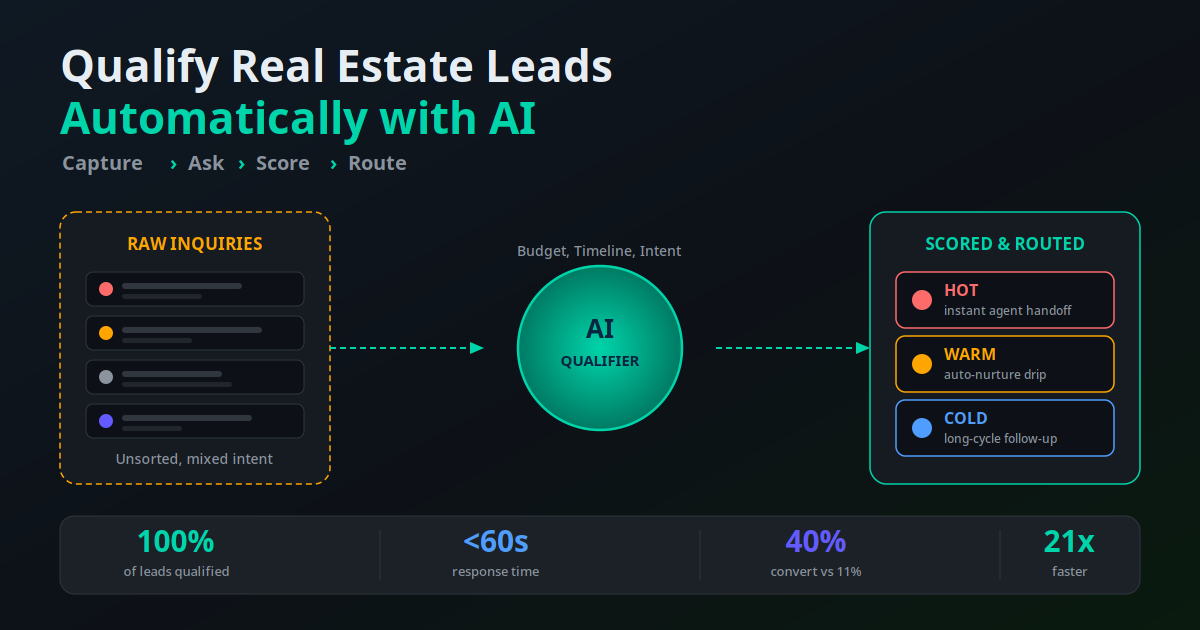
Qualification changes the return on that time. Properly scored and qualified leads convert at about 40%, against roughly 11% for prospects nobody bothered to screen. Deals filtered through a structured framework like budget, authority, need, and timeline close at a 33% higher rate than deals worked on gut feel. You are not generating better leads. You are spending your hours on the ones that were already good.
Key Takeaway
The bottleneck in most real estate pipelines is not lead generation, it is triage. A qualified lead converts around 40% of the time versus 11% for an unscreened one. Automating the screening step is what frees your agents to sell.
This is exactly the job AI is built for. Qualification is repetitive, rule-based, and time-sensitive, which is the worst combination for a human and the best combination for an agent that never sleeps. It fits neatly alongside the broader shift toward AI workflow automation that handles the routine so your people handle the relationships.
What "Qualified" Actually Means in Real Estate
Before you automate anything, you have to define what a good lead looks like, because a machine can only sort by the rules you give it. In real estate, "qualified" almost always comes down to four signals.
- Budget. What price range can they realistically work in? A buyer eyeing a $800k home on a $400k pre-approval is not qualified for that listing, and knowing this early saves everyone a wasted afternoon.
- Timeline. Are they moving in 30 days or "sometime next year"? Timeline is the single strongest predictor of whether a lead deserves a call today or a nurture email.
- Intent. Are they a serious buyer or seller, a browser, or a renter who landed on your listing by accident? Intent separates a pipeline from a mailing list.
- Financing. Cash, pre-approved, or "we haven't looked into a mortgage yet"? Financing status often decides whether a hot-looking lead can actually transact.
Sellers get a slightly different set: the property and its condition, their reason for selling, and how soon they need to be out. But the principle holds. You are looking for readiness and ability, not merely interest.
Here is the part most agents underrate. Qualification rates vary wildly by source: portal leads from a paid site tend to qualify at around 80%, while a Facebook lead-form fill sits closer to 20%. Treat every lead the same and you either smother good portal leads in a slow sequence or waste live calls on cold social ones. An automated system screens all of them and routes each differently, which is where the real advantage sits. For the wider view, our guide to real estate lead management covers the end-to-end flow.
The Four Questions Every Qualification Flow Must Answer
You do not need a twenty-field form. You need four or five questions that map to the signals above, asked in plain language. The trick is designing them so a lead answers without feeling interrogated.
1. Location and property type
"Which areas are you looking at, and are you after a house, a condo, or something else?" This is the easy opener. It feels helpful rather than nosy, and it immediately tells you whether the lead is even in your patch.
2. Price range
"Roughly what budget are you working with?" Frame it as helping you send the right listings, not as a means test. Most serious buyers answer freely; the ones who dodge it entirely are telling you something too.
3. Timeline
"When are you hoping to be moved in?" A specific month is a strong signal. "Just browsing for now" is an honest answer that routes them straight to nurture instead of a sales call.
4. Financing
"Are you planning to buy with cash or a mortgage, and have you spoken with a lender yet?" This one question separates buyers who can move from buyers who only wish they could. A pre-approval turns a warm lead hot.
Ask these two at a time, react to the answers, and you have everything an agent needs to decide whether to pick up the phone. The difference between a form and a conversation is what keeps the lead engaged long enough to finish.
How AI Qualifies a Lead Without Sounding Like a Robot
Speed is where AI earns its keep before it asks a single question. The data on response time is brutal and consistent. Contact a lead within a minute and they convert at roughly 23%; wait 30 minutes and that drops below 5%. Respond within five minutes and you are 21 times more likely to qualify the lead than an agent who waits half an hour. And about 78% of buyers simply go with the first agent who gets back to them.
Now hold that against reality. The average agent takes over 15 hours to respond to a new online inquiry. A lead fills your form at 9pm on a Sunday and your first reply lands Tuesday morning. The AI replies in under 60 seconds, on WhatsApp, email, or SMS, while the lead is still on your listing page.
"The leads didn't get better. We just stopped losing the good ones to slow replies. The assistant answers in seconds and hands us people who are actually ready."
— Team lead, residential brokerage (paraphrased from a client rollout)The "not a robot" part comes down to design. A good qualification agent runs a short conversation, not a survey. It opens warm, asks one or two questions, acknowledges the answer, then asks the next. It handles a lead who replies "why do you need to know my budget?" without breaking. And it discloses that it is an AI up front, which, in my experience, buyers barely react to as long as it is useful. Under the hood this is the same conversational layer that powers a good real estate chatbot, pointed at qualification.
Here is the compact version of what the agent does on every new lead, before a human sees it:
Greet and disclose: "Hi, I'm the AI assistant for [Agency]. Happy to help you find the right place, mind if I ask a couple of quick questions?"
Ask and react: pulls budget, timeline, area, and financing across two or three natural turns, adapting to what the lead says.
Score and route: tags the lead hot, warm, or cold, then either books a call, offers matching listings, or drops them into nurture.
Lead Scoring: Turning Answers Into Hot, Warm, Cold
Scoring is where raw answers become a decision. Every response adds or subtracts points against rules you define, and the running total drops the lead into a bucket. It is easy to reason about and easy to tune as you learn what converts in your market. A workable starting model looks like this, with illustrative points and thresholds you set yourself.
| Signal | Answer | Score |
|---|---|---|
| Timeline | Moving within 60 days | +30 |
| Timeline | Just browsing, no date | +5 |
| Financing | Pre-approved or cash | +30 |
| Financing | Not looked into it yet | +5 |
| Budget | Matches active inventory | +20 |
| Intent | Named a specific property or area | +20 |
| Engagement | Answered all questions | +10 |
Set two thresholds and you have your buckets. Score above 70 and the lead is hot: pre-approved, ready soon, real budget, book the agent now. Between 35 and 70 is warm: interested but missing a piece, usually financing or a firm date, so nurture with intent. Below 35 is cold: long-cycle, worth staying in touch with but not worth a live call today.
The beauty of scoring rules is that they are adjustable. If your hot leads keep failing to convert, your threshold is too low or you are over-weighting the wrong signal. Tighten it. A hot lead in a fast spring market should look different from one in a slow December, and rules let you make that call deliberately instead of by feel.
Where Each Lead Goes: Five Real Scenarios
Scoring only matters if routing follows automatically. Here is how the same system handles five very different leads, each landing in the right place without an agent touching a keyboard.
The pre-approved portal lead at 11pm
Comes in from a paid portal, pre-approved, wants to move in six weeks, budget matches two of your listings. Scores 90. The AI books a viewing on the agent's calendar for the next morning and texts the agent a one-line summary before they have even seen the notification. Hot lead, zero delay.
The Facebook browser with no timeline
Filled a social lead form out of curiosity, no budget shared, "just seeing what's out there." Scores 15. Instead of burning an agent call, the AI drops them into a light monthly nurture sequence with market updates. If they re-engage and answer the budget question later, their score jumps and they get promoted automatically.
The warm buyer who hasn't seen a lender
Clear on area and timeline, realistic budget, but no financing yet. Scores 55. The AI sends a helpful "here's how pre-approval works and why it strengthens your offer" message plus a lender referral, then follows up in a few days. One answered question away from hot, and the sequence is designed to get it.
The seller inquiry hiding in buyer traffic
Messages "what's my home worth?" The AI recognises seller intent, switches to seller questions, captures the address, condition, and reason for selling, then routes to your listing agent with a valuation request already logged. A different track entirely, handled without a human noticing the switch.
The after-hours WhatsApp lead
Texts your business line at 10:40pm about a specific listing. The AI answers instantly on WhatsApp, qualifies across three turns, and books a Saturday viewing. Your agent wakes up to a confirmed appointment instead of a missed message and a cold trail.
The 7-Step Automated Qualification Workflow
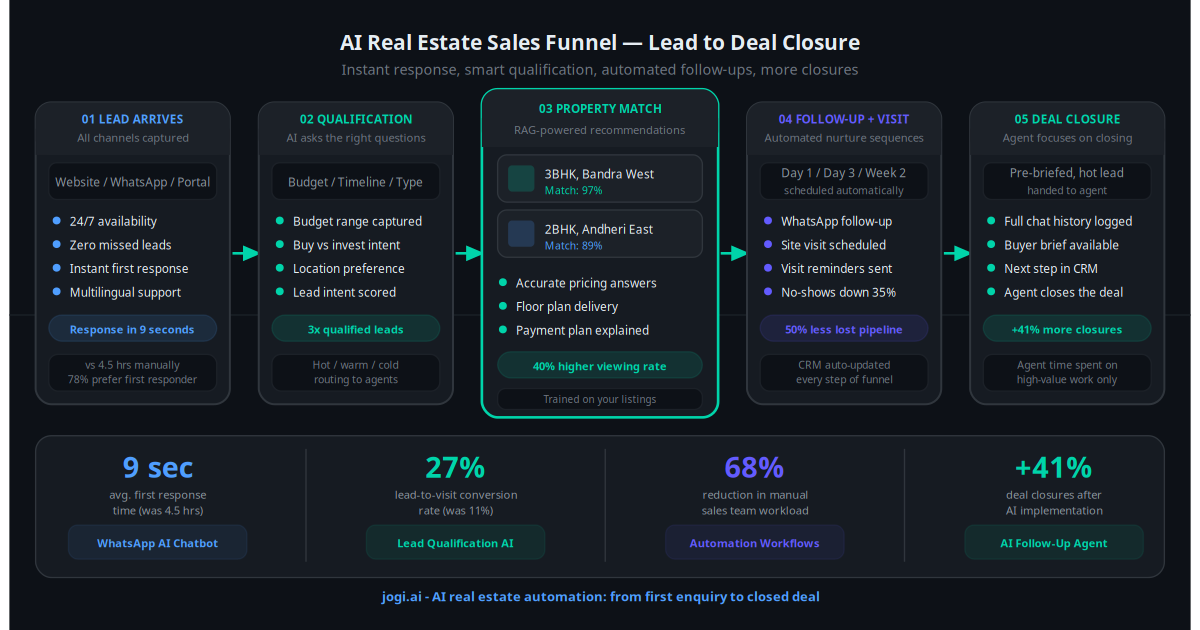
Put the pieces together and it runs as a single pipeline, from the moment a lead arrives to the moment it lands in your CRM with a next action attached. This is the architecture I set up for property teams.
Capture: a lead arrives from any channel, a portal, your website, a Facebook form, or a WhatsApp message, and lands in one place.
Instant response: the AI replies in under 60 seconds on the lead's own channel, before they cool off or contact a competitor.
Conversational qualification: it asks the four core questions, two at a time, adapting to answers and handling objections naturally.
Score: each answer updates the lead's score against your rules, producing a hot, warm, or cold tag in real time.
Route hot leads: qualified buyers get an instant calendar booking and the agent receives a summary with the answers attached.
Nurture the rest: warm and cold leads enter automated sequences that keep them engaged and re-score them as they respond.
Sync to CRM: every lead, tag, transcript, and next step writes back to your CRM so nothing lives in a silo.
Measure and retune: track which scored leads actually converted and feed that back into your thresholds so the system gets sharper each month.
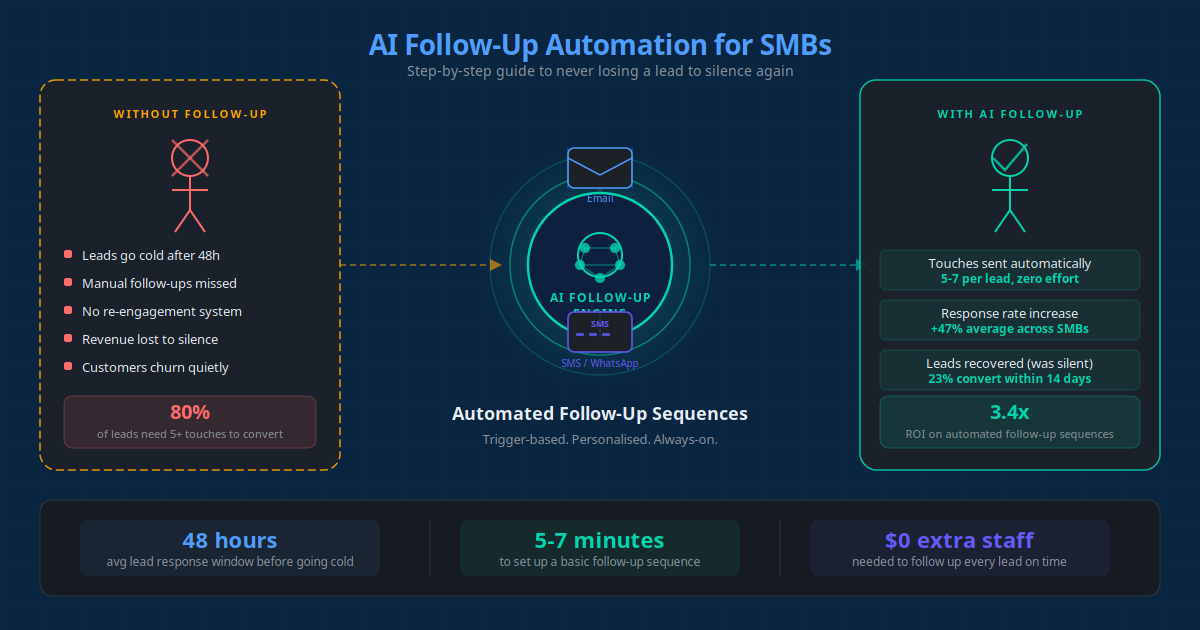
Steps 5 and 6 are where the payoff lands. The follow-up automation that keeps warm leads warm is often worth more than the initial qualification, because those are the deals agents drop most. And because every step writes back through CRM automation, you get a clean, reportable pipeline instead of scattered notes.
Tools and Setup: What You Actually Need
You do not need to build this from scratch or hire a developer. The stack breaks into four layers, and for each there are proven options that plug together.
| Layer | What it does | Common options |
|---|---|---|
| Conversation | Handles the qualifying chat across channels | Custom AI agent, chat + WhatsApp API |
| Logic & scoring | Runs the questions, scoring, and routing | Make, n8n, or Zapier |
| CRM | Stores leads, tags, and pipeline | Follow Up Boss, kvCORE, HubSpot |
| Calendar | Books qualified viewings | Google Calendar, Calendly, Acuity |
If you already run a real estate CRM, start there and build outward. The automation layer, whether that is Make, Zapier, or n8n, is the glue that carries a lead from the conversation into the CRM with its score intact. A qualification agent that handles portal leads flawlessly beats one that half-handles five sources.
My honest advice: do not over-engineer the first version. Pick your highest-volume lead source, wire up the four questions, set rough scoring thresholds, and watch the first fifty conversations closely. You will learn more from those transcripts than from any amount of upfront planning.
Mistakes That Make AI Qualification Feel Robotic
Automated qualification fails in predictable ways, and every one is avoidable. These are the ones I see most often.
Interrogating instead of conversing
Firing all four questions in one message reads like a form and gets abandoned. Ask one or two at a time, acknowledge each answer, and let the conversation breathe.
Hiding that it's an AI
Pretending to be human backfires the moment a lead suspects it, and in several regions disclosure is now required anyway. Say it is an assistant up front. Buyers care far more about a fast, useful answer than about who typed it.
No clean handoff to a human
A hot lead who asks "can I just talk to an agent?" and gets stonewalled by a bot is a lost deal. Build an instant escape hatch to a real person, and always hand hot leads to an agent rather than closing them in chat.
Setting scoring rules and never revisiting them
Your first thresholds will be wrong, and that is fine. Review which "hot" leads actually converted after a month and adjust. Qualification is a system you tune, not a switch you flip once.
Letting qualified leads sit
Speed to qualify means nothing if the hot lead then waits a day for the agent. Pair automated qualification with instant routing and calendar booking, or you have just moved the bottleneck.
Conclusion: Let the Machine Sort, Let Your Agents Sell
The agents who win the next few years will not be the ones with the most leads. They will be the ones who reach the right leads first and never waste an hour on the wrong ones. Automated qualification is how you get there without adding headcount or working later.
Start small. Take your busiest lead source, script the four questions, set scoring thresholds you can adjust, and let an AI assistant answer every inquiry in under a minute. Route the hot ones to a calendar, nurture the rest, and sync it all to your CRM. Within a month you will see it in two numbers: response time and the share of your calls that actually go somewhere.
The buyers are already deciding based on who replies first. The only question is whether that first reply is yours.
To see exactly which of your lead sources an AI qualifier would handle and what it would recover in booked viewings, use the AI Business Twin for a free, personalised analysis in under 10 minutes.
Frequently Asked Questions
What does it mean to qualify a real estate lead?
Qualifying a lead means finding out whether the person is actually ready and able to transact. In real estate that comes down to four things: their budget or price range, their timeline to buy or sell, their intent or motivation, and their financing status. A lead that clears all four is worth an agent's time today. A lead that clears none is worth an automated nurture sequence until the picture changes.
Can AI really qualify leads as well as a human agent?
For the structured part of qualification, AI is often better, because it never gets tired, never skips a question, and responds in seconds at 2am. It asks the same budget, timeline, and financing questions every time and scores the answers consistently. Where humans still win is judgement on nuance and emotional read, which is why the goal is not to replace the agent but to hand them only the leads worth a call.
What questions should an AI ask to qualify a property lead?
Keep it to four or five that reveal readiness: what area and property type are you looking at, what price range are you working with, when are you hoping to move, are you buying with cash or a mortgage, and have you spoken to a lender yet. For sellers, swap in questions about the property, their reason for selling, and their timeframe. Ask them conversationally, one or two at a time, not as a form.
How does AI lead scoring decide hot, warm, or cold?
Each answer adds or subtracts points against rules you set. A pre-approved buyer looking to move in 30 days scores high and is tagged hot. Someone browsing with no timeline and no financing scores low and is tagged cold. Warm sits in between. The thresholds are yours to tune, so a hot lead in a fast market may look different from a hot lead in a slow one.
Will automated qualification make leads feel like they are talking to a bot?
It depends entirely on how you build it. A rigid script that fires ten questions in a row feels robotic and gets abandoned. A well-designed AI copilot asks one or two questions at a time, reacts to the answers, and sounds like a helpful assistant. Disclose that it is an AI, keep the tone warm, and hand off to a human the moment the lead is qualified or asks for one.
How fast can AI respond to and qualify a new lead?
Under 60 seconds, every time, on any channel. That speed matters more than most agents realise. Leads contacted within a minute convert at roughly 23% versus under 5% at the 30-minute mark, and around 78% of buyers go with the first agent who responds. AI closes that response gap without anyone watching the inbox.
Does AI lead qualification work with my existing CRM?
Yes. The point of automated qualification is that the scored lead lands in your CRM with the tag, the answers, and the next action already attached. Most systems connect to common real estate CRMs like Follow Up Boss, kvCORE, HubSpot, or Salesforce through native integrations or a tool like Make or Zapier. The CRM stays your single source of truth.
How much does an AI lead qualification system cost?
For most small teams it runs far below the cost of the leads it saves. A conversational qualification agent connected to your CRM and calendar typically lands in the low hundreds of dollars a month once set up, against the value of even one extra deal a quarter. The honest way to size it is to weigh the monthly cost against the commission on the hot leads you are currently losing to slow response, which is usually the bigger number.