The AI Startup Stack: 7 AI Tools That Replace Entire Teams for Less Than One Salary
The New Math of Business Operations
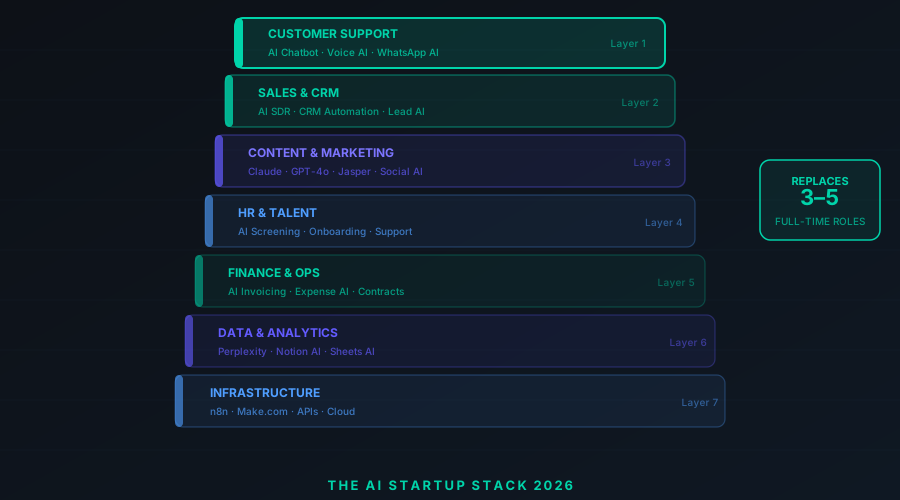
In 2024, the benchmark for a lean 10-person startup was five engineers and five business roles. In 2026, that benchmark has shifted: 3–5 engineers, 2–3 business generalists, and an AI stack that handles what 10–15 additional people would have been doing.
This is not hypothetical. It is what the fastest-growing companies in every sector are actually doing. They have replaced entire functional departments — support, content, ops, research — with AI systems that work 24/7, make no errors at scale, and cost less per month than a single mid-level employee makes in a day.
The question is no longer whether to build an AI stack. It is which tools to use, in what order, and how to integrate them into a system that actually improves over time. This article gives you the definitive answer for 2026.
Key Takeaway
The full AI startup stack — 7 tools covering every major business function — costs $800–$1,500/month. The equivalent human team would cost $350,000–$500,000/year in salaries. The AI stack runs 24/7, never makes HR complaints, and improves automatically.
AI Customer Support — Replaces: 2–4 Support Agents
A properly configured AI support system (built on GPT-4o or Claude, trained on your product documentation, FAQs, and past tickets) resolves 65–80% of all inbound support queries autonomously. It handles multiple conversations simultaneously, remembers context within a session, escalates to humans based on sentiment and complexity, and never has a bad day.
Top tools: Intercom Fin, Zendesk AI, custom RAG chatbot via n8n or Make. For WhatsApp and SMS, build on the WhatsApp Business API with an AI middleware layer.
Real numbers: A SaaS company with 500 monthly support tickets reduced human support time from 60 hours/month to 12 hours/month — freeing their single support hire to focus on complex technical issues and customer success.
AI Sales Prospecting — Replaces: 1–3 SDRs
AI sales development tools identify target accounts, find contact information, research each prospect's business context, draft personalised outreach emails, follow up based on engagement signals, and log everything in your CRM — without a single human action per sequence.
Top tools: Clay + GPT-4o for list building and personalisation; Instantly or Smartlead for sending infrastructure; HubSpot or Pipedrive AI for CRM automation. Custom n8n workflows can tie these together into a fully autonomous outbound engine.
Real numbers: A B2B services company replaced two SDRs ($130,000 in salary) with an AI prospecting stack ($380/month). Pipeline volume increased 40% because the AI ran sequences 24/7 — including on weekends when buyer attention is often highest.
AI Content Engine — Replaces: 1–2 Content Marketers
A modern AI content system does not just write drafts. It identifies trending topics in your niche using real-time data, plans a content calendar, writes SEO-optimised long-form articles, repurposes each into social posts, email newsletters, and short-form videos scripts, then schedules and publishes — all with minimal human editing.
Top tools: Claude 3.5 Sonnet for long-form writing quality; Perplexity for research-backed content; Notion AI for planning and editing workflows; Make.com for connecting writing to publishing platforms (WordPress, LinkedIn, Twitter/X, Instagram).
Real numbers: A fintech startup went from 2 blog posts per month (with a freelancer) to 12 per month (AI-assisted), plus daily LinkedIn posts and a weekly newsletter. Organic traffic grew 280% in six months.
AI Workflow Orchestration — Replaces: 1–2 Ops Coordinators
n8n or Make.com, configured with AI decision nodes, handles the operational glue work that ops coordinators typically do: routing tasks, sending notifications, updating records across systems, generating reports, managing approval workflows, and ensuring nothing falls through the cracks between tools.
Top tools: n8n (self-hosted for maximum customisation) or Make.com (cloud, easier to manage) for workflow orchestration. Zapier for simpler integrations. Any major AI model for intelligent routing and decision-making within workflows.
Real numbers: A 15-person agency eliminated their two-person ops role ($140,000 in salary) using n8n. Project briefing, task assignment, progress tracking, client updates, and invoice generation all run automatically.
AI Finance Automation — Replaces: 1 Finance Administrator
AI finance tools handle invoice processing, expense categorisation, payment reconciliation, and financial report generation. Combined with accounting software AI (QuickBooks AI, Xero AI) and an automation layer, monthly bookkeeping that used to take 20+ hours now takes 2 hours of human review.
Top tools: Dext (receipt and invoice capture), Xero or QuickBooks with AI categorisation, plus a custom multimodal AI workflow for invoice extraction from emails and scanned documents.
Real numbers: A 20-person retail business replaced their part-time bookkeeper ($45,000/yr) with an AI finance stack ($120/month). Month-end close time dropped from 5 days to half a day.
AI Research Intelligence — Replaces: 1 Research Analyst
Perplexity Pro with automated scheduled searches, combined with a web-scraping workflow and AI summarisation, delivers daily competitive intelligence, market news, customer sentiment monitoring, and strategic research briefings — without a dedicated analyst.
Top tools: Perplexity Pro for research tasks; Firecrawl or Apify for structured web data extraction; Claude for synthesis and summary; Make.com for scheduling and distribution.
Real numbers: A consulting firm reduced their research team from two analysts to one, redirecting the freed capacity toward client delivery rather than information gathering. Research output quality improved due to AI's ability to synthesise across hundreds of sources simultaneously.
AI HR Assistant — Replaces: 1 HR Coordinator
AI HR tools handle the high-volume, process-driven work of HR coordination: job description generation, CV screening (first pass), candidate scheduling, onboarding document collection, policy Q&A (via internal chatbot), and offboarding checklists. This frees your HR generalist to focus on culture, performance, and strategic people initiatives.
Top tools: Workable AI for recruiting, BambooHR with AI features for HRIS, custom onboarding AI chatbot via n8n + Slack, and a RAG chatbot trained on your employee handbook for internal policy queries.
Real numbers: A tech company with 50 employees reduced HR admin time by 60% using AI screening and onboarding automation — allowing their HR manager to take on strategic projects that had been backlogged for over a year.
Total Cost vs Total Savings
Full AI Stack Monthly Cost
$670 – $1,500/monthvs. $395,000 – $635,000/year in equivalent human salaries
That is 97%+ cost savings for equivalent output
| Layer | AI Cost/Month | Human Equivalent/Year | Savings |
|---|---|---|---|
| Customer Support | $100–$400 | $60k–$120k | 95%+ |
| Sales Prospecting | $200–$400 | $80k–$160k | 97%+ |
| Content Marketing | $100–$250 | $60k–$100k | 96%+ |
| Ops Workflow | $50–$150 | $60k–$120k | 98%+ |
| Finance Admin | $80–$200 | $40k–$80k | 96%+ |
| Research | $40–$100 | $50k–$80k | 97%+ |
| HR Admin | $100–$200 | $45k–$75k | 95%+ |
How to Sequence Your Rollout
Do not try to implement all seven layers simultaneously. The businesses that fail at AI implementation do so because they try to change everything at once. The businesses that succeed pick one layer, build it properly, and then expand.
The recommended sequence based on ROI and implementation complexity:
- Week 1–2: AI Customer Support — highest visible ROI, fastest to see results
- Week 3–4: AI Workflow Orchestration — the connective tissue that makes other tools work together
- Month 2: AI Content Engine — compounds over time as content builds organic traffic
- Month 2–3: AI Finance Automation — frees time at month-end close cycle
- Month 3: AI Sales Prospecting — only add once you have capacity to handle increased inbound interest
- Month 4: AI Research Intelligence — strategic advantage that builds over time
- Month 4–5: AI HR Assistant — lower urgency, but significant time savings at hiring scale
"The sequence matters. Build the operational foundation first, then add the growth layers. Companies that start with sales AI before fixing their operational AI end up with a pipeline they cannot service."
Conclusion: The Lean AI-Native Team Is the New Default
The AI startup stack is not a cost-cutting exercise — it is a structural advantage. Businesses that build these systems do not just save money; they move faster, operate more consistently, and free their human team to do work that actually requires human judgment.
The tools are available today. The costs are justified at almost any business size. The only remaining question is sequencing: which layer do you build first, and how do you integrate it properly?
For a personalised recommendation based on your specific business, the AI Business Twin will identify which layer has the highest ROI for your industry, team size, and current workflows — in under 10 minutes.
Frequently Asked Questions
Can AI really replace entire teams in a business?
For repetitive, process-driven work — yes. AI handles the volume and consistency of work that previously required multiple people. Customer support, content production, data entry, and lead qualification are all areas where AI handles 80-90% of work at a fraction of the cost. The remaining work — complex judgment, relationships, strategic decisions — still benefits from human expertise.
What is the total cost of the AI startup stack in 2026?
The 7 tools covered total approximately $670–$1,500/month depending on usage tiers. This compares to $395,000–$635,000 in annual salaries for equivalent human roles. The AI stack delivers 95%+ of the output for less than 5% of the cost — and runs 24/7.
Where should a startup begin with AI implementation?
Start with customer support (reducing inbound ticket volume by 60-70%) or workflow orchestration (the operational glue that makes other tools work). Build one system properly, measure the ROI, then expand. Trying to implement everything at once is the most common failure mode.