AI for Tourism & Travel Agencies: The 2026 Playbook




Ready to automate your travel agency?
Get Free AI Audit →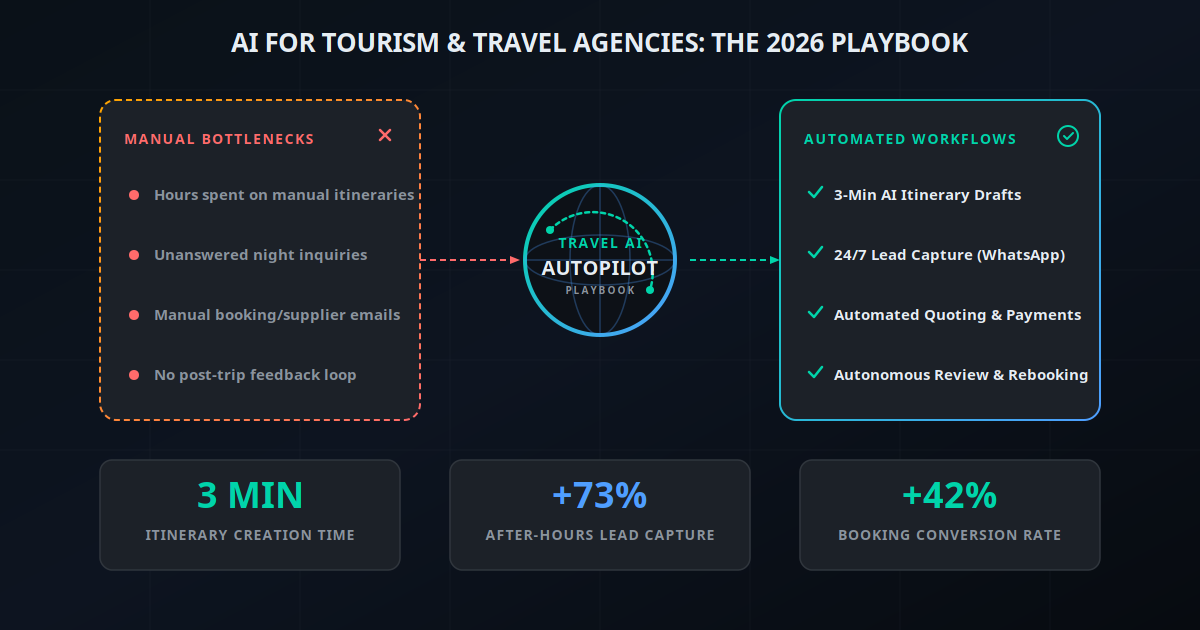
The travel and tourism industry has officially entered the era of agentic AI. In 2026, travellers no longer tolerate 24-hour response delays or generic itinerary templates copy-pasted from search engine queries. When a potential client decides they want to book a custom 10-day trip to Japan, they want answers, personalization, and booking links immediately.
For independent travel agencies and tour operators, managing this standard of customer expectations manually is an operational bottleneck. Agents spend up to 70% of their working hours researching destinations, building custom itineraries from scratch, copying data into CRMs, chasing payments, and manually emailing local suppliers. This leaves very little time for actual relationship building or sales generation.
This playbook provides a comprehensive guide to implementing autonomous workflows to automate your travel agency end-to-end, allowing you to draft custom itineraries in 3 minutes, capture 24/7 leads, manage custom trip complexity, and grow your booking conversion rates by over 42% on autopilot.
Table of Contents
- The State of AI in Travel (2026)
- The Automated Traveller Journey Map
- Multi-Channel Inquiry Capture & Qualification
- AI Itinerary Generation: From 4 Hours to 3 Minutes
- Automated Quoting, Proposals & Secure Payments
- Trip Lifecycle Autopilot: Pre-Trip, In-Trip & Post-Trip Workflows
- CRM Integration & Complex Trip Routing
- Compliance & Automated Supplier Coordination
- Your 5-Step Automation Roadmap
- Key Metrics: Tracking Your Automation Success
1. The State of AI in Travel (2026)
In the past, travel technology focused on self-serve online booking portals (like OTAs) or basic email marketing templates. In 2026, the playing field has shifted to **conversational automation** and **agentic AI engines**. Travellers expect a personal travel assistant experience. If your website only offers a basic contact form with a "we'll reply within 24-48 hours" message, they will navigate to a competitor who handles qualification instantly.
Using autonomous workflows, agencies can bridge this gap. An AI agent is not a dumb chatbot; it is a system that can query databases, interact with your CRM, trigger emails and WhatsApp campaigns, and draft complex day-by-day guides. By shifting the workload of data collection and draft itinerary creation to AI, human travel agents transition from administrative workers into high-value relationship managers.
Key Takeaway
AI does not replace the human touch in travel planning. Instead, it automates the 90% of administration that doesn't require human empathy (such as data entry, basic research, payment follow-up, and status alerts) so agents can focus on building true connections and closing high-margin deals.
2. The Automated Traveller Journey Map
To automate a travel business, you must map the passenger lifecycle. In the old model, every stage required manual human intervention. In the automated model, the client journey flows seamlessly through triggers and APIs, escalating to human support only when necessary.
Let's look at how each step works in detail.
3. Multi-Channel Inquiry Capture & Qualification
Travel inquiries land on multiple touchpoints: website contact forms, WhatsApp Business, Instagram Direct Messages, and Facebook Messenger. A manual system struggles to keep up, leading to slow response times and cold leads.
By implementing a unified AI agent interface, every incoming inquiry gets answered in under 90 seconds. The AI agent initiates a friendly conversation to qualify the lead. It acts as an automated triage, collecting critical fields before booking a call or passing the client to an agent:
- Destination Interests & Dates: Where do they want to go, and when?
- Traveller Breakdown: How many adults, teenagers, or children are travelling?
- Budget Calibrator: What is their estimated budget per passenger (excluding flights)?
- Style Preference: Are they looking for adventure, wellness, luxury, historical, or a relaxed itinerary?
- Flight Status: Have they already booked flights, or do they need booking support?
Once qualified, the lead is created in the CRM, and the AI matches their profile with the agent who specializes in that specific destination. If the lead is a luxury safari planner with a $15,000 budget, the system schedules a call directly on your top safari specialist's calendar, pre-populating all qualification details.
4. AI Itinerary Generation: From 4 Hours to 3 Minutes
Historically, crafting a highly customized 14-day European tour required 3 to 4 hours of researching hotel choices, transit durations, local guides, and activities. In 2026, travel agencies use RAG (Retrieval-Augmented Generation) databases to speed up this process.
By indexing your agency's preferred hotel agreements, contracted local DMC (Destination Management Company) rates, previous traveler feedback, and unique excursions, a custom-trained AI agent can draft a detailed day-by-day itinerary in 3 minutes. The AI reads the traveler profile from your CRM and outputs a highly polished, contextual draft including flight alignments and transit details.
"RAG-enabled itinerary builders allow our agents to act as chief editors rather than copywriters. Instead of researching transit hours or formatting guides from scratch, they edit a 90% complete proposal. It has reduced proposal generation time from 4 hours to 10 minutes."
5. Automated Quoting, Proposals & Secure Payments
Speed to quote is the number one predictor of booking success. Once the itinerary is edited, the system uses automated quoting APIs to query DMC systems for live pricing. The workflow outputs an interactive digital proposal link containing high-resolution photos, daily maps, and live pricing alternatives (e.g., standard vs. luxury hotels).
When the traveler hits "Approve", the workflow automatically triggers a secure payment checkout via Stripe or direct bank transfer APIs. Once the deposit or full payment is verified, the system:
- Updates the CRM status to "Booked".
- Generates an official invoice and receipts, emailing them to the client.
- Drafts and sends automated booking requests to local boutique suppliers or DMCs to secure the reservations.
6. Trip Lifecycle Autopilot: Pre-Trip, In-Trip & Post-Trip Workflows
Client management does not end at booking. A premium travel experience requires multi-touch follow-ups, which are extremely difficult to handle manually. The playbook automates this entire lifecycle via event-driven triggers:
Pre-Trip Preparation Workflows
Once a booking is confirmed, the system initiates a countdown sequence, sending timely updates via WhatsApp and email:
- T-90 Days: Automated checks for passport expiration dates and visa guide deliveries based on nationality.
- T-45 Days: Travel insurance prompts and local weather preparation guides.
- T-14 Days: Itinerary finalization confirmation, packing lists, and local cash recommendations.
- T-3 Days: Pre-departure briefing pack delivery, emergency contact cards, and baggage weight checklists.
In-Trip WhatsApp Support
During the trip, travelers can message a dedicated WhatsApp AI assistant for real-time customer care. The assistant is connected to live API integrations, allowing it to provide instant weather alerts, flight delay notifications, local restaurant recommendations, and guide contact details. If a traveler experiences a serious issue (like a cancelled flight or missed connection), the AI immediately escalates the chat to a live standby human agent, transferring the traveler's full context so they don't have to repeat their issue.
Post-Trip Retention & Review Acquisition
Three days after the traveler returns home, the system triggers an automated email thanking them and prompting them to rate their experience. If the feedback is highly positive (4 or 5 stars), the workflow automatically redirects them to your Google Maps or TripAdvisor profile to leave a public review, while feeding testimonials back into your marketing system. Six months later, the system automatically checks in with custom recommendation prompts based on their past travel preferences (e.g. "We noticed you loved your Amalfi Coast trip last summer, here are 3 curated Greek Island itineraries for your next escape").
7. CRM Integration & Complex Trip Routing
For simple bookings (such as a 3-night beach weekend or basic airport transfers), the system can process bookings end-to-end without human agent involvement. However, travel is often complex. For multi-destination itineraries, custom group tours, or wedding parties, human expertise is non-negotiable.
This is where CRM routing rules come in. All qualification inputs are parsed by the AI. If the itinerary flags a "custom multi-country tour" or "destination wedding group", the CRM bypasses full automation and marks it for manual agent routing. The agent receives a complete dossier compiled by the AI, including qualified traveller preferences, budget ranges, and drafted destination routes, meaning they start their first discovery call with maximum insight.
8. Compliance & Automated Supplier Coordination
A major pain point for travel businesses is coordinating bookings across international suppliers, local tour companies, and transport operators. The playbook automates this communication using structured email and API integrations. Once a client pays their deposit, the AI agent automatically compiles the specific rooms, tour slots, and pick-up details needed from each partner and sends structured booking requests.
Additionally, the AI verifies that bookings comply with your agency's internal safety standards and booking guidelines (e.g. checking that hotel recommendations meet minimum review score thresholds and verifying flight connection durations exceed airport minimums). This prevents human errors, protects client safety, and saves hours of back-and-forth supplier emails.
9. Your 5-Step Automation Roadmap
Implementing automation doesn't have to happen all at once. We recommend a phased 5-week roadmap to deploy your travel agency's digital infrastructure safely:
Week 1: Set Up WhatsApp & Web Chatbot Triage
Deploy Jogi AI qualification flows on your website and WhatsApp to capture incoming inquiries, capture profiles, and schedule discovery calls on autopilot.
Week 2: Sync CRM Lead Workflows
Integrate your inquiry capture with a central CRM (like HubSpot or GoHighLevel) to automatically build traveler cards and assign tasks to specialized agents.
Week 3: Index Your Destination Database
Build a RAG knowledge base containing your DMC rates, hotel agreements, guides, and past proposals to feed your AI itinerary builder.
Week 4: Launch Digital Proposals & Payment Triggers
Connect Stripe or custom invoicing tools to your interactive proposal sheets, setting up automated receipt deliveries upon client checkout.
Week 5: Activate Trip Lifecycle Automated Triggers
Configure the countdown alerts for visa guides, weather updates, flight tracking, post-trip review requests, and rebooking nurtures.
10. Key Metrics: Tracking Your Automation Success
To measure the impact of your new automation playbook, monitor these core performance metrics monthly:
| Metric Category | Manual Baseline | Automated Target | Operational Impact |
|---|---|---|---|
| Lead Response Time | 18–24 Hours | < 90 Seconds | Recovers after-hours leads, prevents competitor shopping |
| Itinerary Creation Time | 3–4 Hours | < 10 Minutes | Frees up agent time for sales calls and consulting |
| Lead-to-Booking Rate | 12% – 15% | 22% – 25% | Qualifies tyre-kickers out and speeds up quote turnaround |
| Post-Trip Review Rate | 8% response | 35% response | Increases Google Maps reviews and local search authority |
| Repeat Booking Rate | 14% annual | 28% annual | Automated check-ins and travel anniversaries capture repeat revenue |
By aligning your agency operations with these target KPIs, you turn administrative hours into profitable sales opportunities. The Jogi AI Engine manages the background, while your travel experts do what they do best: curate unforgettable traveler experiences.
Ready to Scale Your Travel Agency?
Talk to our team about integrating a custom AI Engine with your CRM, booking platforms, and supplier APIs to save hours of admin weekly.
Create Your Free AI Twin →Related Articles
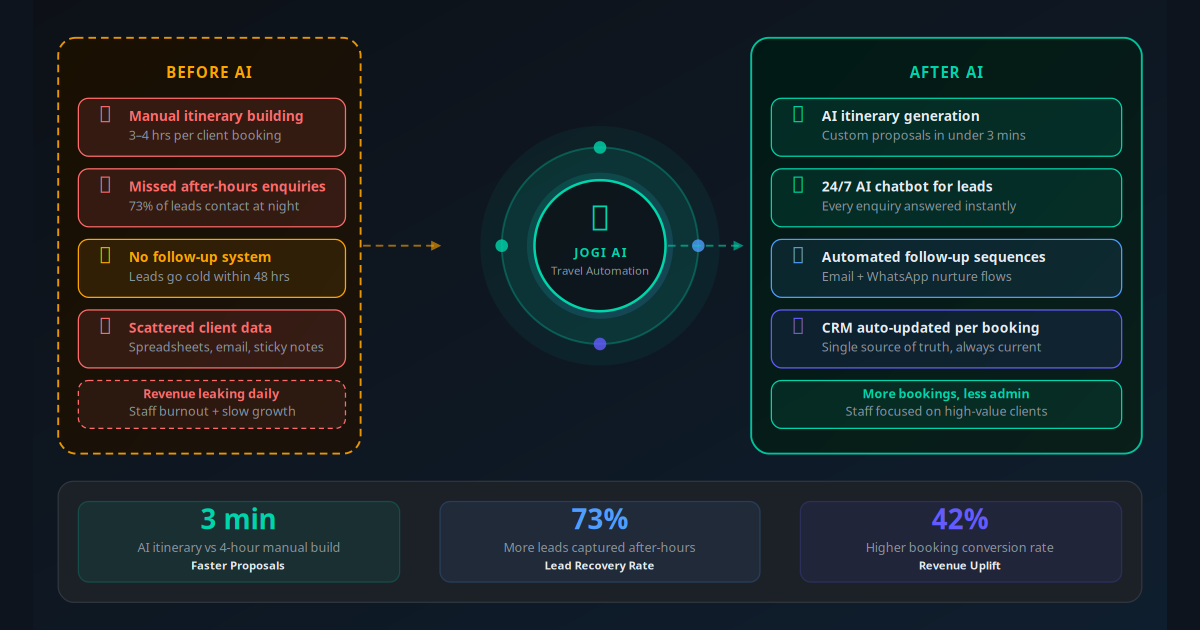
AI Automation for Travel Agencies: Book More, Work Less
How modern travel agencies use automated itinerary builds, 24/7 lead qualification, and booking workflows to increase close rates.
Read More →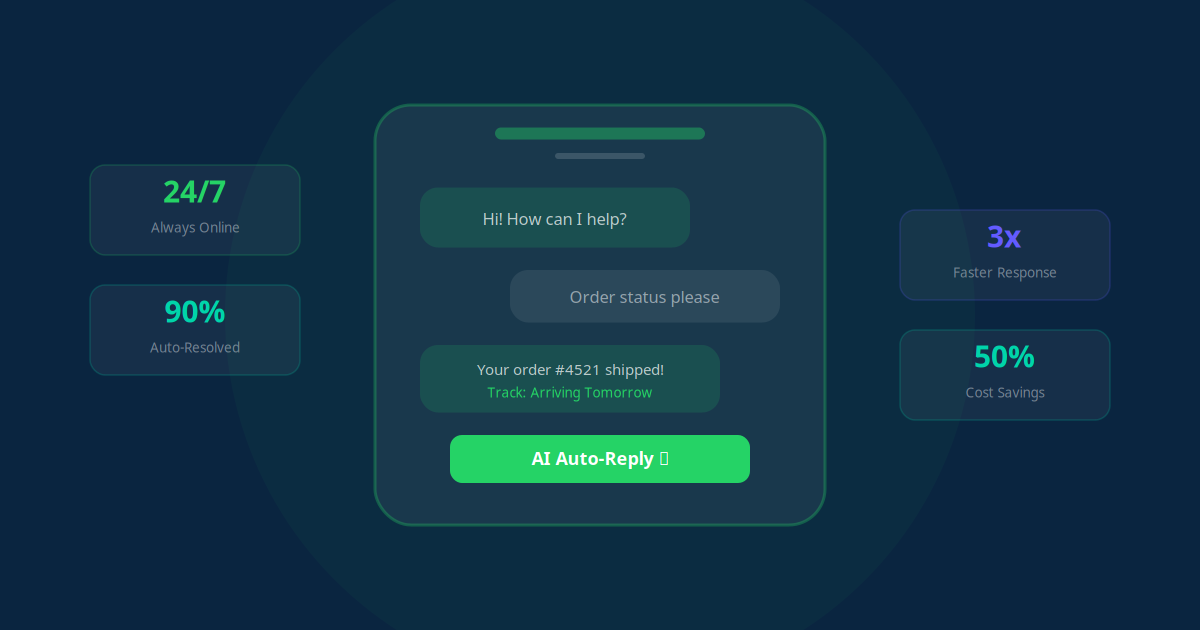
WhatsApp Business Automation: The Complete Guide
Turn WhatsApp into your highest-converting sales channel with automated responses, booking flows, and client nurture sequences.
Read More →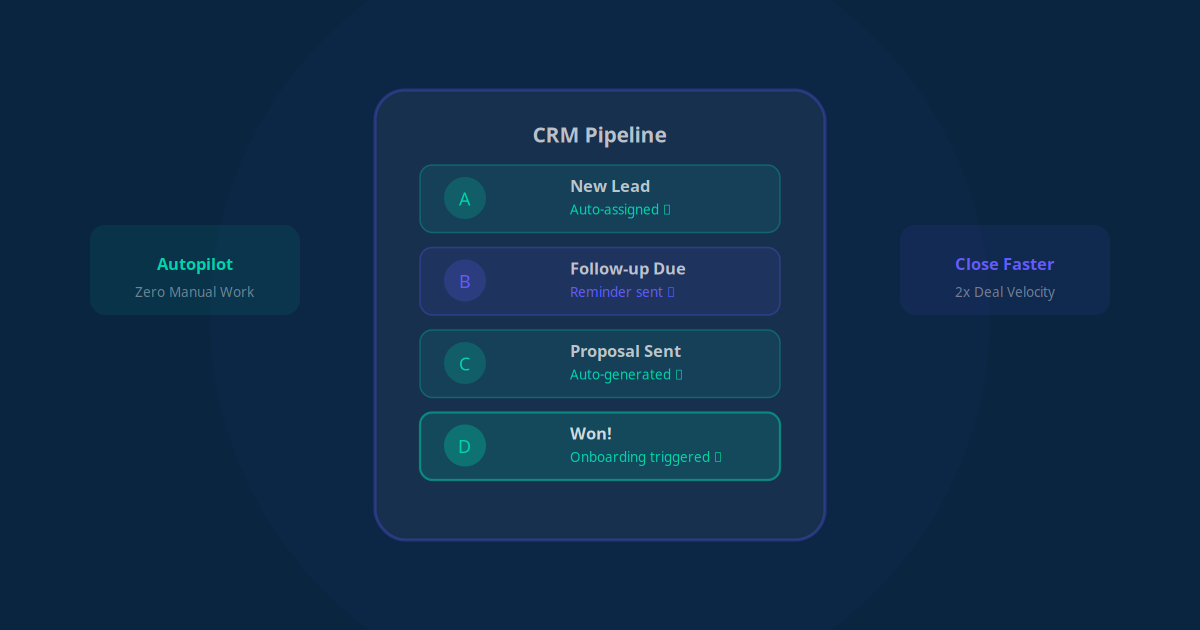
CRM Automation 101: The Beginner's Guide for SMBs
How to set up automated lead workflows, follow-up sequences, and deal tracking so no client ever falls through the cracks.
Read More →