AI Automation for Travel Agencies: Book More, Work Less in 2026




Your competitor just booked a Maldives honeymoon — at 11:30 PM on a Tuesday. The client messaged on WhatsApp, got an instant reply with three package options, answered a few qualifying questions, and confirmed a $7,400 booking before midnight. No agent was awake. No human typed a single word.
That competitor is not a large online travel agency with a 50-person tech team. It is a boutique agency of 6 people that built an AI automation stack over three weekends. And it is now capturing bookings your agency is losing every night while you sleep.
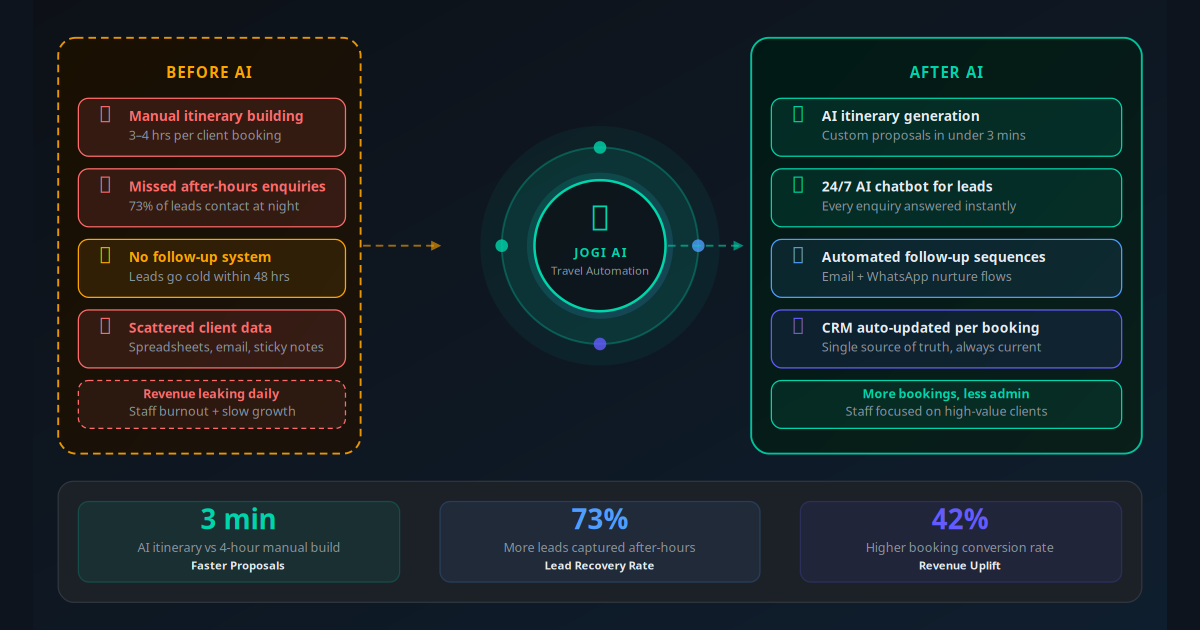
Travel agencies sit in a structurally difficult position. They sell high-consideration, emotionally driven purchases that require deep personalisation — but the admin load to deliver that experience is enormous. Building itineraries takes hours. Following up with enquiries requires discipline. Chasing payments, sending reminders, updating client records — these tasks consume 60–70% of a travel agent's working day, leaving less than a third for the relationship work that actually closes bookings.
AI automation does not replace that relationship work. It eliminates everything else, giving your agents the time and headspace to focus on what only humans can do: understand a client's dream holiday and make it real.
Key Takeaway
Travel agencies that automate lead capture, itinerary generation, and follow-up sequences are closing 42% more bookings per agent — not by working harder, but by eliminating the admin that was blocking revenue in the first place.
Explore all industry-specific AI automation solutions we offer at Jogi AI.
The Hidden Cost of Manual Operations
Ask any travel agent where their time goes and you will hear the same answers: building quotes, chasing leads, responding to the same questions about visa requirements and cancellation policies, updating spreadsheets, and sending payment reminders. These are not value-creating activities. They are friction — and they compound.
Consider a typical mid-size travel agency processing 40 bookings per month. A conservative audit of their operations usually reveals:
- Itinerary and quote building: 3.5 hours per booking average = 140 hours per month
- Lead follow-up (manual calls and emails): 45 minutes per lead, assuming 80 enquiries = 60 hours per month
- Post-booking admin (documents, reminders, supplier confirmations): 1.5 hours per booking = 60 hours per month
- Payment chasing and admin: 20 minutes per booking = 13 hours per month
That is 273 hours per month — roughly 1.7 full-time employees — spent on work that AI can do better, faster, and without taking a lunch break. At a loaded cost of $25/hour, that is $6,825 per month in labour doing tasks that $300/month of software could handle.
The second hidden cost is missed leads. 73% of travel enquiries arrive outside business hours — evenings, weekends, and public holidays. Research by Harvard Business Review found that responding to a lead within 5 minutes makes you 100 times more likely to convert than responding after 30 minutes. Most travel agencies respond within 18 hours. By then, the client has already booked somewhere else.
The agency that responds first wins the booking — not the agency with the best product.
Where AI Fits Into a Travel Agency
AI automation for travel agencies covers five core areas, each with distinct tools and measurable impact:
| Area | What AI Does | Time Saved | Revenue Impact |
|---|---|---|---|
| Lead Capture | AI chatbot handles enquiries 24/7 across web, WhatsApp, and social | 2–3 hrs/day | +73% lead capture rate |
| Itinerary Generation | AI drafts day-by-day itineraries from a client brief in under 10 minutes | 3–4 hrs per booking | 3x more proposals sent |
| Lead Nurturing | Automated email and WhatsApp sequences follow up on every enquiry | 45 min per lead | +42% conversion rate |
| CRM Automation | Records updated automatically at every touchpoint; tasks assigned to agents | 30–60 min/day | Zero leads falling through gaps |
| Post-Booking Admin | Documents sent, reminders scheduled, payment requests automated | 1.5 hrs per booking | Fewer cancellations and disputes |
The most impactful starting point depends on your biggest bottleneck. If you are losing leads overnight, start with AI lead capture. If your agents spend most of their day building itineraries, start with AI proposal generation. If bookings are falling through after the initial enquiry, start with an automated nurture sequence.
Capturing Every Lead — Even at 2 AM
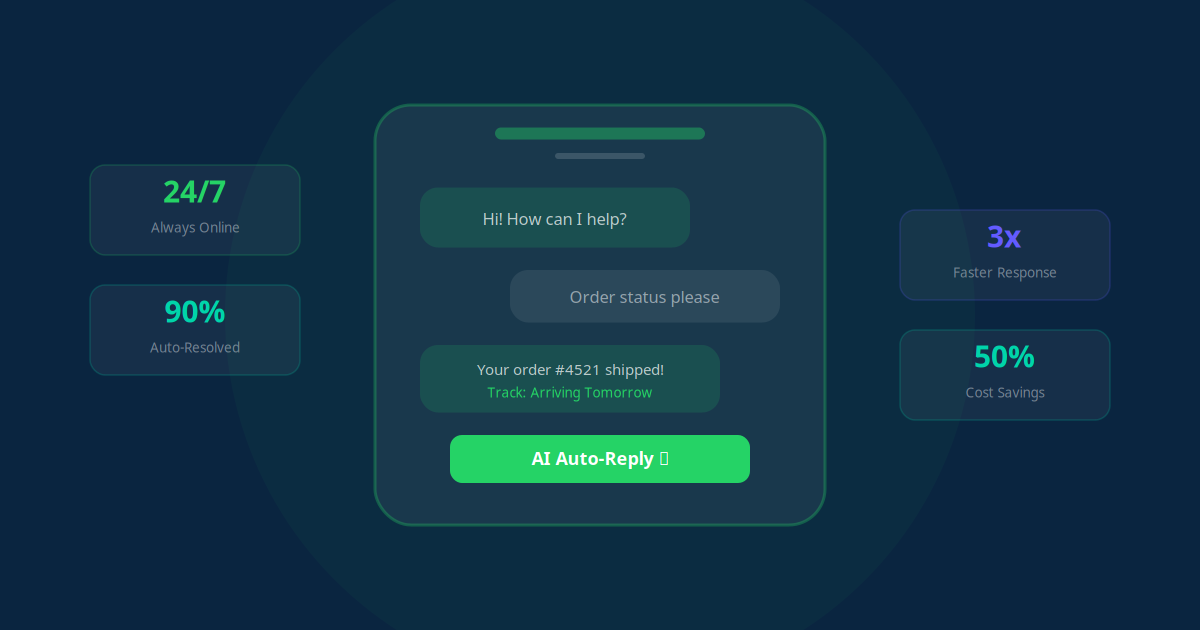
The fastest ROI in travel agency automation comes from a single change: deploying an AI chatbot that responds to every enquiry instantly, at any hour, on every channel you operate.
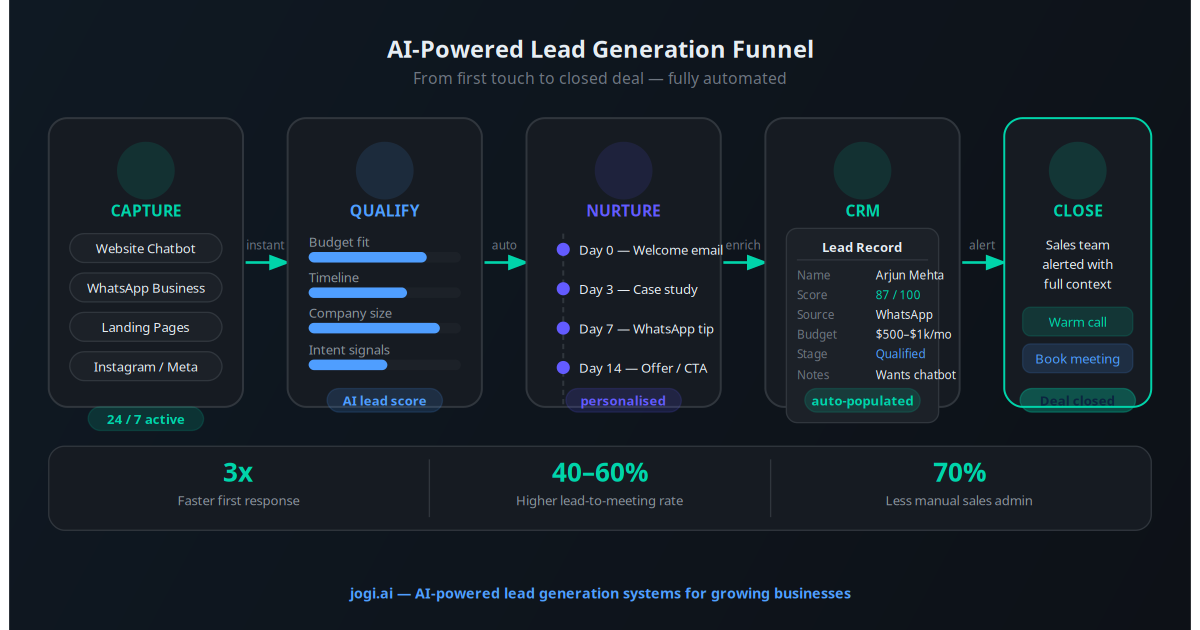
A well-built travel AI chatbot does far more than answer FAQs. When a prospective client messages asking about a Thailand family trip, the chatbot does not just say "thanks for your enquiry, someone will be in touch." It immediately asks qualifying questions: dates, group size, budget range, interests, previous travel experience. It captures the information your agents need to build a great proposal — and routes the qualified lead to the right agent with full context attached.
This works across WhatsApp Business automation, Instagram DMs, Facebook Messenger, and your website simultaneously. A client who discovers your agency through an Instagram reel at 9 PM on a Sunday gets an immediate, intelligent response — not a 36-hour wait.
What the chatbot qualifies:
- Destination interest and travel dates
- Number of travellers and ages (especially important for family and group travel)
- Budget range (or "do you have a budget in mind?")
- Travel style preferences (luxury, adventure, cultural, beach)
- Specific requests (honeymoon, anniversary, bucket list destination)
- Previous travel experience (to calibrate proposal complexity)
Once qualified, the AI schedules a consultation call directly into your agent's calendar, sends the client a confirmation, and creates the CRM record with all captured preferences pre-populated. Your agent starts the call knowing the client's name, destination wish, budget, travel dates, and travel style — instead of spending the first 10 minutes collecting that information manually.
AI Itinerary Generation: From 4 Hours to 10 Minutes
Building a compelling, personalised itinerary is the highest-value activity a travel agent performs — and the one that consumes the most time. A 10-day Europe itinerary tailored to a couple celebrating their 25th anniversary typically takes 3–5 hours to research, structure, format, and write up. At 10 enquiries per agent per week, that is an entire working day spent on itinerary building alone.
AI itinerary generation tools change this completely. Given a structured client brief — destination, duration, travel style, interests, budget tier, and any specific requests — an AI tool produces a detailed day-by-day itinerary with hotel categories, activity suggestions, restaurant recommendations, and logistics notes in under 10 minutes.
The output is not a finished product. It is a 90%-complete draft that your agent reviews, personalises with their specific supplier relationships, and adjusts for current availability. The agent's contribution shifts from "build from scratch" to "review and elevate" — a task that takes 20–30 minutes rather than 4 hours.
This is especially powerful when combined with RAG-based AI chatbots trained on your agency's own destination knowledge — preferred suppliers, past client feedback, negotiated rates, and unique experiences your agency has curated. The AI generates itineraries that sound like they were written by your most experienced agent, every time.
Key Takeaway
AI itinerary generation does not replace agent expertise — it eliminates the 90% of the work that does not require expertise, freeing agents to focus on the 10% that does: personalisation, relationship, and closing.
Real Use Cases Across Agency Types
Boutique Luxury Agency — Lead Qualification and Proposal Speed
A 4-agent boutique agency specialising in luxury safari and honeymoon packages was spending 80% of agent time on enquiries that never converted. After deploying an AI qualification chatbot that screened for budget (minimum $5,000) before routing to an agent, qualified lead volume dropped from 120 to 38 per month — but conversion jumped from 12% to 41%. Net result: 16 bookings per month at $8,500 average value, up from 14 bookings at $6,200 average. Revenue increased 48% with the same team size.
Mid-Size Family Travel Agency — After-Hours Lead Recovery
A family travel specialist handling school holiday packages discovered that 71% of their web enquiries arrived between 7 PM and 10 PM. Their previous setup — a contact form with a 24-hour response SLA — meant most of those leads had already contacted 2 competitors by the time the agency replied. An AI chatbot deployed on the website and WhatsApp brought average response time from 19 hours to 90 seconds. Bookings from after-hours enquiries increased 3.1x in the first 90 days.
Corporate Travel Manager — Automated Policy Enforcement and Booking
A corporate travel management company managing business travel for 12 SMB clients was handling 200+ booking requests per month manually, each requiring policy checks (budget limits, preferred carriers, approved hotels). AI workflow automation now handles 78% of standard bookings end-to-end — policy check, booking confirmation, receipt forwarding, and CRM update — with human review only for out-of-policy requests. Processing time per booking dropped from 45 minutes to 4 minutes.
Adventure Tour Operator — Group Booking Coordination
A small-group adventure operator managing tours for 8–16 people had a complex pre-departure admin burden: deposit collection, medical forms, gear lists, pre-trip briefings, and final payment reminders — all tracked manually across spreadsheets and email. Automating this via a workflow automation platform reduced pre-departure admin from 6 hours per group to under 45 minutes, with zero missed steps and a documented reduction in last-minute cancellations from 18% to 7%.
Destination Wedding Specialist — Multi-Touch Nurture Sequences
A destination wedding travel specialist had a 6-to-12-month lead cycle — couples enquire over a year before their wedding date. Manual follow-up over that period was inconsistent and time-consuming. An automated nurture sequence — 14 touchpoints over 6 months mixing educational content, venue showcases, real wedding stories, and personalised check-ins — kept the agency top of mind throughout the decision period. Booking conversion from initial enquiry increased from 22% to 39%.
Step-by-Step: How to Automate Your Travel Agency
Map your current enquiry-to-booking journey: Before building anything, document every step from first contact to booking confirmation. Identify where leads are lost (usually: overnight/weekend response gaps, slow proposal turnaround, and inconsistent follow-up) and where agent time is consumed by repetitive tasks.
Deploy a 24/7 AI chatbot on your highest-traffic channel: Start with your website and WhatsApp — the two highest-volume channels for most travel agencies. Configure the chatbot to qualify leads with 5 questions, collect contact details, and notify the right agent immediately when a hot lead is captured. This alone recovers the majority of after-hours lost bookings.
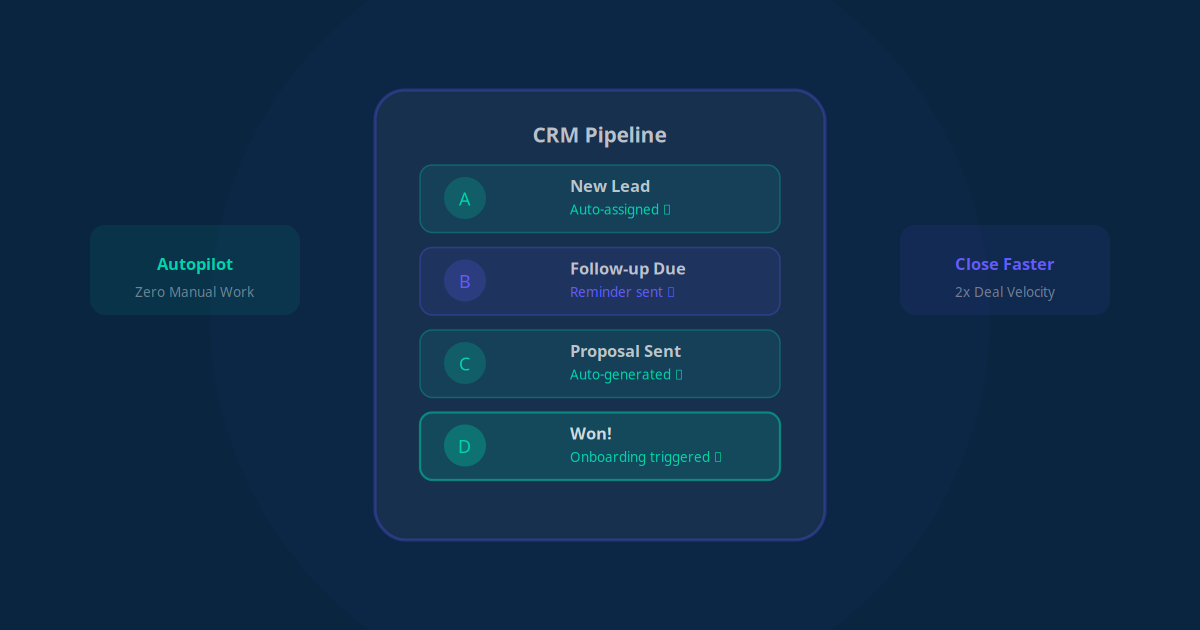
Set up your CRM with automated lead workflows: Every new enquiry should automatically create a CRM record, assign to an agent, set a follow-up task, and trigger the first nurture email within 5 minutes. Use a CRM automation platform that supports multi-step workflows — HubSpot, GoHighLevel, or Zoho CRM all work well for travel agencies.
Build a 5-email automated nurture sequence for new leads: Most travel leads do not convert on first contact — they are researching and comparing. A 5-email sequence over 10 days — starting with a value piece (destination guide or travel tips), moving to social proof (client testimonials, photos), and closing with a soft call to book a consultation — dramatically increases conversion without agent effort. Connect this to your email automation platform.
Integrate an AI itinerary generation tool into your proposal workflow: Tools like TripCreator, Tourwriter, or a custom GPT-4-based system connected to your destination content library can draft 90% of a standard itinerary in under 10 minutes. Set up a standard brief template that agents complete before triggering the AI — destination, duration, travel style, budget tier, group composition, and special requests.
Automate post-booking admin: Configure triggers for each booking stage: confirmation document delivery, passport and visa reminder (sent 90 days before departure), travel insurance prompt (sent 60 days before), final payment reminder (sent 14 days before), pre-departure briefing (sent 7 days before), and post-trip review request (sent 3 days after return). All automated, all personalised with the client's name and trip details.
Set up a re-engagement campaign for past clients: Your existing client database is your highest-converting segment. An automated annual re-engagement sequence — a personalised anniversary message, a "where to travel next" guide based on their previous trip, and a seasonal promotion — generates repeat bookings from clients who might otherwise drift to a competitor or book direct.
Measure, review, and expand: Track your key metrics monthly: lead response time, enquiry-to-consultation conversion, consultation-to-booking conversion, agent hours per booking, and revenue per agent. Use these to identify the next automation opportunity. Most agencies add 2–3 new automations per quarter once the foundation is in place.
AI Tools and Platforms for Travel Agencies in 2026
There is no single "travel agency AI platform" that does everything well. The practical approach is to combine best-of-breed tools for each function and connect them via a workflow automation layer like Make, Zapier, or n8n.
| Function | Recommended Tools | Monthly Cost (approx.) | Key Feature |
|---|---|---|---|
| AI Chatbot (Web + WhatsApp) | ManyChat, Tidio, custom RAG chatbot | $30–$150 | 24/7 multi-channel lead capture |
| CRM + Automation | GoHighLevel, HubSpot, Zoho CRM | $97–$300 | Lead workflows, task assignment, deal tracking |
| Email Automation | ActiveCampaign, Klaviyo, ConvertKit | $29–$100 | Nurture sequences, segmented campaigns |
| Itinerary Generation | TripCreator, Tourwriter, custom GPT | $50–$200 | AI-drafted day-by-day itineraries |
| Workflow Automation | Make (Integromat), Zapier, n8n | $20–$100 | Connects all tools, triggers automated actions |
| Booking & Payments | Stripe + automated invoicing, TravelJoy | $20–$80 | Automated payment reminders, deposit collection |
Total stack cost for a typical 5-agent travel agency: $250–$700 per month. Against average booking values of $3,000–$8,000 and 30–50 bookings per month, recovering even one additional booking per month more than covers the entire stack cost.
If your agency uses automated lead generation and sales funnel management, consider whether your current CRM handles multi-channel attribution — knowing whether a booking came from Instagram, Google Ads, or a referral is critical for optimising your marketing spend.
The ROI Case: What Automation Actually Delivers
"We went from responding to leads the next morning to responding in 90 seconds. In the first month, we booked 8 trips that would never have happened — clients who had already messaged two other agencies before we replied. Now we almost always reply first."
— Director, boutique honeymoon travel agency, 5 agentsThe ROI of travel agency automation falls into three categories:
1. Recovered Lost Revenue (Biggest Lever)
If your agency receives 60 after-hours enquiries per month and previously converted 15% of them (9 bookings) due to slow response, improving response time to under 5 minutes typically lifts conversion to 35–40% (21–24 bookings). At an average booking value of $3,500, that is 12–15 additional bookings per month worth $42,000–$52,500 in gross revenue — from the same enquiry volume you already had.
2. Labour Reallocation (Second Lever)
Automating itinerary drafting, follow-up, and post-booking admin typically recovers 25–35 hours per agent per month. That time is reallocated to high-value activities — more personalised client consultations, complex itinerary crafting, VIP client management, and supplier relationship building. Agencies using AI report revenue per agent increasing 30–45% in the 12 months after automation, without adding headcount.
3. Reduced Cancellations and Disputes (Third Lever)
Automated pre-departure communications — visa reminders, travel insurance prompts, final payment notices, and trip briefings — reduce last-minute cancellations, missed payments, and client disputes arising from poor preparation. One adventure tour operator cut last-minute cancellations from 18% to 7% simply by automating their pre-departure communication sequence, recovering an estimated $28,000 in annual revenue.
Combined, these three levers typically deliver a 300–600% return on the cost of the automation stack within the first year. Most agencies reach full payback within 45–60 days of their first automation going live.
For a personalised estimate of what automation would deliver for your specific agency — including booking volume, average deal value, and current lead conversion rate — the AI Business Twin tool generates a customised ROI projection in under 10 minutes.
Mistakes Travel Agencies Make When Automating
Automating before the process is defined
The most common mistake is attempting to automate a broken or undefined process. If your lead qualification process is inconsistent between agents, automating it will consistently deliver the wrong outcome. Spend one day mapping your ideal lead journey before building a single automation. Document what good looks like at each stage, then automate that documented process.
Using generic chatbot templates not trained on your agency
A generic travel chatbot that cannot answer questions about your specific packages, your cancellation policy, or your signature destinations will frustrate clients and lose leads. Train your AI assistant on your agency's own content — your brochures, your FAQ documents, your supplier information, and your past itineraries. The chatbot should sound like your most knowledgeable agent, not a generic travel bot.
Sending automated messages that feel automated
Clients choosing a boutique travel agency are paying for a personal, curated experience. Automated emails that open with "Dear Valued Customer" destroy that perception immediately. Personalise every automated communication with the client's first name, their destination, and their travel dates at minimum. Use a conversational, warm tone — not corporate boilerplate. Test every message by asking: "Would I feel valued receiving this?"
Ignoring the human handoff
Automation handles the top-of-funnel work. The closing conversation — the moment where a client commits to spending $8,000 on a once-in-a-decade holiday — should always involve a human agent. Build clear handoff triggers: when a lead has been through the qualification chatbot, received the nurture sequence, and requested a consultation, the agent takes over with full context. The automation's job is to deliver a warm, informed lead to a human who can close.
Over-automating too quickly
Agencies that try to automate everything at once usually end up with nothing working well. Start with one automation, run it for 30 days, measure the results, improve it, then add the next. The compound effect of 6 well-tuned automations built over 6 months outperforms a chaotic implementation of 20 automations built in a week. Treat automation like structured workflow improvement — incremental, measured, and always in service of the client experience.
Forgetting the re-engagement opportunity
Most travel agencies have a goldmine sitting untouched in their existing client database. Past clients who loved their experience are the most convertible segment — they already trust you, they already know the quality of your service. A simple automated annual re-engagement sequence — a personalised message on the anniversary of their trip, a "where to travel next" recommendation based on their previous destination, and a seasonal promotion — generates significant repeat booking revenue from a segment that costs nothing to acquire. Agencies regularly report that past client re-engagement campaigns are their highest-ROI marketing activity.
Building the Future-Proof Travel Agency
The travel agencies that will thrive over the next decade are not the ones with the biggest marketing budgets or the most agents. They are the ones that respond fastest, follow up most consistently, and deliver the most personalised client experience — at scale. AI automation is the mechanism that makes all three possible simultaneously.
The technology is no longer complex, expensive, or exclusive to large OTAs. A boutique agency of 3–5 agents can deploy a complete automation stack for under $500 per month and see full ROI within 60 days. The agents who built their value on deep destination knowledge and genuine client relationships lose nothing to automation — they gain 30 hours a month to apply that value more deeply. The agents whose value was built on being fast at data entry have already been disrupted by the OTAs. The question now is whether you adapt before or after your market does.
Use the AI Business Twin to get a free, personalised analysis of exactly which automations would deliver the highest return for your travel agency — including which leads you are currently losing and how much revenue they represent.
Frequently Asked Questions
How does AI automation benefit a small travel agency?
AI automation lets a small travel agency respond to every enquiry instantly — even at 2 AM — without adding staff. It builds personalised itinerary proposals in under 3 minutes, follows up with leads automatically via email and WhatsApp, keeps your CRM updated after every interaction, and sends pre-trip reminders to reduce last-minute cancellations. The net result is more bookings closed per agent and significantly less administrative overhead per trip sold.
What is the biggest time waster AI can eliminate for travel agents?
Manual itinerary building is the single biggest time sink in most travel agencies — it takes 3 to 5 hours per client for a mid-range itinerary. AI itinerary tools cut this to under 10 minutes by pulling destination content, building day-by-day schedules, and generating a formatted proposal from a simple client brief. Agents then review and personalise rather than build from scratch. Across a team of 5 agents handling 10 itineraries a week, that is 150 to 200 hours of productive time recovered monthly.
Can AI handle travel enquiries from WhatsApp and Instagram?
Yes. AI chatbots can be deployed across WhatsApp Business, Instagram DMs, Facebook Messenger, and your website simultaneously. When a lead messages asking about a Bali honeymoon package, the AI responds instantly, asks qualifying questions about budget, dates, and preferences, and either sends a packaged quote or routes the lead to the right agent with full context. This captures leads that would otherwise go cold overnight.
Will AI replace travel agents?
No — AI replaces the repetitive, low-value tasks that prevent travel agents from doing what they do best. Researching supplier options, building itineraries from scratch, chasing payment reminders, answering FAQs about visa requirements — these are tasks AI handles better and faster. The agent's role shifts to consulting, personalising complex trips, managing VIP relationships, and closing high-value bookings. Agencies that adopt AI do not shrink their teams; they grow revenue per agent.
How much does AI automation cost for a travel agency?
A practical AI automation stack for a travel agency — including a CRM with workflow automation, an AI chatbot across web and WhatsApp, an email and SMS nurture system, and an AI itinerary generation tool — typically costs $200 to $600 per month depending on agency size and booking volume. For an agency closing 15 to 30 bookings a month at average values of $2,000 to $5,000, recovering even 2 to 3 additional bookings per month from better lead capture pays for the entire stack several times over.
What CRM should a travel agency use with AI automation?
HubSpot, GoHighLevel, and Zoho CRM all have strong AI and automation capabilities suited to travel agencies. GoHighLevel is popular for agencies that want to run the entire sales funnel — from lead capture through follow-up to booking — in one platform. HubSpot is a better fit for agencies with an established marketing function who want deep analytics. The key requirement is a CRM that triggers automated workflows based on lead actions, integrates with your booking platform, and supports multi-channel communication including WhatsApp and email.
How do I start automating my travel agency without overwhelming my team?
Start with the highest-impact single automation: an AI chatbot that handles after-hours enquiries on your website and WhatsApp. This alone captures leads you are currently losing overnight and over weekends. Once that is running, add an automated follow-up sequence for new leads — a 5-email sequence over 10 days dramatically increases conversion without any manual effort. Add itinerary generation AI and CRM workflow automation in subsequent phases. Most agencies see full return on investment within 60 days of their first automation going live.