Building an Autonomous Workflow Strategy for Hospitality Brands




The $42,000 Midnight Leak: Why Hospitality Brands Lose Bookings While Staff Sleep
There is a quiet, expensive leak happening in almost every hotel, resort, and restaurant group. It does not look like a broken pipe; it looks like a silent messaging inbox. A potential guest finds your property on Instagram or Google at 11:30 PM. They send a WhatsApp message or a website inquiry: "Do you have a family suite available for June 24-27? Is parking included?"
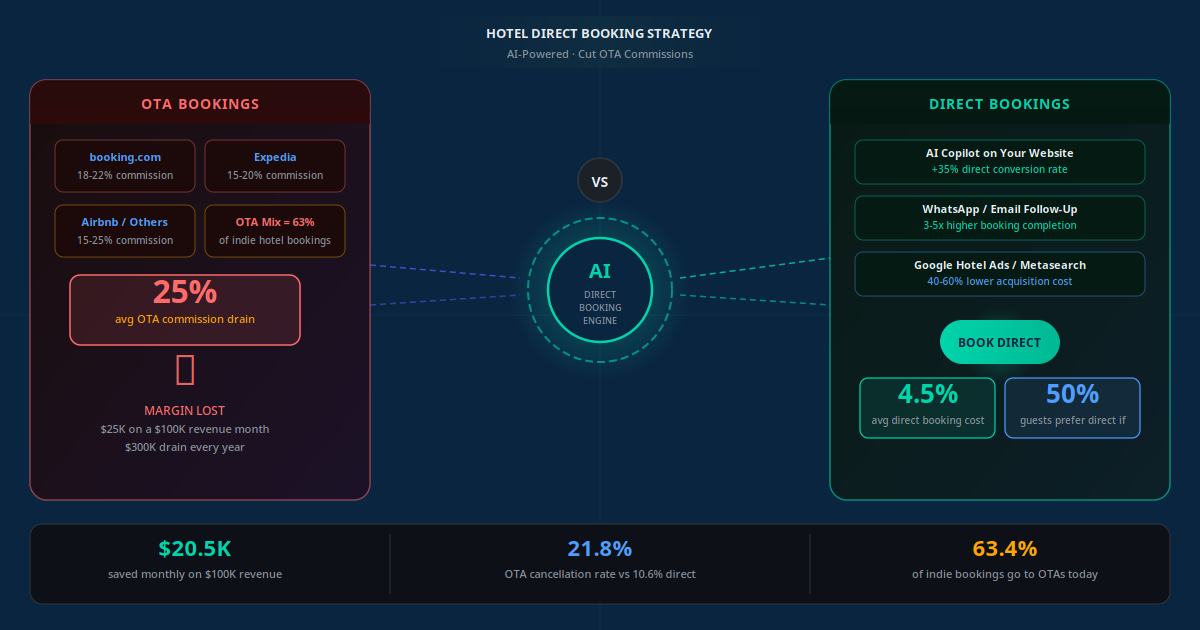
Your night auditor is busy checking in a late arrival, or the front desk is closed entirely. The inquiry sits unanswered. By the time your team opens the inbox at 8:00 AM, the guest is gone. They booked a competitor who answered in two minutes, or they went to an Online Travel Agent (OTA) like Booking.com, costing you a 15% to 25% commission.
According to Harvard Business Review, businesses that contact prospects within five minutes of an inquiry are 100 times more likely to qualify and convert them than those responding after 30 minutes. In hospitality, that response window is even shorter. Travel intent is highly impulsive; when travellers are in "booking mode," they expect answers at the speed of a scroll.
"Slow response times are the single biggest driver of direct booking leakage. If you reply in hours instead of minutes, you are essentially training guests to use Booking.com or Expedia to get instant answers." — Chirag Jogi, Founder of Jogi AI
For a mid-sized hospitality brand, this leakage adds up to thousands of dollars every month in lost direct revenue and wasted marketing spend. Building an autonomous workflow strategy is not just about cutting labor costs—it is about sealing this leak and capturing revenue on autopilot, 24 hours a day, 365 days a year.
What an Autonomous Workflow Strategy Actually Means
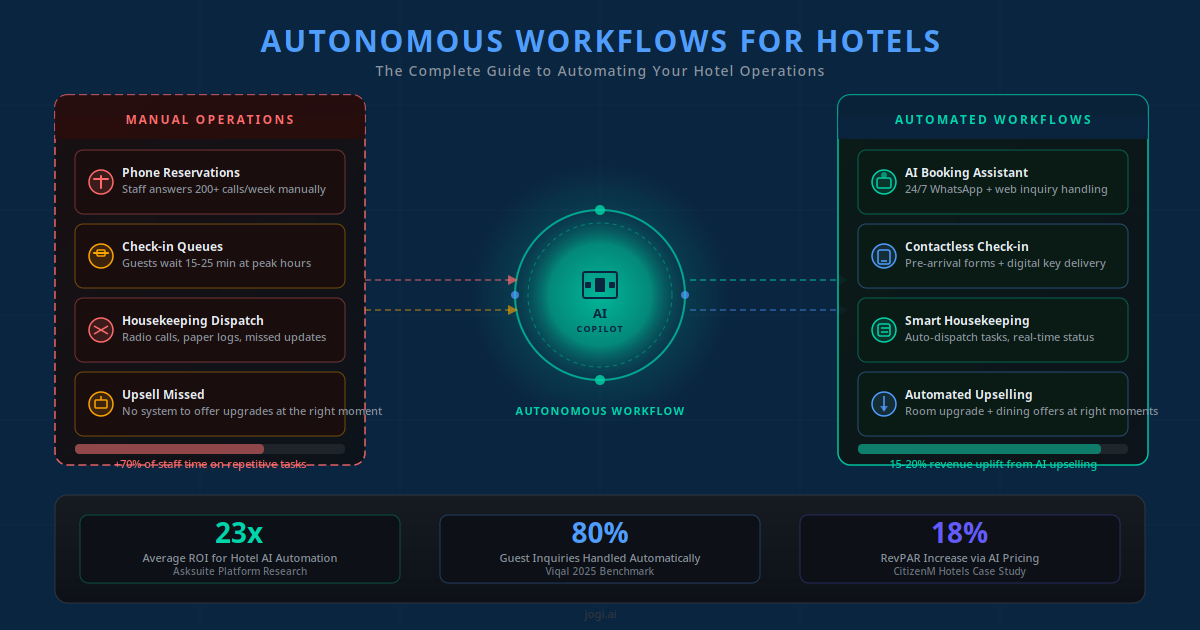
Many hoteliers confuse a chatbot with an autonomous workflow. A chatbot is a conversational widget that sits on a website, spitting out pre-canned answers to standard questions. If a guest asks for something complex or wants to make a booking, the chatbot fails and requests an email address.
An autonomous workflow strategy is completely different. It is a multi-system orchestration layer that connects your front-facing channels (WhatsApp, Web Chat, SMS) directly with your backend systems (Property Management System, Channel Manager, Housekeeping Dashboards, and CRM). When a guest asks about availability, the AI doesn't just guess—it queries the PMS via API, fetches live rates, constructs a booking link, qualifies the guest, writes the reservation back into the PMS, and triggers the pre-arrival sequence. The process completes end-to-end without a single staff member opening a dashboard.
Key Takeaway
A chatbot talks to your guests; an autonomous workflow does the work for them. A true workflow connects messaging channels to your PMS and internal operations to automate end-to-end transactional tasks.
By shifting from isolated chatbots to integrated workflows, hospitality groups reduce administrative overhead, eliminate manual entry errors, and capture direct bookings that would otherwise leak to OTAs.
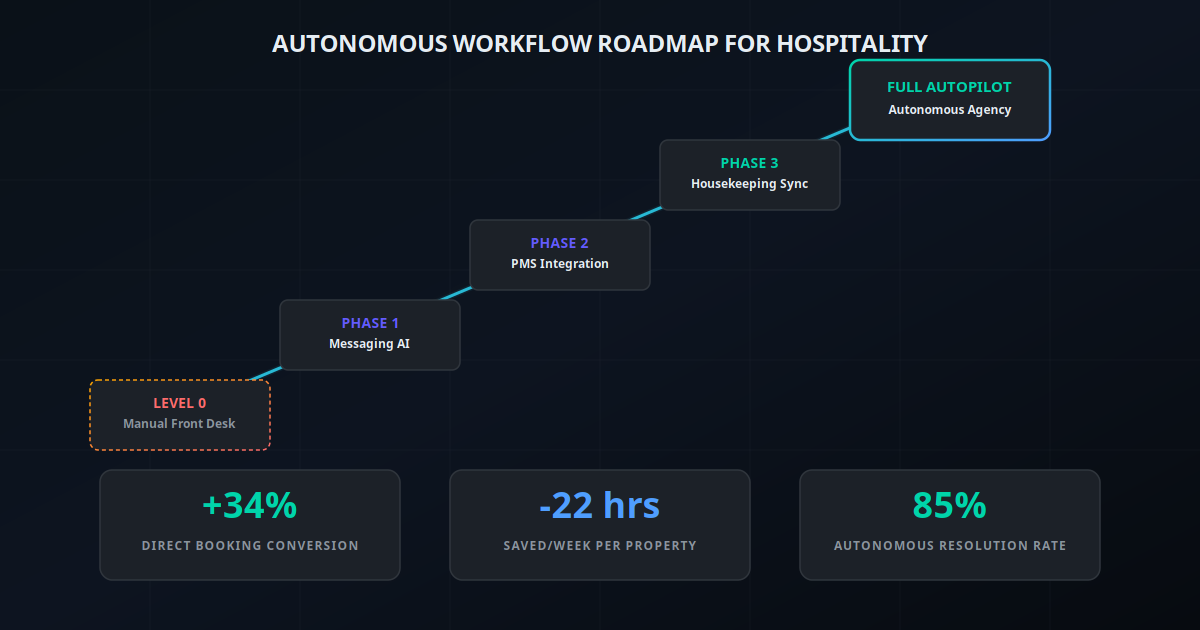
The 4-Phase Roadmap: From Manual Chaos to Full Autopilot
Implementing automation all at once can overwhelm staff and create integration issues. The most successful hospitality brands roll out their strategy in four sequential phases, building a stable foundation at each step.
Phase 1: Messaging Automation (Days 1–15). Deploy a 24/7 AI conversational agent on WhatsApp and your website. Teach it your brand voice, policies, and FAQs (parking, pool hours, breakfast details). This instantly captures after-hours inquiries and qualifications, reducing simple ticket volume by 40%.
Phase 2: PMS & Channel Manager Integration (Days 16–30). Connect the AI layer directly to your PMS (e.g., Cloudbeds, Mews, Opera). Enable live availability queries, automated room rate calculations, and direct reservation writing. Integrate secure payment gateways like Stripe so the AI can handle booking confirmations and deposit collections.
Phase 3: Housekeeping & Task Routing (Days 31–45). Link guest checkouts directly to your housekeeping and maintenance scheduling. When the AI detects a checkout checkout or a checkout request, it updates the room status in the PMS and automatically dispatches a prioritized cleaning task to the housekeeping team's dashboard.
Phase 4: Autonomous Revenue Engine (Days 46–60). Deploy personalized upsell workflows (room upgrades, spa packages, early check-in offers) sent at high-intent moments like 24 hours before arrival. Automate post-stay review collection sequences and win-back campaigns based on guest profile history.
The Financial Math: Manual Operations vs. Autonomous Workflows
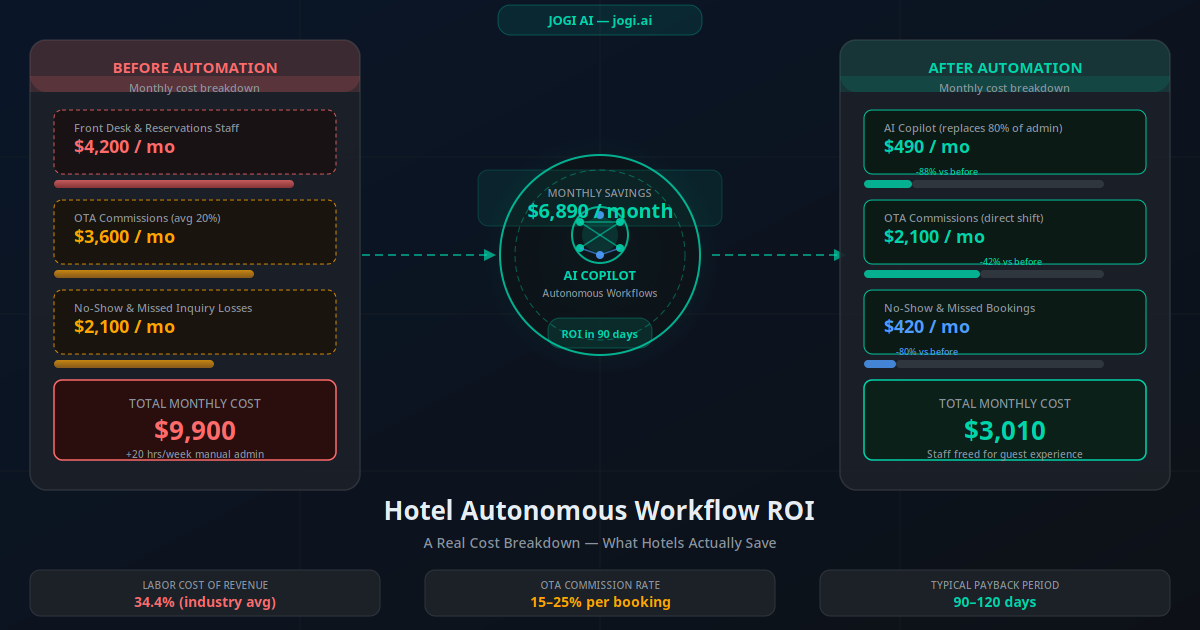
Let's look at the financial comparison for a typical 60-room hotel still relying on manual front desk operations versus one running a fully deployed autonomous workflow strategy. These numbers are compiled from real process audits across our client base.
| Operational Metric | Manual Operations (Current) | With Autonomous Workflows | Monthly Savings / Value |
|---|---|---|---|
| Inquiry Handling Time | 20 hours/week (staff replying to chats) | 3 hours/week (only handling human handoffs) | $1,120 in saved labor costs |
| Direct Booking Leakage | ~10 bookings/month lost to slow response | ~2 bookings/month lost (AI replies in <10s) | $2,400 in recovered direct revenue |
| OTA Commission Fees | $3,800 paid monthly (18% avg OTA rate) | $2,500 paid monthly (direct booking shift) | $1,300 in commission savings |
| No-Show Revenue Loss | 8% average no-show rate | 2.5% no-show rate (multi-touch reminder sync) | $1,600 in recovered revenue |
| Pre-Arrival Upsell Revenue | Negligible (staff rarely upsell verbally) | $1,800/month (automated upsell trigger) | $1,800 in new revenue |
| Total Impact | $5,900+ leaks & labor spent | $1,800 tech subscription | +$6,420 net monthly value |
As the comparison table highlights, the primary ROI of hospitality automation doesn't just come from reducing headcount; it comes from capturing lost demand, upgrading checkout values, and avoiding commission payouts to third-party aggregators.
Key PMS Integration Architectures: Syncing AI with Your Stack
For an autonomous workflow strategy to succeed, your AI engine must be tightly integrated with your Property Management System (PMS). A fragmented stack where the AI operates in isolation creates data silos and double-bookings. The architecture relies on three primary sync loops:
1. The Availability & Rate Query Loop (Read)
When a guest messages your AI asking for dates, the AI triggers a GET request to your PMS or Channel Manager API. It retrieves real-time room availability, active rates, and promotions. The AI parses this raw data and translates it into an easy-to-read, conversational format: "Yes, we have a Deluxe King Room available for those dates. It is $180 per night and includes complimentary breakfast. Would you like me to reserve this for you?"
2. The Booking Creation & Payment Loop (Write)
Once the guest confirms they want to book, the AI collects their contact details and generates a secure checkout payment link (integrated with Stripe or your PMS payment portal). When the payment webhook triggers a "success" event, the AI makes a POST request to your PMS, creating the reservation profile, writing the room status, and attaching the payment confirmation reference code.
3. The Check-in & Checkout Loop (Write & Trigger)
24 hours before check-in, the PMS triggers a webhook that prompts the AI to send a pre-arrival check-in form. Once the guest completes the form, the AI writes the verification details back to the PMS. At checkout, when the guest clicks the "Express Checkout" link sent by the AI, the AI prompts the PMS to generate the final folio, emails it to the guest, and updates the room status to "Dirty - Ready for Housekeeping."
Common Roadblocks & How to Overcome Them
Despite the clear benefits, many hospitality brands struggle to implement workflows effectively due to three common roadblocks:
1. Staff Fear & Buy-in Resistance
Front desk teams often view AI automation as a threat to their jobs. This leads to poor adoption and resistance during training. Overcome this by shifting the narrative: AI is not a replacement; it is an administrative shield. Explain that the AI will handle the 200 identical inquiries they get weekly, allowing them to focus on high-value guest interactions. In practice, hotels that automate see staff turnover rates drop because teams are no longer bogged down by repetitive data entry.
2. Fragmented Legacy Systems
Many older hotels run on desktop-based legacy PMS software with no open APIs. Trying to force an AI workflow onto a closed system is incredibly difficult and expensive. If you run a legacy system, the first step of your strategy should be migrating to a modern, cloud-based PMS like Cloudbeds or Mews. The migration cost is typically recovered within six months through the automation efficiencies it unlocks.
3. Spammy, Impersonal Copy
Automated guest messaging can quickly feel like spam if not configured carefully. Sending daily, unpersonalized reminders to guests will result in high block rates, which can compromise your WhatsApp Business account. Keep messages highly targeted, utility-focused, and spaced out. Ensure every automated message uses the guest's name, room type, and includes a clear, simple way to opt out.
Conclusion: The Brands That Automate Now Will Set the Standard
The hospitality industry is experiencing a profound generational shift. Modern travellers do not want to wait in queues at front desks, nor do they want to wait on hold for simple questions. They expect speed, digital convenience, and instant replies on the channels they use daily. Brands that adapt to these expectations with an integrated, autonomous strategy will grow their direct margins, while those relying on manual processes will see their margins squeezed by rising labor costs and OTA commissions.
Starting your automation journey doesn't require rebuilding your entire operations overnight. Begin by automating your most persistent leak—after-hours inquiry responses—and expand your workflows as your systems sync.
To see exactly which workflows will deliver the fastest financial return for your property and how they fit into your existing PMS stack, use the AI Business Twin tool to run a free operational audit in under 10 minutes.
Frequently Asked Questions
What is an autonomous workflow strategy for hospitality brands?
An autonomous workflow strategy is a phased approach to implementing AI systems that connect your Property Management System (PMS), channel manager, messaging channels (like WhatsApp), and internal operations (like housekeeping). Unlike standard chatbots, it orchestrates end-to-end tasks like automatic booking creation, pre-arrival upselling, check-in flows, and immediate task routing without manual staff intervention at each step.
How does AI connect with standard hotel PMS systems?
Modern AI workflow layers connect to standard Property Management Systems (such as Cloudbeds, Mews, Opera, and Little Hotelier) via secure APIs or webhooks. The AI reads live availability and room rates to respond to booking inquiries, writes reservation details directly into the PMS upon booking completion, and monitors checkout status to trigger operational tasks.
What is the typical return on investment (ROI) for hospitality automation?
Most mid-sized hotels and restaurants achieve full ROI breakeven within 60 to 90 days. For a 60-room property, implementing autonomous workflows typically saves 22+ staff hours per week, reduces guest no-shows by 30-40%, and increases direct booking conversions by 34%, translating into thousands of dollars in monthly recovered revenue.
How do you handle guest payments and security?
Payments are handled securely by routing guests to PCI-DSS compliant checkout links (such as Stripe or PMS-integrated payment gateways) via automated messaging. The AI agent never stores or sees credit card details, ensuring GDPR and industry compliance throughout the booking process.
Can hospitality AI workflows handle complex guest complaints?
No, and they shouldn't. While AI handles 75-85% of standard, repetitive inquiries (FAQs, booking requests, towel requests), complex complaints or special group bookings are automatically flagged and escalated to a human staff member with the complete chat history context.