Hotel Autonomous Workflow ROI: A Real Cost Breakdown




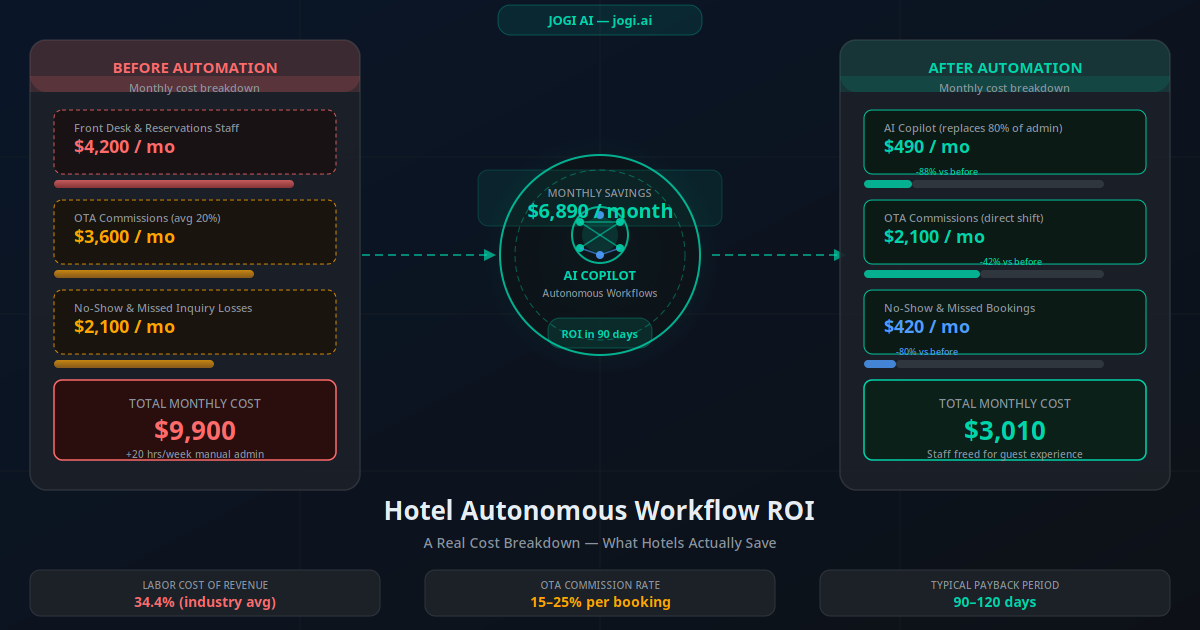
Most hotel owners I talk to know their property is inefficient. They feel it in the daily grind: the front desk fielding the same questions on repeat, the reservations manager chasing no-shows by phone, the owner losing sleep over yet another booking arriving through Booking.com at a 20% commission clip. What they rarely have is a clear number — a concrete financial picture of what the status quo is actually costing them, and what autonomous workflows would genuinely return.
This article gives you that picture. Not a vague promise of "efficiency gains" or "improved guest experience," but real cost line items, a worked example for a mid-size property, and an honest assessment of the payback timeline. I have implemented AI automation across hospitality clients ranging from boutique guesthouses to 120-room independent hotels, and the pattern is consistent enough to be instructive.
The short version: for most independent hotels, the monthly cost of manual operations is between $8,000 and $15,000 — and the entire autonomous workflow stack costs $400 to $900 per month to run. The math is not complicated. The question is whether the transition is worth the disruption. This article helps you answer that.
Key Takeaway
Hotel autonomous workflows typically save $4,000–$8,000 per month for a 40–100 room property. The three biggest cost levers are labor reallocation, OTA commission reduction through direct booking capture, and no-show revenue recovery — all addressable within 90 days of going live.
The Hidden Costs Most Hotel Owners Cannot See
The visible costs are easy to find on your P&L: wages, OTA commissions, software subscriptions. The hidden costs are harder to track, but they add up fast.
Consider what happens every time a potential guest sends an inquiry through your website at 9 PM on a Friday. If there is no one monitoring the inbox, that inquiry sits until Monday morning. By then, the guest has booked with a competitor — or, worse, gone straight to Booking.com and booked you through an OTA at a 20% commission instead of direct at 0%. That is not a cost that shows up as a line item anywhere. It is invisible revenue that never materialised.
The same dynamic plays out with no-shows. Industry data from Cloudbeds shows that OTA bookings cancel or no-show at a rate of 21.8%, versus 10.6% for direct bookings. For a hotel doing 40 rooms per night at $140 average rate, that 11% gap between OTA no-show and direct no-show rates represents roughly $20,000 in annual revenue exposure — money you provisionally counted on and then lost.
"Labor costs alone account for 34.4% of total hotel revenue on average. For an independent property doing $1.2M annually, that is $412,800 per year in wage-related expenses — much of it on tasks that autonomous workflows handle more reliably and at a fraction of the cost."
Before you can evaluate the ROI of automation, you need to see the full cost picture of the status quo. Most hotel owners have not done this calculation. When they do, the case for automation becomes self-evident.
Labor Hours: Where the Money Goes Every Week
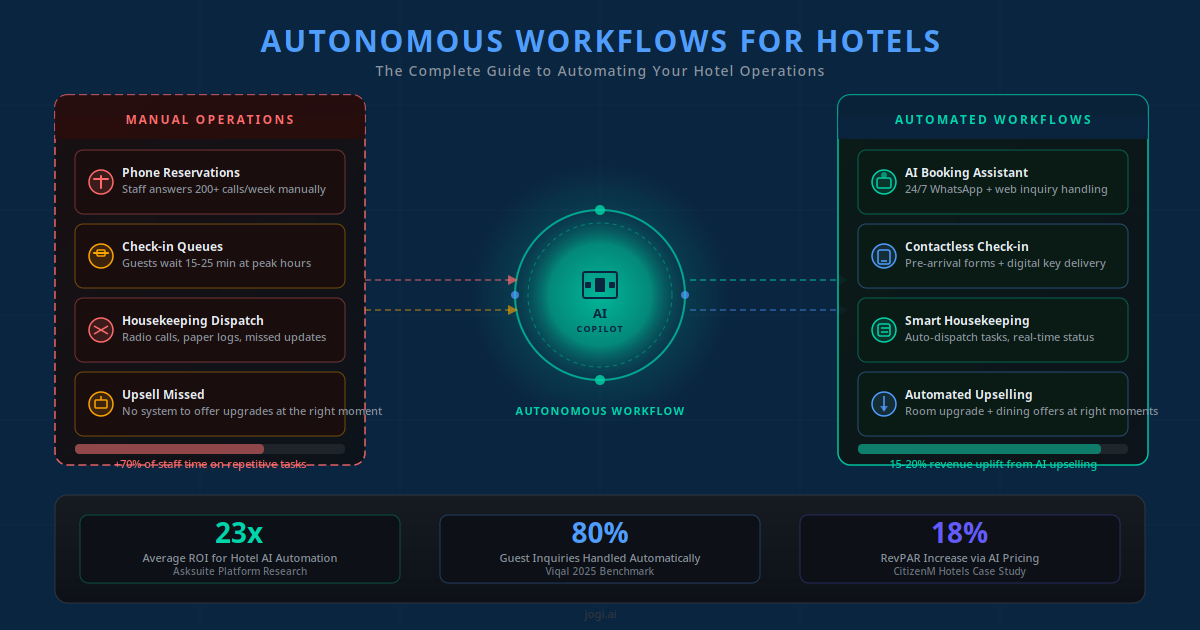
I want to be specific, because this is where the biggest savings live. When I audit a hotel's front-desk and reservations workflow, I typically find the following breakdown of weekly staff time:
| Task | Weekly Hours (typical) | Automatable? | AI Coverage |
|---|---|---|---|
| Answering booking inquiries (phone/email/chat) | 12–18 hrs | Yes — 90% | AI Booking Copilot |
| Sending booking confirmations and follow-ups | 4–6 hrs | Yes — 100% | Automated sequences |
| No-show and reminder calls | 3–5 hrs | Yes — 100% | Automated reminders |
| Pre-arrival upsell and communication | 2–4 hrs | Yes — 95% | Automated sequences |
| In-stay guest requests routing | 3–5 hrs | Yes — 70% | AI triage + routing |
| Post-stay review requests | 2–3 hrs | Yes — 100% | Automated sequence |
| Complex complaints, VIP handling | 4–6 hrs | No — human essential | Escalation path |
If you are paying your front-desk team $18–25 per hour (fully loaded with benefits and NI), that automatable block — roughly 26 to 39 hours per week — costs you between $1,872 and $3,900 per month. Even if you keep all your staff and simply redeploy their time to higher-value guest interactions, the upstream revenue effect of better guest experiences and more proactive upselling more than covers the automation cost.
Where I see the biggest immediate ROI is for hotels that were considering hiring an additional part-time reservations assistant. At $1,800–$2,400 per month for that role, the autonomous workflow stack is a straight substitution — and the AI does not call in sick on Saturday morning during your highest-occupancy weekend.
The OTA Commission Drain
This is the number that usually produces a sharp intake of breath when I show it to hotel owners for the first time. Let me put it plainly.
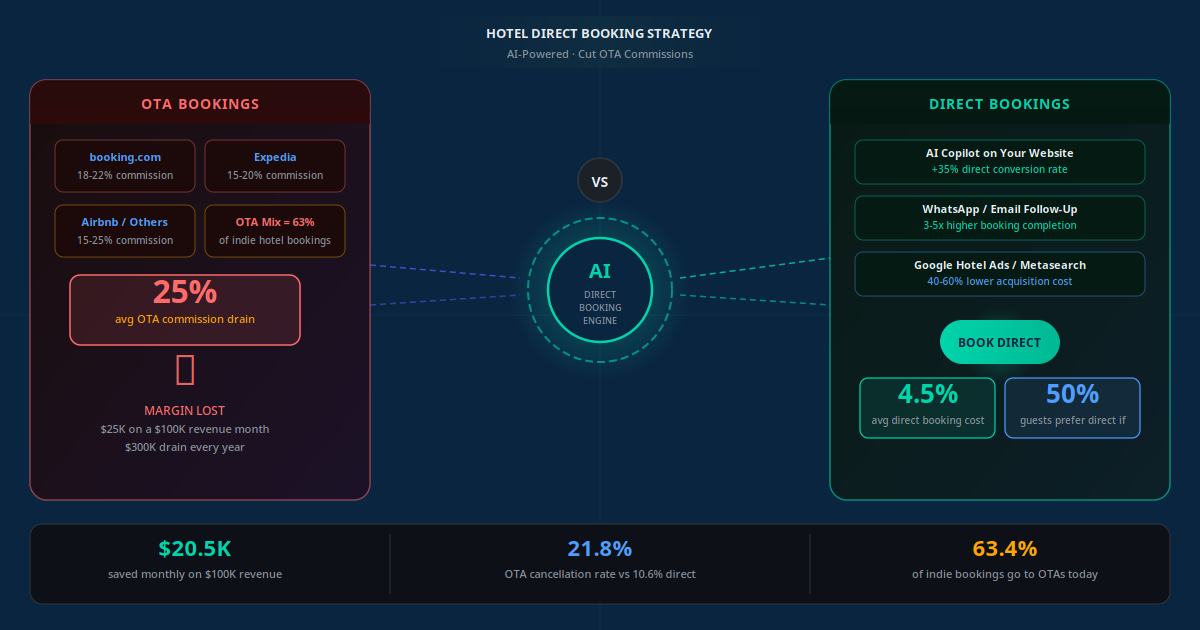
Cloudbeds' State of Independent Hotels report found that independent hotels gave 63.4% of all bookings to OTAs. Booking.com typically charges 15–20%; Expedia ranges from 15–30%. D-EDGE data from Europe shows 77% of independent hotel bookings through OTAs in some markets. If your average nightly rate is $150 and you are doing 50 rooms per night at 70% occupancy, your monthly revenue is around $157,500. At 65% OTA mix and a 20% commission rate, you are paying approximately $20,475 per month to OTA platforms.
The autonomous workflow intervention here is an AI booking assistant on your website and WhatsApp that captures inquirers before they leave to book on an OTA. When a potential guest visits your site, searches for availability, and starts a conversation — the AI handles the full booking flow: shows availability, confirms rates, collects the reservation, and sends confirmation. No OTA involved. No commission paid.
You do not need to shift all your OTA bookings to direct to see a material impact. Shifting 15–20% of OTA volume to direct — which is achievable in the first 90 days with an active AI booking assistant — saves $3,000–$4,000 per month at the revenue scale above. That alone covers the cost of the entire autonomous workflow stack, typically five to ten times over. Learn more about the direct booking strategy in our dedicated article on how hotels cut OTA commissions with AI.
No-Shows and Missed Inquiries: The Silent Revenue Leak
No-shows hurt twice. First, you lose the revenue from the room that sat empty. Second, if you have a late cancellation policy, enforcing it manually through phone calls and emails is time-consuming and often ineffective.
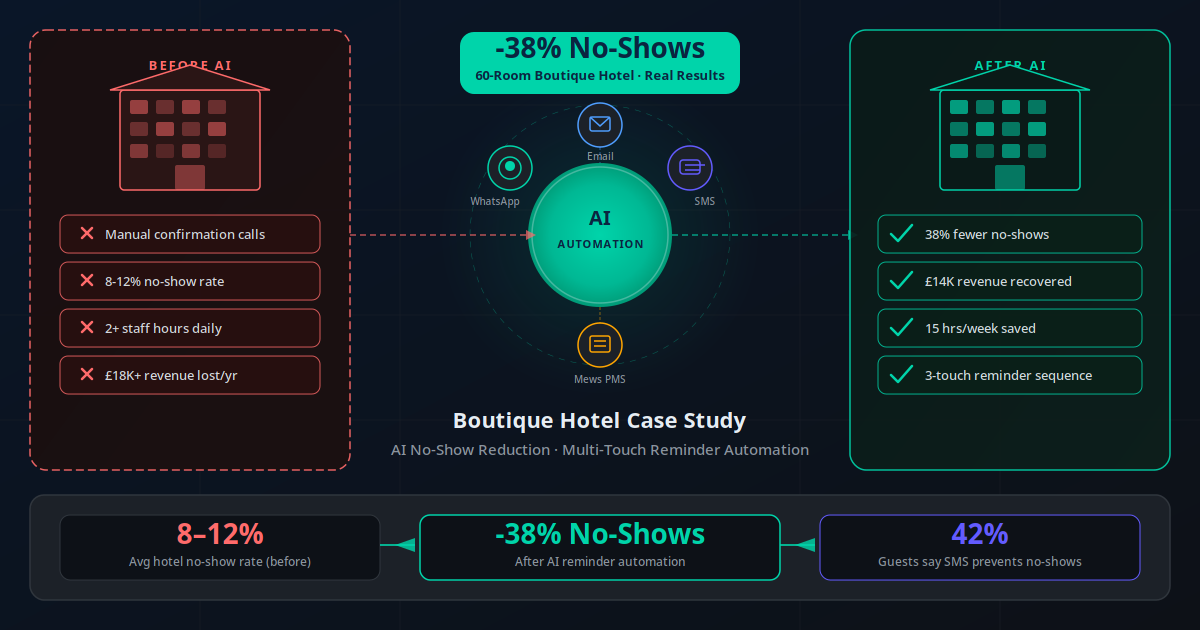
Our no-show reduction case study showed a 38% reduction in no-shows at a boutique property after deploying an automated multi-touch reminder sequence: an email confirmation immediately after booking, a WhatsApp message 7 days before arrival, an SMS reminder 48 hours out, and a final WhatsApp the morning of arrival. The sequence costs almost nothing to run and requires zero staff time after initial setup.
For a 60-room hotel averaging $140 per night at 75% occupancy, a 38% reduction in no-shows on OTA bookings (which no-show at roughly double the rate of direct) recovers approximately $1,800–$2,400 per month in room revenue that would otherwise have walked out the door.
Missed inquiries are harder to calculate precisely, but the directional case is clear. If your front desk is not staffed at 9 PM and a potential guest WhatsApps about availability for next weekend — that inquiry will go unanswered until morning. By then, the guest has booked elsewhere. An AI booking assistant handles that inquiry in under 60 seconds and converts it to a direct reservation. In my experience across hospitality implementations, this after-hours capture typically adds 8–15% to monthly booking volume for properties that were not previously covering that time window.
Real Hotel Use Cases: What the Numbers Look Like
40-Room Boutique Hotel — Primary Win: No-Show Reduction
Problem: 22% no-show rate on OTA bookings, no automated reminder system. Solution: multi-touch WhatsApp and email reminder sequence integrated with PMS. Result: no-show rate dropped to 11% within 60 days, recovering an average of $1,400 per month in room revenue. Automation stack cost: $380/month. Payback achieved in week three.
80-Room Independent Hotel — Primary Win: Direct Booking Shift
Problem: 70% OTA mix, paying $18,000/month in commissions. Solution: AI booking assistant on website and WhatsApp automation capturing direct inquiries with instant availability and pricing. Result: OTA mix dropped to 54% within 4 months, saving $4,800/month in commissions. Stack cost: $680/month. Payback in month one.
35-Room Guesthouse — Primary Win: Labor Reallocation
Problem: owner personally handling all email inquiries, booking confirmations, and reviews. Consuming 20+ hours per week. Solution: AI Copilot handling 85% of inquiry volume, automated confirmations and review requests. Result: owner reclaimed 16 hours per week, reinvested in upsell and in-person guest experience. Revenue per stay increased 12% through more active upselling. Stack cost: $290/month.
120-Room Hotel Group (3 Properties) — Primary Win: Multi-Property Scale
Problem: centralised reservations team of 4 FTEs spending 60% of time on confirmations, reminders, and inquiry responses. Solution: multi-agent AI system handling all three properties from a single AI layer. Result: team of 4 reallocated, 2 redeployed to revenue management and group sales, 2 roles eliminated through natural attrition. Monthly saving: $8,200. Stack cost: $1,200/month.
How to Calculate Your Baseline Before You Automate
Before committing to any automation solution, spend one hour building your own baseline cost picture. Here is the framework I use with clients.
Step 1 — Labor cost of automatable tasks. Count the weekly hours your team spends on: booking inquiries, confirmations, reminders, in-stay requests, and review requests. Multiply by fully-loaded hourly rate. This is your labor baseline.
Step 2 — OTA commission exposure. Take last month's OTA bookings, multiply the room revenue by your average commission rate. This is what you paid to Booking.com and Expedia. Estimate realistically how much of that could be captured direct with an AI booking assistant (15–25% is typically achievable without aggressive marketing spend).
Step 3 — No-show revenue loss. Count last month's no-shows. Multiply by your average nightly rate. That is the gross revenue you lost. A good reminder sequence can recover 30–40% of that.
Step 4 — Missed inquiry estimate. If you are not staffed 24/7, estimate how many inquiries come in during unstaffed hours. Even a conservative 10% of total monthly inquiries arriving after-hours and going unanswered is a meaningful number. Multiply by your average booking value.
Add all four together. That is your status quo cost. The autonomous workflow stack that addresses all four typically costs 5–15% of that number to run. For most properties, the first two line items alone justify the investment many times over. Explore the broader picture in our guide on the complete hotel autonomous workflow guide.
Six Steps to Your First Autonomous Workflow
Audit your current cost baseline: Spend one hour completing the four-step calculation above. Write down the actual numbers — do not estimate. You need a real baseline to measure against.
Connect your PMS: Before any AI can handle bookings, it needs real-time access to your property management system. Confirm your PMS has an API or integration layer. Common PMS platforms (Cloudbeds, Little Hotelier, Mews, Opera) all have integration options.
Deploy no-show reminders first: This is the fastest win and requires the least guest-facing risk. A four-touch automated reminder sequence (email + WhatsApp) reduces no-shows within 30 days. It is also the best way to test your PMS integration under live conditions before exposing the AI to inbound inquiries.
Add the AI booking assistant: Once PMS integration is verified, deploy the AI on your website chat and WhatsApp. Train it on your room types, rates, cancellation policy, and FAQs. Run it in parallel with your team for two weeks — review every escalation to find gaps in the AI's knowledge.
Automate confirmations and pre-arrival upsell: Set up triggered email and WhatsApp sequences for every confirmed booking. Confirmation at booking, room upgrade offer 14 days out, spa or F&B upsell 7 days out, arrival instructions 48 hours out. This generates incremental revenue with zero recurring labor cost.
Measure at 90 days and expand: Compare your actual cost baseline against post-automation numbers. For most properties, the 90-day numbers are compelling enough to justify expanding the automation into post-stay review requests, loyalty re-engagement, and housekeeping routing. Track OTA mix, no-show rate, and inquiry response time as your primary KPIs.
The sequence matters. Starting with no-show reminders builds team confidence, validates the PMS integration, and delivers visible wins before you touch the more complex inbound booking flows. Properties that try to automate everything at once typically encounter integration issues mid-stream that undermine trust in the system. See our guide on the 10 hotel workflows to set up first for a more detailed sequencing guide.
"Hotels making the right tech investments achieve 18–28% higher RevPAR compared to those that do not. Autonomous workflows are no longer a competitive advantage — they are rapidly becoming the floor."
— Phocuswright research cited by Otelciro, 2025When Automation Does NOT Pay Off
I want to be honest about the cases where autonomous workflows do not deliver the expected return, because overselling this leads to bad implementations and disappointed clients.
Small occupancy, low inquiry volume
If you are running a 10-room guesthouse with 20 bookings a month, the labor savings do not justify the cost of a full automation stack. A lighter-touch solution — automated confirmations through a booking engine and basic WhatsApp templates — is a better fit. Full autonomous workflows start delivering meaningful ROI at roughly 25+ rooms and 60+ bookings per month.
PMS with no API access
An AI booking assistant that cannot read real-time availability from your PMS will eventually double-book rooms or confirm unavailable dates. This is worse than no automation at all. If your PMS does not have integration capabilities, the first investment should be migrating to a modern PMS — not building an AI on top of a system that cannot support it.
Teams that are not on board
I have seen AI implementations fail entirely because the front desk team saw the autonomous workflow as a threat rather than a tool. When staff route inquiries away from the AI or override its confirmations, you get the cost of the system without the benefit. Team briefing and genuine buy-in are prerequisites, not afterthoughts. The framing that works best: "The AI handles the repetitive stuff so you can focus on the moments that actually matter to guests."
Over-automating guest-facing touchpoints
Hospitality is a relationship business. Guests who receive nothing but automated messages from booking to checkout report lower satisfaction scores, even when the messages are perfectly accurate and timely. The sweet spot is automating the functional touchpoints (confirmations, reminders, routing) while preserving human presence at the emotionally significant moments: the welcome, the problem resolution, the farewell. AI-assisted support workflows work best when the AI handles the volume and humans handle the moments.
The Financial Case Is Clear — The Question Is Sequencing
For independent hotels and boutique properties, autonomous workflows represent one of the highest-return investments available. The cost of the status quo — hidden in labor hours, OTA commissions, no-show losses, and after-hours inquiry leakage — typically runs between $8,000 and $18,000 per month for a 40–100 room property. The autonomous workflow stack that addresses these drains costs $400–$900 per month to run. The math, once you actually do it, is rarely close.
The hotels that get the most out of automation are not the ones that deploy everything at once. They start with the fastest wins — no-show reminders and direct booking capture — establish confidence in the system, and then expand into upsell sequences, CRM automation, and reputation management. That crawl-walk-run approach delivers measurable ROI within the first 90 days while managing the integration and team adoption risks that derail more ambitious rollouts.
If you want to see exactly where your property's biggest cost leaks are — and which workflows would close them fastest — use the AI Business Twin for a free personalised analysis in under 10 minutes.
Frequently Asked Questions
How much does hotel automation software actually cost per month?
A practical hotel autonomous workflow stack typically costs between $300 and $800 per month for a 30-80 room property, depending on the number of channels and integrations required. This includes a conversational AI layer, WhatsApp and email automation, and PMS integration. Setup fees vary from zero to around $2,000 depending on the provider. When you compare that to the $3,000-$6,000 per month spent on front-desk admin and the 15-25% OTA commission drain, the payback period is usually 60-120 days.
What is the typical payback period for hotel automation?
Based on implementations I have seen, most hotels reach payback in 90 to 120 days. The fastest paybacks come from hotels that were paying high OTA commissions and had significant no-show losses — both of which are immediately addressable with autonomous workflows. Larger properties with more staff to reallocate see faster payback because the labor saving component is bigger.
Does hotel automation reduce the need for front desk staff?
In practice, most hotels do not eliminate front desk staff — they reallocate them. The AI handles the high-volume, repetitive tasks: answering booking inquiries, sending confirmations, processing check-in pre-fills, and routing housekeeping requests. This frees your people to focus on guest experience, upselling, and the moments that genuinely require a human touch. Properties that have tried to cut staff too aggressively report worse guest satisfaction scores.
How much can a hotel realistically save on OTA commissions with AI?
The amount depends on your current OTA mix and how aggressively you pursue direct bookings. Industry data shows independent hotels give 63% of bookings to OTAs on average. Shifting even 15-20% of those to direct channels — through an AI booking assistant on your website and WhatsApp — saves roughly $1,500 to $4,000 per month for a mid-size property charging $120-180 per night. The AI captures website visitors before they leave to book on Booking.com or Expedia.
What hotel processes deliver the fastest ROI from automation?
In my experience, the three fastest-payback workflows are: no-show and cancellation reminder sequences (recovers 30-40% of otherwise lost revenue within days of going live), direct booking AI on your website and WhatsApp (reduces OTA commission spend from month one), and automated pre-arrival upsell messages (generates incremental revenue with zero incremental labor). These three alone typically cover the cost of the entire automation stack.
What are the risks of automating hotel operations?
The main risks are over-automation (removing human touchpoints that guests actually value), integration reliability (if the AI cannot read real-time availability from your PMS, it books incorrectly), and poor prompting (an AI that gives wrong information damages trust). The mitigation is straightforward: start with back-office and reminder workflows before front-of-house, test integrations thoroughly before going live, and always give guests a clear path to a human. Data privacy compliance under GDPR or your local equivalent is also essential — guest data must be handled correctly.