5 Silent Money Leaks Draining Your Business (And How AI Plugs Each One)




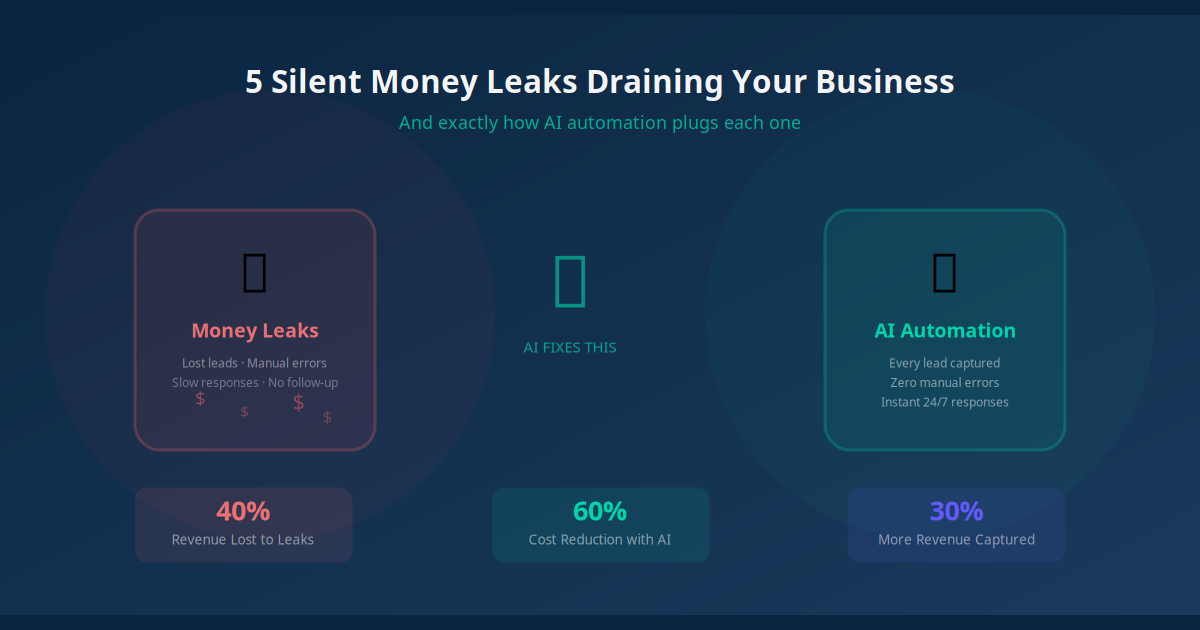
What if you found out that your business was quietly losing 20–40% of its potential revenue every single month — not from bad products, not from poor marketing, not from insufficient effort — but from operational blind spots you have never even thought to look at?
That is the uncomfortable reality for most small and medium businesses. Money is not just going out through your expenses. It is slipping through invisible cracks in your operations — leads that were never followed up, invoices that were paid 60 days late, customers who churned because nobody noticed them going quiet, sales that were lost in the 4-hour gap between inquiry and response.
These are not catastrophic failures. They are silent, systemic leaks. And because each individual leak seems small, most business owners never add them up to see the total cost. But they add up to a staggering amount. Let us look at the five most common — and exactly how AI automation seals them shut.
Key Takeaway
The average small business loses between ₹2 lakh and ₹10 lakh per year to operational inefficiencies that could be eliminated entirely with targeted AI automation. The leaks are not obvious — but once you see them, you cannot unsee them.
Money Leak #1: The Speed-to-Lead Gap
The Leak: A potential customer discovers your business, visits your website, fills out a contact form — and then waits. Two hours pass. Maybe six. By the time someone from your team responds, the prospect has already booked a call with your competitor who replied in 8 minutes.
Research consistently shows that the probability of converting a lead drops by over 80% if the response time exceeds 5 minutes. For most manual operations, a 5-minute response is impossible. The average response time for small businesses is 47 hours. That is not a typo. Forty-seven hours.
Money Leak #2: The Follow-Up Failure
The Leak: You had a great first call with a prospect. They seemed genuinely interested. You sent a proposal. And then — silence. You meant to follow up, but other things came up, and it fell through the cracks. Weeks later, you find out they went with someone else.
Studies show that 80% of sales require 5 or more follow-up touchpoints after the initial contact. Yet 44% of salespeople give up after just one follow-up. For solopreneurs and small teams without a dedicated sales function, most leads get zero systematic follow-up at all. The money simply evaporates.
Money Leak #3: The Late Payment Spiral
The Leak: You delivered the work. You sent the invoice. And now it sits unpaid for 45 days while you grow increasingly uncomfortable about following up, because the client relationship feels fragile and you do not want to seem aggressive. Meanwhile, your own bills are due.
In India, the average small business invoice is paid 37 days late. For a business with ₹50 lakh in annual revenue, that payment delay represents a working capital gap of over ₹5 lakh that has to be covered somehow — whether through a credit line, delayed supplier payments, or personal funds. Late payments are not just inconvenient. They are a structural cash flow crisis that kills otherwise healthy businesses.
Money Leak #4: The Customer Churn You Never Saw Coming
The Leak: A customer who was active six months ago has gone completely quiet. They have not responded to your last two newsletters. They have not made a purchase in 90 days. They are on the edge of moving on — and you have no idea, because you are too busy with current customers to notice which ones are quietly leaving.
Acquiring a new customer costs 5–7 times more than retaining an existing one. Yet most small businesses have no systematic mechanism for detecting and re-engaging customers who are showing churn signals. By the time they are gone, it is far harder to win them back than it would have been to catch them at the moment they started going quiet.
Money Leak #5: The Manual Data Entry Tax
The Leak: Every time a new lead fills out your form, someone manually copies their details into your CRM. Every time an order comes in, someone manually enters it into your inventory system. Every time an expense is submitted, someone manually logs it in your accounting software. This manual re-keying of data is not just slow — it is error-prone at a rate of 1–5% per data entry task, and those errors cascade into billing mistakes, wrong shipments, compliance issues, and customer complaints that require even more manual time to resolve.
The hidden cost of manual data entry is not just the time it takes. It is the downstream cost of fixing every error it introduces.
Adding Up the True Cost of Your Leaks
Let us put real numbers on this for a typical service business generating ₹50 lakh annually:
- Speed-to-lead gap: Losing 3 qualified leads per month at an average deal value of ₹25,000 = ₹9 lakh per year in lost revenue
- Follow-up failure: Converting 15% more of existing proposals at current revenue = ₹7.5 lakh in additional revenue
- Late payment spiral: Eliminating a 37-day average delay on ₹50 lakh = ₹5 lakh in recaptured working capital
- Customer churn: Retaining 2 additional customers per year at ₹50,000 LTV each = ₹1 lakh in retained revenue
- Data entry errors: Eliminating billing errors and dispute resolution time = ₹2 lakh in recaptured time and cost
Total: ₹24.5 lakh per year in revenue recaptured, cash flow restored, and costs eliminated. That is not a hypothetical. That is what AI automation actually delivers when deployed against these five specific leak points.
Key Takeaway
Most businesses do not need more customers to grow significantly. They need to stop losing the value of the customers they already have. Plugging your operational leaks with AI automation is often the highest-ROI growth move available to a small business — because you are recovering money that was already yours.
Where to Start
The instinct when confronted with five problems is to try to fix all five at once. Resist that instinct. Start with the leak that is costing you the most money, and fix it completely before moving to the next one.
For most businesses, the ranking looks like this:
- Speed-to-lead gap (highest immediate revenue impact)
- Late payment spiral (highest cash flow impact)
- Follow-up failure (highest medium-term revenue impact)
- Customer churn monitoring (highest long-term retention impact)
- Data entry automation (highest operational efficiency impact)
A free AI audit from Jogi AI will tell you exactly which leak is costing you the most and what a targeted automation would look like to plug it. The leaks are real. The fix is available. The only question is how long you are willing to wait to claim it.