AI Lead Qualification Case Study: How a Brokerage Reclaimed 25 Hours a Week




The brokerage had a good problem and a bad one, and they were the same problem. Leads kept coming in. Nobody had time to work them.
Twelve agents, roughly 600 inbound inquiries a month across portals, the website, and paid social. On paper that pipeline should have printed money. In practice, most of those leads went stale before anyone got to them, and the agents who did chase them spent their best hours asking the same four questions over and over: are you buying or renting, what is your budget, when are you looking to move, are you pre-approved. By the time a genuinely hot buyer surfaced, they had usually already replied to a faster agent somewhere else.
That last part is not a hunch. According to the National Association of Realtors' 2025 buyer data, 78% of buyers work with the first agent who responds to their inquiry. Meanwhile the average agent takes over 15 hours to respond to a new lead. The gap between those two numbers is where deals die.
This is the story of how one brokerage closed that gap with an AI qualification agent, what it cost, what broke in the first two weeks, and the exact numbers after 90 days. I have changed the name and rounded a few figures, but the workflow and the results are real. We built it.
Key Takeaway
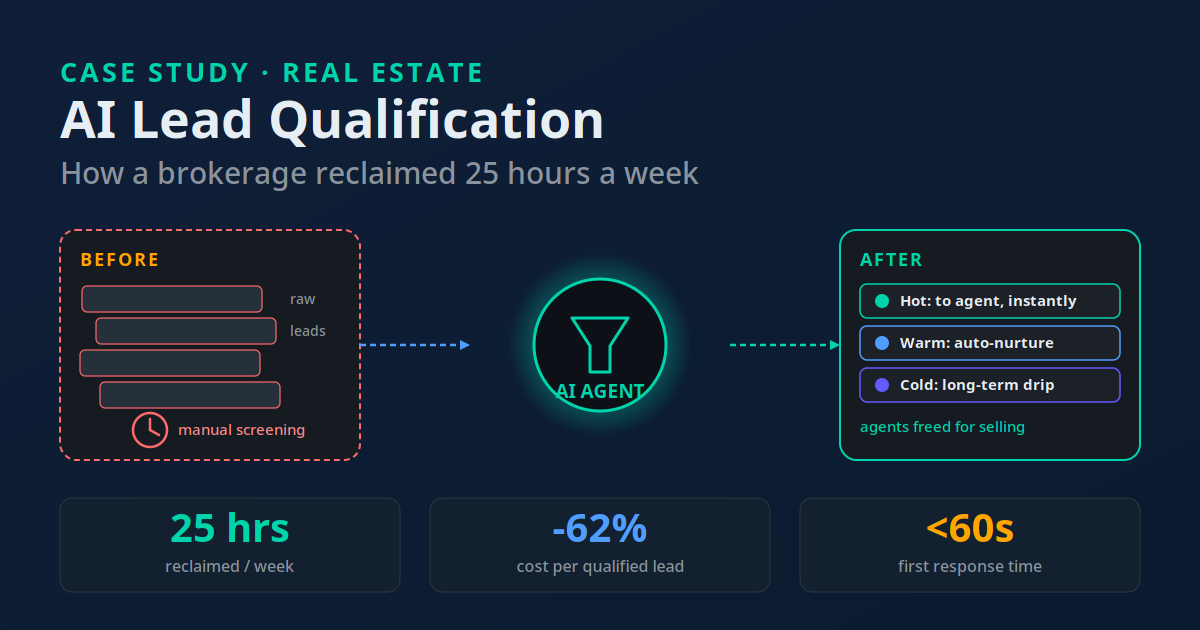
The brokerage did not add more agents or buy more leads. They put an AI agent in front of the pipeline to reply instantly, qualify every lead, and route only the ready ones to a human. That single change gave twelve agents back 25 hours a week and dropped cost per qualified lead by 62%.
The brokerage: a growing team drowning in leads
The brokerage runs a mixed residential book: first-time buyers, upgraders, and a steady stream of rental inquiries that mostly go nowhere but still have to be answered. Lead volume had roughly doubled over two years as they leaned harder into portal advertising and paid social. Headcount had not.
Their setup was normal, which is exactly why it is worth describing. A shared inbox and a CRM collected everything. During the day, whichever agent was free grabbed new leads and started replying. After hours and on weekends, leads piled up until Monday. The team lead spent a chunk of every morning triaging the overnight pile and deciding who got what.
Nobody was bad at their job. The math was just against them. At 600 leads a month with an industry-average conversion rate sitting between 0.4% and 1.2%, the vast majority of those inquiries were never going to close, and the team had no fast way to tell the 3 or 4 real buyers apart from the 596 tyre-kickers. So they treated all of them roughly the same, which meant the real buyers got a slow, generic response and the time-wasters got hours of attention they did not deserve.
They had tried the obvious fixes first. A stricter follow-up rule that agents were supposed to hit within an hour, which held for about a week before the busy days swallowed it. A part-time assistant to screen the overnight pile, which helped a little and cost real money. Neither touched the core issue, because the core issue was not effort. It was that a human simply cannot answer 600 inquiries fast, at all hours, without something giving. When the constraint is human availability, you do not fix it by asking humans to try harder.
Where 25 hours a week were actually going
Before we build anything, we time-track the current process. You cannot claim to save 25 hours if you never measured the 25 hours. So we sat with the team for a week and logged where the qualification work actually went. Here is the weekly breakdown across the twelve agents plus the front desk.
| Task | Who did it | Hours / week |
|---|---|---|
| First reply to new inquiries | Whoever was free | 6.5 |
| Chasing non-responders (2nd, 3rd follow-up) | Agents | 7.0 |
| Asking qualifying questions by phone / text | Agents | 5.5 |
| Logging notes and updating CRM records | Agents + front desk | 4.0 |
| Morning triage of the overnight pile | Team lead | 2.5 |
| Total | 25.5 |
Look at what that table is really saying. Almost none of those 25 hours is selling. It is admin dressed up as sales. Research backs up how common this is: agents spend an estimated 60% to 80% of their time on unqualified leads that never close. The team was not lazy. They were buried.
The other cost was invisible on any timesheet: speed. When a buyer submits a form at 9pm and hears back at 10am, you have lost them. Responding within five minutes makes an agent 21 times more likely to qualify that lead than waiting 30 minutes. The brokerage's median first response was closer to three hours during the day and far worse overnight. Every one of those hours was quietly leaking revenue.
The fix: a conversational AI qualification agent
The solution was not a bigger CRM or a stricter follow-up rule. It was a conversational AI agent that sits in front of the pipeline and does the first-touch qualification automatically, the same way a sharp inside-sales rep would, except instantly and at any hour.
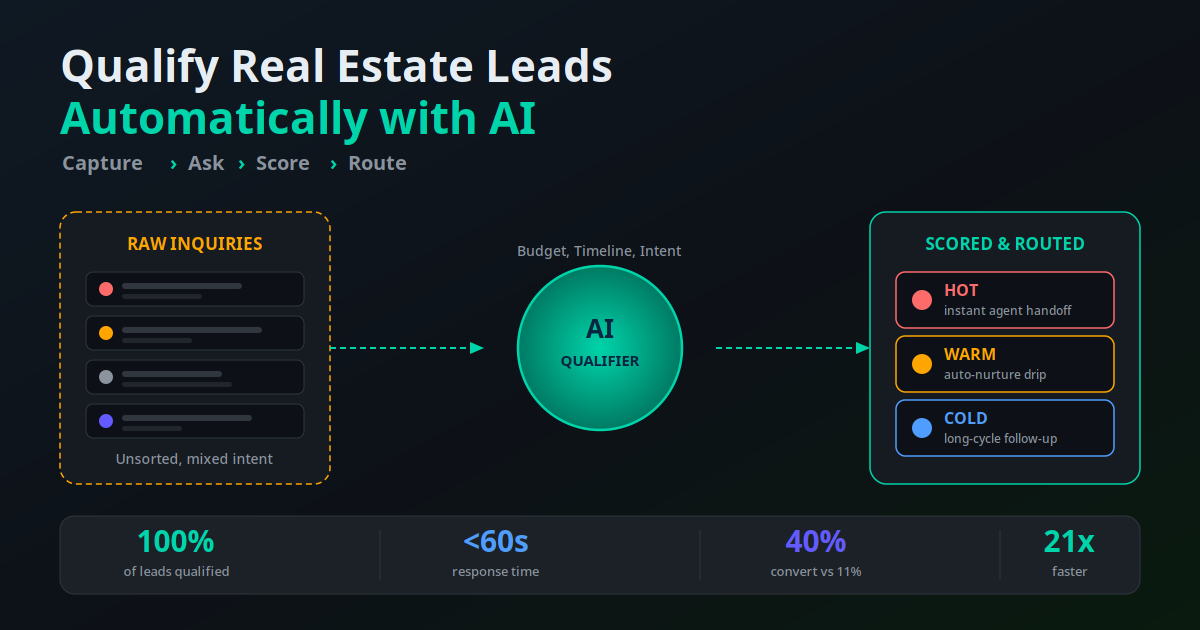
When a lead comes in from any channel, the agent replies in seconds, holds a short natural conversation to understand what the person actually needs, scores them, and routes them. If you want the broader picture of how this fits a whole agency, we covered it in our guide to AI workflow automation and in this piece on automated lead qualification for real estate. Here, the agent was built to capture five things on every lead.
Budget and financing
Price range they are working with, and whether they are cash, pre-approved, or still need a mortgage conversation. This one dimension alone separates most serious buyers from browsers.
Timeline and urgency
Are they looking to move this month, this quarter, or "just seeing what's out there"? The agent asks plainly and records the answer, so nobody wastes a call on someone twelve months out.
Buyer, seller, or renter intent
What the person is actually trying to do. Renters and sellers get routed to completely different tracks, so a rental inquiry never lands on a listing agent's desk by accident.
Location and property fit
Area, property type, must-haves. The agent checks this against live inventory so a hot lead can be matched to real listings before a human ever picks up the thread.
Motivation and readiness signals
Softer cues in how someone answers: whether they have sold before, whether a lease is ending, whether they have already viewed places. These nudge the score up or down and shape the handoff.
Crucially, the agent does not just collect answers and dump them in a form. It writes a short plain-English summary of every lead, sends it to the CRM, and decides where the lead goes next. That routing decision is the whole point.
Before and after: the qualification workflow
The clearest way to see the change is to put the old flow next to the new one. Same lead, two very different journeys.
Before
- Lead lands in a shared inbox, waits
- Agent replies hours later, if at all
- Same four questions asked by phone
- Half of leads never reply again
- Notes typed into the CRM by hand
- Team lead sorts the pile each morning
After
- Lead gets an instant, personal reply
- AI qualifies in a short conversation
- Lead scored on budget, timeline, intent
- Hot leads handed to an agent live
- Summary auto-written to the CRM
- No morning triage; routing is automatic
Under the hood, the new flow runs as seven steps. Every one of them used to be a human task. Now only the last one is.
Lead arrives: A form, portal inquiry, or WhatsApp message hits the system, day or night.
Instant reply: The AI agent responds in under 60 seconds with a warm, on-brand message and the first qualifying question.
Conversational qualification: It works through budget, timeline, intent, and location in a natural back-and-forth, not a rigid form.
Live inventory check: For buyers, it matches stated criteria against current listings and flags real fits.
Scoring: Answers roll up into a hot / warm / cold score using rules the brokerage set.
Routing and CRM log: A summary is written to the CRM and the lead is routed by score to the right destination.
Human handoff: Hot leads are pushed to an available agent immediately, with the full context already captured.
The numbers after 90 days
Here is what the team actually measured 90 days after go-live, compared against their pre-automation baseline.
| Metric | Before | After 90 days |
|---|---|---|
| Median first response time | ~3 hours | Under 60 seconds |
| Team hours on qualification / week | 25.5 hrs | ~1 hr (oversight only) |
| Cost per qualified lead | ~$48 | ~$18 |
| Leads answered after hours | 0% | 100% |
| Lead-to-appointment rate | 8% | 21% |
The 25 hours a week is the headline, but the lead-to-appointment jump is the number that pays the bills. Structured qualification is known to lift conversion by up to 30%; because this brokerage combined it with instant response, they did better than that. More appointments from the same lead spend, without a single new hire.
The cost side told the same story. Here is the cost-per-qualified-lead math, which is really just the qualification labour divided by the qualified leads that came out the other end.
| Cost driver | Before (manual) | After (automated) |
|---|---|---|
| Agent hours spent qualifying | High | Near zero |
| Software / AI agent cost | None | Fixed monthly |
| Qualified leads produced / month | Fewer, slower | More, faster |
| Cost per qualified lead | ~$48 | ~$18 |
"The first week, one agent said the quiet part out loud: 'I have not answered a rental inquiry in five days and I closed two deals.' That was the whole pitch, right there."
— Team lead, residential brokerageWhat actually made it work
Plenty of brokerages buy an AI tool and see nothing change. The difference between this rollout and a dead one came down to a few things we got right on purpose.
The scoring rules were theirs, not ours
We did not hand them a black box. The team defined what "hot" meant for their market: pre-approved, moving inside 60 days, and matched to at least one live listing. When the agents own the definition, they trust the routing. That trust is what makes them actually work the leads the system sends them.
Hot leads went to a human immediately
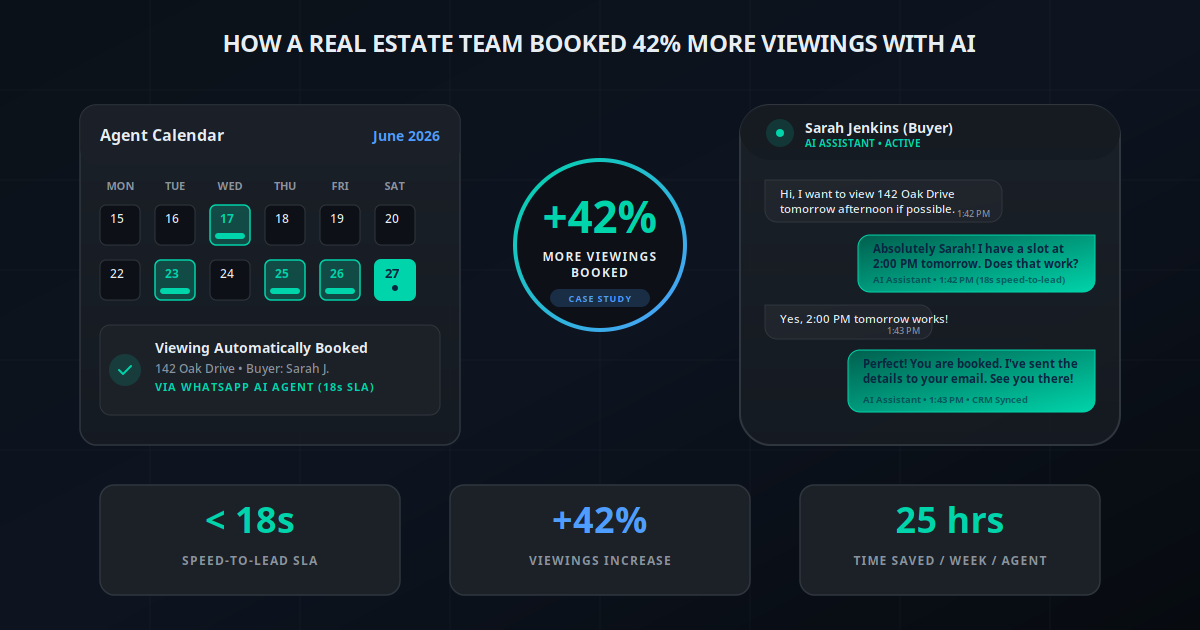
The agent never sat on a ready buyer to squeeze in more questions. The moment a lead crossed the hot threshold, it pinged an available agent with the full summary already attached. Speed-to-lead only matters if the human end is fast too, which is the same lesson from our write-up on instant AI follow-up booking 42% more viewings.
Warm and cold leads were not abandoned
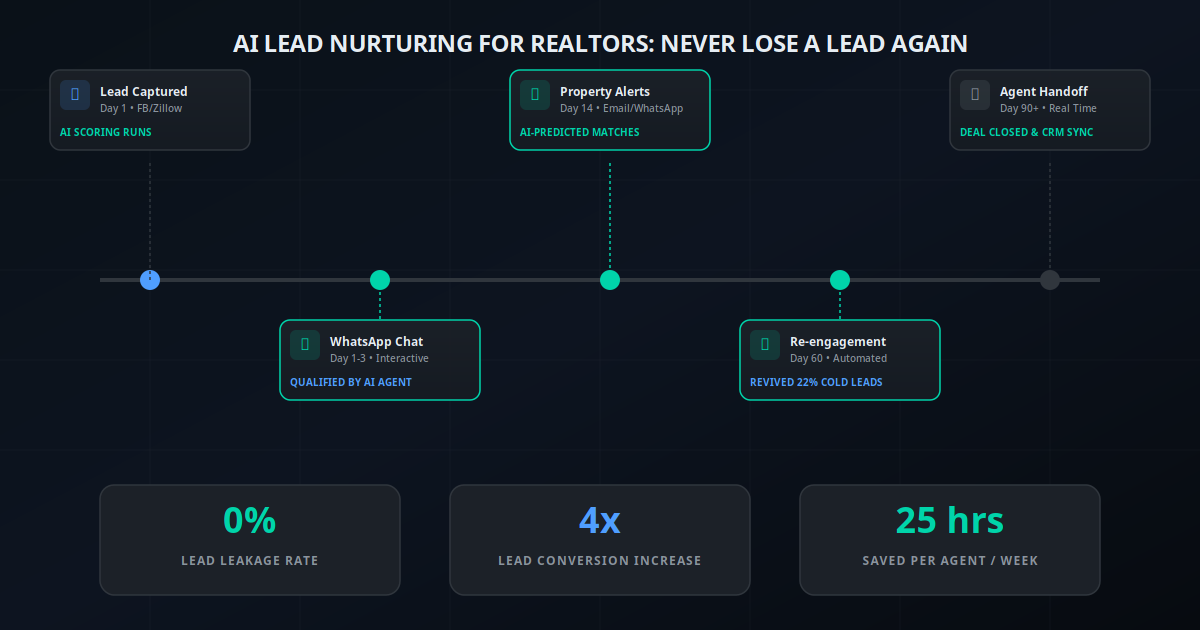
The old process quietly dropped anyone who was not ready today. The new one puts warm leads into an automated nurture sequence and cold leads onto a long, low-touch drip. A buyer who is nine months out is not a dead lead. They are a future closing the brokerage used to throw away.
It plugged into the CRM they already had
Nobody had to learn a new system or migrate data. The AI agent read from and wrote to the existing CRM, so from an agent's seat, leads just started arriving pre-qualified and pre-summarised in the tool they already lived in. Low friction is why adoption stuck.
What they got wrong in the first two weeks
It was not a clean launch. It rarely is. Two things broke early, and both are worth flagging because they are the exact traps most teams hit.
The agent asked too many questions
Version one tried to capture everything up front, and some leads dropped off mid-conversation because it felt like an interrogation. We cut the required questions down to the four that actually drive the score and let the agent gather the rest naturally, or leave it for the human. Qualification completion rate jumped once we stopped being greedy.
Agents did not trust the "cold" tag at first
For the first week, a couple of agents kept re-working leads the system had marked cold, convinced they knew better. Mostly they were wrong, and it wasted the very time we were trying to save. The fix was showing them the outcomes: the cold leads they insisted on chasing converted at almost nothing. Once they saw the data, they let the routing do its job.
There was a smaller third lesson too. The first CRM sync wrote duplicate records for a few days because two lead sources shared an email format. A boring bug, an easy fix, but a reminder that the plumbing between your lead sources and your CRM matters as much as the AI on top of it.
How to replicate this in your brokerage
You do not need 600 leads a month or twelve agents for this to pay off. The pattern scales down to a solo agent and up to a large team. If you want to run the same playbook, do it in this order.
Start by measuring your real baseline for one week: how fast you reply, how many leads you actually qualify, and how many hours it eats. Then write down what "hot" means in your market in one sentence you would bet on. Connect a single lead source first, usually your website or busiest portal, and let the AI agent handle only that channel until you trust it. Watch the first fifty conversations closely and tune the questions. Only then widen it to every channel and add the nurture tracks for warm and cold.
The teams that succeed treat this as a workflow change, not a software purchase. The AI is the easy part. The discipline of defining your scoring and actually working the leads it sends you is what turns a demo into 25 reclaimed hours. For the sales-side view of why instant response drives this whole effect, our piece on automating the sales funnel goes deeper.
Conclusion: the pipeline was never the problem
This brokerage did not have a lead-generation problem. They had a lead-response problem, and it was strangling a pipeline that was already big enough. The leads were there the whole time. The team just could not get to the right ones fast enough to matter.
An AI qualification agent fixed that by doing the one job humans do worst at scale: replying instantly, consistently, at 2am, to the 597th rental inquiry with the same patience as the first hot buyer. That freed twelve people to do the job humans do best, which is close. Twenty-five hours a week back, cost per qualified lead down 62%, and appointments up because the fast leads finally got a fast answer.
If your agents are spending their mornings screening leads instead of selling, you are sitting on the same opportunity. To see exactly which parts of your pipeline an AI agent would handle and how many hours it would give back, use the AI Business Twin for a free, personalised analysis in under 10 minutes.
Frequently asked questions
What does AI lead qualification actually do for a real estate brokerage?
It replies to every new inquiry within seconds, asks a short set of qualifying questions in a natural conversation, scores the lead on budget, timeline, financing and intent, then routes it. Hot leads go straight to an agent, warm leads enter a nurture sequence, and cold leads drip on a long cycle. Agents only ever talk to people who are actually ready to move, which is where the reclaimed hours come from.
How did the brokerage save 25 hours a week?
Before automation, agents and the front desk spent time on first replies, chasing non-responders, asking the same qualifying questions by phone, and logging everything in the CRM by hand. The AI agent absorbed all four of those tasks across roughly 600 leads a month. Adding up the minutes each agent saved came to about 25 hours a week for the team of twelve.
Will an AI qualification agent make leads feel like they are talking to a robot?
Only if it is built badly. The brokerage's agent opens by identifying itself as an assistant, keeps questions short and conversational, and hands off to a human the moment a lead is qualified or asks for one. Response quality actually went up, because leads got a real answer in seconds instead of waiting hours for a callback. Useful and fast beats a slow human every time.
How long did it take to set up and see results?
The build and testing took about three weeks, most of which was mapping the qualifying questions and connecting the CRM. Results showed up almost immediately on response time, since the agent was instant from day one. The 25-hour and cost-per-lead numbers stabilised around the 90-day mark once agent adoption was complete and the routing rules were tuned.
Does the AI replace the agents?
No. It replaces the screening work, not the selling. The agent handles the repetitive first-touch and qualification that used to eat the mornings, then hands qualified people to a human who does the relationship-building, showings and negotiation. The brokerage did not cut headcount. They redirected the same twelve people toward higher-value work.
What tools does a setup like this need?
At minimum: a channel to capture inquiries (website forms, portals, WhatsApp), a conversational AI layer to run the qualification, a scoring and routing logic layer, and a CRM as the system of record. Most brokerages already have the CRM and the lead sources. The AI qualification and routing layer is the part that gets added, and it connects to what you already run.
How much does automated lead qualification cost versus doing it by hand?
For this brokerage, cost per qualified lead dropped from about 48 dollars to 18 dollars, a 62 percent cut. The automation carries a monthly software cost, but it removed far more in wasted agent hours and recovered leads than it added. Most teams handling a few hundred leads a month reach payback inside the first two to three months.