Multimodal AI for Business: What Text + Image + Video AI Means for How You Operate
Beyond Text: Why AI That Sees and Hears Changes Everything
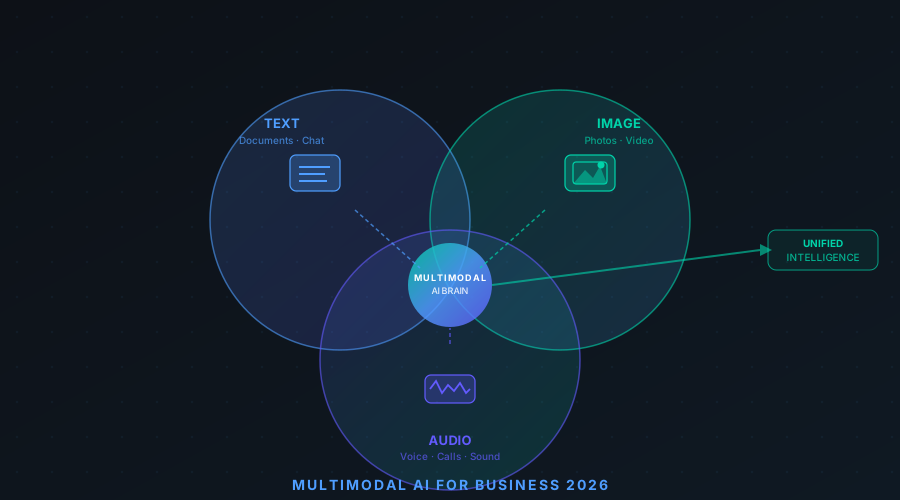
When most business owners think of AI, they picture a chatbot — something that reads and writes text. And for two years, that was largely accurate. But the AI landscape of 2026 looks radically different. The most impactful AI systems today are not text-only. They are multimodal — meaning they can process text, images, audio, and video simultaneously, within a single reasoning context.
The implication is enormous. Think about how much of your business actually runs on text. Your invoices arrive as PDFs with handwritten notes. Your product quality is assessed visually. Your customer complaints come as voicemails. Your supplier contracts are scanned documents. None of these were previously automatable with a text-only AI. With multimodal AI, they are.
This is not a future capability. It is live, production-ready, and already being used by businesses across every industry. The question is whether yours is one of them.
What Is Multimodal AI?
Multimodal AI refers to artificial intelligence systems trained on and capable of reasoning across multiple input types — most commonly text, images, audio, and increasingly video. Rather than treating each modality separately, multimodal models develop a unified representation that allows them to understand relationships between different types of information.
A multimodal AI can:
- Read a scanned invoice image and extract all line items into structured data
- Look at a photo of a product and generate a complete product description
- Analyse a customer support call recording and produce a structured summary with sentiment score
- Watch a short video walkthrough and produce written step-by-step documentation
- Compare two product images and identify quality defects or differences
- Process a handwritten form and extract the information into a database
The core insight is that business data is inherently multimodal. Most real-world information does not arrive as clean, typed text. Multimodal AI bridges the gap between messy, mixed-format reality and the structured data your systems need to operate.
Key Takeaway
Multimodal AI does not just add image recognition to a chatbot. It fundamentally changes what can be automated — because it can finally process the majority of real-world business information that text-only AI could not touch.
Why 2026 Is the Inflection Point for Multimodal AI
Three things converged in 2025–2026 to make multimodal AI genuinely production-ready for businesses:
1. Model Quality Crossed the Reliability Threshold
GPT-4o, Claude 3.5 Sonnet, and Gemini 2.0 Ultra all achieved accuracy rates on document and image understanding tasks that are now comparable to or better than trained human professionals in many domains. Invoice extraction, for example, now reaches 97%+ accuracy on clean documents — above the typical human data entry error rate of 1–3%.
2. API Costs Dropped to Business-Viable Levels
Processing a high-resolution image through a multimodal model costs less than $0.01 today. A business processing 500 invoices per day would spend less than $150/month on AI inference costs — a fraction of one data entry employee's salary for an afternoon.
3. No-Code Integration Became Available
You no longer need a machine learning engineer to use multimodal AI. Platforms like Make.com, n8n, and Zapier now have native multimodal AI nodes. You can build a workflow that watches a folder, processes incoming invoice images, and pushes structured data to your accounting software — with no code at all.
High-Value Business Use Cases in 2026
Invoice & Receipt Processing
Suppliers email scanned invoices. Multimodal AI extracts vendor, date, line items, and totals into your accounting system automatically. Zero manual data entry. 97%+ accuracy.
Product Catalogue Automation
Upload product photos. AI generates descriptions, extracts dimensions, suggests categories, and flags image quality issues — populating your e-commerce catalogue without a copywriter.
Visual Quality Control
Manufacturing defect detection, restaurant food presentation scoring, property condition assessment for real estate — AI that sees and scores visual quality at scale.
Contract & Document Review
Scanned contracts, handwritten agreements, and mixed-format documents are parsed, summarized, and key clause extraction happens automatically — reducing legal admin time by 70%.
Customer Support Call Analysis
Audio recordings of support calls are transcribed, sentiment-scored, key issue categorized, and recommended resolution generated — all before a human manager even sees the ticket.
Competitive Intelligence
Screenshots of competitor websites, product images, and pricing pages are fed to an AI agent that tracks changes and alerts your sales team to competitive threats in real time.
Deep Dive: E-Commerce Visual Product Intelligence
One of the most impactful applications is in e-commerce. A fashion retailer with 2,000 SKUs previously needed a team of copywriters, photographers, and catalogue managers to keep product listings accurate and compelling. With multimodal AI:
- Product photos are uploaded to a folder
- AI analyses each image: identifies garment type, colour, material texture, style, and key features
- Generates an SEO-optimised product description and title
- Suggests appropriate category tags and size guidance
- Flags images with poor lighting or background quality
- Publishes approved listings directly to Shopify
What previously took two copywriters 40 hours per week now runs in four hours — entirely automated, with a human reviewing and approving the final batch.
"We went from 3 days to 4 hours to launch new products. Our catalogue accuracy improved and the copy quality is actually better than what we were producing manually."
How to Implement Multimodal AI Without an Engineering Team
The no-code path to multimodal AI is more accessible than most business owners realize. Here is a practical starting framework:
For Document Processing (Invoices, Contracts, Forms)
Use an n8n or Make.com workflow triggered by email attachments or a watched folder. Connect a GPT-4o or Claude 3.5 node with a structured extraction prompt. Output directly to Google Sheets, Airtable, QuickBooks, or Xero. Build and test in under a day.
For Product Image Analysis
A similar workflow triggered by file upload to Google Drive or Dropbox. The AI node receives the image and a prompt defining what to extract (description, tags, dimensions). Output flows to your CMS or product database. Add a human review step before publishing with a simple approval form.
For Call Recording Analysis
Most modern VoIP systems (RingCentral, Aircall, JustCall) provide recording URLs via webhook. n8n receives the webhook, downloads the audio, passes it to a transcription + analysis node, and pushes the structured summary into your CRM ticket. Your support manager sees a pre-analysed ticket, not a raw recording.
The Multimodal Models Powering Business in 2026
| Model | Best For | Modalities | Cost (per image) |
|---|---|---|---|
| GPT-4o (OpenAI) | General document + image tasks | Text, Image, Audio | ~$0.005–$0.015 |
| Claude 3.5 Sonnet (Anthropic) | Complex document reasoning, long context | Text, Image | ~$0.003–$0.012 |
| Gemini 2.0 Ultra (Google) | Video analysis, native Google Workspace | Text, Image, Audio, Video | ~$0.004–$0.018 |
| Llama 3.2 Vision (Meta) | Self-hosted, privacy-sensitive data | Text, Image | Infrastructure only |
What Comes Next: Video Intelligence and Real-Time Multimodal
The current generation of multimodal AI excels at static analysis — process a document, analyse a photo, transcribe a recording. The next wave is real-time multimodal reasoning: AI that watches a live video feed, listens to an ongoing conversation, and makes decisions in real time.
Early applications are already emerging: AI systems that monitor retail shop floors for customer behaviour and queue length, construction site safety monitoring, restaurant kitchen quality checks during service, and live customer support calls where AI provides real-time guidance to human agents.
For most businesses, the immediate priority should be static multimodal automation — documents, images, and recordings. Real-time applications will follow as infrastructure costs continue to fall.
Conclusion: Your Business Data Is Already Multimodal
Here is the practical reality: the information that runs your business — invoices, product photos, customer calls, contracts, forms — has always been multimodal. Only the AI tools to process it have been missing. That gap has now closed.
The businesses that act on this in 2026 will eliminate entire categories of manual processing work. The ones that wait will find themselves competing against companies that operate leaner, faster, and more accurately — at lower cost per transaction.
The starting point does not have to be complex. Pick your most painful manual data processing task. Build one multimodal workflow. Measure the time saved. Then expand. For help identifying where multimodal AI will have the highest impact on your specific business, the AI Business Twin provides a personalised analysis in minutes.
Frequently Asked Questions
What is multimodal AI?
Multimodal AI is an artificial intelligence system that can process and reason across multiple types of data simultaneously — such as text, images, audio, and video. Unlike text-only AI, it can read a scanned invoice, understand a photo of a product defect, or listen to a customer call while also accessing written context.
Which businesses benefit most from multimodal AI?
Businesses that handle physical documents (accountants, legal firms, logistics), visual products (retail, manufacturing, real estate), or high-volume customer interactions (hospitality, healthcare, e-commerce) see the highest ROI because they have data types that traditional text-only AI cannot process.
Is multimodal AI available for small businesses?
Yes. GPT-4o with vision, Claude 3.5 Sonnet, and Gemini 2.0 are all available via API at costs accessible to small businesses. Many no-code platforms like Make.com and n8n have integrated multimodal AI capabilities, making implementation possible without a developer team.