RAG AI Assistants: The Smarter Chatbot Every Business Needs in 2026
Your customers are asking questions right now. Some are simple — "What are your pricing plans?" — and some are unexpectedly specific: "I placed an order last Tuesday and the invoice doesn't match what you quoted. Can you help?" Traditional chatbots handle the first category reasonably well. For everything else, they frustrate.
The problem is not that businesses chose the wrong technology. The problem is that most chatbots are built like FAQ machines — pre-programmed, rigid, and entirely disconnected from your actual business data. When a customer asks something outside the scripted templates, the bot either guesses wrong or deflects with a dead-end message.
This is exactly the failure mode that RAG — Retrieval-Augmented Generation — was designed to eliminate.
RAG-powered AI assistants do not guess. They look up the right answer from your own knowledge base before responding. The result is an AI that sounds intelligent because it actually is — trained on your real data, speaking in your voice, built for your business.
What Is RAG? A Plain-English Explanation
RAG stands for Retrieval-Augmented Generation. It combines two powerful AI capabilities into one seamless workflow:
- Retrieval — Searching through a structured knowledge base — your FAQs, product docs, pricing sheets, policies, CRM notes, past support tickets — to surface the most relevant information for a given query.
- Generation — Using a large language model (LLM) to compose a clear, conversational, on-brand response based entirely on what was retrieved.
Think of it this way: instead of a chatbot that tries to memorise every possible answer (and inevitably gets many wrong), a RAG system actively looks up information and then explains it in natural language — just as a knowledgeable employee would.
The difference this makes for customers is dramatic:
Standard chatbot: "I'm sorry, I didn't understand your question. Please try rephrasing or contact our support team."
RAG assistant: "Based on your current plan, your billing date is the 5th of each month. Your last invoice was $249, and the next one is due in 8 days. Would you like me to send a copy to your email?"
One of these builds trust. The other erodes it.
Why Traditional Chatbots Keep Failing Your Business
Most business chatbots fail not because the idea is flawed — but because they're built around a fundamentally broken assumption: that you can predict every customer question in advance. You cannot. And your customers know it.
Here is what typically goes wrong:
- Hallucinations — The bot fabricates an answer that sounds plausible but is factually incorrect, silently eroding customer trust.
- Scripted rigidity — Anything slightly off-script triggers a dead end or a generic "please contact us" response that wastes everyone's time.
- No business context — The bot has no access to your actual products, pricing history, or customer records. It answers from a vacuum.
- Stale content — The bot was trained months ago and has no idea about your latest offers, policy updates, or new service tiers.
- Damaged escalation — Customers reach a human agent already frustrated, which means agents spend the first few minutes de-escalating rather than solving the problem.
These are not edge cases. They are everyday experiences for millions of customers across every industry. And each one is a revenue leak — a missed sale, a churned customer, a wasted support hour.
The Core Problem
Rule-based chatbots are designed around what you expect customers to ask. RAG AI assistants are designed around what customers actually ask — and they find the right answer in your own knowledge base every time.
How RAG-Powered AI Assistants Work
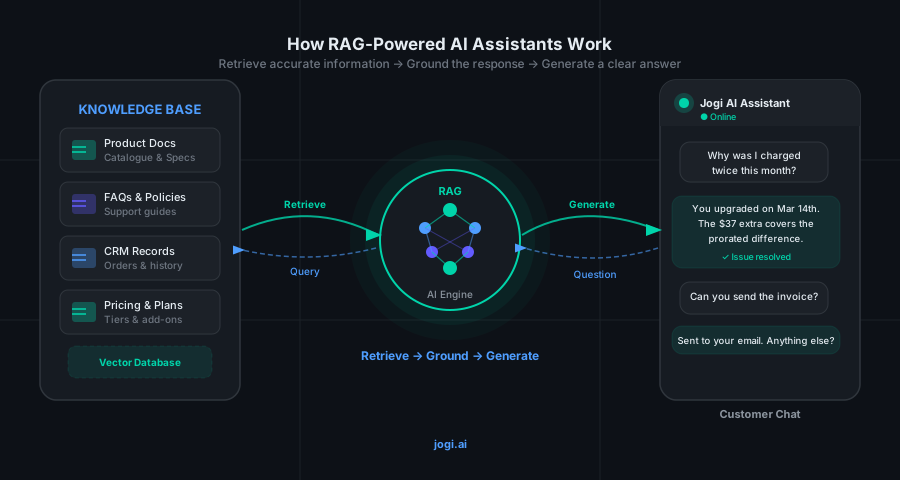
The RAG workflow operates in three stages, all happening in under two seconds:
Your business documents — product catalogues, pricing sheets, FAQs, support guides, policy docs, onboarding materials, CRM notes — are processed, chunked, and stored in a private vector database. This becomes your AI's living memory.
When a customer asks a question, the AI searches the vector database for the most semantically relevant content. Crucially, it does not search by keywords — it understands meaning. A customer asking "How do I get my money back?" retrieves the same refund policy as "What is your cancellation process?" — because the intent is identical.
The retrieved content is passed to a large language model, which composes a clear, natural-language response. Critically, the AI is grounded in retrieved facts — it does not fabricate. If the answer is not in your knowledge base, it says so and offers an escalation path.
This three-stage process makes RAG assistants dramatically more reliable than traditional chatbots. They are not guessing. They are reading your documentation, understanding the customer's intent, and explaining the right answer — contextually, conversationally, and consistently.
Real-World Use Cases: Where RAG Makes the Biggest Difference
Customer Support Automation
A SaaS company builds a RAG assistant trained on its product documentation, billing policies, and historical support tickets. When a user asks, "Why was I charged twice this month?" — the bot retrieves the billing policy and account data, then responds with specifics: "It looks like you upgraded your plan mid-cycle on March 14th. The extra charge of $37 covers the prorated difference for the remaining days. Here is a breakdown." Ticket resolved. No human needed. Customer satisfied.
By contrast, a traditional bot would either return the refund policy verbatim (unhelpful) or say "Please contact billing support" (frustrating).
Sales Assistant and Lead Qualification
A real estate agency builds a RAG assistant trained on their entire property portfolio — location, pricing, availability, floor plans, amenities, and financing options. A website visitor asks: "Do you have 3-bedroom flats in Bandra under ₹1.5 crore?" The assistant retrieves matching listings and responds with specific options, schedules a viewing, and captures contact details — all within the same conversation. No sales agent required for the initial qualification.
Internal Knowledge Assistant for Teams
An operations team builds an internal RAG assistant trained on their SOPs, HR policies, onboarding guides, and project wikis. A new employee asks: "What is the expense reimbursement policy for international travel?" The assistant retrieves the exact policy section and provides a clear, accurate summary — along with a link to the reimbursement form. This alone can save HR teams dozens of hours per week fielding repetitive internal queries.
WhatsApp and Omnichannel Deployment
RAG assistants work across every channel — website chat, WhatsApp Business, email, Telegram, and Instagram DMs. The same knowledge base powers all of them, ensuring consistent answers and consistent brand voice regardless of where customers reach out. A WhatsApp user gets the same quality of response as a website chat user — instantly, at 2 AM, without any human involvement.
What Businesses Gain When They Switch to RAG
The impact of a well-built RAG assistant is measurable from the first month:
But beyond the numbers, there is something less quantifiable and more important: customers stop feeling like they are talking to a machine. That is the real competitive advantage.
What to Look for When Building a RAG Assistant
Not all RAG implementations deliver the same results. Here is what distinguishes a well-built system from an overcomplicated one:
- Clean knowledge ingestion. Your source documents need to be structured, current, and chunked intelligently. A good implementation partner audits your content before building — because garbage in means garbage out.
- High retrieval accuracy. The semantic search layer is where RAG lives or dies. Benchmark retrieval against a set of real customer questions before going live. If the wrong content is being retrieved, the responses will be wrong too.
- Guardrails and escalation logic. When the AI does not have an answer, it should say so gracefully and offer a clear next step — not hallucinate or leave the customer stranded with silence.
- Easy knowledge base updates. Your business changes constantly — prices, products, policies. Your RAG assistant should be straightforward to update through a simple interface, not require a re-training exercise every time.
- CRM and live data integration. The most powerful RAG assistants combine static knowledge with real-time retrieval from your CRM, order management system, or helpdesk — enabling responses that reference actual account data, not just general documentation.
The Future of AI Assistants: 2026 and Beyond
RAG is already reshaping how businesses communicate with customers and teams — but the technology is evolving rapidly. Here is what is coming next:
- Multimodal RAG — Assistants that can retrieve and reason over images, PDFs, spreadsheets, and diagrams — not just text documents. Useful for product catalogues, technical manuals, and contract review.
- Real-time data retrieval — Seamless integration with live inventory, pricing feeds, and account data alongside static knowledge — so the assistant always has the most current information.
- Voice-integrated RAG — Phone support bots that speak naturally using retrieved knowledge, reducing call centre queues and wait times without sacrificing accuracy.
- Proactive AI assistants — Instead of waiting for questions, assistants that flag issues before customers notice them. "Your subscription renews in 7 days. Based on your usage, you may want to consider upgrading. Would you like to review your options?"
Businesses that build RAG infrastructure now will have a compounding advantage. The knowledge base grows richer, retrieval improves, and the customer experience compounds over time. Those who wait will be playing catch-up in a market where speed and accuracy have already become the baseline expectation.
Key Takeaway
RAG-powered AI assistants are not a chatbot upgrade — they are a fundamentally different way of using AI. They ground every response in your real business knowledge, making them accurate, consistent, and genuinely useful to your customers. In 2026, that is the standard your customers already expect.
The Bottom Line: Stop Guessing, Start Retrieving
If your current chatbot is scripted, slow to update, or answers customer questions with approximations rather than facts — you are not running customer support automation. You are running a liability dressed up as convenience.
RAG-powered AI assistants change that equation entirely. They bring your business knowledge to life, respond accurately at scale, and continuously improve as your knowledge base grows. The technology is here. The use cases are proven. The only question is how quickly you move.
At Jogi AI, we design and deploy custom RAG-based AI assistants tailored to your industry, your data, and your customer journey. Whether you need a customer-facing support bot, a sales assistant that qualifies leads, a WhatsApp automation layer, or an internal knowledge tool for your team — we build, test, and deploy it so you can focus on running your business.
The best time to build your AI assistant was six months ago. The second best time is today.