Quick AI Wins for Small Tourism Businesses




Ready to automate your tourism business?
Get Free AI Audit →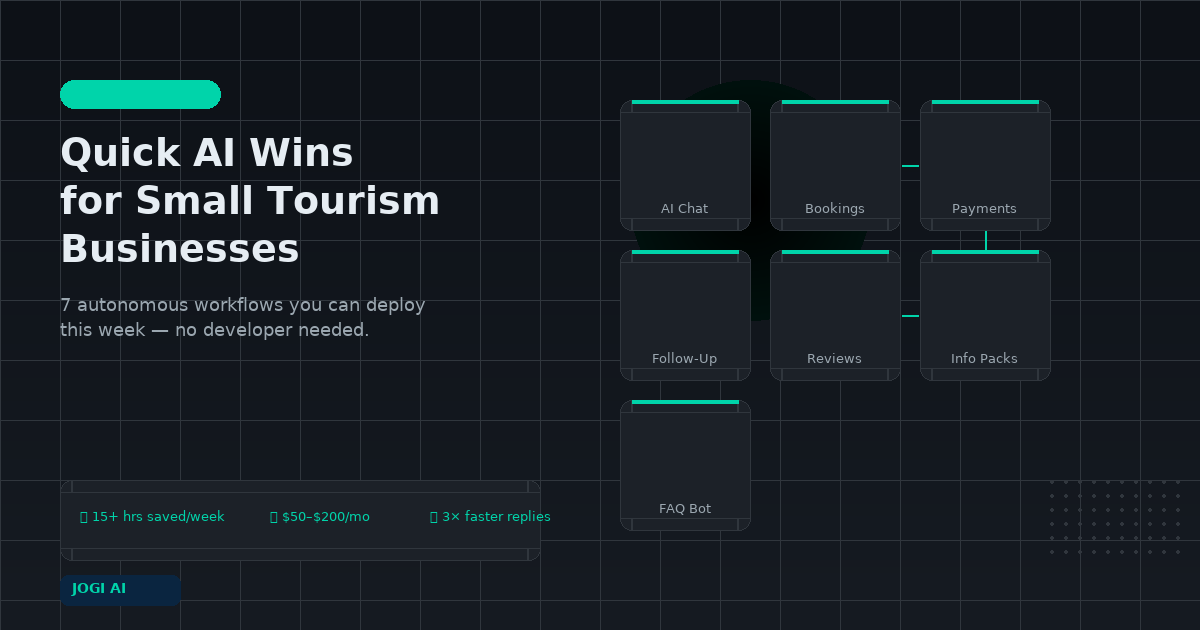
If you run a small tour company, a boutique travel agency, or an adventure activity provider, you've probably heard that "AI is the future." But between managing bookings, answering WhatsApp messages at 11 pm, and chasing deposit payments, who has time to figure out machine learning pipelines?
Here's the truth: you don't need machine learning pipelines. The most impactful AI automations for small tourism businesses are simple, affordable, and deployable in a single afternoon. We're talking about tools that cost $50–$200 per month and can save a 3-person team 15–25 hours every week.
This guide covers 7 quick AI wins you can implement this month — no developer, no enterprise budget, no six-month "digital transformation" project. Just practical automations that let a small operator punch above their weight and compete with companies ten times their size.
Key Takeaway
Small tourism operators lose 40–60% of after-hours inquiries because nobody is available to respond. A single AI Copilot on WhatsApp or your website recovers those leads for under $80/month — and it's the highest-ROI automation you can deploy.
Table of Contents
1. Why Small Operators Can Punch Above Their Weight
Large tour operators have dedicated IT teams, custom booking engines, and seven-figure marketing budgets. On paper, a 3-person travel agency in Ahmedabad or a family-run safari company in Kenya can't compete. In practice, the opposite is now true.
Here's why: AI tools have democratized operational capability. The same WhatsApp AI Copilot that a 200-employee company uses is available to you for $50/month. The same automated email follow-up sequence costs $30/month on Mailchimp or Brevo. The same review request automation runs on a free Zapier tier.
Small operators actually have an advantage. You can deploy a new automation in hours, not months. You don't need approval from a board or an IT security review. Your customer relationships are personal enough that AI-enhanced messages still feel authentic, while a corporate chain's automated messages feel robotic.
"A 5-person adventure tour company using a WhatsApp AI Copilot and automated booking confirmations will outperform a 50-person operator using spreadsheets and manual email. Speed and responsiveness win bookings, not headcount."
2. The 7 Quick AI Wins
Win #1: 24/7 Inquiry AI Copilot
Travel inquiries don't follow business hours. A potential client researching a Bali honeymoon at 11:30 pm won't wait until 9 am for a reply. They'll message three competitors and book with whoever responds first.
Deploy an AI Copilot on WhatsApp, your website, or Instagram DMs that instantly acknowledges inquiries, asks qualifying questions (destination, dates, group size, budget range), and either provides immediate answers from your FAQ database or books a callback for your team. Average setup time: 3–4 hours. Monthly cost: $50–$80. Time saved: 6–8 hours/week.
Real-World Example
A 4-person Goa-based tour operator deployed a WhatsApp AI Copilot and captured 23 additional qualified leads in the first month — leads that would have been lost to after-hours silence. That translated to 7 extra bookings worth ₹4.2 lakh ($5,000).
Win #2: Automated Quote Follow-Up
You send a beautifully crafted itinerary quote. The client says "looks great, let me think about it." Then silence. Manually following up on every open quote is tedious and easy to forget. An automated follow-up sequence solves this:
- Day 2: Friendly WhatsApp check-in — "Hi Sarah, any questions about your Rajasthan itinerary?"
- Day 5: Email with a limited-time incentive — "We're holding your hotel block until Friday."
- Day 10: Final nudge with social proof — "12 groups booked this route last month."
This sequence runs automatically once a quote is marked "sent" in your CRM or booking sheet. Monthly cost: $30–$60. Time saved: 3–4 hours/week. Conversion uplift: 18–25% on previously stalled quotes.
Win #3: Booking Confirmation & Reminder Flow
Once a client pays their deposit, trigger an instant WhatsApp confirmation with booking reference, payment receipt, and next steps. Then schedule automated reminders:
- T-30 Days: Balance payment reminder with secure payment link.
- T-14 Days: Visa and passport expiry check.
- T-3 Days: Pre-departure briefing pack delivery.
This eliminates the "did we send them the details?" anxiety and reduces no-shows by up to 35%. Monthly cost: $20–$40 (usually included in your CRM or WhatsApp tool). Time saved: 2–3 hours/week.
Win #4: Pre-Trip Info Packs
Instead of manually compiling Word documents with visa info, weather forecasts, packing lists, and local tips, create a templated info pack system. Tag each booking with a destination, and the system automatically sends a destination-specific info pack at T-7 days. Include local SIM card advice, tipping etiquette, emergency contacts, and a day-by-day brief.
Use a tool like Make.com or Zapier to pull the destination tag from your CRM and send the matching PDF via WhatsApp or email. Monthly cost: $15–$30. Time saved: 2–3 hours/week.
Win #5: Automated Review Requests
Most small operators never ask for reviews systematically. The result? Your Google Maps profile has 14 reviews while competitors have 200+. An automated flow sends a personalized thank-you message 3 days after the trip ends, with a direct link to your Google Business or TripAdvisor review page.
If the client rates you 4 or 5 stars internally, the system directs them to leave a public review. If they rate 3 stars or below, it routes them to a private feedback form so you can address issues before they go public. Monthly cost: $20–$40. Time saved: 1–2 hours/week. Expected review increase: 3–5× more reviews within 90 days.
Win #6: Lapsed-Traveller Win-Back
Past clients are your warmest leads. They've already trusted you with their holiday. Yet most small operators never re-engage them. Set up an automated win-back campaign that triggers 6 and 12 months after their last trip:
- 6-Month Check-in: "Hi David, your anniversary of the Kerala houseboat trip is coming up! Here are 3 curated experiences we think you'd love."
- 12-Month Seasonal Prompt: "Last year you explored Ladakh in July. This year, we've added two new routes with private camping."
Monthly cost: $20–$40 (email platform or WhatsApp broadcast). Time saved: 1–2 hours/week. Repeat booking uplift: 15–22%.
Win #7: FAQ Deflection
Your team answers the same 15 questions every day: "What's included?", "Is breakfast included?", "Can I cancel?", "What's the best time to visit Manali?" An AI Copilot trained on your FAQ knowledge base deflects 60–75% of these repetitive queries instantly, freeing your team for high-value sales conversations.
Build your FAQ database once (it takes about 2 hours), and the AI handles the rest. Monthly cost: $0–$30 (often included in your chatbot platform). Time saved: 4–6 hours/week.
Key Takeaway
These 7 automations combine to save a small tourism team 15–25 hours per week at a total cost of $120–$200/month. That's the equivalent of hiring a part-time assistant for the cost of a dinner reservation.
3. The Small Tourism Automation Flow
Here's how these 7 wins connect into a single automated customer journey:
Each node connects through simple triggers: a form submission triggers the AI Copilot, a CRM status change triggers the follow-up, a payment webhook triggers the confirmation, a date-based countdown triggers the info pack, a trip-end date triggers the review request, and a calendar interval triggers the win-back. FAQ deflection runs passively across all touchpoints.
4. Quick Win Comparison: Effort, Cost & Time Saved
| Quick Win | Setup Effort | Monthly Cost | Time Saved/Week |
|---|---|---|---|
| 24/7 Inquiry AI Copilot | 3–4 hours | $50–$80 | 6–8 hours |
| Automated Quote Follow-Up | 2–3 hours | $30–$60 | 3–4 hours |
| Booking Confirmation & Reminders | 1–2 hours | $20–$40 | 2–3 hours |
| Pre-Trip Info Packs | 2–3 hours | $15–$30 | 2–3 hours |
| Automated Review Requests | 1–2 hours | $20–$40 | 1–2 hours |
| Lapsed-Traveller Win-Back | 2–3 hours | $20–$40 | 1–2 hours |
| FAQ Deflection | 2 hours | $0–$30 | 4–6 hours |
Total setup time: 13–19 hours (spread across 1–2 weeks). Total monthly cost: $120–$200. Total time saved: 19–28 hours per week.
5. Tools That Need No Developer
You don't need to hire a developer or learn Python. These platforms offer drag-and-drop automation builders designed for non-technical business owners:
- ManyChat: WhatsApp and Instagram AI chatbot builder. Great for inquiry capture and FAQ deflection. From $15/month.
- Tidio: Website live chat with AI-powered auto-responses. From $29/month.
- Make.com: Visual workflow automation (the "glue" connecting your CRM, WhatsApp, and email tools). From $9/month.
- Mailchimp / Brevo: Automated email sequences for follow-ups, info packs, and win-back campaigns. From $13/month.
- Google Forms + Zapier: Free review collection with automated routing. Zapier from $0/month (free tier).
- Jogi AI: Done-for-you AI agent deployment — we build, test, and maintain the automation stack for you. Custom pricing.
6. Realistic Cost for a Small Team
Let's break down the actual monthly investment for a 3-person tourism business automating all 7 workflows:
| Tool | Purpose | Monthly Cost |
|---|---|---|
| ManyChat Pro | WhatsApp AI Copilot + FAQ deflection | $15 |
| Tidio (Communicator) | Website chatbot + live chat backup | $29 |
| Make.com (Core) | Workflow glue: triggers, webhooks, CRM sync | $9 |
| Brevo (Starter) | Email follow-ups, info packs, win-back | $25 |
| WhatsApp Business API | Broadcast messages, booking confirmations | ~$30 (usage-based) |
Total estimated monthly cost: $108–$160. That's less than the revenue from a single additional booking that your 24/7 AI Copilot captures in its first week.
7. Common Pitfalls to Avoid
AI automations fail when they're set up without clear thinking. Here are the most common mistakes small tourism businesses make:
- Automating everything at once: You'll burn out trying to deploy 7 workflows in a single weekend. Start with one, refine it, then add the next.
- Forgetting the human escalation path: Every AI Copilot needs a clear handoff to a human agent for complex queries (multi-destination custom tours, complaints, special needs). If your bot can't escalate, frustrated clients will leave.
- Using generic templates: "Dear Customer" messages destroy trust. Always personalize with the client's name, destination, and trip dates. Most tools support merge fields — use them.
- Not testing the client experience: Send yourself through the entire automated journey before launching. Message your own WhatsApp bot at 11 pm and see if the experience feels right.
- Ignoring message timing: Sending a follow-up email at 3 am in the client's timezone kills open rates. Set timezone-aware delivery rules.
- Skipping the FAQ knowledge base update: Your AI Copilot is only as good as its training data. Update your FAQ document monthly with new questions you've answered manually.
Key Takeaway
The #1 pitfall is deploying an AI chatbot without a human escalation path. Clients who feel trapped in a bot loop will leave and never return. Always include a "Talk to a human" option within 2 interactions.
8. What to Automate First
If you're starting from zero, here's the recommended order based on ROI and ease of implementation:
Week 1: 24/7 AI Inquiry Copilot
This is your highest-impact win. Deploy on WhatsApp or your website to capture after-hours leads immediately. Expected ROI: first additional booking within 7–14 days.
Week 2: Quote Follow-Up Sequence
Connect your quoting process to an automated 3-touch follow-up. This recovers 18–25% of quotes that would otherwise go cold.
Week 3: Booking Confirmation + Reminders
Automate the post-payment experience. Instant confirmations + countdown reminders reduce no-shows and increase client confidence.
Week 4: Review Requests + FAQ Deflection
Add the review automation to boost your Google Maps presence, and deploy FAQ training to deflect repetitive questions from your inbox.
Month 2: Pre-Trip Packs + Win-Back Campaigns
With the core automation running, layer in destination-specific info packs and lapsed-traveller re-engagement campaigns for long-term retention.
9. Measuring Impact Simply
You don't need a data analytics dashboard to measure whether your automations are working. Track these 5 numbers in a simple spreadsheet:
- After-hours inquiries captured: Count how many WhatsApp or website leads your AI Copilot handles outside 9–6 business hours. Before automation, this number was zero.
- Quote-to-booking conversion rate: Track the percentage of sent quotes that convert to paid bookings. Expect a lift from 12–15% to 22–30% after deploying follow-up automations.
- Average response time: Measure how long clients wait for a first reply. Your AI Copilot should bring this under 90 seconds, compared to 4–18 hours manually.
- Google reviews per month: Count new reviews before and after your automated review request flow. Expect a 3–5× increase.
- Repeat booking rate: Track what percentage of clients book again within 12 months. Win-back automations should push this from ~14% to ~25%.
| Metric | Before Automation | After Automation |
|---|---|---|
| After-Hours Lead Capture | 0 leads/month | 15–30 leads/month |
| Quote Conversion Rate | 12–15% | 22–30% |
| First Response Time | 4–18 hours | < 90 seconds |
| Google Reviews/Month | 1–2 reviews | 6–10 reviews |
| Repeat Booking Rate | ~14% | ~25% |
Review these numbers monthly. If any metric isn't improving after 30 days, check your automation setup — the issue is almost always a broken trigger, a poorly written message template, or a missing escalation path.
Ready to Deploy Your First AI Win?
Create a free AI Business Twin to see exactly which automations would save the most time for your tourism business — with a custom cost and ROI estimate.
Create Your Free AI Twin →Related Articles
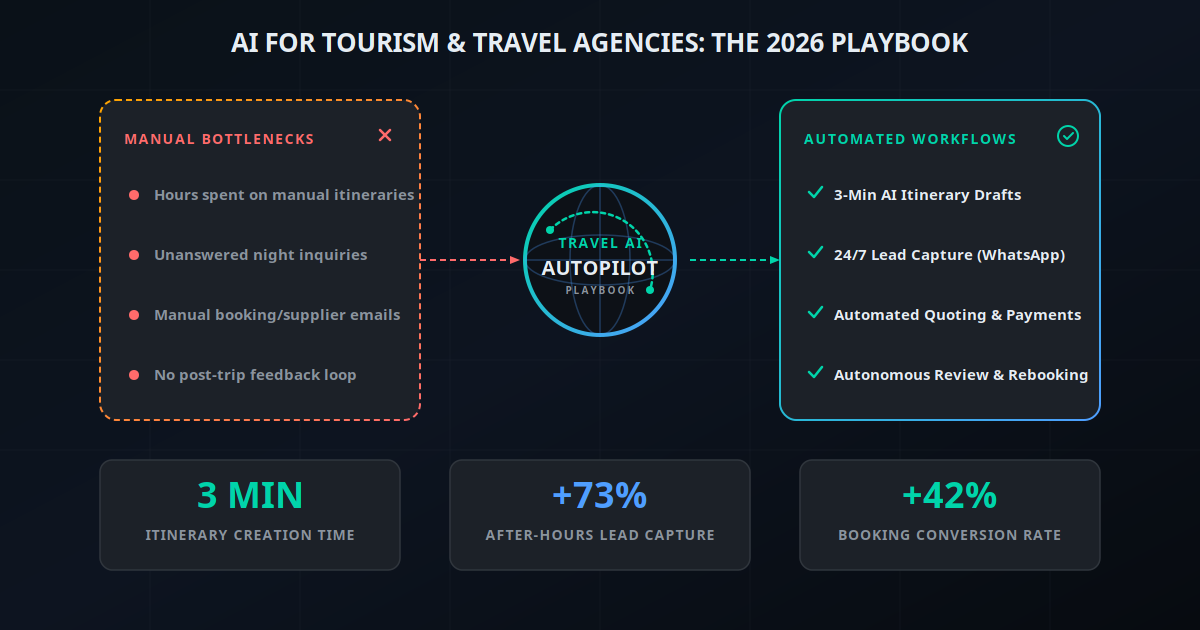
AI for Tourism & Travel Agencies: The 2026 Playbook
Discover how tourism and travel agencies use AI to automate itinerary building, capture 24/7 leads, manage bookings, and increase revenue in 2026.
Read More →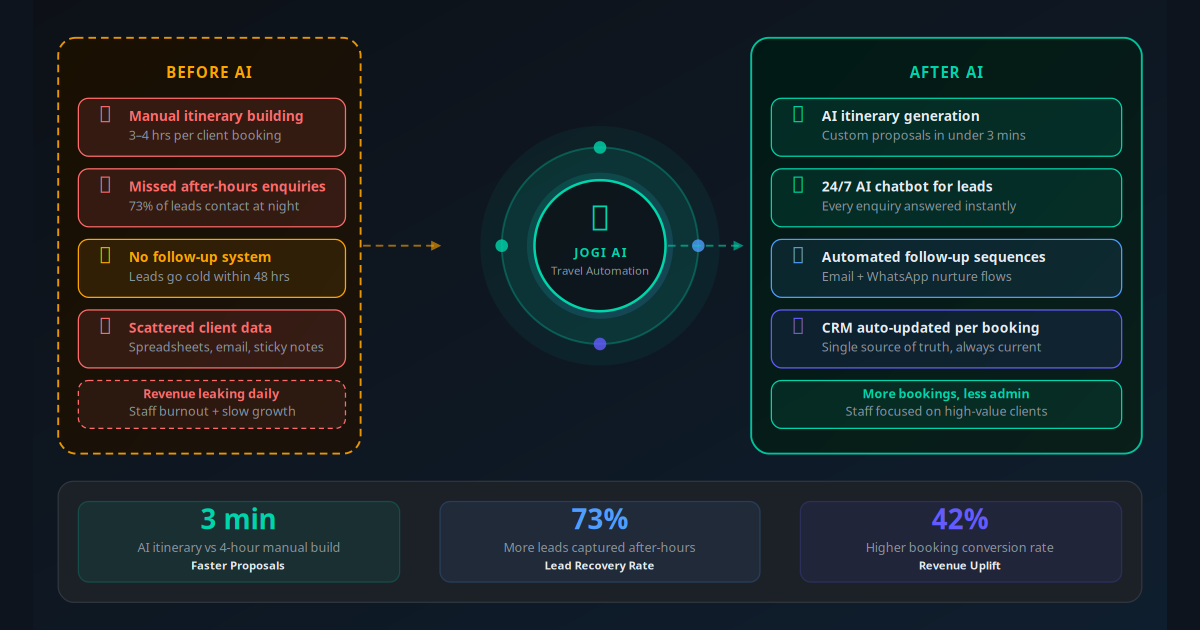
AI Automation for Travel Agencies: Book More, Work Less
How modern travel agencies use automated itinerary builds, 24/7 lead qualification, and booking workflows to increase close rates.
Read More →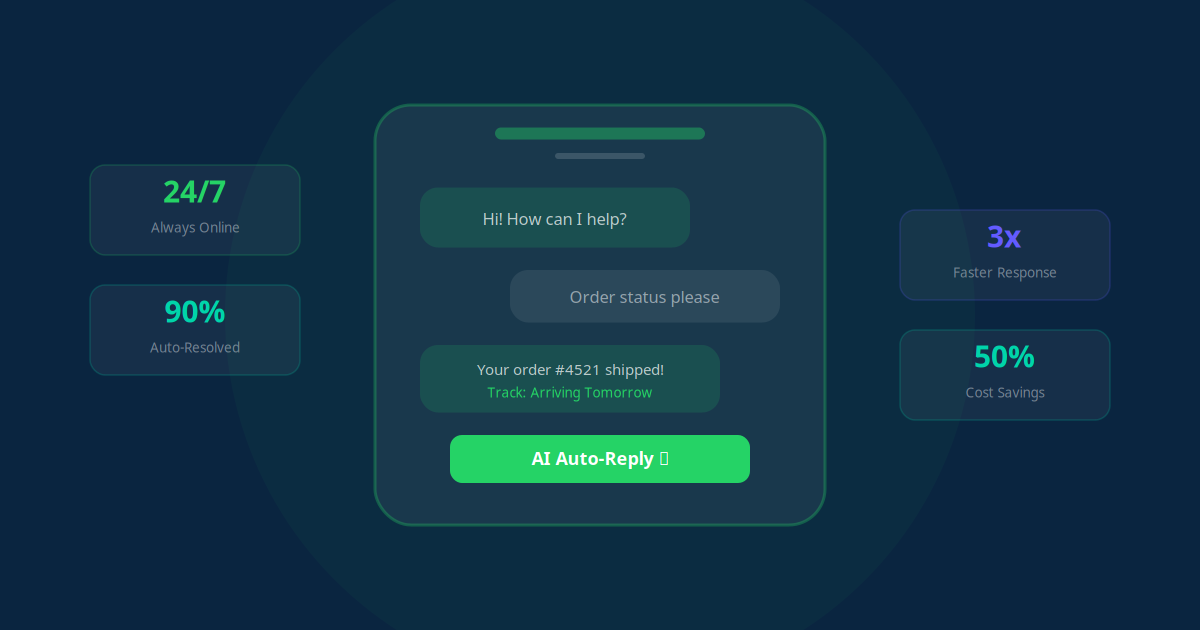
WhatsApp Business Automation: The Complete Guide
Turn WhatsApp into your highest-converting sales channel with automated responses, booking flows, and client nurture sequences.
Read More →