Voice AI Agents: The Invisible Employee That Handles Calls, Bookings & Support 24/7
The Missed Call Problem Is Costing You More Than You Think
Here is a number most business owners do not know: 62% of calls to small businesses go unanswered. A customer calls your clinic at 7 PM to book an appointment. Your receptionist left at 5. They call your plumbing company at 8 AM on a Saturday. Your team does not start until Monday. They call your restaurant during the lunch rush. Nobody picks up because everyone is on the floor.
Every missed call is a missed revenue opportunity. In most service businesses, a single missed booking is worth $50–$500. At 20 missed calls per week, that is $52,000–$520,000 in annual revenue walking out the door — not because of bad service, but because of a capacity problem.
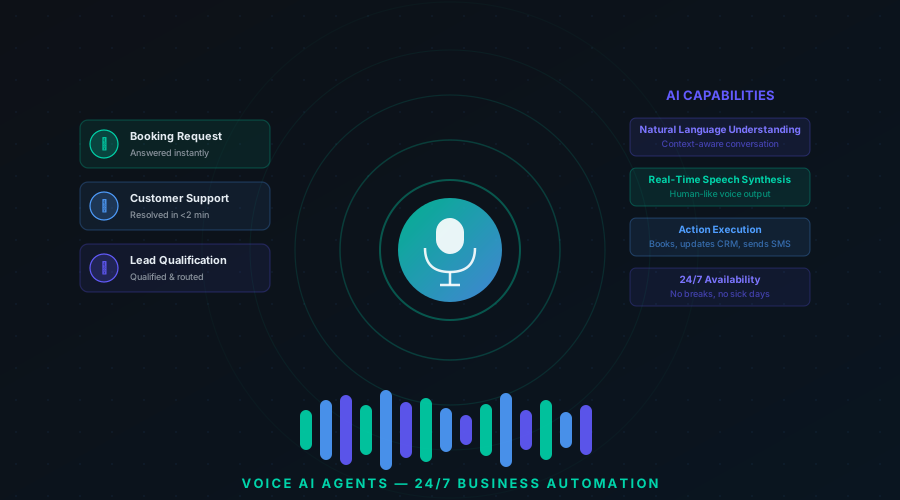
Voice AI agents solve this problem completely. They answer every call, immediately, at any hour, with contextual intelligence — and they do not just answer questions. They book appointments, qualify leads, collect information, update your CRM, and send follow-up messages. All without a human on the other end of the line.
What Is a Voice AI Agent?
A voice AI agent is an AI system that engages in natural, real-time spoken conversations over the phone (or any voice channel) and can take meaningful actions based on what it hears. It combines four technologies:
- Automatic Speech Recognition (ASR): Converts the caller's speech to text in real time. Modern ASR handles accents, background noise, and natural speech patterns with 95%+ accuracy.
- Large Language Model (LLM): The AI brain that understands what the caller needs, decides how to respond, and determines what actions to take — using your business's specific knowledge and context.
- Text-to-Speech (TTS): Converts the AI's response to natural-sounding speech. 2026 TTS (ElevenLabs, OpenAI TTS, PlayHT) produces voice quality that is indistinguishable from human speech in most telephony contexts.
- Action Execution Layer: The piece that makes voice AI genuinely useful — the ability to actually do things: query your calendar, create a booking, look up an order, update a CRM record, send an SMS confirmation.
The voice AI agent is not an IVR (press 1 for billing, press 2 for support). It is a natural conversation where the AI understands intent, asks clarifying questions, and completes a real task — the same way a competent human receptionist would.
Key Takeaway
Voice AI agents are not phone trees. They understand natural conversation, handle multi-turn dialogue, and take real actions — booking appointments, qualifying leads, updating records — in real time during the call.
How Voice AI Actually Works in 2026
The technology stack behind a production voice AI agent looks like this:
- Customer calls your phone number (the same number you already use)
- The call is routed to a telephony API (Twilio, Vonage, or a VoIP provider)
- A voice AI platform (Vapi, Retell AI, or a custom build) handles the conversation orchestration
- The LLM (GPT-4o, Claude, or Gemini) processes each caller turn and generates a response with function calls
- The TTS layer converts the response to speech with sub-200ms latency (fast enough to feel natural)
- When the AI decides to take an action (book a slot, create a record), it calls your connected APIs in real time
- At call end, a summary is sent to your CRM, and any follow-up messages (SMS, email) are triggered automatically
The critical advancement in 2026 is low latency realtime inference. The gap between when a caller finishes speaking and when the AI responds is now under 600ms — within the range that feels like natural conversation to most people. Earlier voice AI was perceptibly slow; that limitation is now largely solved.
Real Business Use Cases
Healthcare: Appointment Booking and No-Show Reduction
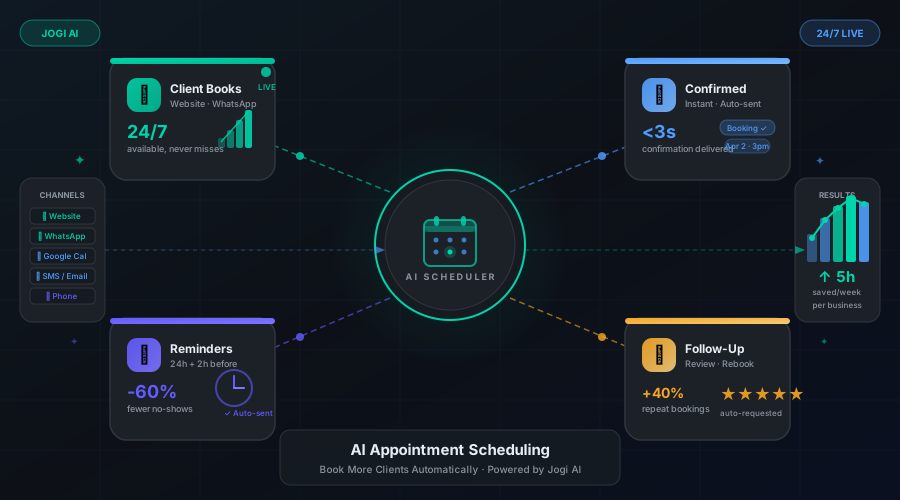
A medical clinic's voice AI agent handles 100% of inbound booking calls after hours, answers insurance and service questions from a trained knowledge base, sends confirmation SMS with calendar links, and makes automated reminder calls 24 and 2 hours before appointments. No-show rates dropped 38% at one multi-specialty clinic within 90 days of deployment.
Real Estate: Lead Qualification at Scale
A real estate agency's voice AI answers every inbound enquiry call, qualifies the lead (buyer or renter? Budget? Timeline? Location preference?), checks available properties in real time, and books a viewing with the relevant agent — all in under 3 minutes. Qualified leads per week doubled without hiring additional staff.
Restaurant: Reservation Booking Without a Receptionist
The voice AI answers all reservation calls, confirms availability by checking the reservation system in real time, books the table, takes special requests, and sends a confirmation with the booking details. During busy periods, it handles multiple calls simultaneously — something a human never could.
Home Services: Quote Collection and Scheduling
A plumbing and electrical services company's voice AI collects job details (type of work, location, urgency), checks technician availability, schedules a visit, and sends the customer a confirmation with technician name and arrival window. Emergency calls outside business hours are automatically escalated via SMS to the on-call technician.
Outbound: Sales Follow-Up and Appointment Reminders
Voice AI is not just for inbound. Outbound voice agents follow up on web form submissions within 5 minutes (research shows response time under 5 minutes increases conversion by 900%), remind customers of upcoming appointments, and run satisfaction surveys after service delivery — all automatically, triggered by CRM events.
A Sample Voice AI Call Flow: Dental Clinic
Customer calls at 9 PM: "Hi, I'd like to book a teeth cleaning appointment."
AI responds instantly: "Of course. Are you a new or existing patient?" — queries database based on caller ID to check if known.
Customer: "Existing. My name is Sarah Ahmed." — AI confirms identity and pulls up patient record.
AI: "Great, Sarah. I can see your last visit was 8 months ago. Our hygienist has availability this Thursday at 2 PM or Friday at 10 AM. Which works better for you?"
Customer: "Thursday at 2 PM please." — AI books the slot in real time.
AI: "Perfect, you are booked for Thursday at 2 PM with our hygienist Lisa. I am sending you a confirmation SMS now. Is there anything else I can help with?"
Post-call: SMS confirmation sent, CRM record updated, reminder calls scheduled for Wednesday evening and Thursday morning.
Total human involvement: zero. Total call time: under 2 minutes. Total cost: approximately $0.12.
Voice AI Platforms Worth Knowing in 2026
| Platform | Best For | Pricing (approx.) | Complexity |
|---|---|---|---|
| Vapi | Developer-friendly, most customisable | $0.05/min + LLM costs | Medium |
| Retell AI | Production-ready, enterprise features | $0.07/min all-in | Low–Medium |
| Bland AI | High-volume outbound campaigns | $0.09/min | Low |
| Synthflow | No-code voice AI builder | From $29/month | Low |
| Custom (Twilio + OpenAI) | Maximum control, self-hosted | Infrastructure only | High |
The ROI Numbers: What Businesses Are Actually Seeing
"Our missed call rate dropped from 58% to 4%. We are capturing bookings we would have lost to competitors. The voice agent paid for itself in the first week."
— Founder, physiotherapy clinic, 3 locationsAcross businesses deploying voice AI agents in 2026, the consistent results are:
- Call answer rate: From 38–65% to 98%+ (AI handles all overflow and out-of-hours)
- Booking conversion on inbound calls: Typically 15–25% higher (no hold time, immediate booking capability)
- No-show rate: 30–45% reduction when AI reminder calls are added
- Cost per call handled: $0.08–0.25 per call vs $2.50–$8 for a human call handler
- Payback period: Most businesses see full ROI within 30–45 days
How to Build Your First Voice AI Agent
The fastest path from zero to a working voice AI agent for a service business:
Step 1: Define the Core Use Case (1 hour)
Pick one job: inbound booking, FAQ answering, lead qualification, or appointment reminders. Do not try to build everything at once. A focused agent does one thing extremely well.
Step 2: Choose Your Platform (1 day)
For non-developers: Synthflow or Retell AI. For developers with CRM integration needs: Vapi. For maximum customisation: build on Twilio + OpenAI realtime API. Most service businesses start with Retell AI for its balance of capability and ease.
Step 3: Connect Your Calendar or Booking System (1 day)
The agent's most important action is booking. Connect it to your actual scheduling system (Google Calendar, Calendly, Acuity, Cliniko, etc.) via their APIs. This is the step most critical to get right — the agent needs to check real-time availability and create real bookings.
Step 4: Train on Your Knowledge Base (1 day)
Upload your service list, FAQ document, pricing, location details, and any policies. The AI uses this to answer questions accurately without hallucinating. Keep it focused on what callers actually ask.
Step 5: Test With Real Calls (2–3 days)
Call the agent yourself. Have colleagues call it. Try unusual requests, interruptions, and edge cases. Listen to recordings. Tune the system prompt until it handles 95%+ of calls accurately before going live.
Step 6: Route Calls and Go Live
Set up call routing so the AI answers first with a graceful human transfer option for complex issues. Monitor the first week closely, reviewing every call that ended in human transfer to understand what to improve.
Honest Limitations to Know Before You Deploy
Voice AI agents are genuinely powerful, but they are not perfect. Be aware of:
- Strong accents and poor audio quality: ASR accuracy drops on very strong regional accents or calls from noisy environments. A graceful "I did not catch that, could you repeat?" handling is essential.
- Complex multi-issue calls: When a caller has 3 unrelated questions and an emotional complaint, the agent may struggle to sequence them correctly. Design clear escalation paths.
- Integration reliability: The agent's value depends entirely on the reliability of its API connections. Test your calendar, CRM, and SMS integrations under load before go-live.
- Regulatory transparency: Under EU AI Act and emerging US state laws, voice AI agents must identify themselves as AI at the start of calls. Build this into your greeting script.
- Latency on complex queries: If the AI needs to query multiple APIs before responding, latency can increase. Design your call flows to front-load data collection before triggering complex lookups.
Conclusion: Every Call Answered, Every Hour of the Day
Voice AI agents represent one of the clearest ROI opportunities in business technology today. The combination of nearly-zero missed call rate, reduced no-shows, and 24/7 booking capability creates a revenue impact that is measurable within weeks, not quarters.
For businesses where the phone is still the primary customer contact channel — healthcare, home services, hospitality, real estate, professional services — voice AI is not a nice-to-have. It is rapidly becoming table stakes.
The technology is production-ready. The platforms are accessible. The economics are compelling. The only question is whether you build it before or after your competitors do.
To see how a voice AI agent would work for your specific business — including which call types it would handle and estimated revenue recovered from missed calls — use the AI Business Twin for a free, personalised analysis.
Frequently Asked Questions
Can customers tell they are talking to a voice AI agent?
In 2026, the voice quality of systems built on ElevenLabs, OpenAI TTS, or PlayHT is indistinguishable from human speech to most listeners in a standard phone call. However, EU AI Act requirements and best practice both require disclosure — voice AI agents should identify themselves as AI at the start of the call. Most businesses find this has minimal impact on customer satisfaction when the AI is genuinely helpful.
What can a voice AI agent actually do on a call?
A properly built voice AI agent can: answer questions using your knowledge base, book appointments directly into your calendar system, collect customer information and create records in your CRM, process simple orders or requests, qualify sales leads with structured questions, escalate to a human when needed, and send follow-up SMS or email after the call ends. The key is that it executes actions — it does not just answer questions.
How much does a voice AI agent cost to build and run?
Infrastructure costs for a voice AI agent are approximately $0.05–$0.12 per minute of call time. A business handling 1,000 call minutes per month would spend $50–$120 on inference costs. Total running costs typically range from $100–$400/month — compared to $30,000–$60,000/year for a part-time call handler.
Which industries benefit most from voice AI agents?
Industries where the phone is the primary customer contact channel see the highest ROI: healthcare clinics (appointment booking, no-show reduction), real estate (lead qualification), restaurants (reservation booking), home services (scheduling, quote collection), and any business with high inbound call volume and predictable query types.