AI for Commercial Real Estate: A Broker's Playbook




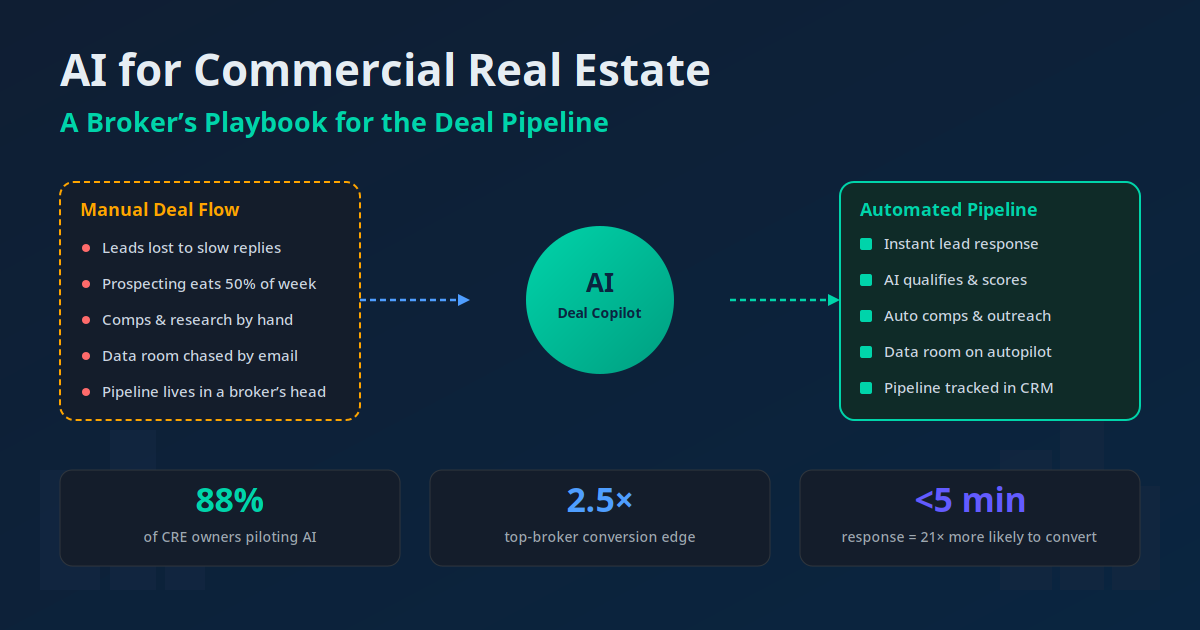
A broker I worked with last year kept a whiteboard behind his desk with 30-odd live deals on it. Sticky notes, arrows, a column for "chase this week." It was the single source of truth for a pipeline worth several million in fees, and it lived entirely in his head and on that wall. When he was travelling, the pipeline effectively stopped.
That is the honest state of a lot of commercial real estate desks. The deals are big, the cycles are long, and the day-to-day is buried under prospecting, follow-up, comps, and document chasing. Brokers spend roughly half their week generating leads and networking, and a good chunk of the rest on marketing admin. The selling, the part that actually earns the fee, gets squeezed.
AI changes the shape of that week. Not by closing deals for you, but by taking the repetitive middle off your plate so you spend more hours where your judgment is worth something. This guide walks through where AI fits across the commercial pipeline, what to automate first, the numbers behind it, and the parts of the job you should keep firmly in human hands.
Why Commercial Breaks the Residential Playbook
Plenty of AI tools are built for residential agents, and if you drop them onto a commercial desk they misfire. The reason is simple: the two businesses are shaped differently.
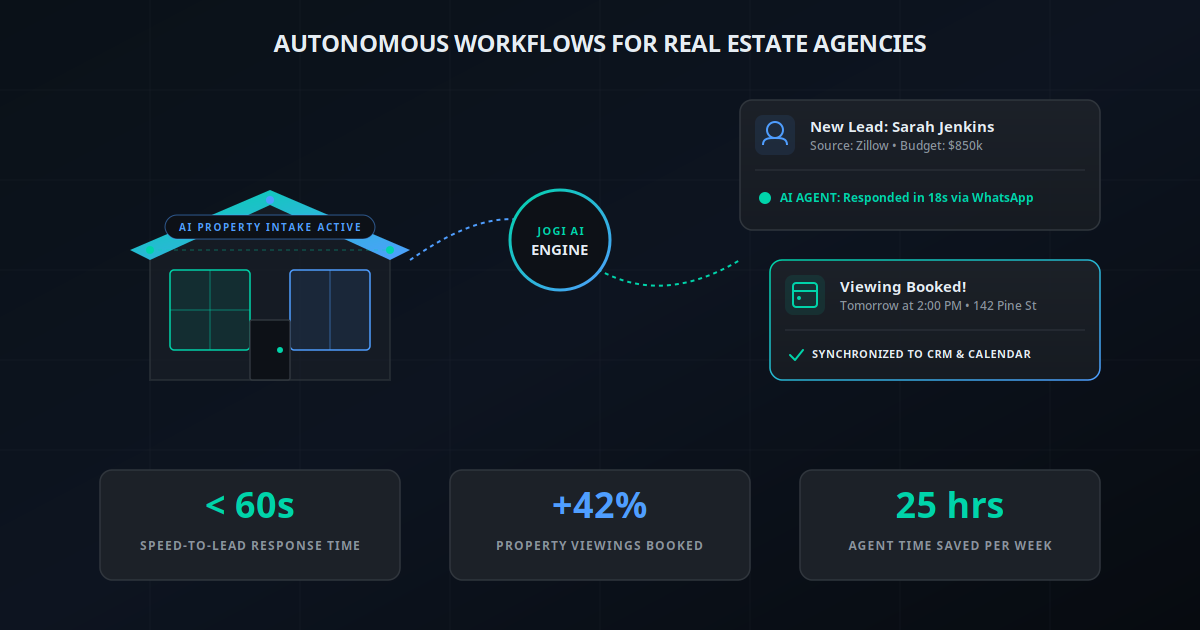
Residential runs on volume and speed. Many similar transactions, short cycles, a buyer who wants a viewing this weekend. The winning move is responding first and moving fast, which is why residential automation obsesses over speed-to-lead. If you run a residential team, our real estate automation work and the full guide to autonomous workflows for real estate agencies cover that ground.
Commercial is a different animal. Fewer deals, far larger tickets, and a cycle measured in months or quarters. A single office lease or industrial sale can involve a principal, a tenant rep, lenders, attorneys, and an asset manager, all needing different documents at different times. The work that decides whether you win is not "reply in 60 seconds." It is qualifying a prospect properly, running defensible comps, keeping a data room clean, and staying warm with a decision-maker over six months without becoming annoying. That is the work AI should be pointed at.
Key Takeaway
Residential AI is tuned for speed and volume. Commercial AI has to survive long cycles, multi-party coordination, and heavy documentation, so it earns its keep on qualification, research, and pipeline continuity, not just fast replies.
The Commercial Deal Pipeline, and Where Time Leaks
Before you automate anything, map where the hours actually go. Every commercial desk runs some version of the same pipeline, and each stage has a predictable time sink that AI can absorb.
| Deal Stage | What Eats the Time | Where AI Takes Over |
|---|---|---|
| Sourcing | Manually scanning listings, owners, and market signals | Monitors data sources and surfaces matching opportunities |
| Lead capture & response | Inquiries from portals, email, and referrals sitting unanswered | Replies instantly, captures details, logs the lead |
| Qualification | Repeating the same budget, timeline, and intent questions | Runs structured qualification and scores the prospect |
| Comps & research | Pulling data and formatting comparables by hand | Drafts comp summaries and market briefs for review |
| Documents & data room | Chasing NDAs, OMs, and files across email threads | Organises access, sends the right doc, tracks who saw what |
| Follow-up & close | Remembering who to nudge across a months-long cycle | Runs the cadence and flags deals going quiet |
Look at the middle column. None of it is deal-making. It is the connective tissue that has to happen for deal-making to occur, and it is exactly the kind of structured, repetitive work that AI handles well. When I audit a brokerage, this table is usually where we start, because it turns a vague "we should use AI" into a specific list of workflows worth building.
Where AI Actually Moves the Needle
Here are the workflows that consistently earn their place on a commercial desk. You do not need all of them on day one. Pick the one or two that map to your biggest leak.
Deal Sourcing and Lead Capture
An AI agent can watch your inbound channels and your data sources at once. Every inquiry from a portal, your website, or a referral gets an instant, qualified reply instead of sitting in an inbox until Tuesday. This matters more than most brokers admit. Response inside five minutes makes you many times more likely to convert a lead, and a study of top brokerages found 41 percent never responded to website leads at all. That is free pipeline being left on the floor. The mechanics are close to what we describe in AI lead generation for the sales funnel.
Qualification at Scale
Not every inquiry is a real deal, and chasing the ones that are not is where brokers lose their week. An AI copilot can ask the qualifying questions naturally, budget, timeline, asset type, financing, decision authority, then score and route the lead so only the serious ones reach your calendar. Warm-but-not-ready prospects drop into a nurture track instead of a black hole.
Comps and Market Research
Give an AI agent your data sources and it will draft a first-pass comp set and a market brief in minutes, formatted the way you present to clients. You still check the numbers, always, but you start from a draft instead of a blank page. This is the single biggest time-saver most brokers feel in the first week.
Document and Data-Room Workflows
CRE runs on paper. NDAs, offering memoranda, financials, LOIs. An AI layer can route the right document to the right party, answer routine questions about the file from inside a controlled system, and track who accessed what. This is where a retrieval-based assistant trained on your own documents does real work, because it answers only from your approved materials rather than guessing.
Follow-up and Pipeline Tracking
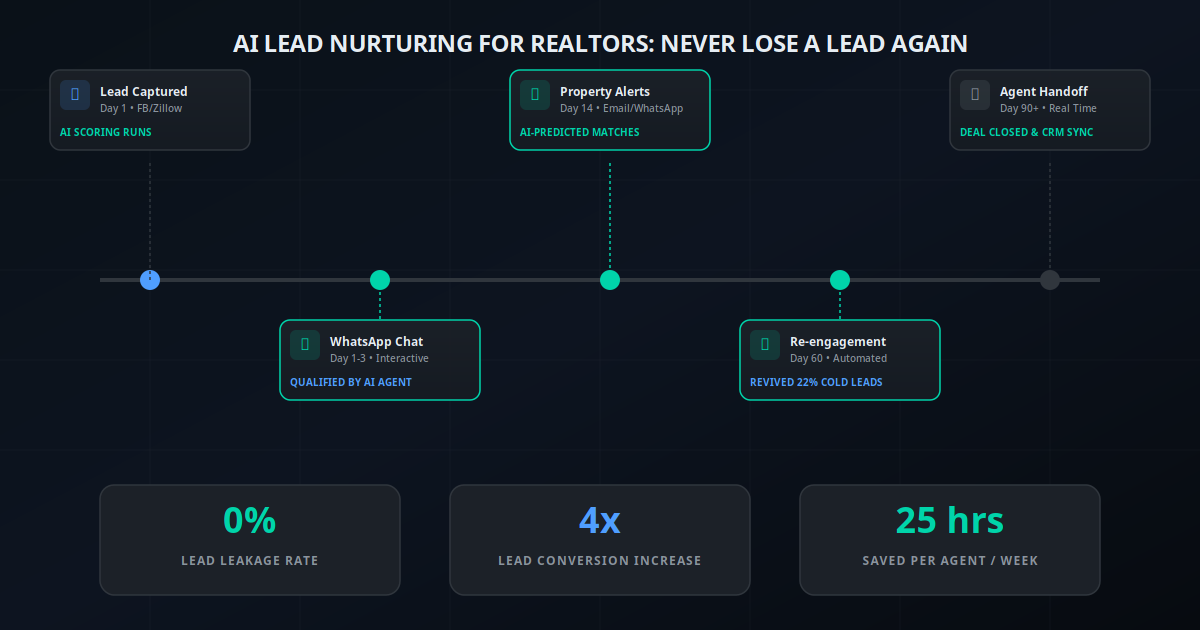
The whiteboard problem. An AI-driven cadence keeps every deal warm across a long cycle and logs activity into your CRM automatically, so the pipeline lives in a system instead of one person's memory. If your CRM is a mess today, start with the fundamentals in CRM automation 101, then layer nurture on top the way we cover in AI lead nurturing.
What This Looks Like in Practice
Investment Sales: Instant Response on Inbound Interest
A boutique investment sales team pointed an AI assistant at every "is this still available?" inquiry from listing portals. It replied in seconds with the key metrics, asked three qualifying questions, and booked calls with genuine buyers. Their response rate on inbound went from patchy to near-total, and brokers stopped spending mornings triaging tyre-kickers.
Tenant Rep: Qualifying at the Top of the Funnel
A tenant-rep broker used an AI copilot to run first-touch qualification on requirement inquiries, capturing size, location, budget, and lease timing before any human time was spent. Roughly a third of inquiries were filtered out as not-yet-real, and the broker's calendar filled with prospects who were actually in-market.
Comps on Demand for a Small Team
A three-broker industrial shop wired an AI agent to their data sources so any broker could ask for a comp set on an asset class and submarket and get a formatted draft back in minutes. Pitch prep that used to eat an afternoon became a review-and-refine task, and they took more listing meetings as a result.
Data Room That Answers Itself
On a large disposition, the team stood up a document assistant over the offering materials. Prospective buyers got fast, accurate answers to routine questions about the file, pulled only from approved documents, while the broker was flagged for anything sensitive or off-script. Fewer repetitive emails, faster buyer progression.
Building Your Deal Pipeline, Step by Step
Here is the sequence I use when putting AI onto a commercial desk. It runs from first inquiry to close, and it is deliberately built one layer at a time so you prove each piece before stacking the next.
Capture every inquiry: connect portals, website, and email so no lead lands anywhere the AI cannot see it. One inbox, one system of record.
Respond and qualify instantly: the AI replies in seconds, asks your qualifying questions, and scores intent before a broker spends a minute.
Route the serious ones: hot prospects hit your calendar with context attached; warm ones drop into an automated nurture track.
Arm the pitch: AI drafts comps and a market brief so you walk into the meeting with numbers ready to verify, not a blank page.
Run the deal on rails: data-room access, document routing, and LOI-stage follow-up handled inside a controlled system.
Track to close: every touch logs to the CRM automatically, and the AI flags any deal going quiet so nothing dies from neglect.
Notice the order. You are not trying to automate the whole desk in a weekend. You get instant response working, prove it, then add qualification, then comps, then the document layer. Each step stands on its own, which is the same principle behind any solid business process automation build.
The Numbers: Adoption, Trust, and Payoff
The commercial industry has moved faster than its reputation suggests, but with a clear line between what it will let AI do and what it still keeps in human hands.
- 88% of CRE investors and owners have started AI pilots, and adoption among occupiers and tenants runs even higher at 92%.
- 66% of CRE professionals use AI weekly or daily, yet only about 5% trust it enough to inform a final deal decision unassisted.
- Over half (53%) use AI for support only and keep it out of final calls, which tells you exactly where to draw the automation line.
- Top-quartile commercial brokers convert qualified leads roughly 2.5x better than average, driven largely by follow-up frequency and speed of response, the two things AI is best at enforcing.
- Responding within five minutes makes a broker many times more likely to convert a lead, while 41% of top brokerages never respond to web leads at all.
Read those together and the strategy writes itself. Let AI own speed, consistency, and research. Keep the valuation and the handshake human. The market for AI in real estate is projected to reach roughly $989 billion by 2029, so this is not a fad you can wait out.
"The point of automation on a commercial desk is not to close the deal for you. It is to make sure no deal ever dies because someone forgot to follow up."
— Chirag Jogi, Founder, Jogi AIOn payback, the CRE math is friendly. A focused setup covering response, qualification, and follow-up costs a few hundred dollars a month. Commercial commissions run into five and six figures. Recover a single deal that would otherwise have gone cold and you have paid for a year of automation, with change to spare.
Mistakes Brokers Make When Automating
Automating the Relationship Instead of the Admin
The fastest way to damage a commercial practice is to let AI cold-pitch a principal you have spent two years courting. Automate the plumbing, the qualification, follow-up reminders, document routing, and keep the relationship touches personal. Prospects can tell the difference, and in CRE the relationship is the asset.
Trusting the Comps Without Checking Them
AI drafts comps fast, and it will occasionally be confidently wrong. Treat every AI-generated number as a draft to verify, not a fact to forward. The 5% trust figure exists for a reason. Use AI to get to 90% in a tenth of the time, then do the final 10% yourself.
Building Everything at Once
The teams that stall are the ones that try to automate sourcing, qualification, comps, and documents in one project. Ship one workflow, run it for a few weeks, fix what breaks, then add the next. Momentum comes from finished pieces, not grand plans.
Ignoring the Data It Runs On
An AI agent is only as good as the CRM and documents behind it. If your pipeline lives on a whiteboard and your files live in twelve email threads, fix the foundation first. Clean data in, useful automation out.
Where Humans Stay Essential
Being straight about the limits is what makes the rest credible. Some of this job should never be handed to a model.
Judgment on a specific asset. Whether this building at this price in this cycle is a good deal is a call that blends data with instinct and local knowledge. AI informs it; you make it.
Negotiation and reading intent. Sensing when a counterparty is bluffing, when to push, when to hold, that is human work, and it is most of what earns your fee.
Confidentiality and compliance. CRE runs on NDAs and sensitive financials. Use business-tier AI that does not train on your data, keep documents in access-controlled systems, and restrict what the AI can retrieve based on who is asking. The same confidentiality and record-keeping duties you already carry apply to any AI vendor that touches deal data.
Stakeholder coordination at the sharp end. AI can route documents and chase routine items, but when a lender, an attorney, and a principal disagree, a person needs to sit in the middle and hold it together.
Conclusion: Clear the Desk, Win the Deal
Commercial real estate is not going to be automated away. The deals are too large, too specific, and too relationship-driven for that. What is changing is how a broker spends the week. The prospecting, the follow-up, the comps, the document chasing, all of that can move to AI, which hands you back the hours that actually close business.
Start where the leak is worst, usually speed-to-lead and follow-up, prove one workflow, then build outward toward qualification, comps, and the data room. Keep the valuation and the handshake human. Do that and you get the upside without the risk the trust numbers warn about.
To see which parts of your specific desk are worth automating first, and roughly what it would recover in deals that currently go cold, use the AI Business Twin for a free, personalised analysis in under 10 minutes.
Frequently Asked Questions
How is AI for commercial real estate different from residential real estate tools?
Residential tools optimise for speed and volume across many similar transactions. Commercial deals are fewer, larger, and slower, so CRE AI has to handle long sales cycles, multi-party coordination, heavy documentation, and financial underwriting rather than just fast lead follow-up. The highest-value work in CRE is qualification, comps and market research, data-room management, and keeping a slow pipeline warm over months, so that is where broker-focused AI is aimed.
Can AI really handle CRE deal sourcing and comps, or just admin work?
It handles both, but with different levels of autonomy. AI can run sourcing and outreach, draft comp summaries, pull market data, and organise a data room with very little supervision. For valuation, deal structuring, and final numbers, most brokers keep AI in a drafting role and verify the output themselves. The 2026 data shows this split clearly: adoption is high, but only about 5 percent of firms trust AI enough to drive final deal decisions unassisted.
Will AI replace commercial real estate brokers?
No. AI removes the repetitive middle of the job, which is prospecting, chasing documents, formatting comps, and logging pipeline activity. Relationships, negotiation, judgment on a specific asset, and reading the intent of a counterparty stay firmly human. The brokers who gain the most are the ones who let AI clear the admin so they spend more hours in front of clients and in live deals.
How much does it cost to automate a CRE brokerage's pipeline?
A focused starter setup covering lead response, qualification, and follow-up typically runs a few hundred dollars a month in software and infrastructure. A full pipeline build with CRM integration, comps assistance, and data-room workflows costs more but is usually a small fraction of a single commercial commission. Because CRE fees are large, recovering even one deal that would have gone cold generally covers a year of automation.
Is it safe to put confidential deal and client data into AI systems?
It can be, if you set it up deliberately. Use business-tier AI services that do not train on your data, keep sensitive documents inside access-controlled systems, and restrict what the AI can retrieve based on who is asking. Confidentiality agreements and record-keeping obligations still apply, so treat AI like any other vendor that touches deal data and put the same controls around it.
Where should a commercial broker start with AI automation?
Start with speed-to-lead and follow-up, because that is where deals leak with the least effort to fix. Put an AI assistant on every inbound inquiry so prospects get a fast, qualified response, and automate the follow-up cadence so nothing sits untouched. Once that is stable, add comps assistance and data-room workflows. Build one workflow at a time and prove it before stacking the next.