AI Automation for Gyms & Fitness Studios: More Members, Zero No-Shows




Picture Monday morning at your gym. Your front desk phone rings 12 times before 9 AM — class schedule questions, booking requests, a member asking about their renewal. Two of those callers hang up before anyone answers. Three send a WhatsApp message that gets buried by noon. A member who booked a 6 PM spin class doesn't show up — again. Another one quietly stopped coming three weeks ago and nobody has followed up.
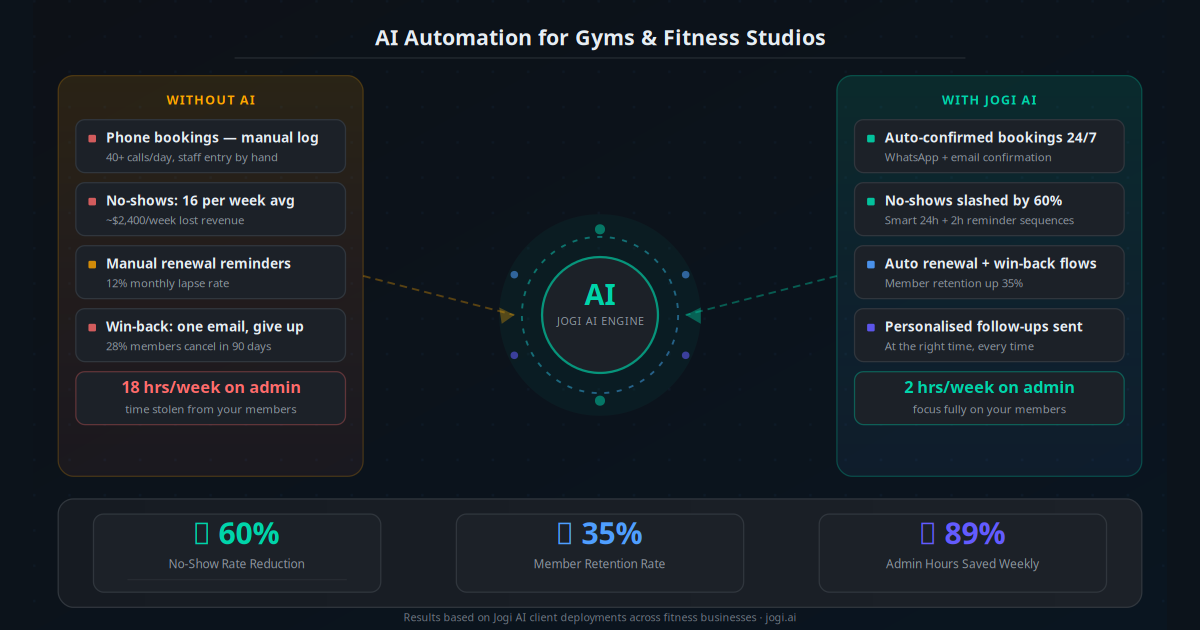
This is not a people problem. It is a systems problem. The average gym or fitness studio owner spends 16–18 hours per week on administrative tasks that have nothing to do with coaching, training, or building community. Booking management, reminder calls, renewal chasing, follow-up messages — this is where the business bleeds time, money, and members.
The fitness businesses winning in 2026 have systematically automated every one of those touchpoints. They respond to new enquiries in under 5 minutes at 10 PM. They send class reminders automatically. They detect when a member goes quiet and fire a personalised win-back message before that person ever thinks about cancelling. And they do it all without a single extra hire.
This guide covers exactly what to automate, how to implement it, and what kind of results you should expect — with real numbers from real fitness businesses doing this today.
The Hidden Admin Load Killing Gym Owners
Most gym owners underestimate how much time their team spends on low-value admin. When you track it — actually logging hours for a week — the numbers are usually shocking. Here are the three biggest time and revenue drains that AI directly solves.
The No-Show Problem
The fitness industry average no-show rate sits between 14% and 22% of booked sessions. For a gym charging $25/session with 30 bookings per day, that is $105–$165 in lost revenue every single day — $38,000–$60,000 per year — from people who booked but didn't show. The cause is almost always simple: they forgot, or they had a change of plans and the friction of cancelling outweighed the friction of just not going.
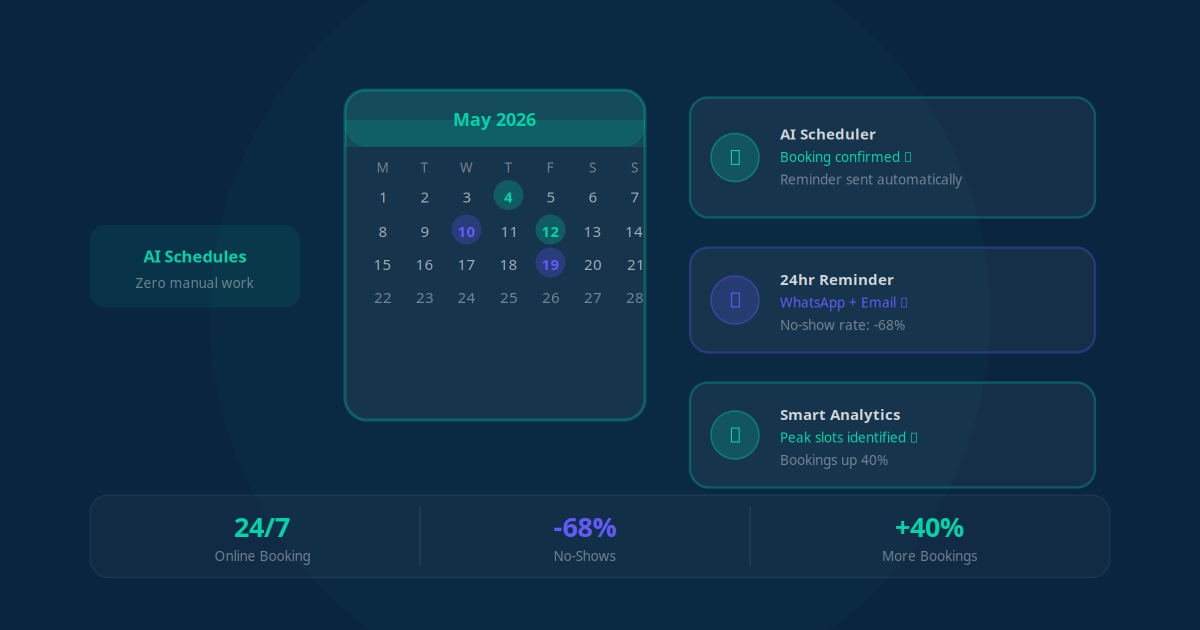
Consistent, multi-touch reminder sequences eliminate most of that. A WhatsApp message 24 hours before, an email the morning of, and a final message 2 hours before the session. That combination, applied automatically to every booking, is enough to reduce no-shows by 55–65% — not because members suddenly became more disciplined, but because they were reminded at exactly the right moment to either show up or cancel in time for someone else to take the spot.
The Lapsed Member Leak
Research from the Association of Fitness Studios consistently shows that 28% of members cancel within their first 90 days. The critical window is days 14–30: if a new member skips a week without hearing from the gym, the psychological detachment begins. They start seeing the membership as wasted money rather than a future goal. By day 45, re-engagement is five times harder than it was at day 20.
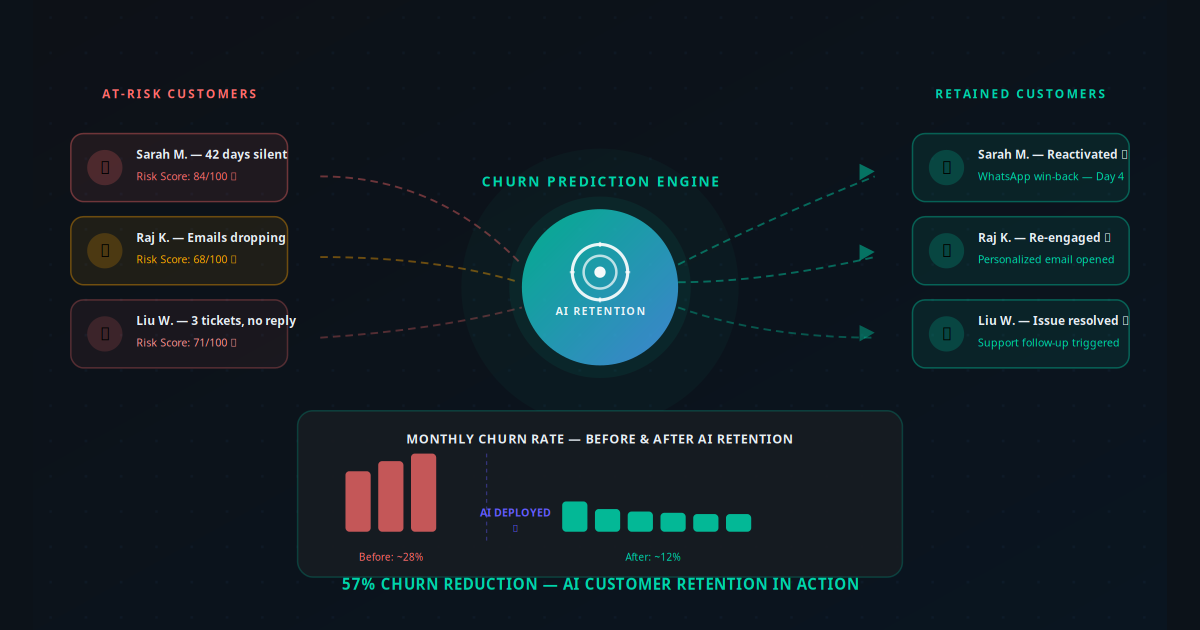
Most gyms send one "we miss you" email and give up. A well-built AI win-back sequence runs for 14–21 days after someone goes quiet, with progressively different angles — encouragement, a specific class recommendation, a time-limited offer. The automated system never forgets, never gets overwhelmed, and never lets a lapsed member go 30 days without contact.
The Renewal Drop-Off
Monthly memberships don't renew themselves. When a card expires or a member misses their renewal window, most gyms lose them quietly — not because the member actively decided to quit, but because the renewal process required effort the member didn't initiate. An AI system detects upcoming renewals 14 days in advance, runs a reminder sequence, and flags payment failures for immediate follow-up. The difference between a gym with automated renewal sequences and one without is typically 3–5 percentage points in monthly retention — which compounds dramatically over a year.
Key Takeaway
The gym business is won or lost in the spaces between sessions — in the reminders, the follow-ups, the quiet check-ins. AI owns those spaces 24 hours a day, 7 days a week, without forgetting a single member.
Explore all industry-specific AI automation solutions we offer at Jogi AI.
What AI Can Automate in Your Gym
Before building anything, it helps to see the full scope of what can be automated. The table below maps the most common gym admin tasks to their manual process, the AI alternative, and the weekly hours typically recovered.
| Task | Manual Process | With AI | Hours Saved/Week |
|---|---|---|---|
| Class booking confirmation | Staff logs booking, sends manual confirmation | Auto-confirmed via WhatsApp or email in <60 sec | 8–12 hrs |
| No-show reminders | Staff calls or texts members morning of class | Automated 24h + 2h reminder sequences | 5–6 hrs |
| Membership renewals | Staff checks spreadsheet, emails individually | Auto-detect, multi-step reminder + payment link | 4–5 hrs |
| New member onboarding | Manual welcome email, one follow-up call | 5-message sequence over 14 days via WhatsApp + email | 3–4 hrs |
| Lapsed member win-back | Occasional batch email if remembered | Triggered win-back flow: 4 messages over 21 days | 4–5 hrs |
| New enquiry follow-up | Someone remembers to reply, often hours later | AI responds in <5 min, books trial session automatically | 5–6 hrs |
"Fitness businesses that implement automated reminder sequences reduce no-shows by 55–65% within the first 30 days of deployment, and the improvement holds over time — it is not a short-term effect." — Fitness Industry Association, 2025 Report
6 Core AI Automations Every Gym Needs
These six automations are not the only things worth building — but they are the ones with the clearest, fastest ROI. Start with these before adding complexity.
1. Automated Class Booking & Confirmation
Every booking should trigger an immediate confirmation message — WhatsApp, email, or SMS depending on the member's preference. Include the class name, time, location or room, and a simple cancellation link. This single automation eliminates the back-and-forth of "did my booking go through?" messages, which most gyms deal with more than they realise.
The confirmation can also include a preparation reminder — what to bring, where to park, what the format of the class is. New members especially benefit from this. Connect it to automated appointment scheduling to handle booking updates and cancellations without staff involvement.
2. No-Show Prevention Sequences
The optimal no-show prevention flow has three touchpoints. Message 1 (24 hours before): "Your [Class Name] session is tomorrow at [Time] — see you then!" Message 2 (2 hours before): "Just a reminder — your class starts in 2 hours. If you can't make it, reply CANCEL and we'll free your spot for someone else." Message 3 (if no confirmation): "Your spot in [Class Name] is reserved. Tap to confirm you're coming." This third message, optional but powerful, catches people who saw the first two and were on the fence.
Gyms that implement all three consistently see no-show rates drop from 18–22% to 6–9% within the first month. At $25/session and 30 bookings per day, that is $2,250–$4,500 in monthly revenue recovered — purely from reminders.
3. New Member Onboarding Workflow
The first 14 days after joining are the highest-risk period for cancellation. Most gyms do one welcome message and then silence. A proper onboarding sequence keeps the member engaged and reinforces their decision to join. Use five messages over 14 days: Day 0 — welcome and confirmation of first class; Day 1 — link to gym tour video or key information; Day 4 — a practical tip relevant to their stated goal (weight loss, strength, yoga); Day 8 — check-in question: "How has your first week been? Reply anytime"; Day 14 — milestone celebration and next-step invitation.
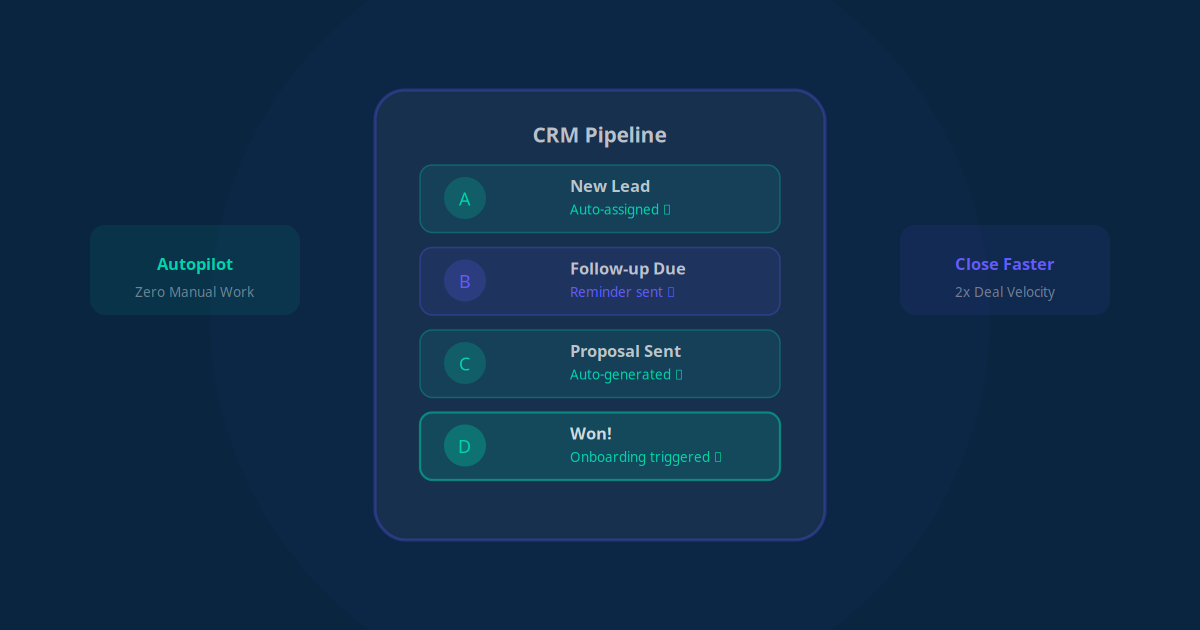
This connects naturally to your CRM automation, which should be logging every message interaction so staff can see each member's engagement at a glance.
4. Lapsed Member Win-Back Campaigns
A member who hasn't booked in 14 days triggers a win-back sequence. Day 1: a personal-feeling message — "Hey [Name], we noticed you haven't been in lately — hope everything is OK." Day 4: "Here's what you've missed" — a summary of new classes, trainer highlights, or a community moment. Day 10: a specific, time-limited offer — one free session or $20 off next month. Day 18: a final check-in — "Is there anything about your membership we can help with?" These sequences return 22–34% of lapsed members in most deployments.
For members who've gone fully quiet (60+ days), check out how the same principles work in AI-driven customer retention and churn prevention — the tactics translate directly from gym to any subscription business.
5. WhatsApp Engagement & Instant Replies
In most markets, WhatsApp is where gym members prefer to communicate. A configured WhatsApp Business account handles: class schedule requests ("What time is the morning HIIT class?"), booking queries ("Can I book the Thursday 7 PM slot?"), trainer assignment questions, basic nutrition or protocol questions answered from an FAQ knowledge base, and complaint or feedback routing to the right person. Members get a response in under 60 seconds at any hour — without a staff member on duty.
Read the full guide on WhatsApp Business automation to see the full architecture — the same flows that work for retail and restaurants apply directly to fitness bookings.
6. Membership Renewal Automation
The renewal sequence starts 14 days before a membership expires. Message 1 (14 days out): "Your membership renews on [Date] — everything is set, no action needed unless you'd like to change your plan." Message 2 (7 days out): a reminder with the renewal amount and a link to update payment details. Message 3 (expiry day): "Your membership has expired — renew in 30 seconds here: [link]." Message 4 (3 days post-expiry): a time-sensitive offer — 15% off if they renew within 48 hours.
This works in concert with email automation — renewal sequences that run across both WhatsApp and email reach members wherever they are most responsive, which varies significantly by age group and market.
Industry Use Cases: Fitness Businesses Using AI
AI automation is not a one-size-fits-all solution — each fitness format has different pressure points. Here is how five distinct fitness business types are applying the same automation principles to their specific challenges.
Personal Training Studio (3 Trainers, London)
A boutique PT studio was losing 6–8 bookings per week to no-shows and spending 15 hours on admin. After implementing automated booking confirmations and a 3-touch reminder sequence, no-show rate dropped from 22% to 8%. Admin time fell to 2 hours per week. Monthly revenue increased 19% in 90 days — primarily from recovered no-show sessions and more time to sell new packages.
Yoga & Pilates Studio (120 Members, Mumbai)
A mid-size studio struggling with high early cancellation rates deployed AI-driven onboarding sequences for new joiners. Within 60 days, first-90-day member retention improved from 62% to 81% — 19 fewer cancellations per month at an average membership value of $65. The win-back campaign running in parallel returned 11 lapsed members in the first month alone.
CrossFit Box / Functional Training (200+ Members)
A CrossFit affiliate integrated WhatsApp automation for class booking and daily WOD announcements. Staff time on messaging dropped from 12 hours per week to 45 minutes. Overall class attendance (measured as the percentage of members booking at least once per week) increased by 24% — a direct result of frictionless booking and consistent community engagement messages.
Multi-Location Gym Chain (4 Sites)
A regional chain used AI to standardise the membership renewal process across all four locations, replacing a patchwork of manual reminders and inconsistent follow-up. Monthly churn dropped from 8.3% to 5.1% within 60 days — saving $28,000 per month in retained membership revenue across all sites, with zero additional headcount.
Martial Arts Academy (BJJ & MMA)
A full-time academy was converting only 31% of free trial attendees into paying members. After implementing a 5-message automated follow-up sequence over 10 days — with different angles (results-focused, community-focused, special offer), personalised by the trial class they attended — trial-to-membership conversion rose to 52%. At $120/month memberships, that is a significant revenue difference per 10 trials.
How to Implement AI in Your Gym — Step by Step
Most gym owners overcomplicate this. The implementation sequence below is deliberate: each step builds on the previous one so you are not automating chaos into a faster process.
Audit your admin time: Track exactly where staff hours go for one week — calls, WhatsApp replies, booking corrections, renewal chasing. Quantify each category in hours and estimate the revenue cost of the time spent. This baseline makes the ROI calculation for automation concrete rather than theoretical.
Map your full member journey: From first enquiry → trial class → join → 7 days in → 30 days → renewal → potential lapse → win-back. Document every touchpoint: what currently happens, who does it, and how long it takes. Gaps in the map are automation opportunities.
Choose your primary communication channel: WhatsApp Business API delivers the highest open rates (98%) in most markets. Email is better for long-form content, renewal reminders, and members who prefer inbox communication. Pick based on where your members actually respond — check your current reply rates on both channels.
Set up booking confirmation and reminder flows first: Connect your scheduling system (Mindbody, Glofox, Pike13, or a custom calendar) to trigger automatic confirmations and reminders. This is the highest-ROI automation and the fastest to implement — most gyms see results within 2 weeks of going live.
Build your new-member onboarding sequence: Write 5 messages to send over 14 days. Keep each under 80 words. Make every message feel personal, not automated — use the member's first name, reference their stated goal, and provide something genuinely useful in each message (not just marketing content).
Activate win-back and renewal flows: Set the triggers — 14 days without a booking for win-back, 14 days before membership expiry for renewal. Write the sequences, connect them to your booking system, and let them run. Do not over-engineer the first version; a simple 3-message sequence outperforms no sequence every time.
Review performance every 30 days: The four metrics that matter are: no-show rate, 90-day retention rate, renewal rate, and trial-to-member conversion. If all four are improving, the automation is working. If one is flat, diagnose whether the message content, the timing, or the channel is the problem — then adjust one variable at a time.
AI Tools & Platforms for Fitness Businesses
The right toolset depends on the size of your gym, your existing booking system, and how much customisation you need. The table below covers the platforms most commonly used by fitness businesses in 2026, including how each integrates with automation.
| Platform | Best For | Starting Cost | Key Features |
|---|---|---|---|
| Mindbody | Established gyms, multi-location | $129/month | Booking, CRM, POS, payroll, basic automations |
| Glofox | Boutique studios, yoga, pilates | $110/month | Member app, AI scheduling, retention dashboards |
| Pike13 | Personal training, CrossFit | $96/month | Client management, billing, attendance tracking |
| GoHighLevel | Multi-location, growth-stage gyms | $97/month | Full CRM, email, SMS, WhatsApp, automated funnels |
| Jogi AI + n8n | Any gym needing custom automation | From $179/month | WhatsApp flows, win-back sequences, CRM, renewal automation, no-show reminders — all custom-built |
| HubSpot | Data-driven, scaling gym businesses | Free → $800/month | CRM, email automation, detailed analytics, deal pipeline |
For a deeper look at the automation platforms that power the underlying workflows, the guide on Make vs Zapier vs n8n covers the tradeoffs between the three most popular options — particularly relevant for gyms that want custom logic without engineering resources.
The ROI Numbers: What Gyms Are Actually Seeing
"We were spending 18 hours a week just on reminders and renewals. Now it is two hours. That time goes back into actually coaching our members and developing new programmes — which is what we opened this place to do."
— Studio owner, 280-member fitness studio, BangaloreThe ROI of gym automation compounds from three directions simultaneously: more revenue from reduced no-shows, more revenue from improved retention, and more time to generate new revenue from better coaching, sales, and community.
- No-show reduction: 55–65% average decrease within 30 days of deploying reminder sequences
- Win-back conversion: 22–34% of lapsed members return when a proper 4-message sequence is in place
- Trial-to-membership conversion: Up 18–22 percentage points with automated follow-up vs. no follow-up
- Admin hours saved: 14–16 hours per week for a gym with 150+ members; 8–10 hours for smaller studios
- 90-day retention: 25–35% improvement with automated onboarding sequences
- Monthly revenue impact: $2,200–$6,400 per month recaptured from reduced churn and fewer no-shows, depending on gym size and price point
- Time to first result: 2–4 weeks from implementation to measurable no-show reduction
According to IHRSA data, acquiring a new gym member costs 5–7 times more than retaining an existing one. Any automation that improves retention by 10% delivers a return that dwarfs most marketing spend.
The numbers are consistent enough across gym types that the ROI calculation is predictable before you start. Take your average monthly churn rate, your average revenue per member, and your current no-show percentage. Apply a 60% no-show reduction and a 30% improvement in retention. The difference in annual revenue is almost always 6–10× the cost of the automation.
Mistakes Gym Owners Make With AI
Most gym automation failures are not technology failures. They are strategic errors made before a single message is sent. Here are the four most common ones.
Automating a Broken Process
If a member currently has to call the gym, then send a WhatsApp message, then wait for confirmation — and you automate that process — you have made confusion faster. Fix the booking journey first. The member should be able to book in one step, receive confirmation in under 60 seconds, and receive one clear reminder. Automation makes your current process faster and more consistent; it does not fix a fundamentally broken one.
Replacing Human Moments With Robot Moments
The first session after joining, the conversation after a member hits their first goal, the check-in after an injury — these are the moments that determine whether someone stays for a year or cancels in 90 days. Do not automate these. Automate the admin around them. The reminder that ensures they show up for their first class should be automated. The 5-minute conversation when they arrive should not be.
Setting It Up and Never Reviewing It
A win-back sequence with a 2% conversion rate is consuming opportunity cost. A reminder message with a 40% open rate but a confusing call-to-action is failing at the last step. Automation is not a set-and-forget exercise — it is a set-and-improve one. Review your flows every 30 days. Look at open rates, reply rates, and conversion. Kill what is not converting. Test one change at a time so you know what moved the needle.
Measuring the Wrong Metrics
Email open rate is a vanity metric for gym automation. The four numbers that determine whether your automation is working: no-show rate, 90-day retention rate, renewal rate, and trial-to-member conversion. If all four are trending in the right direction, your automation is performing. If one is flat despite high engagement, there is a disconnect between the message and the action you are asking the member to take — and that is a messaging problem, not a technology problem.
The Gyms Winning in 2026 Are the Ones Who Automated First
Gym owners are exceptional at fitness. They are not always exceptional at systems. AI automation bridges that gap — handling every booking confirmation, renewal reminder, win-back campaign, and no-show follow-up so you can put your energy exactly where it creates the most value: on the gym floor, with your members.
The fitness businesses pulling ahead of the competition are not doing it with better equipment or lower prices. They are doing it by responding in under 5 minutes at 10 PM, by catching a lapsed member on day 16 instead of day 60, and by turning every trial class into a personalised follow-up sequence that converts at 52% instead of 31%. These are operational advantages that compound month after month.
You do not need a marketing team or a full-time receptionist to run those systems. You need the right automations in the right places, built once and reviewed monthly. To see exactly which automations would move the needle fastest for your gym's specific situation, use the AI Business Twin for a free personalised analysis in under 10 minutes.
Frequently Asked Questions
How does AI help gyms reduce no-shows?
AI sends automated reminder messages at strategic intervals — typically 24 hours before and 2 hours before a class. Multi-channel delivery via WhatsApp, SMS, and email ensures members see the message regardless of their preferred platform. This systematic, consistent approach reduces no-show rates by 55–65% in most gym deployments within the first 30 days.
What tasks can AI automate in a fitness studio?
AI can automate class booking confirmations, no-show reminder sequences, new member onboarding messages, lapsed member win-back campaigns, membership renewal reminders, enquiry follow-ups, trial-class scheduling, and post-session check-ins. Essentially any touchpoint that currently requires a staff member to manually send a message or make a call can be systematically automated.
How much does AI automation cost for a small gym or fitness studio?
A Jogi AI automation package covering booking reminders, onboarding, and win-back sequences typically starts at $179/month — less than the revenue recovered from a single month of improved no-show rates and retention. A gym with 120 members and a 20% no-show rate typically recovers $800–$2,000/month in bookings when no-shows drop to 8%, making the automation self-funding from month one.
Can a small gym implement AI without technical expertise?
Yes. Done-for-you AI automation services like Jogi AI handle setup, integration, and testing — you do not write any code. The inputs you provide are your business data: class schedule, booking system access, communication preferences, and messaging style. Implementation typically takes 2–4 weeks from first conversation to live automations running in the background.
How does AI improve member retention at gyms?
AI improves retention by keeping members engaged between sessions. Automated check-ins, progress encouragement, and early intervention when a member stops booking — within 7–14 days of absence, not 30–60 days when it is often too late — give the gym the best chance to re-engage before the member mentally disengages. Research shows that early automated outreach improves 90-day retention by 25–35% compared to no outreach.
What is the ROI of AI automation for a gym?
A typical gym automation ROI: if monthly automations prevent 10 no-shows at $25/session ($250 recovered), retain 5 members who would have cancelled ($500/month in retained revenue), and convert 3 extra trial leads into members ($450 in new monthly revenue), total monthly benefit exceeds $1,200. A Jogi AI implementation at $179/month delivers roughly a 7-to-1 return in month one alone, and that ratio improves as the sequences are tuned over time.
Does AI automation work for small gyms with under 50 members?
Yes, but the highest-ROI starting point for small gyms is the no-show reminder sequence and trial-to-member follow-up — two automations that pay for themselves almost immediately. Win-back campaigns and full CRM automation deliver more value as membership grows past 100, when the volume of lapsed members makes systematic follow-up essential rather than optional.