AI Customer Retention: Predict Who's About to Leave and Win Them Back — Automatically




The Leaky Bucket Problem Draining Your Revenue
Here is a number most business owners never sit down to calculate: the average SMB loses 20–30% of its customers every year. Not to bad service. Not to better pricing from a competitor. Mostly to silence — the quiet drift that happens when a business forgets to stay present, and a customer forgets why they chose you.
The arithmetic is brutal. A business with 400 active clients losing 25% annually loses 100 clients every year. If average client value is $1,200 per year, that is $120,000 evaporating before you even account for the cost of finding replacements. And replacing them is expensive — acquiring a new customer costs 5–7x more than retaining an existing one.
Yet most businesses spend 80–90% of their marketing budget on acquisition. The leaky bucket keeps leaking. Revenue is flat even as the team hustles harder. New customers fill the top of the bucket; churned customers drain out the bottom at the same rate.
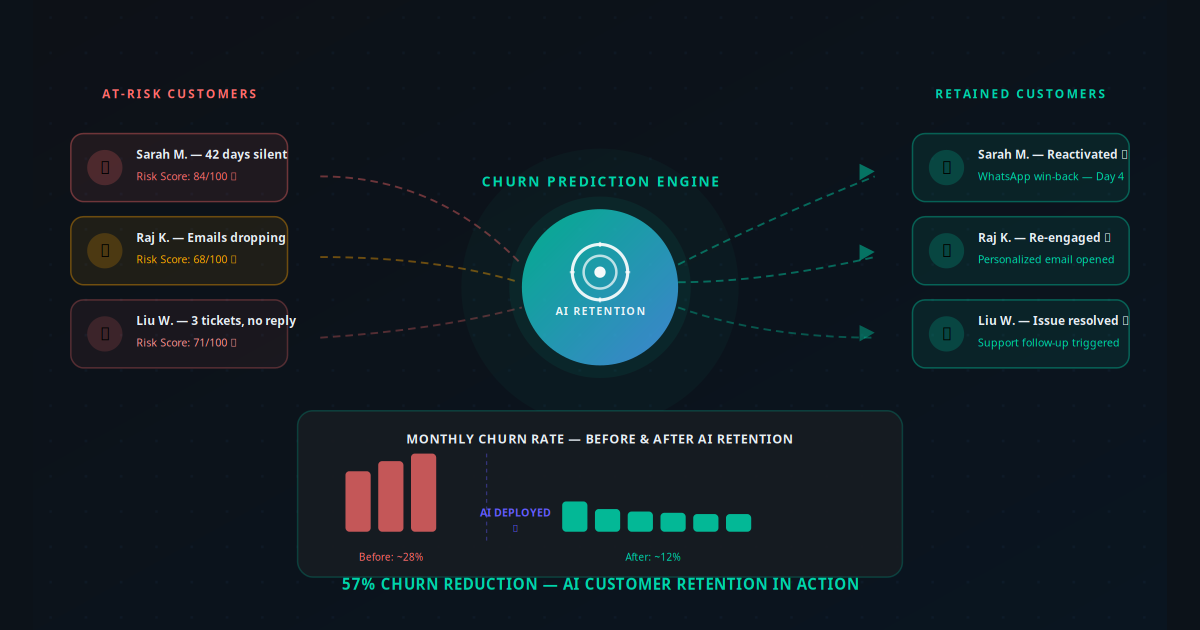
AI customer retention fixes the leak directly. It monitors every customer's behavior in real time, calculates their churn risk continuously, and automatically triggers personalized outreach before the relationship breaks. For businesses that implement this correctly, the result is compounding: lower churn each month means a higher active customer base, higher recurring revenue, and dramatically better return on every acquisition dollar spent.
What AI Customer Retention Actually Means
AI customer retention is not a single tool or a "we miss you" email blast. It is a system with four connected layers:
- Continuous behavioral monitoring: The AI watches every customer's activity signals — purchase frequency, email engagement, login patterns, support interactions, response times — and updates a churn risk score for each customer in real time.
- Churn prediction: When a customer's behavior starts matching the historical pattern of customers who eventually churned, the AI flags them as at-risk before the relationship breaks down. This early warning is the difference between intervention and post-mortem.
- Automated, personalized outreach: When churn risk crosses a defined threshold, the system automatically triggers a retention sequence — personalized based on the customer's history, industry, and the specific signal that triggered the risk flag. Not a mass email. A message that feels like it was written specifically for that customer.
- Win-back campaigns: For customers who have already disengaged — stopped purchasing, stopped responding — a separate automated sequence attempts reactivation with a compelling, relevant offer through their preferred channel.
The fundamental shift from traditional retention is timing and scale. A human team reviews churn data monthly — usually too late to save the relationship. AI monitors it continuously and acts the moment a risk signal appears, for every customer simultaneously, without needing a retention specialist for each account.
Key Takeaway
AI customer retention is not reactive damage control. It is a proactive, continuously running system that identifies at-risk customers weeks before they leave — and automatically intervenes with personalized outreach that actually works.
The Churn Signals AI Catches That Humans Miss
The most dangerous churn signal is the one that looks like nothing at all. Customers rarely say "I'm about to leave." They go quiet. They engage a little less each week. They stop opening emails. They delay responding. By the time a human notices the pattern, the customer has mentally already moved on.
AI catches these signals in real time, across every customer simultaneously:
| Churn Signal | What It Looks Like | Human Detection | AI Detection |
|---|---|---|---|
| Engagement drop | Email open rate falls below 15% for 3+ campaigns | Monthly review — usually too late | Real-time, within 48 hours of third non-open |
| Purchase frequency drop | Customer who buys monthly goes 6+ weeks without purchase | Quarterly review, anecdotally | Detected after first missed purchase window |
| Support ticket surge | 3+ complaints or support requests in 30 days | End-of-month reports | Risk score updated after each ticket — immediate |
| Login / activity gap | No portal or app login for 21+ days | Rarely detected at all | Early warning triggered at day 14 |
| Price sensitivity signals | Requests for discounts, downgrades, or competitor comparisons | Anecdotally, via sales team | Flagged from email and chat content analysis |
| Competitor mentions | References to alternatives in support chats or emails | Rarely caught | NLP analysis of all customer communications |
The power of AI churn prediction is not that it catches any one signal — it is that it combines multiple weak signals into a composite churn risk score. A customer with slightly lower email engagement, one support ticket, and a delayed invoice payment might score 71/100. None of those individually would trigger a human follow-up. Together, they mean this customer is 71% likely to churn within 60 days without intervention.
5 AI Retention Automations Every Business Needs
1. Early Warning System + CRM Task Trigger
When a customer's churn risk score crosses a defined threshold (typically 65–70 out of 100), the system automatically creates a task in your CRM and tags the customer as at-risk. For high-value accounts, this triggers a personal outreach task for your team. For standard accounts, it routes them into the automated re-engagement sequence. The critical element is that this happens the moment the threshold is crossed — not at the next monthly review.
2. Personalized Re-engagement Sequences
When engagement drops below a threshold, the customer enters an automated email sequence personalized based on their purchase history, industry, and the specific behavior that triggered the risk flag. This is not a generic "we miss you" email. It is a message that references what they bought, what they got from it, and what they might be missing — written to feel like it came from a person who actually paid attention to their account.
3. Proactive Support Follow-up
Customers who file support tickets — especially multiple tickets in a short period — have a dramatically higher churn probability. AI-powered customer support workflows can automatically trigger a follow-up WhatsApp message or call 24 hours after ticket resolution, confirming the issue was fully resolved and offering a direct line if anything remains unclear. This single touchpoint significantly increases satisfaction scores among at-risk customers.
4. Win-Back Campaigns via WhatsApp and Email
For customers who have already disengaged — last purchase over 90 days ago, emails consistently unopened — a win-back campaign sequence activates through multiple channels. WhatsApp automation typically outperforms email for win-back because open rates are 4–5x higher. The campaign includes a meaningful reactivation incentive — not just a discount, but a relevant offer based on what the customer actually valued in your product or service.
5. Loyalty Milestone Triggers
Automated recognition of customer milestones — 1-year anniversary, 10th purchase, $10,000 lifetime spend, referral that converted — creates positive emotional anchors that significantly reduce churn among your highest-value customers. A personalized message at the right moment costs virtually nothing to send but creates the kind of "they actually noticed me" experience that keeps customers for years. These moments are invisible to manual processes; AI tracks them automatically and triggers outreach the day they occur.
Industry-Specific Use Cases
Healthcare & Clinics: Patient Retention on Autopilot
AI monitors appointment frequency for every patient. A patient who normally visits every 3 months but has not booked in 4 months is automatically flagged. The clinic's system sends a personalized WhatsApp reminder with a direct booking link and a brief note about why their next visit is due. No-show rates and patient attrition both drop — often by 30–40% — within the first quarter of implementation. See how one clinic reduced no-shows by 62% using AI-driven patient re-engagement.
E-commerce: Purchase Cadence Monitoring and Win-Back
AI tracks purchase cadence, product category preferences, and average order value for every customer. When a customer who normally buys monthly goes 6 weeks without a purchase, they enter a win-back sequence with a personalized offer based on their specific purchase history — not a random sitewide sale. This is fundamentally different from standard abandoned cart recovery: it targets customers who completed previous purchases but have since gone silent.
SaaS & Subscriptions: Usage Drop Detection
For subscription businesses, AI monitors feature adoption rates, login frequency, and active user counts within each account. When usage drops below baseline for 14 consecutive days, a proactive check-in sequence activates — offering a feature walkthrough, a dedicated account review session, or a personalized success tip based on the customer's actual usage pattern. Catching disengagement at day 14 is far more effective than discovering it at cancellation.
Professional Services & Agencies: Client Engagement Scoring
Client engagement scores are calculated from email open rates, meeting attendance, response times, and project interaction frequency. Clients whose engagement score drops below a threshold automatically trigger a proactive outreach from their account manager — framed as a check-in, not a "we noticed you're pulling away." The difference between a client who churns and a client who stays is often a single well-timed conversation. AI makes sure that conversation happens before it is too late.
Hospitality & Food & Beverage: Visit Frequency Reactivation
Hotels and restaurants track visit frequency per guest. A guest who visited monthly but has not returned in 8 weeks receives a personalized offer via their preferred channel — WhatsApp for guests who engaged there, email for those who historically respond to email. The offer references their actual preferences (the suite they usually book, the dish they always order), making it feel personal rather than promotional. For a full playbook on hospitality AI, see the hotel chatbot and guest retention guide.
A Sample AI Retention Workflow: Digital Agency Client
Signal detected: Client's email open rate drops below 12% for 3 consecutive campaigns. Login to the client portal falls from weekly to once in 28 days. AI churn risk score: 74/100.
Threshold crossed (70+): CRM automatically creates a "Client At Risk" task for the account manager. Client enters Re-engagement Sequence A. Task is flagged as high priority if client LTV exceeds $5,000.
Day 1 — Personalized email: Subject line references the client's specific project milestone. Body highlights recent results achieved and previews the next phase of work. No generic content.
Day 4 — If email unopened: WhatsApp message sent with a brief value-focused message and a direct question ("Are you happy with the progress on [Project X]?"). WhatsApp open rate: 94%.
Day 9 — If still unresponsive: High-value clients trigger a personal phone call task for the account manager. Standard-tier clients receive a final email with a specific offer — a free strategy session or account review — with a hard expiry date to create urgency.
Day 15 — Win-back escalation: If no response across all channels, client enters Win-Back Campaign B — a 30-day sequence with an exclusive reactivation package. Internal alert sent to leadership for personal outreach on high-value accounts.
Reactivation confirmed: Client replies or re-engages. Campaign exits automatically. Churn risk score resets. Milestone tracker updated. Account manager notified to continue the conversation personally.
Total human time per at-risk client in this workflow: approximately 10 minutes for high-value accounts, near-zero for standard accounts. Without the system, catching and acting on churn signals manually would require a dedicated team member reviewing data and sending personalized outreach every day — at a cost of $3,000–$5,000 per month in staff time.
Tools to Build Your AI Retention System
| Tool Type | Examples | What It Does | Best For |
|---|---|---|---|
| CRM with AI scoring | HubSpot AI, Pipedrive AI, Salesforce Einstein | Built-in churn scoring from engagement and pipeline data | Service businesses, B2B agencies |
| Email automation | Klaviyo, ActiveCampaign, Drip | Behavioral triggers, personalized sequences, win-back flows | E-commerce, subscription businesses |
| WhatsApp automation | Jogi AI WhatsApp system, WATI, Interakt | High-open-rate re-engagement and win-back via WhatsApp | Service businesses, hospitality, clinics |
| Predictive analytics | ChurnZero, Gainsight, Mixpanel | Deep churn scoring with product usage signals | SaaS, subscription, app-based businesses |
| Custom AI pipeline | Make + OpenAI + your CRM | Fully custom churn scoring and personalized outreach logic | Complex, multi-channel businesses |
For most SMBs, the fastest path to a working AI retention system is combining your existing CRM automation with a behavioral email platform and a WhatsApp automation layer. This two-channel approach covers the customers who respond to email and the customers who only respond to WhatsApp — which, for most service businesses, is a significant percentage.
For businesses that need more sophisticated churn prediction — with custom scoring models built on your specific customer data — a multi-agent AI system can be built to monitor signals across all channels simultaneously and orchestrate retention campaigns with near-zero latency.
The ROI: What Businesses Are Actually Seeing
"We were losing 22% of clients annually without understanding why. After implementing AI churn prediction and automated re-engagement, that dropped to 11% within 6 months. That is 55 clients we kept that we would have lost — at an average LTV of $4,200 each."
— Founder, digital marketing agency, 240 active clientsAcross businesses deploying AI retention systems in 2026, the consistent results are:
- Churn rate reduction: 35–57% within first 6 months when all five automation layers are active
- Win-back rate on properly sequenced campaigns: 15–28% (vs. 3–6% for generic win-back emails)
- Revenue recovered per $1 spent on retention automation: $4–$12, depending on customer LTV
- Average time to first measurable result: 3–4 weeks (first win-back conversions visible within 2 weeks)
- Payback period: Most businesses see full ROI on implementation cost within 6–10 weeks
- Customer lifetime value increase: 18–34% improvement over 12 months due to reduced churn and increased repeat purchase frequency
A 5% improvement in customer retention rate increases profit by 25–95%, according to research by Bain & Company. For most SMBs, retention is the highest-ROI lever available — and AI makes it operationally achievable without a large customer success team.
3 Mistakes That Kill Your Retention Strategy
Mistake 1: Intervening Too Late
Most businesses define "at-risk" as 90+ days of inactivity. By that point, the customer has almost certainly already made a mental decision to leave. The relationship is recoverable in theory, but the emotional commitment to the alternative is already forming. Set your intervention threshold at 30–45 days of reduced engagement — before the customer has consciously started evaluating alternatives. Early intervention has 3–4x higher success rates than late-stage win-back.
Mistake 2: Generic Mass Outreach
Sending a "We miss you — here's 10% off" email to 2,000 disengaged customers is the equivalent of no outreach at all. Customers can feel the difference between a message that was written for them and one that was written for everyone. AI personalization — referencing the customer's actual purchase history, specific results they achieved, and the exact reason they chose you in the first place — drives the 4–8x higher conversion rates that distinguish effective retention from checkbox marketing.
Mistake 3: Single-Channel Dependency
Some customers respond to email. Others only respond to WhatsApp. A segment of your highest-value customers still want a phone call. A retention system that relies on one channel will consistently miss the customers who use others — often the most valuable customers who are simply not email people. Build at minimum a two-channel approach (email + WhatsApp) and let behavioral data tell you which channel works for each customer. For businesses where voice matters, add a voice AI layer for high-value accounts. The voice AI agent guide shows how this works for outbound retention calls specifically.
Conclusion: Stop Filling the Bucket. Fix the Leak.
Customer retention is the highest-ROI activity in most businesses. Acquiring a new customer costs 5–7x more than keeping an existing one, yet most SMB marketing budgets are 90% acquisition-focused. Every month that the churn rate stays at 20–25%, the business is running in place — new customers offset by silent exits, revenue flat despite genuine effort.
AI customer retention changes this equation by making proactive, personalized retention achievable at any scale. You do not need a large customer success team. You need the right behavioral signals monitored in real time, the right risk thresholds that trigger action, and the right automated sequences that feel personal — and AI handles all three simultaneously, for every customer in your database, around the clock.
The businesses winning on retention in 2026 are not working harder on it. They have built a system that works continuously in the background, quietly keeping customers who would otherwise have left. The compounding effect of this — month after month of incrementally lower churn — produces revenue growth that eventually dwarfs acquisition efforts.
To see what an AI retention system would look like for your specific business — including which churn signals to monitor, what sequences to build, and what the estimated revenue impact would be — use the AI Business Twin for a free, personalized analysis in under 10 minutes.
Frequently Asked Questions
How does AI predict customer churn?
AI predicts churn by analyzing behavioral patterns in your customer data — purchase frequency, email engagement rates, support ticket history, login patterns, and response times — and comparing them against patterns from customers who previously churned. When a current customer's behavior starts matching historical churn patterns, the AI flags them as at-risk with a numerical churn probability score. The earlier this signal fires, the more time you have to intervene before the customer mentally decides to leave.
What data does AI need to predict customer churn?
The most valuable inputs are: purchase history (dates, amounts, categories), email engagement metrics (opens, clicks, unsubscribes), customer support interactions (frequency, resolution time, sentiment), product usage data if applicable (logins, feature adoption), and direct feedback signals (NPS scores, survey responses). You do not need all of these to start — even basic purchase frequency and email engagement data can produce useful churn predictions for most SMBs.
How much does an AI customer retention system cost to build?
A CRM-based AI retention system using tools like HubSpot, Klaviyo, and WhatsApp automation typically costs $200–$600 per month in platform fees, depending on list size. A custom-built pipeline using Make or n8n with AI personalization can be built for $50–$150 per month in infrastructure. Against average customer lifetime values of $500–$5,000, retaining even 5–10 additional customers per month makes this investment highly profitable within the first 4–8 weeks.
How quickly can I see results from an AI retention system?
Most businesses see measurable improvement in churn rate within 60–90 days of deploying an AI retention system. Win-back campaigns often produce results within 2–3 weeks of launch. The compounding revenue effect becomes very visible in months 4–6, when customers you retained through the system appear as repeat purchases that would otherwise have been absent from your revenue.
Can AI retention work for service businesses, not just e-commerce?
Absolutely — service businesses often see the highest ROI from AI retention because client lifetime value is higher and the cost of acquiring a replacement client is greater. Churn signals for service businesses include declining meeting attendance, slower email response times, fewer referrals, and support ticket patterns. Win-back campaigns for service businesses focus on re-demonstrating value through case studies and results achieved, rather than discount-based offers.
What is the difference between churn prediction and a win-back campaign?
Churn prediction is proactive — it identifies at-risk customers before they leave so you can intervene while the relationship is still intact (highest success rate). Win-back campaigns are reactive — they target customers who have already disengaged or churned, attempting reactivation with a compelling offer. Best-practice AI retention uses both together: churn prediction for early-stage intervention and win-back campaigns as a second line of defense. Combined, they recover 20–30% more revenue than either approach alone.