AI Automation for Retail Stores: Your Complete 2026 Playbook




The Retail Automation Opportunity in 2026
Walmart's AI systems process 2.5 petabytes of customer data daily. Amazon's recommendation engine — powered by years of machine learning investment — drives 35% of all revenue on the platform. Zara's AI-powered demand forecasting keeps stockouts below 2% across 2,000 stores globally. For years, these capabilities cost tens of millions of dollars and required dedicated data science teams. Independent retailers watched from the sidelines.
That changed. The AI infrastructure that powers enterprise retail is now available as accessible monthly subscriptions — tools that any store owner can configure over a weekend without writing a single line of code. A fashion boutique in Bangalore, a specialty grocery in Cape Town, or a sporting goods shop in Manchester can now automate their inventory management, customer service, marketing, and loyalty programs for under $300 per month.
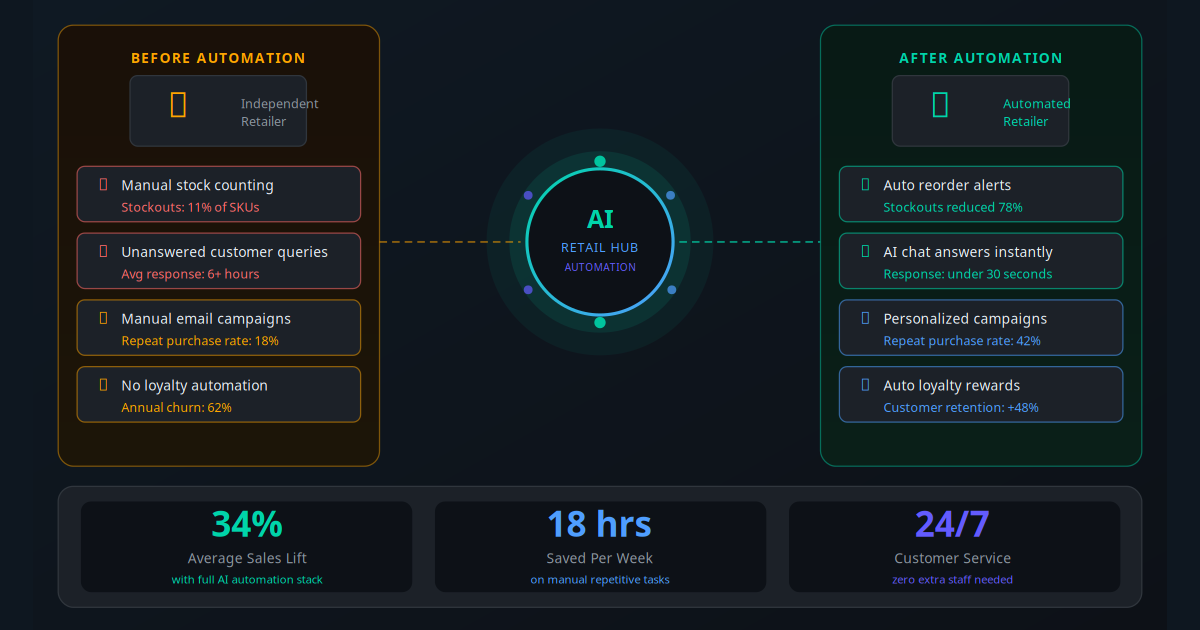
The results are not theoretical. Independent retailers who implement AI automation report an average 34% increase in sales within the first 6 months. They save 18 hours of manual work weekly — equivalent to recovering more than two full working days every week. Customer satisfaction scores improve by 22%. Stockouts drop by 78%. And they achieve all of this without increasing headcount.
The question is no longer whether AI automation is relevant to retail. It is which processes to automate first, what tools to use, and how to measure the ROI. This guide answers all three with specifics — no vague promises, no enterprise case studies that don't translate to a 1–5 location store. Just the workflows, platforms, and numbers that retail store owners are using in 2026.
What AI Actually Automates in a Retail Store
Before examining tools or steps, it helps to understand precisely what "AI automation" means in a retail context. The term gets overused. Here is what it actually looks like in practice.
Inventory management means the system monitors your stock levels in real time, compares them against historical sales velocity and upcoming seasonal patterns, and sends you — or your supplier — a purchase order or alert when a product approaches its reorder level. You stop the manual stock counts. You stop the emergency supplier calls when something sells out unexpectedly. You stop losing sales to preventable stockouts, which currently cost independent retailers an average of 11% of potential annual revenue.
Customer service means a chatbot — on your website, WhatsApp, or Instagram — answers the 20 questions your staff are asked most often: store hours, product availability, return policy, order status, gift wrapping, store directions. It answers instantly, at any hour, without a staff member. Your team gets back 15–20 hours per week to invest in the in-person experience that AI cannot replicate.
Email and SMS marketing means campaigns go out automatically based on customer behaviour. A birthday discount arrives 3 days before a customer's birthday. A win-back email triggers when a customer hasn't visited in 90 days. A back-in-stock notification fires the moment an item a customer browsed is replenished. A thank-you sequence begins after their first purchase. All triggered by data. All sent at the optimal moment. None of it requiring you to draft messages weekly.
Loyalty programs run on rules rather than manual point-counting. A customer reaches 500 points at checkout — their reward is sent automatically. A VIP-tier customer makes their fifth purchase in a month — they receive a tier-upgrade email that evening with new benefits. Everything tracked in your CRM, everything triggered without a staff member manually checking spreadsheets.
Review collection works on a schedule. Three days after a purchase, an automated SMS goes out asking for a Google review. A five-star reviewer gets a follow-up asking if they'd share on social media. A three-star reviewer's message routes to your inbox for personal follow-up. Review volume increases 3–5 times over with zero manual effort.
Key Takeaway
The highest-ROI retail automations are also the simplest to build: automated reorder alerts, an AI chat layer for customer queries, and triggered email sequences based on purchase behaviour. Most retailers see measurable results within 30 days of deploying these three together.
Explore all industry-specific AI automation solutions we offer at Jogi AI.
The Numbers: What AI-Powered Retail Looks Like
The average independent retailer wastes 23 hours per week on tasks that AI handles in seconds. That is equivalent to paying half a full-time employee to do data entry — and getting no customer value from it.
Here is how the time savings and revenue impacts break down by automation type, based on data from retailers who have deployed these systems in 2025–2026:
| Automation | Weekly Time Saved | Revenue Impact | Setup Time |
|---|---|---|---|
| Smart inventory alerts | 8–12 hours | −78% stockouts | 1–2 days |
| AI customer chat | 15–20 hours | +22% satisfaction score | 2–3 days |
| Email & SMS sequences | 5–8 hours | +42% repeat purchases | 1 day |
| Loyalty automation | 3–5 hours | +34% customer lifetime value | 3–5 days |
| Abandoned cart/browse recovery | 2–3 hours | +15% online revenue | 1 day |
| Automated review requests | 1–2 hours | +180% review volume | 1 day |
The cumulative effect of stacking these automations is what generates the 34% sales lift figure. Each individual automation produces modest but measurable gains. Together, they compound: more reviews bring in more new customers, better inventory means fewer lost sales, triggered emails increase repeat purchases, and loyalty automation improves customer lifetime value. The math is straightforward once the systems are connected.
6 Retail Automation Wins to Deploy in 30 Days
1. Smart Inventory Management and Reorder Alerts
AI inventory automation starts with connecting your POS system — Shopify, Square, Lightspeed, WooCommerce, or similar — to an automation layer. Once connected, you set minimum stock thresholds per product or category. When any item drops below its threshold, the system fires: an alert to your supplier via email or WhatsApp, a low-stock flag in your dashboard, and — if you configure it — an automatic draft purchase order for your approval.
More sophisticated setups add demand forecasting. The AI analyses your 12-month sales history, identifies seasonal patterns and promotional uplift, and recommends reorder quantities that account for supplier lead times. A sporting goods store typically sees a 40% spike in hiking boot demand from March to May. The AI models this pattern automatically and adjusts reorder points weeks before the spike arrives — rather than after you run out.
The results are consistent: stockouts drop from an industry average of 11% of SKUs to under 2.5%. Overstock — the equally costly mistake of tying up cash in slow-moving inventory — also reduces because the system learns which products move slowly and adjusts reorder quantities down accordingly. Practical starting point: Cin7, Shopify's built-in inventory notifications, or a Make.com workflow connecting your POS to your supplier's email system.
2. AI Customer Chat on WhatsApp and Your Website
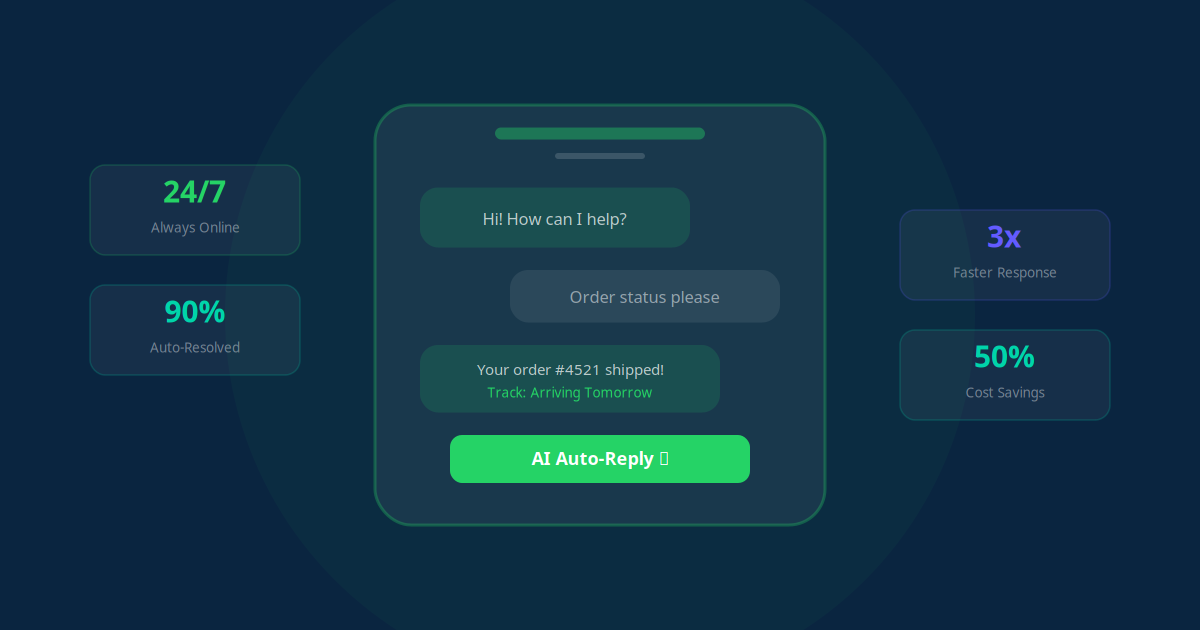
The most time-consuming part of retail customer service is answering the same 20 questions repeatedly. "Are you open on Sundays?" "Do you have this in size 10?" "What's your return policy?" "Can I get gift wrapping?" "How long does delivery take?" An AI chatbot connected to your product catalog and FAQ document handles all of these — on your website, on WhatsApp, and on Instagram Direct — in under 30 seconds, 24 hours a day.
For retailers with a WhatsApp Business account, WhatsApp automation extends this further: order status updates sent automatically, promotional broadcasts to segmented customer lists, and appointment reminders for in-store experiences. WhatsApp open rates for retail messages average 98% — compared to 22% for email — making it the highest-reach channel available to most independent retailers.
When a question falls outside the chatbot's training — a genuinely complex complaint, a bespoke order request, a sensitive return situation — the system flags the conversation for human follow-up within minutes. The key design principle: every AI chat deployment needs a clear escalation path, not an infinite chatbot loop. Build the handoff before launch. Pair this with the broader principles in our guide to AI customer support workflows to get the escalation architecture right.
3. Automated Email and SMS Marketing
Most retail owners either send batch promotions — same message, everyone, whenever they remember — or nothing at all. Both approaches leave substantial revenue uncollected.
AI-driven email automation sends the right message to the right customer at the right moment. A win-back sequence fires when a customer who bought 90 days ago hasn't returned: an email with a personalised discount on the category they last purchased from. Studies consistently show win-back campaigns recover 14–26% of lapsed customers when triggered at the correct interval. A birthday automation sends a discount code 72 hours before the customer's birthday — birthday emails generate 179% higher transaction revenue than standard promotional emails. A post-purchase sequence thanks the customer 24 hours after purchase, sends care instructions on day 7, and offers a complementary product suggestion on day 14.
None of this requires you to write emails weekly. You write the sequences once, configure the triggers, and the system runs them indefinitely. For templates and the specific trigger configurations that perform best in retail, read our guide to automated email sequences for every business.
4. Loyalty Program Automation
Manual loyalty programs — paper punch cards, spreadsheets, staff manually adding points — are among the highest-friction operations in retail. Customers lose cards. Staff forget to add points. Rewards are never redeemed because nobody reminds the customer they qualified.
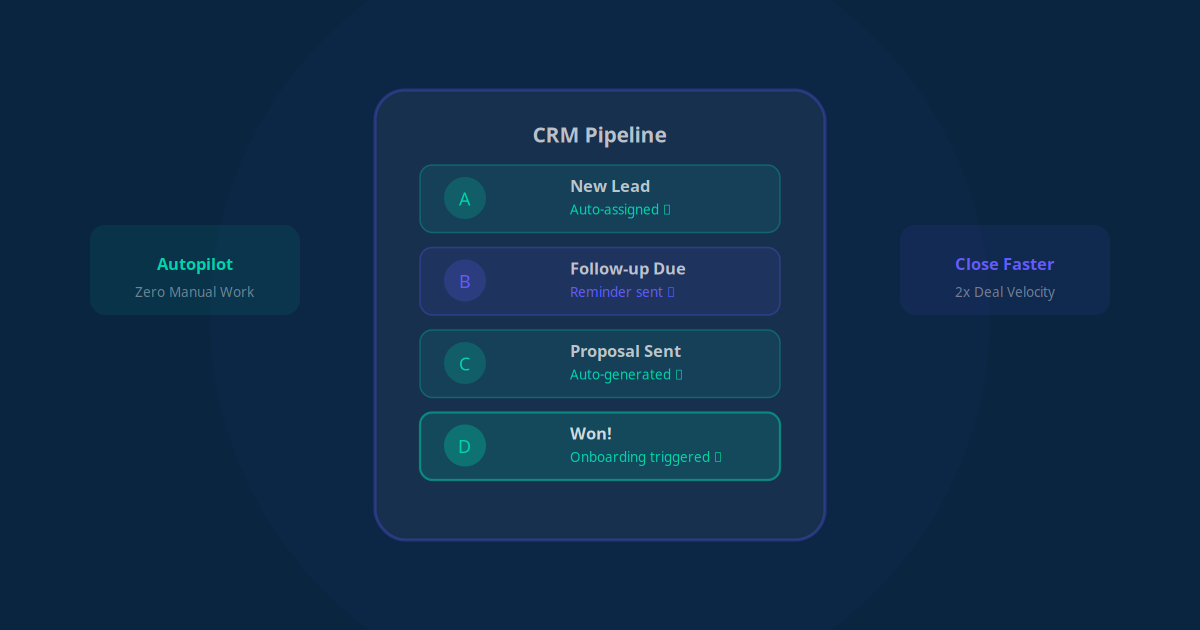
CRM automation connects your loyalty program directly to your POS, so points are assigned automatically at checkout, stored against the customer's profile, and trigger reward notifications the moment a threshold is crossed. A customer who reaches Gold tier spend automatically receives a tier-upgrade email that evening — not when a staff member gets around to checking. Connected to your email and WhatsApp tools, loyalty automation can also send points-balance reminders ("You are 120 points away from a free product"), expiry alerts ("Your 500 points expire in 7 days"), and exclusive early-access offers for your top-tier customers. The result is 5–8 times more redemptions than manual loyalty systems produce — and redemptions are the metric that correlates most strongly with repeat purchase behaviour.
5. Abandoned Cart and Browse Recovery
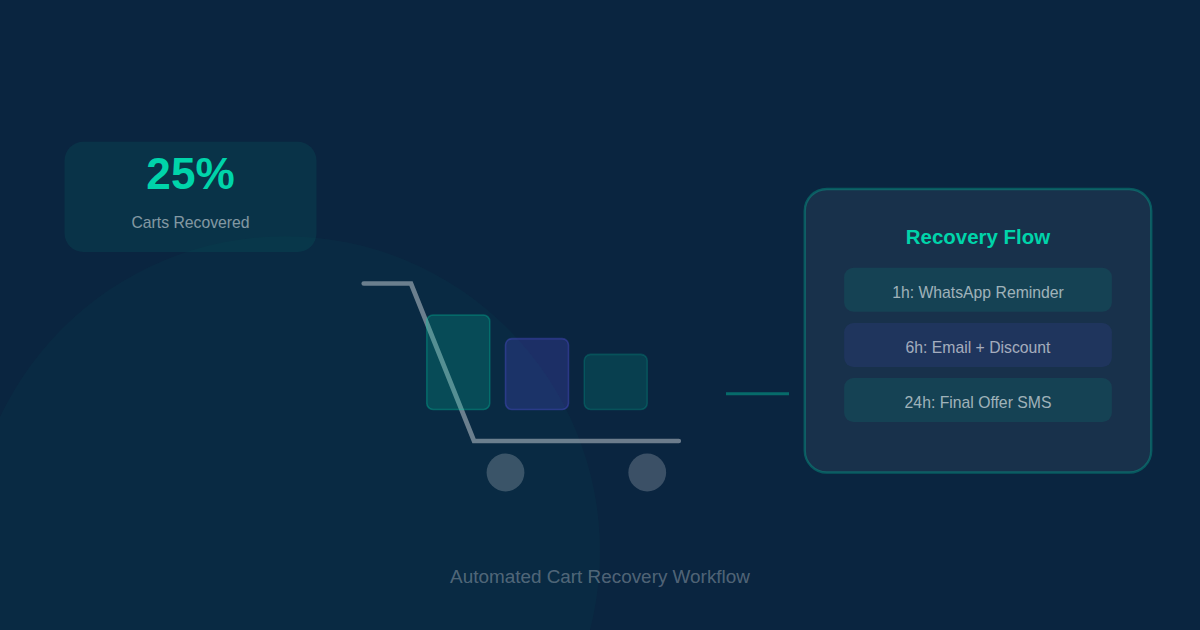
For retailers with an online store, the average cart abandonment rate is 70–80%. Of every 10 customers who add something to their cart, 7 or 8 leave without buying. An abandoned cart sequence recovers 10–20% of those — which often generates more incremental revenue than any other single marketing activity.
A basic sequence: 30 minutes after abandonment, an email shows exactly what the customer left behind. 24 hours later, a follow-up. 72 hours later, a small discount or free shipping offer. For high-value carts, a WhatsApp message. For physical stores, a "browse abandonment" equivalent uses loyalty app check-ins or email capture at the store entrance — if a customer visited but didn't purchase, an automated email 3 days later includes a personalised offer based on what departments they browsed.
The detailed sequence templates, WhatsApp integration setup, and timing optimisation are all covered in our full guide to abandoned cart and browse recovery.
6. Automated Review Collection and Response Routing
Reviews are retail oxygen. 93% of consumers say online reviews influence their purchase decisions. The problem is that collecting them manually is inconsistent — staff sometimes ask, sometimes forget, and customers rarely volunteer without prompting.
An automated post-purchase review request solves this permanently. Three days after a purchase (long enough for the product to be used, short enough for the purchase to still be fresh), an SMS or email goes out with a direct link to your Google Business Profile or Trustpilot page. One tap to leave a review. The volume impact is typically 3–5 times more reviews within 30 days of enabling this automation.
Add routing logic: five-star reviewers receive a follow-up asking if they'd share on social media. Three-star and below reviewers get a personal message from the store owner asking what went wrong. This transforms your review process from passive hope into an active reputation management system — and the negative-feedback routing often surfaces operational issues before they escalate into public complaints.
Industry Use Cases: Real Stores, Real Results
Fashion Boutique — 3 Locations
A multi-brand fashion boutique faced inconsistent stock across locations, 60–80 daily Instagram DM queries, and a repeat purchase rate stuck at 21%. After deploying AI automation: inventory sync across all three locations with automatic transfer alerts when one location runs low on a fast-moving SKU, an Instagram DM bot that sends new-arrival lookbooks to interested followers, and a 3-email post-purchase sequence with personalised styling suggestions based on what the customer bought. Result: repeat purchase rate increased from 21% to 39% within 90 days, Instagram DM response time dropped from 6 hours to under 2 minutes, and cross-location stock gaps fell by 65%.
Specialty Grocery / Health Food Store — 1 Location
A health food grocery with 1,200 SKUs was losing 14% of annual revenue to stockouts on its top 80 products. The owner spent 6 hours weekly managing supplier email chains and manually checking stock levels. After connecting their Lightspeed POS to an automated reorder system with WhatsApp alerts to the buying team for fast-moving items and a weekly loyalty email for seasonal specials: stockouts on top SKUs dropped from 14% to 1.8% within 8 weeks, supplier management time fell from 6 hours to 45 minutes weekly, and the loyalty email generated an average $1,200 in incremental weekly revenue.
Electronics and Gadget Retailer — 2 Locations
An electronics retailer received 60–80 customer queries per day about product compatibility, warranty claims, and stock availability. Staff spent 3+ hours daily answering these — time that could not be spent on in-store demonstrations. After deploying an AI chatbot connected to the product database and warranty management system: 82% of queries resolved without human intervention, response time from 4 hours to under 1 minute, and staff time redirected to in-store demo activity. Customer satisfaction score improved from 3.6 to 4.4 out of 5 within 60 days.
Sporting Goods and Outdoor Store — Seasonal Demand
A sporting goods retailer with strong seasonal demand peaks — summer hiking, winter skiing — was consistently understocked at peak season and overstocked in off-season. Both problems cost margin: lost sales in peak and discounting to clear stock in off-season. After implementing AI demand forecasting with seasonal pattern analysis: purchase order recommendations adjusted for seasonal uplift 8 weeks in advance, resulting in 34% fewer stockouts during peak periods and a 22% reduction in end-of-season markdown inventory that had previously been eroding gross margin by 4.5 percentage points.
Pet Supply Store — Subscription-Style Loyalty
A pet supply store built an AI-driven loyalty program that enrolled customers at their pet's first purchase, tracked each pet's product history, and automated reorder reminders for recurring items (food, flea treatment, grooming supplies) at each customer's approximate purchase interval. Combined with AI-powered customer support for dietary and product questions, average customer lifetime value increased 38% over 12 months — without a single loyalty programme staff member.
Your 7-Step Retail Automation Roadmap
The most common failure mode in retail automation is buying tools before understanding the problem. Here is the sequence that produces reliable results:
Map Your Manual Time Drain: Before purchasing any tools, spend 30 minutes listing every task your team does that is repetitive and rule-based — stock counting, reorder emails, replying to the same customer questions, manually sending promotional messages, manually adding loyalty points. Estimate hours per week per task. This list is your automation roadmap. The highest hours = the highest-priority first automation.
Connect Your POS as the Data Foundation: Most retail automation depends on your POS system as the primary data source. Confirm your POS has an API or integration capability. Shopify, Square, Lightspeed, and WooCommerce all have extensive integration ecosystems. If your POS is older and lacks API access, consider migrating first — without connected real-time data, automation is severely limited and often inaccurate.
Set Up Your Customer CRM: A retail CRM connects customer purchase history to your marketing and loyalty tools. If you don't have one, start with Klaviyo (which doubles as email marketing) or HubSpot's free CRM tier. Import your existing customer data from your POS. Segment immediately: by purchase frequency, last purchase date, average order value, and product category. These segments power every downstream automation.
Deploy Your AI Chatbot: Install Tidio, Freshdesk Messaging, or a similar tool on your website and connect it to WhatsApp Business. Train it with your top 30 FAQs, product catalog highlights, and return or exchange policy. Configure escalation rules for questions it cannot answer — these should route to your WhatsApp or a staff email for human follow-up. Test extensively before going live: try unusual questions, complaints, and edge cases.
Launch Your First Email Sequence: Build your post-purchase sequence (thank you at 24 hours, care tips at day 7, complementary product suggestion at day 14) using Klaviyo or Mailchimp. Connect the trigger to your POS so it fires automatically after every purchase. This single sequence, once built correctly, runs indefinitely and generates passive repeat purchases without any ongoing effort.
Activate Inventory Alerts: Configure minimum stock thresholds for your top 100 SKUs. Set up automated supplier notifications or internal alerts when thresholds are breached. Most modern POS systems have this as a built-in feature — if yours does, turn it on today. If not, a Make.com or Zapier workflow can bridge the gap between your POS and your supplier communication.
Measure at Day 30, Then Expand: After 30 days, measure four numbers: repeat purchase rate, customer query response time, stockout rate, and weekly staff hours on repetitive tasks. All four should be moving in the right direction. If they are, add loyalty automation at day 45 and abandoned cart recovery at day 60. Build systematically — each automation compounds the ones before it.
AI Tools and Platforms for Retail
The retail automation tool ecosystem in 2026 is mature and well-supported. These are the platforms most commonly used by independent retailers with 1–10 locations:
| Tool | Primary Use | Pricing | Best For |
|---|---|---|---|
| Tidio | AI chatbot + live chat | From $29/month | Small–mid retailers, any sector |
| Klaviyo | Email & SMS automation | From $20/month | Any product-based retailer |
| Cin7 | Inventory management | From $349/month | Multi-SKU, multi-location stores |
| Yotpo | Reviews + loyalty | From $79/month | Brand-focused retailers |
| Make.com | Custom workflow automation | From $9/month | Tech-comfortable store owners |
| Gorgias | E-commerce support | From $10/month | Online + physical store hybrids |
The challenge with building a retail automation stack from individual tools is integration complexity — each tool needs to talk to the others, and the connections require maintenance. For retailers who want these connected into a single automated system without managing 6 separate platform integrations, the AI Business Twin audit identifies exactly which tools fit your store's existing POS and which automation layer requires the least integration overhead.
If you want to understand how the underlying automation workflow layer works before committing to specific tools, our comparison of Make vs Zapier vs n8n covers the key trade-offs for retail use cases in detail.
The ROI Case: What Retailers Are Seeing
"We were spending 22 hours a week on stock management, WhatsApp replies, and manually sending promotions. After 60 days of automation, that is down to 4 hours. Our repeat purchase rate went from 19% to 41%."
— Owner, specialty apparel store, 2 locationsAcross retail automation deployments in 2025–2026, the consistent performance data shows:
- Inventory: Retailers report 78% reduction in stockouts and 22% reduction in overstock within 90 days of deploying smart reorder alerts
- Customer chat: AI chatbots handle 75–85% of customer queries without human intervention, freeing 15–20 hours of staff time weekly on average
- Email automation: Triggered sequences generate 34% higher revenue per email subscriber compared to batch-and-blast promotional sends
- Loyalty: Automated loyalty programs produce 5–8 times more redemptions than manual point systems and increase CLV by 28–40%
- Reviews: Automated post-purchase review requests produce 3–5 times the review volume within 30 days of activation
- Payback period: Retailers with monthly revenue above $15,000 typically recover the cost of a $150–$300/month automation stack within 3–6 weeks
The revenue impact compounds over time. A retailer who implements all six automations in month 1 has a higher customer retention rate, a lower stockout rate, and more reviews than their competitors by month 3. By month 6, those advantages produce the 34% revenue lift that appears repeatedly in the data. For a broader view of how AI builds long-term revenue pipelines beyond the retail floor, read our guide to AI lead generation and sales funnel automation.
5 Mistakes Retailers Make When Automating
1. Automating Before Cleaning the Data
If your product catalog has duplicate entries, incorrect prices, or missing categories, your AI chatbot will give wrong answers and your inventory system will produce inaccurate alerts. If your customer database has duplicate profiles, your loyalty automation will send the wrong rewards or fail to send any at all. Before connecting any automation tool, spend one day auditing your product data and one day auditing your customer database. Correct all prices, remove duplicates, standardise categories, and merge duplicate customer records. This single step determines whether your automation works reliably or repeatedly embarrasses you in front of customers.
2. Deploying Chat Without an Escalation Path
A chatbot with no human handoff is a customer frustration machine. When a customer has a genuinely complex issue — a defective product, a lost shipment, a special order request — and receives a canned chatbot response, their frustration escalates quickly. Every AI chat deployment must have a clear escalation mechanism: "Would you like me to connect you with a team member?" followed by an immediate WhatsApp notification to staff or a flagged ticket in your support inbox. Test this escalation path yourself — as a customer — before going live with the chatbot. If the handoff is broken, fix it before you launch.
3. Sending the Same Message to Every Customer
Retail automation works because it is personalised. If you use automation tools to send the same broadcast to your entire customer list, you have simply upgraded from manual batch-and-blast to automated batch-and-blast — and you will see email open rates drop as customers recognise generic messages. Segment from day one. A first-time buyer gets different messaging than a VIP who has purchased 15 times. A customer who buys childrenswear gets different product suggestions than a customer who buys menswear. The segmentation is what generates the ROI difference between "automation that works" and "automation that feels like spam."
4. Ignoring Your Existing POS Data
Most independent retailers have 12–24 months of valuable purchase history sitting in their POS system, unused. This data is the foundation of good automation — it shows which customers are at churn risk (last purchase 90+ days ago, declining frequency), which products have seasonal patterns, which customer segments spend most per visit, and which product combinations are frequently bought together. Before buying any automation tool, export your POS data for the last 12 months and spend 2 hours analysing what it tells you. The patterns often surprise store owners and reshape which automations they should prioritise — not always the ones they assumed.
5. Measuring the Wrong Metrics After Launch
The right metrics for retail automation are: repeat purchase rate (should increase within 60 days), average order value (should rise as product recommendations are adopted), customer query response time (should drop below 5 minutes for 80%+ of queries), and stockout rate (should fall from the typical 8–15% to under 3%). The wrong metric is email open rate — it tells you almost nothing about revenue impact and fluctuates based on preview text and send time rather than automation quality. Set up a simple monthly dashboard tracking these four numbers before you launch, so you have a genuine before-and-after comparison that demonstrates ROI clearly.
The Independent Retailer Who Automates Wins the Decade
The gap between what enterprise retailers can do with technology and what independent retailers can afford has effectively closed. The AI that powers Zara's demand forecasting is not the same software — but it is the same capability, available now, accessible to any store without a data science team or a seven-figure technology budget. Independent retailers who act on this in 2026 will have a compounding advantage by 2027: better margins, higher customer lifetime value, fewer stockouts, more reviews, and more hours freed for the in-store experience that no algorithm can replace.
The retailers who wait will find the gap reverting — but in the opposite direction. Competitors who have automated their inventory, customer service, and loyalty programs will respond to customers faster, run out of stock less often, and retain customers at significantly higher rates. That is a structural disadvantage that compounds quarterly.
The six automations covered in this guide — inventory alerts, AI chat, email sequences, loyalty automation, abandoned cart recovery, and review collection — are all deployable in under 30 days with tools available today. The ROI is measurable within 6 weeks. The only open question is where to start.
Use the AI Business Twin to get a free, personalised analysis of which retail automations fit your specific store type, existing POS system, and current team size — including a prioritised roadmap and estimated revenue impact — in under 10 minutes.
Frequently Asked Questions
What retail processes can AI actually automate?
AI can automate inventory monitoring and reorder alerts, customer service via chatbot for store hours, product availability, return policies and order status, email and SMS campaigns triggered by customer behaviour, loyalty program point tracking and reward delivery, post-purchase review requests, abandoned cart recovery sequences, and personalised product recommendation emails. The most common starting point for independent retailers is the AI chatbot and automated email sequences, as these deliver visible ROI within 30 days.
How much does AI automation cost for a retail store?
A basic retail automation stack typically costs $100 to $350 per month: an AI chatbot tool like Tidio at $29 to $49 per month, email automation via Klaviyo at $20 to $60 per month depending on list size, and an automation connector like Make.com at $9 to $29 per month. For inventory management, tools like Cin7 start at $349 per month but are typically worth it only for stores with 500 or more SKUs or multiple locations. Most retailers see full payback within 30 to 45 days.
Can a small independent retailer with one location afford AI automation?
Yes. The entry point for meaningful retail automation is under $100 per month. A single-location retailer can deploy an AI chatbot, automated post-purchase email sequences on a free tier for smaller contact lists, and inventory alerts using their existing POS system's built-in notification features, which are often free. The ROI from preventing just two or three stockouts per month typically covers the full monthly cost of automation tools.
Does AI automation replace retail staff?
No. AI automation eliminates repetitive, rule-based tasks such as answering FAQs, sending emails, and tracking inventory, so your staff can focus on work that requires human judgment and creativity. In-store experience, product knowledge consultations, handling complex complaints, visual merchandising, and community building are all human strengths that AI cannot replicate. Retailers who automate typically redirect staff time rather than reduce headcount — the productivity gain goes into higher-value customer interactions.
How does AI inventory management work for a retail store?
AI inventory management connects to your POS system to read real-time stock levels. You set minimum stock thresholds per product or category. When a product falls below its threshold, the system triggers an alert to your inbox, WhatsApp, or directly to your supplier via automated email. More advanced setups add demand forecasting that analyses your sales history, identifies seasonal patterns, and adjusts reorder quantities automatically to prevent both stockouts and overstock accumulation.
What ROI should I realistically expect from retail AI automation?
Based on data from retailers implementing AI automation: inventory automation reduces stockouts by 60 to 80 percent within 90 days; AI chatbots handle 75 to 85 percent of customer queries without human intervention, saving 15 to 20 hours of staff time weekly; triggered email sequences generate 34 percent more revenue per subscriber than batch campaigns; automated review requests produce three to five times more reviews within 30 days. The payback period for a $150 to $300 per month automation stack is typically three to six weeks for retailers with monthly revenue above $15,000.
Where should a retail store owner start with AI automation?
Start with the automation that saves the most staff time first. For most retailers, that is either the AI customer service chatbot, which saves 15 to 20 hours weekly, or automated email sequences, which save 5 to 8 hours weekly. Both can be deployed in under a week and show measurable results within 30 days. Connect your POS data first, then add a chatbot, then build your email sequences. Add inventory automation and loyalty automation in months two and three once you have the data foundation in place.