The ROI of Automating Your Restaurant: Labor Savings vs Software Cost




Talk to any restaurant owner, and the conversation inevitably turns to margins. Labor costs are climbing, food costs are unpredictable, and third-party delivery services are taking up to 30% of order totals. Running a restaurant has always been a game of inches, but in 2026, the squeeze is tighter than ever.
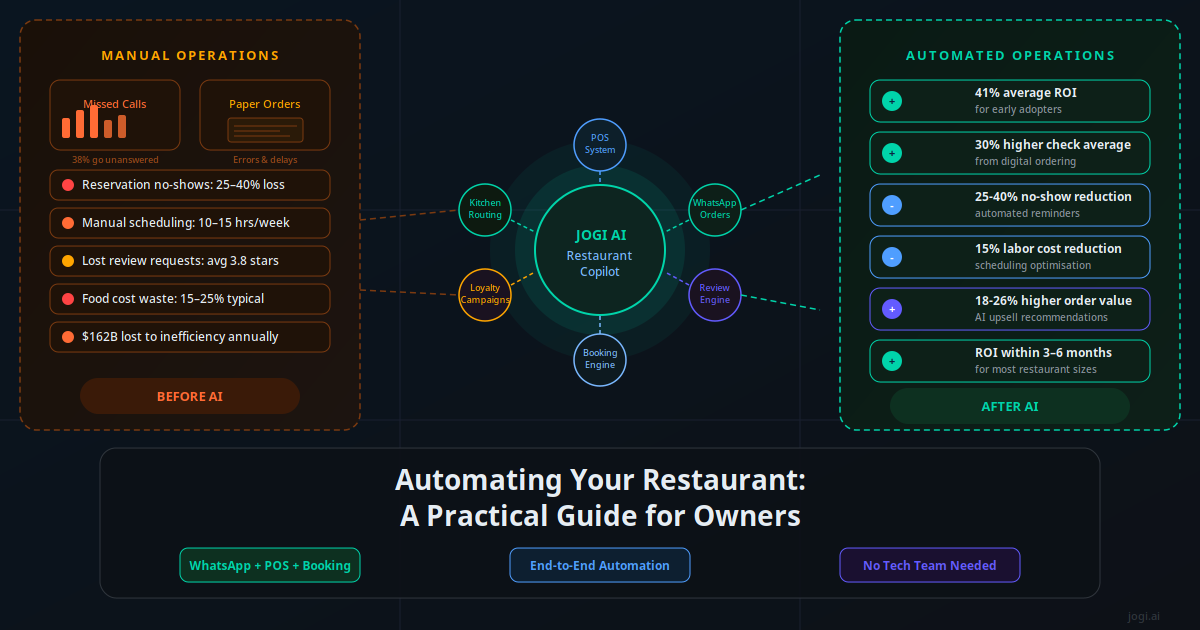
When the topic of AI or automation arises, many owners assume it is a luxury reserved for multi-national fast-food chains or tech-obsessed corporate groups. They think of expensive kiosks or robots flipping burgers. But the real revolution in restaurant tech is invisible: it is the automation of the administrative back-office, guest reservations, and order handling. This guide breaks down the hard math of what manual operations cost you, what an autonomous stack costs, and how to measure the real return on investment (ROI).
Key Takeaway
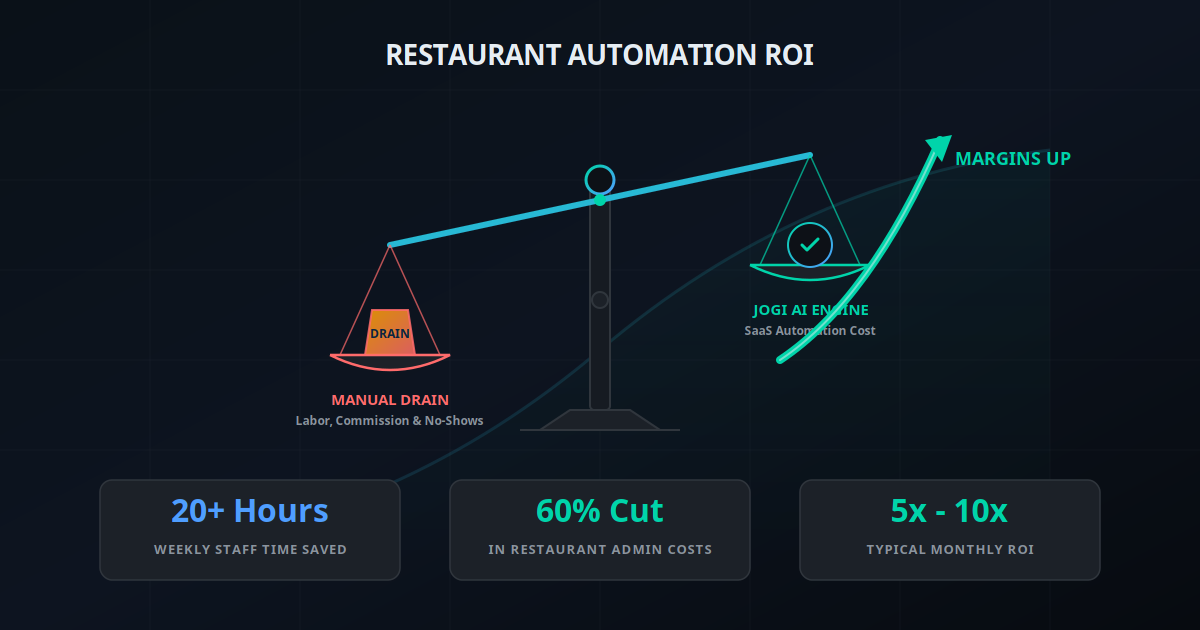
Restaurant autonomous workflows typically deliver a 5x to 10x ROI. By automating reservation confirmations, phone booking inquiries, and WhatsApp/web order intake, a mid-sized restaurant saves 15–25 staff hours per week, cuts no-show rates by 40%, and shifts high-commission delivery orders back to direct margins.
The High Stakes of Thin Restaurant Margins
According to the National Restaurant Association, average restaurant profit margins hover between 3% and 6%. For a venue bringing in $100,000 a month, that translates to just $3,000 to $6,000 in monthly net profit. In an environment this tight, you cannot easily raise menu prices without risking customer backlash.
This means your biggest opportunity for increasing net profit is cost optimization and revenue recovery. Because margins are so thin, every dollar you save on labor or recover from missed calls goes directly to your bottom line. Saving $3,000 in monthly operating costs does not just make your life easier—it effectively doubles your net profit. Automation is the most direct tool available to accomplish this.
"In the restaurant business, a dollar saved in operating costs has the same bottom-line impact as generating $15 to $20 in new sales. That is why efficiency-driven technology yields such a massive cash-flow multiplier."
Labor Cost: The Hours Spent Off the Floor
Labor is typically a restaurant's largest expense, often swallowing 30% to 35% of gross revenue. However, much of this labor is spent on non-cooking, non-service tasks. When we audit independent restaurants, we typically find hosts, managers, and servers spending significant chunks of their shifts doing the following:
| Manual Task | Est. Hours / Week | Can Be Automated? | AI Replacement System |
|---|---|---|---|
| Answering reservation/FAQ phone calls | 8–12 hrs | Yes — 85% | AI Phone Receptionist / Voice Agent |
| Processing web/WhatsApp orders manually | 5–8 hrs | Yes — 95% | AI WhatsApp Ordering Assistant |
| Confirming bookings & re-confirming large parties | 3–5 hrs | Yes — 100% | Automated CRM Sequences |
| Post-dining feedback and Google Review requests | 2–4 hrs | Yes — 100% | Automated SMS / WhatsApp Triggers |
| Updating POS menus across multiple apps manually | 2–3 hrs | Yes — 80% | Direct POS-Middle Menu Sync |
At an average loaded hourly wage of $18 (including taxes, benefits, and admin costs), this administrative block of 20 to 32 hours per week costs your restaurant $1,440 to $2,304 every month. This is time your team is spending looking at screens or holding phones, instead of engaging with diners on the floor, running food, or upselling specials.
No-Shows & Missed Calls: The Hidden Revenue Leaks
If a table sits empty, you cannot sell its time retroactively. This makes missed inquiries and no-shows the most frustrating losses in hospitality.
Missed Call Calculations
During busy service hours (Friday and Saturday between 7 PM and 9 PM), the host stand is overwhelmed. Phones ring, but they go unanswered because the staff is greeting guests and running bills. Industry studies show that the average restaurant misses 20% to 30% of incoming phone calls. If only 5 of those missed calls per week were potential bookings for tables of four (with an average ticket size of $100), you are letting $2,000 in weekly revenue slide straight to your competitors.
The No-Show Exposure
No-shows represent another massive leak. A table of 6 that fails to show up on a Saturday night represents not only a lost ticket of $150+ but also prevents you from booking that table for another party. By deploying an automated multi-touch reminder sequence (SMS confirmation upon booking, WhatsApp reminder 24 hours prior with a 1-click 'Confirm' or 'Cancel' button), restaurants regularly reduce their no-show rates by 40% to 60%. This is the topic of our detailed AI restaurant bookings case study.
Squeezing Out Delivery App Commissions
Third-party delivery platforms (UberEats, DoorDash, Grubhub) are a double-edged sword. They bring order volume, but they take a massive chunk of it. A 20% to 30% commission rate turns an already thin restaurant margin into a break-even or loss-making transaction.
An autonomous AI assistant running on your restaurant's WhatsApp Business profile or website can take delivery and takeout orders directly. The AI answers guest questions, formats their order, processes payments via Stripe or similar providers, and pushes the ticket directly into your POS. Because the transaction runs on your own channel, the transaction cost is under 3%—meaning you keep 97% of the margin, rather than giving 25% away. Shifting just 10% to 15% of your delivery volume to your direct channels can result in thousands of dollars in monthly margin recovery.
"We saw our delivery profit margins increase by 18% in just 60 days after we pointed our social media order links to our direct AI ordering assistant instead of third-party platforms."
— Executive Chef & Owner, The Grill House, 2026Calculating Your Restaurant's Baseline Cost
Before implementing any new tech, you must calculate your current operational leakage. Follow this simple 4-step framework:
1. Admin Wage Leakage: (Weekly hours host/managers spend on phones/confirmations/reviews) × (Hourly loaded wage) × 4.3. This is your monthly administrative labor baseline.
2. Missed Cover Loss: (Estimated missed calls per month) × (0.15 booking conversion rate) × (Average table size of 3) × (Average guest spend). This is your missed opportunity cost.
3. No-Show Loss: (Number of no-show tables last month) × (Average table ticket size). This is your lost margin baseline.
4. Portal Commission Spend: Total delivery commission fees paid to UberEats/DoorDash last month. This is your commission baseline.
Add these four numbers together to calculate your Total Manual Cost Baseline. This is the baseline you will use to measure the return on your automation investment.
Worked ROI Example: A Single Venue Case Study
Let's look at the numbers for a typical mid-sized, single-venue casual dining restaurant with the following stats:
- Monthly Gross Revenue: $120,000
- Average Ticket Size: $80
- Average Guest Count per Table: 3 ($240 average booking value)
- Current Monthly Delivery/Takeout Volume: $30,000 (of which $25,000 runs through third-party apps at a 25% commission)
Here is what the math looks like before and after deploying a basic autonomous workflow stack:
| Cost Category | Before Automation (Manual) | After Jogi AI Automation | Monthly Net Recovery |
|---|---|---|---|
| Administrative Labor | 80 hours/month = $1,440 | Reallocated to floor (0 hours admin) | +$1,440 (wage efficiency) |
| No-Show Room Loss | 15 tables no-show = $3,600 | Dropped 50% (7 no-shows) = $1,680 | +$1,920 (recovered revenue) |
| Missed Call Bookings | 80 missed calls, est. 12 lost tables = $2,880 | 90% answered by AI voice = $2,592 recovered | +$2,592 (new revenue) |
| Delivery Commissions | $25,000 volume @ 25% = $6,250 paid | 15% shifted to direct AI ordering = $937 commission saved | +$937 (captured margin) |
| Tech Subscription Cost | $0 | Jogi AI Engine Stack = $450/month | -$450 (software cost) |
| MONTHLY TOTAL | $14,170 cost & leaks | $2,130 remaining leaks + stack cost | +$6,439 Net Margin Boost |
In this realistic scenario, the restaurant invested $450/month in software and reclaimed $6,439 in monthly value. That is a 14.3x return on investment (ROI) in month one.
Payback Period Math: Breaking Even on Setup
When calculating payback periods, you must include both the recurring subscription fee and the one-time integration setup cost. If your setup fee is $1,200 and your monthly subscription is $450, your total year-one investment is $6,600 ($550/month average).
With a net monthly recovery of $6,439, the payback math looks like this:
Payback Period = (One-Time Setup Fee) / (Monthly Net Recovery - Monthly Subscription)
Payback Period = $1,200 / ($6,439 - $450) = 0.20 months (approx. 6 days)
Even if your restaurant recovers only half of the estimated amounts, the break-even point is reached in under 12 days. This makes restaurant automation one of the lowest-risk, fastest-payback investments a business owner can make.
Speeding Up Table Turn & Filling Covers
On busy weekend nights, the bottleneck is often the kitchen or the payment process. If guests sit around for 15 minutes waiting for a server to bring the card machine, that table is not being turned for the next party.
Autonomous workflows speed up table turn times in two ways:
- Pre-Ordering options: For large groups or quick lunch bookings, the AI booking assistant can send a WhatsApp link to pre-order meals. The kitchen can start prep before the guests sit down, shortening table time by 15–20 minutes.
- Automated Instant Pay: A link texted to the guest's phone allows them to split and pay the bill instantly via Apple Pay or Google Pay, bypassing the server card machine shuffle. Turning each table just 10 minutes faster on a busy Saturday night allows you to squeeze in an extra seating turn per station, adding 10% to 15% to your weekend covers. Read more on how this is structured in our restaurant booking automation guide.
Unlocking Repeat-Visit Revenue Lift
Acquiring a new diner is five times more expensive than keeping an existing one. Yet, most independent restaurants have no systematic database or guest CRM. They rely on people walking back in by chance.
An automated CRM workflow captures diner details at the point of reservation or direct order. Here is a simple, high-converting sequence:
The 48-Hour Review Capture
Forty-eight hours after dining, the system sends a automated WhatsApp: "Thanks for dining with us! How was your experience?" If the response is positive (4 or 5 stars), the system automatically texts a link to your Google Review page. If it is negative, it routes the message directly to the manager's phone for immediate resolution before they post online.
Slow-Night Re-engagement
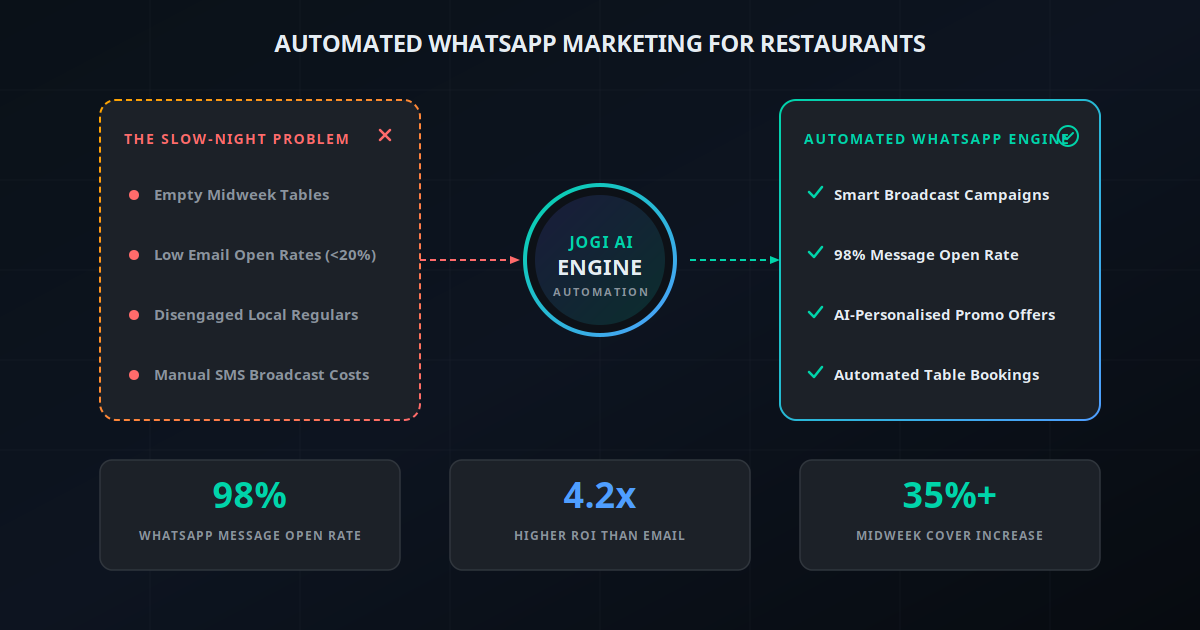
On a quiet Tuesday morning, the system filters guests who haven't dined in the last 45 days and broadcasts a personalized WhatsApp offer: "Hey Sarah, we miss you! Dine with us this Tuesday or Wednesday and get a free appetizer on us." This segment-specific targeting fills empty seats on slow nights with zero manual labor. Check out the strategy in automated WhatsApp marketing for restaurants.
The Soft Benefits: Staff Focus & Guest Experience
While hard financial numbers drive the decision, the operational soft benefits are equally crucial:
- Reduced Order Errors: AI ordering systems parse text inputs and push details directly to your POS. This eliminates transcription errors made by busy staff writing on paper.
- Lower Employee Turnover: Staff hate repetitive admin work. Freeing hosts from answering the phone on repeat allows them to focus on hospitality, leading to higher job satisfaction and lower turnover.
- 24/7 Responsiveness: AI agents answer guest queries instantly at 2 AM or 2 PM. Guests get booking confirmations in seconds, rather than waiting for your doors to open.
ROI by Venue Type: QSR vs. Fine Dining
The ROI calculation shifts depending on the style of your restaurant:
Quick Service Restaurants (QSR) & Fast Casual
In QSR, the goal is transaction volume and speed. The primary ROI driver is labor cost reduction in order taking and commission savings on delivery. Automated WhatsApp order taking and web ordering chatbots allow a single staff member to manage a much larger volume of orders during peak hours, directly reducing wages as a percentage of sales.
Fine Dining & Full Service
In fine dining, guest experience and personalization are paramount. The ROI driver here is revenue recovery (no-show reduction) and guest profiling. The AI booking assistant ensures that guests are reminded politely of their reservations and collects dietary preferences, allowing your servers to provide highly tailored service when they arrive. Learn more in our restaurant automation guide.
Build vs. Buy: Why In-House Integrations Fail
Some restaurant groups attempt to build custom integrations by hiring a software agency to link their POS system (Toast, Clover, Square) with a custom AI model. This is almost always a mistake.
Custom POS integrations require constant maintenance. Every time Toast or OpenTable updates their API, your custom code will break. A custom build typically costs between $10,000 and $30,000 up front, plus ongoing developer maintenance. In contrast, using a managed service like Jogi AI provides out-of-the-box native integrations that are maintained on your behalf, reducing your risk and keeping setup fees under $1,500.
Risks of Automation and How to Mitigate Them
No technology is without risk. Here are the three primary pitfalls of restaurant automation and how to avoid them:
1. Losing the Warm Hospitality Touch
If guests feel they are interacting with a cold machine at every point, your brand value drops. Mitigation: Never automate your dining room hospitality. Use AI to handle the back-office, confirmations, and initial booking queries. Keep the in-person greeting, table check-ins, and food delivery human.
2. POS Integration Outages
If your POS drops offline, the AI might process orders that the kitchen never receives. Mitigation: Choose tools with fallback mechanisms. If a POS API call fails, the system must immediately alert the manager via SMS and email with the order details so it can be handled manually.
3. Poor RAG Data and Wrong AI Answers
If your AI tells guests you have gluten-free options when you do not, you face severe safety and trust issues. Mitigation: Provide the AI with clear, structured markdown files containing menus, allergy warnings, and restaurant policies. Run the system in "draft mode" (where answers must be approved by staff before sending) for the first two weeks to ensure accuracy.
An Automation ROI Checklist for Restaurant Owners
Confirm your POS and reservation platform: Verify that your systems (Toast, Clover, SevenRooms, OpenTable) have open API layers or native integration partners.
Calculate your baseline leaks: Complete the 4-step baseline calculation to write down your actual manual cost structure.
Deploy booking reminder sequences first: Start with no-show reduction. It has the lowest risk and immediately proves its ROI in week one.
Set up the AI phone receptionist: Route missed calls to a conversational voice agent during peak and after-hours to capture booking inquiries.
Expose AI ordering channels: Direct your social media and WhatsApp ordering links to your direct AI ordering assistant to bypass delivery commissions.
Audit performance monthly: Track your covers, no-show rate, time saved, and third-party delivery portal mix to verify your net profit gains.
Margin Recovery Is Just One Integration Away
With restaurant profit margins sitting at 3% to 6%, you cannot afford to bleed money to missed phone calls, no-show bookings, and delivery commission portals. The math of restaurant automation is simple: the status quo costs most casual dining venues between $6,000 and $14,000 every month in administrative inefficiencies and lost revenues. An autonomous workflow stack that addresses these leaks costs $300 to $700 per month.
By starting small—deploying automated confirmations to secure bookings, routing busy phones to an AI receptionist, and directing online orders to direct commission-free channels—you can capture thousands in net margin recovery within your first 60 days. In a game of inches, automation gives you the feet you need to scale.
To see exactly where your venue's biggest cost leaks are and get a custom automation playbook, use our AI Business Twin tool for a free personalized analysis in under 10 minutes.
Frequently Asked Questions
What is the typical ROI of restaurant automation?
Most restaurants see a 4x to 10x return on investment (ROI) on their monthly software spend. The savings come from reallocating 15-25 labor hours per week, recovering missed calls (which average $80-$120 in booking value each), reducing guest no-shows by 40%, and shifting 10-15% of delivery portal orders to commission-free direct channels.
How much does restaurant automation software cost per month?
A standard restaurant autonomous workflow stack (including AI WhatsApp ordering, an AI phone receptionist, and POS integration) costs between $300 and $700 per month. Setup fees range from $500 to $2,000 depending on integrations with existing systems like POS (Toast, Clover, Square) or reservation engines (OpenTable, SevenRooms).
Can automation completely replace front-of-house or phone staff?
No. Automation is designed to handle repetitive, low-context administrative tasks—answering 'are you open,' taking bookings, and collecting delivery details. The goal is to free up hostesses and servers to focus entirely on guest experience and table management on the floor, which directly increases table turn speed and order values.
How much do delivery commission savings contribute to ROI?
Significantly. Platforms like UberEats and DoorDash charge 15% to 30% per order. Shifting even 10% of those orders to a commission-free AI WhatsApp or web ordering assistant saves hundreds of dollars in margins every week. For a restaurant doing $40,000 in monthly delivery volume, shifting 15% to direct captures roughly $800 to $1,500 in pure profit monthly.
What is the payback period for a restaurant automation stack?
The payback period is usually extremely short, typically between 30 and 60 days. Because many of the wins (recovering missed phone bookings, automated booking reminders that cut no-shows) take effect in week one, the initial setup cost is quickly offset by recovered revenue and immediate wage efficiency.
What are the risks of automating restaurant operations?
The key risks are integration failures with your POS or reservation book, over-automating guest interactions which harms the warm hospitality feel, and poor AI prompt designs. To mitigate these, always start with background processes (reminder sequences, basic Q&A) before automating direct ordering, choose platforms with native API support for Toast/Square, and always give guests an easy way to talk to a human.