Building a Scalable AI Workflow Stack for Real Estate: Layer by Layer, Not Tool by Tool




Why buying tools one at a time keeps you busy and broke
Walk into most growing real estate agencies and you will find the same graveyard. A lead capture form here. An email drip tool there. A separate dialer, a separate transaction checklist, a WhatsApp number someone answers on their personal phone. Each tool was bought to fix one painful day. None of them talk to each other.
I have watched this pattern play out with agency after agency. The team is drowning, so they buy software. The software helps a little, so they buy more. Two years later they are paying for nine subscriptions and an agent still copies a new portal lead into a spreadsheet, then into the CRM, then into the email tool by hand. That copying is the tax you pay for a pile of tools instead of a stack.
The numbers back up what the eye can see. Fragmented systems cost teams roughly 15 hours a week in manual busywork, and disconnected data is the single biggest reason automation projects quietly die. When your lead source does not know your CRM exists, no amount of clever software saves you — because a human still has to be the integration.
A stack is different. It is a set of workflows designed as one system, where every piece writes to a shared brain. Build it that way and each layer you add makes the previous ones more valuable instead of adding another window to check. This guide walks through how to plan that system for a real estate agency, in the order that actually works.
Start with the outcome, then audit what you already run
Before you look at a single product, write down the outcome you want in one sentence. Not "use more AI." Something like: "Every inbound lead gets a personal reply in under two minutes, gets nurtured for 180 days, and lands in front of an agent only when it is ready to book a viewing." That sentence is your north star. Every tool either serves it or gets cut.
Then audit what you already have. Most agencies own more capability than they use. List every tool, what it costs per month, what job it does, and — this is the part people skip — where the data goes when it leaves that tool. Nine times out of ten, the answer is "nowhere, someone types it into the next thing." That is your real problem, and it is cheaper to fix than to buy around.
While mapping agency workflows, I have found the audit itself pays for the project. One brokerage discovered they were paying for two email platforms nobody remembered subscribing to and a dialer that duplicated their CRM's built-in one. Cutting the dead weight covered the first three months of the new build. Start by understanding your current operations honestly; the gaps tell you where automation earns its keep.
Key Takeaway
A scalable stack is designed backward from one clear outcome and forward from an honest audit of what you already run. Buy nothing until you know where your data currently gets stuck.
Prioritise with a simple impact-vs-effort grid
Once you know the outcome and the gaps, you have a list of things you could automate. You cannot do them all at once, and you should not try. Score each candidate workflow on two axes: how much revenue or time it recovers (impact) and how hard it is to build and connect (effort). Then sequence the build so the easy wins come first and fund everything after.
| Workflow | Impact | Effort | Build order |
|---|---|---|---|
| Instant lead response (speed-to-lead) | High | Low | Do first |
| Lead qualification & scoring | High | Medium | Do second |
| Long-term nurture sequences | High | Medium | Do third |
| Viewing & transaction coordination | Medium | Medium | Do fourth |
| Listing marketing & review requests | Medium | Low | Do fifth |
The point of the grid is discipline. High-impact, low-effort work goes first because it produces cash and proof fast, which buys you team buy-in and budget for the harder layers. Anything low-impact and high-effort waits, possibly forever. Most agencies never need to automate the exotic stuff; the boring high-impact workflows are where the money hides. Rank ruthlessly, and revisit the grid every quarter as your data improves and new gaps appear.
The four layers of a real estate stack
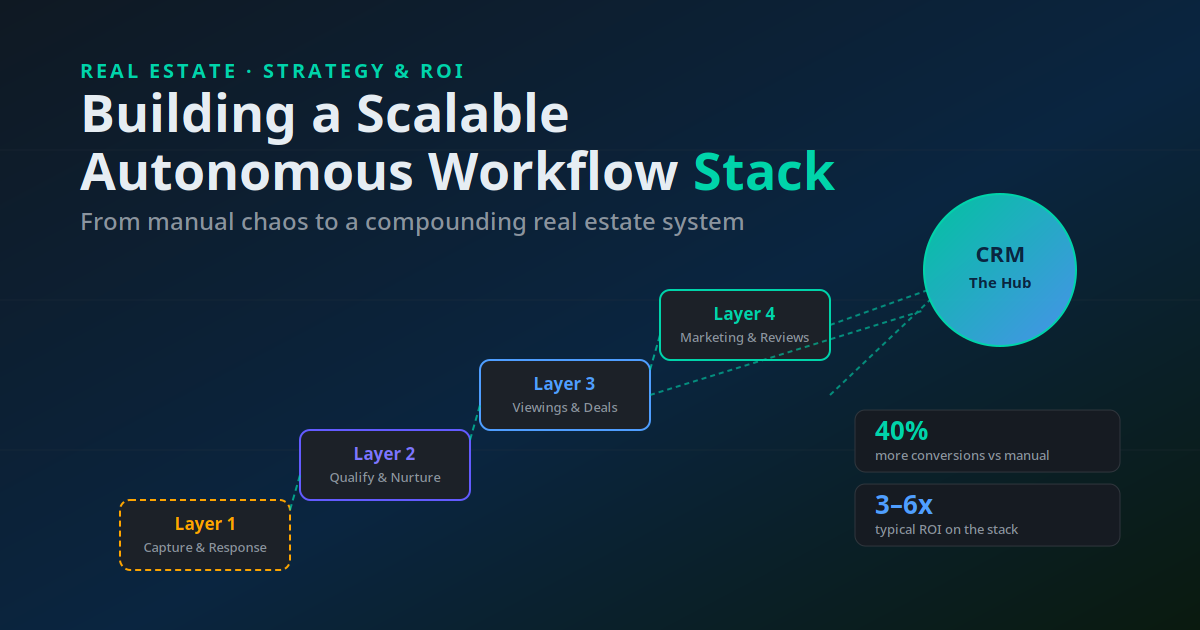
Every real estate agency's stack, no matter how large, breaks into four layers that build on each other. Get them in this order and each one feeds the next.
Layer 1 — Capture & instant response
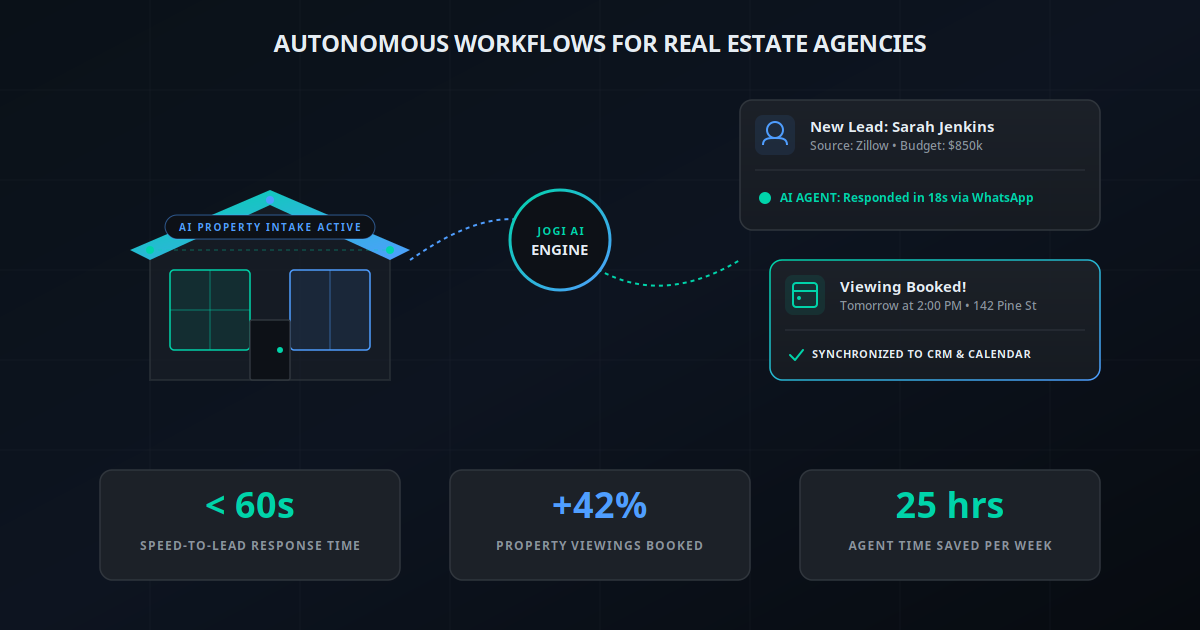
Every lead from every source — portals, your site, social ads, WhatsApp — flows into one intake and gets an instant, personal reply. This is the highest-leverage layer because leads contacted within five minutes are up to 21 times more likely to convert, and 78% of buyers work with whichever agent responds first. See how AI lead management catches inquiries the moment they arrive.
Layer 2 — Qualification & nurture
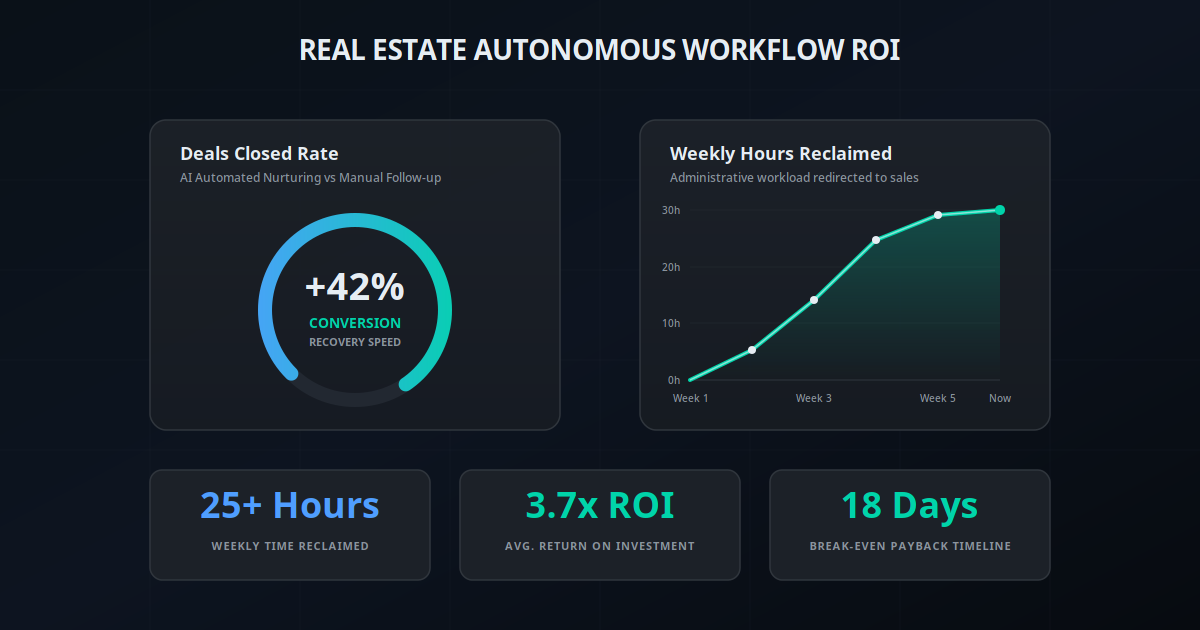
Once captured, the AI asks the qualifying questions a good agent would — buyer or renter, budget, timeline, area — scores the lead, and drops cold ones into automated nurture so nothing goes stale. AI-driven nurture lifts conversion by around 40% versus manual follow-up, mostly by staying consistent when humans get busy. Pair it with email automations that keep leads warm for months.
Layer 3 — Viewings & transactions
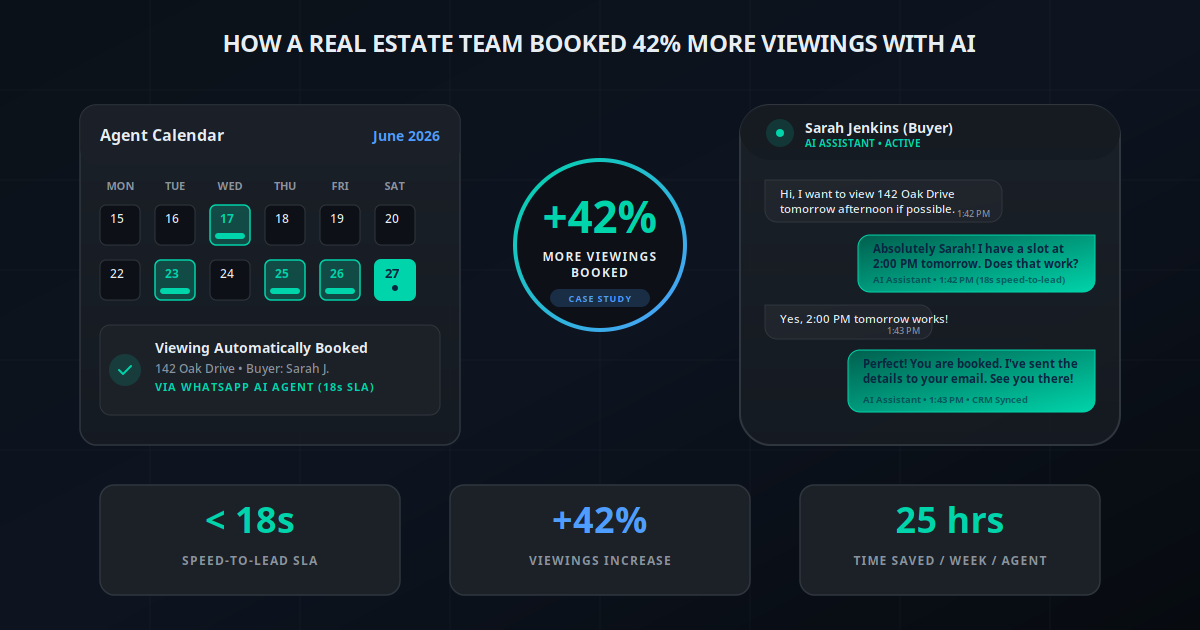
Qualified leads get booked into viewings against real agent availability, with reminders that cut no-shows. After an offer, the AI runs the transaction checklist — documents, deadlines, status updates to both sides — so deals stop stalling in admin. One team that automated follow-up booked 42% more viewings without adding staff.
Layer 4 — Marketing & reviews
The top layer keeps the pipeline full. New listings get social posts and email blasts generated and scheduled automatically, past clients get re-engagement campaigns, and every closed deal triggers a review request at the moment the client is happiest. This is where a good CRM foundation pays off, because reviews and referrals compound off the data the lower layers already captured.
Notice the shape. Layer 1 is cheap and urgent. By Layer 4 you are running growth marketing off data you never had to type in. The complete guide to autonomous workflows for agencies breaks each layer down further if you want the full map.
Make your CRM the hub, not another silo
Here is the decision that makes or breaks scalability: your CRM is the hub, and everything else plugs into it. Not the portal. Not the email tool. The CRM. Every layer reads from and writes to that one place, so a lead's entire history — first click, every message, viewing, offer, close — lives in a single record any workflow can act on.
Choose the hub carefully, because switching later is painful. For real estate specifically, platforms like Follow Up Boss and kvCORE have the deepest automation ecosystems, but the right choice is the one your team will actually use and that exposes a clean API. Agents using an integrated CRM close roughly 28% more deals, and integration cuts admin time by around 40% — but only if the connections are real, not a human retyping fields. Our CRM automation primer covers how to wire this up.
Two rules I hold firm on with every client. First, integration strategy: prefer native integrations, then a connector layer like Make, Zapier, or n8n for the gaps, and custom API work only where it genuinely earns its cost. Second, data ownership. Before you commit, confirm you can export every contact and note on demand and that the vendor cannot hold your history hostage. If the data is not portable, the stack is not yours.
A phased rollout your team will actually adopt
The best-designed stack fails if agents ignore it. Roll it out in phases, prove value at each step, and bring the team along instead of dropping a new system on them Monday morning.
Set the baseline: Measure today's speed-to-lead, conversion, and hours spent on admin before touching anything. You cannot prove ROI you never measured.
Ship Layer 1 to one team: Turn on instant lead response for a single pod of agents. Small blast radius, fast feedback, quick fixes.
Prove it, then expand: Once that pod sees more booked viewings, roll Layer 1 to everyone. Agents adopt what visibly makes them money.
Add qualification and nurture: Layer 2 and 3 go in once the CRM hub is holding clean data and the team trusts the intake.
Train on the exceptions: Show agents how to handle the handoffs — when AI escalates to them and why. Training is about the edges, not the happy path.
Layer on marketing: With the pipeline flowing and data clean, switch on listing marketing and review requests to keep the top of funnel full.
In our implementations, the phased approach beats the big-bang launch every time. Agents who watched Layer 1 book them extra viewings stopped asking whether the AI would replace them and started asking when the next layer was coming. Adoption is a trust problem, and trust is earned one visible win at a time.
Budget and projected ROI by phase
You do not fund a stack with one big cheque. You fund each phase with the returns of the one before it. For a team of 10 to 25 agents, a full build typically runs $6,000 to $15,000, plus a few hundred dollars a month per active layer. Here is how the phases tend to pay back.
| Phase | What it does | Typical payback |
|---|---|---|
| Layer 1 — instant response | Recovers leads lost to slow replies | Days to first week |
| Layer 2 — qualify & nurture | Lifts conversion ~40%, frees agent hours | 30–60 days |
| Layer 3 — viewings & deals | Cuts no-shows, unblocks stalled transactions | 60–90 days |
| Layer 4 — marketing & reviews | Refills pipeline, compounds referrals | Ongoing lift |
"We stopped thinking about software cost and started thinking about deals we were losing at 9 PM. The first layer paid for the whole project before we finished building the second."
— Principal, independent brokerageAcross structured real estate pipelines, automation ROI consistently lands in the 3x to 6x range, with full payback usually clear within 60 to 90 days. The reason phasing matters for ROI is simple: an early win funds the next layer, so you are never betting the whole budget on a system nobody has proven yet. If you want the deeper math, the ROI of autonomous workflows for agencies lays out the cost model.
Measure what matters, then iterate
A stack is never finished; it is tuned. Pick a small set of numbers and watch them per layer, monthly. Speed to first response. Lead-to-appointment rate. Appointments to closed deals. Hours saved per agent per week. Everything else is noise until these move.
The discipline that separates agencies that scale from those that stall: if a layer is not moving its number after 60 days, you fix that workflow before building the next one. A broken Layer 2 does not get better by adding Layer 4 on top; it gets buried. Treat the stack like a pipeline you optimize, not a project you finish. The workflow automation playbook goes deeper on measurement loops.
And keep the loop human. The AI handles volume; your agents handle judgment and relationships. The best stacks I have built make agents look superhuman — every lead answered, every deal on track — while quietly removing the busywork that used to eat their evenings. That balance, not the software, is what makes it stick.
Build the system, not the pile
The agencies that win the next few years will not be the ones with the most AI tools. They will be the ones whose tools form a single system — one hub, four layers, each funding the next. That is the whole difference between a stack and a graveyard of subscriptions.
Start with one outcome. Audit honestly. Sequence by impact and effort. Put the CRM at the center, prove each layer before adding the next, and measure four numbers that actually matter. Do that and the stack compounds — every lead you capture today keeps working for you months from now, without anyone retyping a thing.
The cost of waiting is not zero. Every week on a pile of disconnected tools is another 15 hours of busywork and another batch of leads lost to a slow reply. To see exactly which layers your agency should build first and what each would return, use the AI Business Twin for a free personalised analysis in under 10 minutes.
Frequently Asked Questions
What is a real estate AI workflow stack?
It is the connected set of AI-driven workflows that runs your agency end to end — lead capture and instant response, qualification and nurture, viewing and transaction coordination, and marketing and reviews. The word stack matters. It is not a pile of separate apps. Every layer writes to and reads from one central CRM, so a lead captured on Monday is still being worked automatically three months later.
Why not just buy the best tool for each job?
Because best-of-breed tools that do not talk to each other create data silos, double entry, and blind spots. An agent ends up copying a lead from the portal into a spreadsheet, then into an email tool, then into the CRM. That manual glue is exactly the work you were trying to remove. Fragmented systems cost teams around 15 hours a week in busywork. A stack built around one hub removes that copying entirely.
Which layer should a real estate agency automate first?
Layer 1 — lead capture and instant response — almost always wins first. Leads contacted within five minutes are up to 21 times more likely to convert, yet the average agent takes far longer to reply. Fixing speed-to-lead is low effort and high impact, and it starts recovering revenue in the first week, which funds the rest of the build.
How much does a real estate AI stack cost to run?
For a small team of 10 to 25 agents, a full deployment typically lands between $6,000 and $15,000 to build, then a few hundred dollars a month per layer to run. You do not pay for it all at once. Each phase is funded by the returns of the previous one, and most agencies reach payback within 60 days of switching on the first two layers.
Do I own my data if I build on someone else's CRM?
You should insist on it. Before you commit to any CRM as your hub, confirm you can export every contact, note, and activity record in a standard format on demand, and that the platform offers an open API. If a vendor locks your history behind their walls, your stack is not really yours. Data ownership and portability are non-negotiable when the CRM is the center of everything.
How do I measure whether the stack is working?
Track four numbers per layer: speed to first response, lead-to-appointment rate, appointments-to-deals, and hours saved per agent per week. Set a baseline before you automate anything, then review monthly. If a layer is not moving its number after 60 days, fix that workflow before adding the next one. The stack should compound; each layer makes the next more valuable.