AI for Property Managers: Automate Tenant Comms, Rent Collection and Leases




The Admin Trap That Limits Every Property Manager
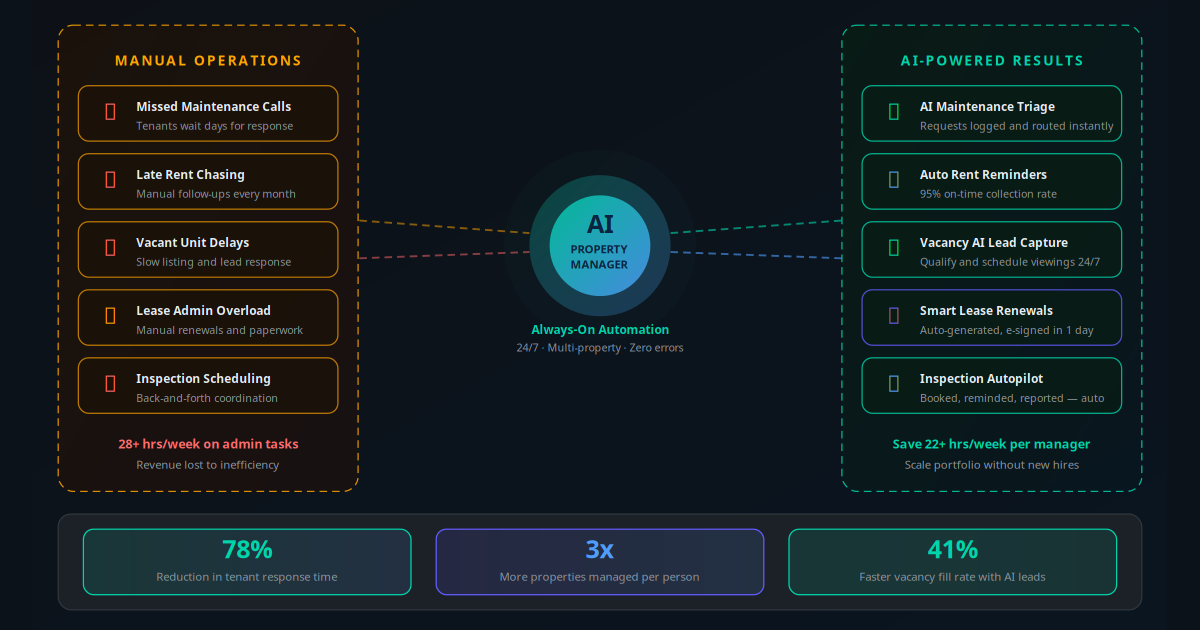
Picture a Tuesday morning. You have 12 unread WhatsApp messages from tenants — a leaking tap in Unit 4, a noise complaint from Unit 7, someone asking when their lease expires, and three rental enquiries for the vacant apartment you listed on Friday. Your phone rings. It is the council calling about a safety certificate. By 10 AM, you have not touched a single property visit, a revenue conversation, or anything that actually grows your business.
This is the admin trap. And it is not unique to you. Property managers across the industry report spending 60 to 70% of their working week on reactive, repetitive communication tasks — messages that follow the same patterns, questions that have the same answers, reminders that need to go out on the same schedule, every single month. The actual skill of property management — negotiating, advising landlords, reading market conditions, handling disputes — gets compressed into whatever time is left.
The direct cost is real. Every hour spent chasing a late rent payment manually is an hour not spent acquiring a new landlord client. Every afternoon consumed by scheduling back-and-forth for a routine inspection is growth foregone. And as your portfolio grows, the administrative burden compounds faster than your capacity to handle it.
AI automation breaks this equation. Not by replacing human judgment, but by handling the predictable, repeatable layer of property management that consumes time without requiring expertise. The property managers deploying these systems are running portfolios three times the size they managed two years ago — with the same team.
Key Takeaway
Property management's biggest growth constraint is not deal flow or landlord relationships — it is administrative throughput. AI automation removes the ceiling by handling routine tenant communications, rent reminders, maintenance triage, and lease workflows at scale.
Explore all industry-specific AI automation solutions we offer at Jogi AI.
Where Your Time Actually Goes: The Breakdown
Before you can automate anything, you need to see the task distribution clearly. Research from the National Association of Residential Property Managers and independent time-tracking studies of property management businesses consistently shows the same pattern:
| Task Category | Hours/Week (50-unit portfolio) | Automatable? | AI Impact |
|---|---|---|---|
| Tenant communication (queries, complaints) | 8–12 hours | 80% yes | AI chatbot handles routine queries 24/7 |
| Rent collection and late payment follow-up | 4–6 hours | 90% yes | Automated reminder sequences, payment links |
| Maintenance request intake and coordination | 5–8 hours | 75% yes | AI triage, contractor routing, status updates |
| Vacancy enquiries and viewing scheduling | 3–5 hours | 85% yes | AI lead capture, qualification, calendar booking |
| Lease renewal admin | 2–4 hours | 70% yes | Automated notice, document generation, e-sign |
| Inspection scheduling and reporting | 2–3 hours | 65% yes | Automated scheduling, reminder sequences |
| Reporting to landlords | 2–4 hours | 60% yes | Automated monthly reports from integrated data |
A 50-unit portfolio generates roughly 26–42 hours of administrative work per week. The automatable portion — 75 to 85% of it — can be handled by AI systems working around the clock. What remains is the 15–25% that genuinely requires human expertise: dispute resolution, legal interpretation, complex negotiations, and landlord relationship management.
A property manager handling 80 properties today does the same core administrative work as one handling 25 properties in 2020. The volume has scaled; the tools have not kept pace — until now.
Six High-Impact AI Automation Use Cases
1. AI Tenant Communication and Query Handling
The most immediate win. A AI-powered support workflow handles the bulk of inbound tenant messages — questions about maintenance schedules, bin collection days, parking rules, lease terms, utility responsibility, and community policies. These queries follow predictable patterns and have fixed answers. An AI chatbot connected to your property knowledge base responds instantly, 24/7, via WhatsApp, SMS, or your tenant portal. Response times drop from hours to seconds. Tenant satisfaction scores typically rise 25–35% within 90 days of deployment, simply because someone (or something) is always there.
2. Automated Rent Collection and Late Payment Sequences
Manual rent chasing is one of the most emotionally draining and time-consuming tasks in property management. AI turns it into a fully automated sequence: a reminder 5 days before rent is due, a confirmation when payment clears, a gentle first nudge if payment is not received by the due date, an escalating sequence of follow-ups with increasing urgency, and a flag to the property manager when a case needs human intervention. This sequence runs automatically across every tenant, every month, without any manual input. Businesses using automated email and message sequences for rent collection report on-time payment rates improving from 74% to 91% within two months.
3. Maintenance Request Triage and Contractor Routing
When a tenant reports a problem, the AI collects structured information (nature of issue, unit number, severity, access availability), classifies the urgency level, and routes it to the correct contractor with the job details already populated. For genuine emergencies — gas leaks, flooding, security breaches — the system triggers an immediate SMS or call to the on-call contact. Routine jobs are batched and dispatched according to contractor schedules. The property manager sees a clean, classified queue instead of a chaotic mix of WhatsApp photos and voicemails. Resolution time typically drops 40–60% because the right information reaches the right person immediately.
4. Vacancy Lead Capture and Viewing Scheduling
Every day a property sits vacant costs money. AI compresses the vacancy-to-tenanted timeline by handling the full initial enquiry funnel: capturing leads from listing portals and your website, responding instantly with property details, asking pre-qualifying questions (move-in date, number of occupants, income verification, pet requirements), filtering out unsuitable applicants, and scheduling viewings directly into your calendar without back-and-forth. An AI-powered lead generation system working 24/7 means your vacant property is being actively marketed and pre-qualified around the clock. Property managers using AI for vacancy management report 30–41% faster let times.
5. Lease Renewal Workflow Automation
Lease renewals are completely predictable — you know when they are coming, what documents are needed, and what the process looks like. Yet they consume hours of manual work per tenancy. AI automates the entire sequence: identifies upcoming expirations 90 days in advance, sends renewal offer communications to tenants, generates draft renewal agreements with current market rent, routes the signed document for landlord approval, and triggers the e-signature workflow. The property manager reviews and approves; the AI executes every step around that decision point. A 100-unit portfolio with 30% annual turnover saves 15–20 hours per month in lease renewal administration alone.
6. Inspection Scheduling and Reporting
Routine property inspections require scheduling, tenant notification, reminder sequences, access coordination, and post-inspection reporting. AI handles scheduling by checking available windows in your calendar, sending tenant notifications, issuing reminders (7 days, 24 hours, 2 hours before), and generating the inspection report template pre-populated with property details. After the inspection, photos and notes can be processed by AI to generate structured condition reports automatically. Workflow automation applied to inspections typically saves 45–60 minutes per inspection in administrative overhead.
Real-World Property Management Scenarios
Residential Property Manager — 120 Units, 3-Person Team
Problem: 60% of the team's time was consumed by WhatsApp messages and phone calls from tenants asking routine questions (bin days, parking rules, maintenance status, lease details). Solution: AI chatbot deployed on WhatsApp and tenant portal, trained on property-specific knowledge bases. Result: 78% of routine queries handled by AI without any human involvement. The team redirected 22 hours per week to landlord acquisition, adding 40 new units to the portfolio in 6 months without additional hires.
Commercial Property Manager — 30 Tenants, Mixed Use
Problem: Late rent was endemic — 34% of tenants paid after the due date, requiring manual chasing every month. Solution: Automated rent reminder sequence via email and SMS, with escalating urgency and direct payment links. Result: Late payments dropped from 34% to 8% within 3 months. The property manager recovered 6 hours per month previously spent on manual chasing and avoided two potential disputes that were caught early by the automated escalation system.
Estate Agency Property Management Department — 250 Units
Problem: Vacancies were averaging 32 days to fill because enquiry responses were slow (often next-day) and viewing scheduling required multiple email exchanges. Solution: AI lead capture on all portals, instant WhatsApp response with property details and pre-qualification questions, automated viewing booking linked to diary management. Result: Average days-to-let dropped from 32 to 19. The department calculated this saved approximately £38,000 in lost rental income per year across the portfolio.
Independent Landlord — 18 Properties, Self-Managed
Problem: Managing 18 properties as a side operation while working full-time was becoming unsustainable — routine maintenance coordination and tenant queries were consuming every evening and weekend. Solution: WhatsApp AI assistant for tenant queries, automated maintenance request form with AI triage, rent reminder sequences via WhatsApp Business automation. Result: Active property management time dropped from 18 hours per week to 5 hours. The landlord added 4 more properties within a year without feeling overwhelmed.
Build-to-Rent Operator — 400 Apartments, 6-Person Management Team
Problem: Lease renewal season (March–June) created a predictable bottleneck — staff could not process renewals fast enough, resulting in holdover tenancies and revenue uncertainty. Solution: AI-driven renewal workflow triggered 90 days before expiry, with automated communications, market-rate proposals, document generation, and e-signature routing. Result: Renewal processing time per tenancy dropped from 3.5 hours to 40 minutes. The team processed 30% more renewals in the 2026 season than in 2025 with the same headcount.
How to Implement AI Automation: Step-by-Step
The most effective approach starts with the highest-ROI use case and expands systematically. Here is the sequence that works for property management businesses of all sizes:
Audit your admin time (Week 1): Track every task for one week. Categorise each as routine/repetitive or judgment-required. This gives you the data to prioritise and measure ROI post-implementation.
Start with tenant communication (Weeks 2–3): Build your property knowledge base — service policies, maintenance contacts, lease FAQs, local information. Deploy a RAG-based AI chatbot on your tenant-facing WhatsApp number or portal. This is the quickest win: immediate reduction in message volume and 24/7 coverage.
Automate rent collection sequences (Weeks 3–4): Set up your payment reminder workflow in your CRM or automation platform. Map the 5-day-before, due-date, and escalation sequences. Connect to your bank or payment gateway for automatic payment confirmation triggers.
Build the maintenance triage system (Weeks 4–6): Create a structured maintenance request form (web or WhatsApp). Build the classification logic (emergency / urgent / routine) and contractor routing rules. Connect to your property management software for ticket creation. Test with real requests before going live.
Deploy vacancy lead capture (Week 6–7): Connect your listing portal webhooks or set up a dedicated WhatsApp number for vacant property enquiries. Build the pre-qualification question flow and link your calendar for viewing booking. Ensure your CRM automation captures every lead automatically.
Automate lease renewal workflows (Week 8): Set up expiry-triggered workflows in your property management platform. Create renewal letter templates and connect your document generation and e-signature tools. Build the landlord approval step into the workflow.
Add landlord reporting automation (Week 9): Configure monthly report generation that pulls occupancy, rent collection, maintenance costs, and inspection status from your integrated systems. Automate delivery by email on the first of each month to each landlord with their portfolio-specific data.
Review and optimise (Week 10 onwards): Check your AI chatbot escalation logs to find common questions it is not answering well. Review maintenance ticket resolution times. Track vacancy days-to-let before and after. Use this data to refine the system monthly.
Property Management AI Tools: What to Use
No single tool does everything. A practical property management AI stack combines purpose-built property software with general-purpose automation layers:
| Tool Category | Recommended Options | Best For | Approx. Cost |
|---|---|---|---|
| Property Management Platform | AppFolio, Buildium, Arthur Online | Core portfolio data, accounting, leases | $1.40–$3/unit/month |
| Workflow Automation | Make (formerly Integromat), n8n | Connecting systems, trigger-based workflows | $9–$29/month |
| AI Chatbot / Tenant Comms | Jogi AI custom chatbot, Tidio, Intercom | 24/7 tenant query handling | $50–$200/month |
| WhatsApp Automation | WhatsApp Business API via Twilio | Rent reminders, maintenance updates, comms | $0.005–$0.04/message |
| Document Generation | Docusign + Pandadoc, Jotform | Lease renewals, inspection reports, notices | $15–$40/month |
| AI Knowledge Base (RAG) | Custom RAG chatbot (Jogi AI) | Answering property-specific tenant questions | From $179/month |
| CRM | HubSpot Free, Pipedrive, Airtable | Vacancy leads, landlord relationships | $0–$45/month |
For a property management business just starting with automation, the priority stack is: (1) a workflow tool like Make or n8n as the central automation layer, (2) WhatsApp Business API for tenant communication, and (3) an AI chatbot trained on your property data. You can build a meaningful automation system for under $300 per month that pays for itself within 30 days.
The ROI Numbers: What Property Managers Are Seeing
"We went from managing 65 properties with 3 staff to managing 140 properties with the same team. The AI handles all the routine communication. We focus on the relationships and the decisions."
— Director, residential property management company, South East EnglandThe ROI from property management AI automation comes from three distinct sources:
- Time savings: Property managers report saving 18–28 hours per week per full-time manager through AI automation. At an average fully-loaded cost of £40/hour (including overheads), that is £37,440–£58,240 in annual capacity freed per person.
- Vacancy reduction: At an average UK monthly rent of £1,300, reducing average vacancy period from 30 days to 19 days saves £476 per vacancy event. A 100-unit portfolio with 25% annual turnover generates 25 vacancy events per year — that is £11,900 per year in recovered rental income.
- Portfolio growth without headcount: If one property manager can handle 50 units manually but 150 units with AI, each additional 100 units represents new revenue that requires no additional salary costs. At 10% management fee on £1,300 average rent across 100 units, that is £156,000 per year in management fees unlocked per person who would otherwise have been hired.
Against these gains, a full AI automation stack costs £150–£500 per month. The payback period is typically 30–60 days. Across a 12-month horizon, the return on a £3,000–£6,000 annual investment is typically £50,000–£200,000 in capacity, recovered rental income, and growth enablement — depending on portfolio size.
Key Takeaway
AI automation in property management is not primarily a cost-saving tool — it is a capacity-scaling tool. The financial upside comes from being able to grow your portfolio without proportionally growing your team.
Mistakes to Avoid When Automating Property Management
Automating Without a Clear Escalation Path
AI handles routine queries well. It handles angry tenants, legal disputes, and safety emergencies badly. Every automated system you deploy must have a clear, obvious route to a human. Tenants who cannot reach a person when they need one will escalate through every channel available, creating more work than the automation saved. Design your AI chatbot to immediately identify distress or urgency and route to a human with full context attached.
Training the AI on Vague or Incomplete Information
An AI chatbot trained on a thin knowledge base will hallucinate — it will confidently give tenants wrong information about maintenance timelines, lease terms, or landlord policies. Before you go live, invest time in building a thorough, accurate knowledge base covering every question tenants actually ask. Review the first 200 conversations the AI handles and close every knowledge gap you find. Accuracy matters more than breadth.
Deploying AI for Rent Reminders Without Personalisation
Generic, robotic-feeling rent reminders often backfire — tenants ignore them or complain. The most effective automated rent reminder sequences are personalised by first name, reference the specific property and tenancy, and maintain a respectful tone even at the escalation stage. A well-designed email automation sequence feels like it was written by your best property manager, not generated by a machine.
Ignoring the Landlord Communication Side
Property managers often focus AI automation on tenant-facing processes and neglect the landlord side. Monthly reporting, maintenance approval workflows, rent review notifications, and inspection summaries are all equally automatable — and landlords who receive prompt, clear, consistent communication are significantly more likely to stay and refer others. Build landlord communication automation into your stack from the start.
Trying to Replace Judgment With Automation
Experienced property managers make dozens of judgment calls per week: whether a maintenance issue is the tenant's responsibility or the landlord's, how to approach a sensitive rent arrears conversation, whether a renewal rent increase is market-appropriate or risks losing a good tenant. AI cannot make these calls. Trying to automate them will create errors, disputes, and damaged relationships. Use AI to handle the predictable; reserve your expertise for the decisions that actually need it. This principle applies across all professional services, from coaching and consulting to property management.
Not Measuring the Right Metrics
Many property managers deploy AI and then fail to measure whether it is working. Track these specific metrics before and after automation: average response time to tenant queries, percentage of messages resolved without human involvement, average days-to-let for vacant properties, percentage of rent paid on time, hours per week spent on administrative tasks per manager, and portfolio size per full-time equivalent. Without measurement, you cannot optimise — and you cannot make the business case for expanding the system.
Scaling Your Portfolio Without Scaling Your Headcount
Property management has always been a people-intensive business. Every landlord expects responsiveness. Every tenant expects to be heard. Every vacant unit needs active management. The administrative demands of delivering this at scale have historically meant that portfolio growth required proportional headcount growth — a model that limits margins and makes property management businesses difficult to scale.
AI automation breaks that constraint. The routine layer of property management — the messages, reminders, requests, forms, and reports — can now be handled by systems that work 24/7 without error, at a cost that is a fraction of what human labour requires. What remains is the work that genuinely requires your expertise: the negotiations, the relationships, the judgment calls. That is what you should be spending your time on. AI handles the rest.
Property managers who adopt these systems now are building a structural advantage: the ability to grow their portfolio, improve their service quality, and increase their margins simultaneously. Those who wait are building the same headcount-constrained business they have always had, now competing against operators who can move faster and serve better at lower cost.
To see exactly which parts of your property management operation are ready for AI automation — and what the ROI looks like for your specific portfolio — use the AI Business Twin for a free personalised analysis in under 10 minutes.
Frequently Asked Questions
What can AI actually automate in a property management business?
AI can automate tenant communication (answering queries 24/7 via chat or WhatsApp), maintenance request intake and triage, rent reminder sequences, lease renewal workflows, vacancy listing and lead qualification, inspection scheduling and follow-up reports, and routine document generation. These tasks typically consume 60 to 70 percent of a property manager's working day.
How does AI handle maintenance requests for rental properties?
Tenants submit requests via a chatbot, WhatsApp, or a web form. The AI classifies the urgency (emergency, urgent, routine), collects the relevant details (unit number, description, access availability), logs the ticket in your property management system, and routes it to the correct contractor or maintenance team. For emergencies, it can trigger an immediate SMS alert to your on-call contact. This eliminates the manual triage process entirely.
Will AI replace property managers?
No. AI automates the repetitive administrative layer of property management — the routine messages, reminders, data entry, and scheduling. The work that requires judgment, relationship-building, legal interpretation, and negotiation remains firmly with human property managers. The result is that one manager can handle significantly more properties, not that managers become redundant.
How much does AI property management automation cost?
A practical AI automation stack for property managers typically costs between $200 and $600 per month depending on portfolio size and which tools you integrate. This covers a CRM, a chatbot or AI communication layer, workflow automation, and document generation. The return on investment is typically seen within 60 to 90 days through time savings and reduced vacancy periods.
Can AI help with tenant screening?
AI can automate the front end of tenant screening: collecting applications, verifying that required documents have been submitted, and pre-qualifying applicants against your stated criteria (income, rental history, references). The final screening decision — reviewing credit reports, checking references, making the tenancy offer — should always remain with a human to ensure fair housing compliance and sound judgment.
What property management software integrates best with AI tools?
The most AI-friendly property management platforms in 2026 include AppFolio, Buildium, Propertyware, Rent Manager, and Arthur. These all offer APIs that allow AI workflow tools (like Make, n8n, or Zapier) and AI chatbots to connect for automated data sync, maintenance ticket creation, and tenant record updates. Standalone landlords using spreadsheets can start with a simpler stack built around Airtable and a WhatsApp chatbot.
How does AI automation help fill vacant properties faster?
AI accelerates vacancy fill by responding to every inquiry instantly (24/7), qualifying leads automatically with a set of pre-screening questions, scheduling viewings without back-and-forth email, and sending automated follow-ups after viewings. Property managers using AI for vacancy management report a 30 to 41 percent reduction in average days-to-let, which directly reduces lost rental income.
Is it safe to let AI communicate with tenants on my behalf?
Yes, when done correctly. AI should be configured with accurate, approved information about your properties and policies. All AI communications should be clearly branded so tenants know they are interacting with your business, and there should always be a clear escalation path to a human for complex or sensitive issues. AI handles routine queries well; disputes, complaints, and legal matters should always involve a human.