AI Automation for Recruitment & Staffing Agencies: From First Search to Signed Placement




A recruiter I worked with last year kept a sticky note on her monitor. It said "reply to Priya." Priya was a strong candidate for a warehouse-supervisor role, she had applied on a Tuesday, and by the time the recruiter got through her screening backlog and reached that note, it was Friday. Priya had already accepted an offer somewhere else. The role stayed open another three weeks.
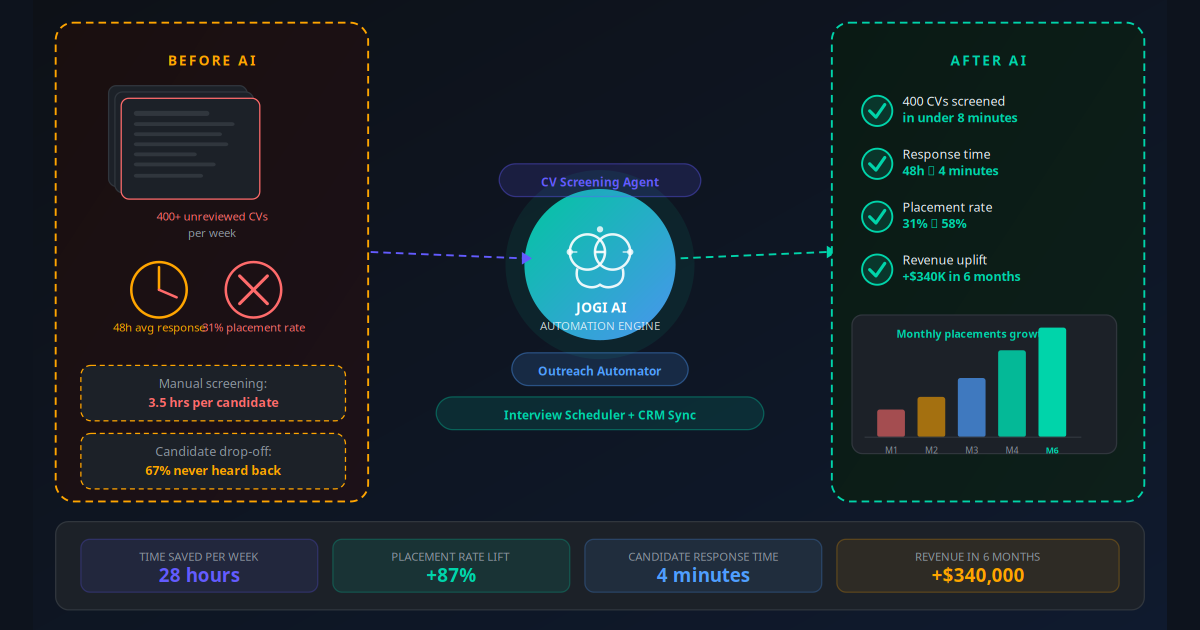
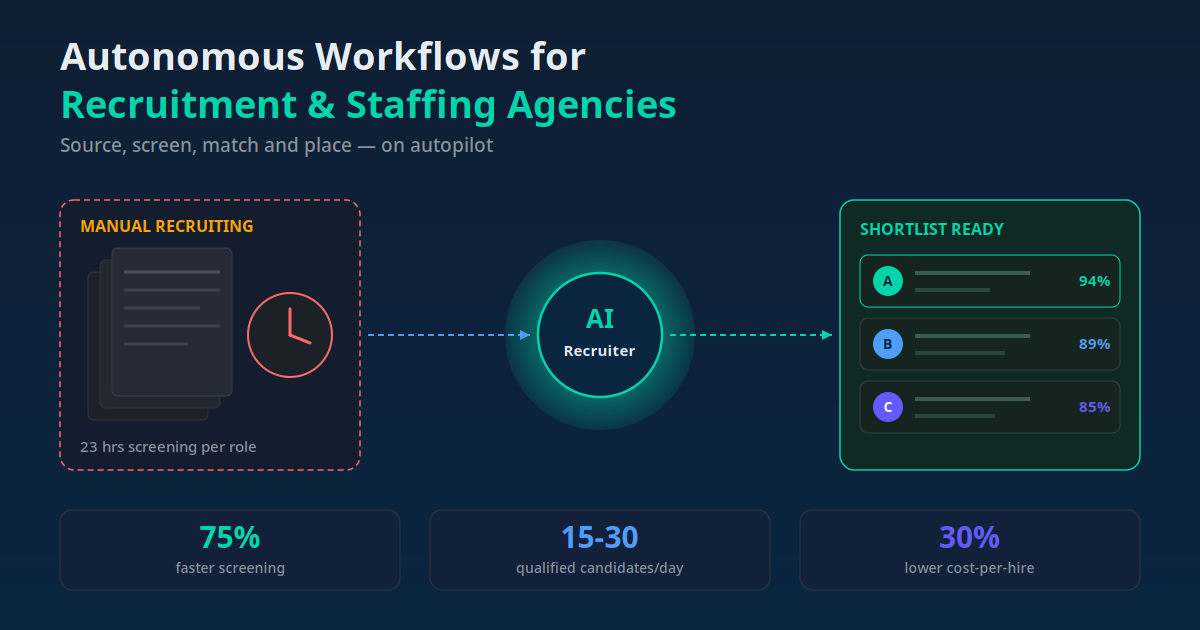
That is not a story about a bad recruiter. She was excellent. It is a story about arithmetic. Recruiters spend an average of 23 hours screening candidates for a single open role, and roughly 78% of that time goes to people who never make it past the first phone screen, according to SHRM's 2025 benchmarking data. When one person is doing all of that by hand across a dozen live roles, good candidates fall through the cracks. Not because anyone dropped the ball, but because there were more balls than hands.
This is exactly the gap AI automation closes for a recruitment or staffing agency. Not by replacing the recruiter's judgement, but by taking the sourcing, screening, scheduling, and status-chasing off their plate so they can spend their hours where they actually make money: talking to people and closing placements. In this guide I will walk through what these workflows look like in practice, where the real time goes, the numbers agencies are seeing, and how to build this without breaking your process or your compliance obligations.
What manual recruiting actually costs your agency
Agencies live and die on two numbers: time-to-fill and cost-per-hire. Both have been moving the wrong way. The average US hiring process now runs about 42 days from open to accepted offer, and 60% of companies reported their time-to-hire got worse in 2024. Every extra day a role sits open is a day your client stays frustrated and your placement fee sits unearned.
Look at where the money leaks and it is rarely the interesting work. A recruiter spending 20 minutes on a first-round phone screen across 50 candidates a week loses 16-plus hours — two full working days — just on first calls, most of which end in a no. That is $800 to $1,200 a week in labour spent filtering, per recruiter. Add CV formatting, manual job-board posting, interview scheduling, and the endless "just checking in" emails, and a large share of a desk's week never touches the parts that win business.
Here is the part that stings. Most of that work is repetitive and rule-bound, which is precisely the kind of work software now handles well. The agencies pulling ahead are not the ones with the most recruiters. They are the ones whose recruiters spend their day on relationships instead of admin.
Key Takeaway
The bottleneck in most agencies is not talent or effort. It is that skilled recruiters spend the majority of their week on repetitive filtering and coordination. Automating that layer is what lets a desk carry more roles without burning out or hiring more people.
What an autonomous workflow means on a staffing desk
Let me be precise, because "AI recruiting" gets used to mean everything from a keyword filter to a magic robot that hires people. Neither is what I am talking about.
An autonomous workflow is a chain of steps that runs on its own once triggered, calling on AI where judgement or language is needed and on your existing systems where data lives. A candidate applies. The workflow parses their CV, scores it against the live role's criteria, checks for duplicates in your ATS, drafts a summary for the recruiter, and either books a screening call or sends a polite hold message. No one had to touch a keyboard for any of that. The recruiter opens their morning to a ranked shortlist with reasoning attached, not a raw inbox of 90 applications.
The important word is "agent." Older recruitment tech was a filter — it matched keywords and threw away the rest. A modern AI agent reads a CV the way a person would, understands that "managed a team of 8" and "team lead" mean similar things, and can act: create a record, send a message, book a slot, flag a compliance gap. This shift from matching to doing is what the current wave of agentic AI actually delivers, and it is why the results look different from the applicant-tracking tools you may have tried five years ago.
The human stays in the loop on every decision that matters. The agent proposes; the recruiter disposes. That framing is good ethics and good practice, and as we will see later, it is also what keeps you on the right side of hiring regulation.
Where your recruiters' hours actually go
Before you automate anything, it helps to see the week laid out honestly. This is a rough split for a full-desk recruiter working a mix of roles, based on time studies and what I see when I audit agency desks. Your numbers will vary, but the shape rarely does.
| Activity | Typical share of week | Automatable? |
|---|---|---|
| Sourcing & searching databases | High | Mostly. AI agents surface and rank profiles |
| Screening & first-round filtering | High | Mostly. AI scores and summarises, human reviews |
| Interview scheduling & coordination | Medium | Fully. The fastest win of all |
| Candidate & client status updates | Medium | Fully. Triggered messages keep everyone warm |
| CV formatting & submittal prep | Medium | Fully. Draft in seconds, recruiter edits |
| Candidate & client conversations | Medium | No. This is the human's job, protect it |
| Closing, negotiation & relationship building | Lower than it should be | No. Automation exists to grow this slice |
The goal is not to automate the bottom two rows. It is to shrink the top five so the bottom two can grow. When I map this for a client, the "aha" moment is always the same: the work that generates fees is the smallest slice of the week, and it is being squeezed by admin that a machine can do faster.
The seven workflows worth automating first
You do not roll all of this out at once. You stack wins. These are the seven workflows I start agencies with, roughly in order of speed-to-value.
1. Candidate sourcing agents
An AI sourcing agent scans job boards, professional networks, and your own database against a role brief, then returns a ranked list of profiles with match reasoning. A recruiter sourcing by hand produces two to three qualified candidates a day; an agent can surface fifteen to thirty. You still decide who to approach, but you start from a much richer pool. This pairs naturally with your broader lead generation and sourcing funnel so client-side business development and candidate-side sourcing feed the same pipeline.
2. Resume screening and scoring
Every inbound application gets parsed, scored against the role's must-haves and nice-to-haves, checked for duplicates, and summarised into a two-line brief. The recruiter reviews a ranked shortlist instead of reading 90 CVs. Done well, this cuts time-to-shortlist by around 75% and lets teams complete far more screens per week.
3. Automated interview scheduling
This is the fastest, least controversial win and the one I always deploy first. The agent offers candidates real slots from the interviewer's calendar, books the meeting, sends invites, and handles reschedules — no more nine-email ping-pong. Teams routinely claw back five to eight hours a week from scheduling alone.
4. Candidate nurture and status updates
The single biggest complaint candidates have about agencies is silence. Triggered messages across email and WhatsApp keep candidates informed at every stage — application received, shortlisted, interview booked, feedback pending. Set this up once with email automation and WhatsApp Business automation and your candidate experience quietly becomes a competitive advantage.
5. Pre-screening conversations
For high-volume roles, an AI agent can run a first-round conversation — confirming availability, right-to-work, salary expectations, and location — over chat or a voice AI call. Only candidates who clear those basics reach a human. This is where the 78% of screening time spent on non-advancing candidates gets reclaimed.
6. Client updates and submittal prep
Clients want to know what is happening with their roles. The workflow drafts weekly pipeline summaries per client and formats candidate submittals to the client's template in seconds. Recruiters used to spend 20-plus minutes per submittal; agents get that under ten while keeping the human final edit.
7. Post-placement and redeployment
The placement is not the end. Automated check-ins during the guarantee period catch problems early, and redeployment agents flag when a contractor is rolling off so you can re-place them before they go looking elsewhere. Your best source of your next placement is often the candidate you placed last quarter, and this is how a good CRM automation setup keeps that relationship alive without manual reminders.
How it plays out on different desks
"Recruitment agency" covers wildly different businesses. A high-volume industrial desk and a boutique executive-search firm have almost nothing in common operationally, so the automation looks different too. Here is how it lands across the desks I have worked with.
High-volume industrial & logistics staffing
The problem is throughput: hundreds of applicants for warehouse, driver, and picker roles, most needing the same three checks. AI screening and voice pre-qualification handle the volume, confirming availability and right-to-work before a human is involved. One desk I supported went from a two-day screening backlog to same-day shortlists during peak season, and stopped losing candidates to faster competitors.
Healthcare & nursing staffing
Compliance is the whole game — licences, certifications, references, and shift availability all have to be current. Here the agent shines at document chasing and expiry tracking: it requests missing credentials, flags anything about to lapse, and keeps a clean audit trail. Recruiters stop playing document detective and spend their time on the relationships that fill hard shifts.
Permanent & professional recruitment
Longer cycles, fewer roles, higher fees. Automation here is less about volume and more about never letting a good candidate go cold. Sourcing agents widen the top of the funnel, nurture sequences keep passive candidates warm across a months-long search, and the recruiter focuses on the consultative work clients actually pay a premium for.
IT & contract technology recruitment
Fast-moving contracts, niche skills, and candidates who ghost the moment a better rate appears. Speed-to-contact is everything. The workflow surfaces matching contractors from the database the instant a role lands, drafts a personalised outreach, and books calls within the hour. In contract IT, the agency that reaches the candidate first usually wins the placement.
RPO & embedded recruitment teams
When you run recruitment on behalf of a client, you are judged on their metrics and their candidate experience. Automation gives you consistency at scale: every applicant screened the same way, every candidate updated on schedule, and clean reporting the client can see. It is how a small team credibly runs hiring for a much larger organisation. Our recruitment agency case study walks through exactly this kind of build.
Executive & retained search
The lightest touch. You would never let an agent run a confidential C-suite approach. But research, market mapping, and drafting long-lists still eat analyst hours, and AI compresses that groundwork so consultants spend more time on the discreet, high-judgement conversations that define the mandate.
A candidate journey, from search to placement
To make this concrete, here is a single mid-skill role — say a customer-service team lead — moving through an automated desk. Watch how little manual work each step needs.
Role intake: The recruiter takes the brief and enters the must-haves and nice-to-haves. The workflow turns it into structured criteria and auto-posts to the relevant boards.
Sourcing: The sourcing agent scans the database and job boards, surfacing 25 ranked profiles by the next morning alongside fresh inbound applicants.
Screening: Every CV is parsed, scored, de-duplicated, and summarised. The recruiter opens a shortlist of 12 with match reasoning, not a heap of 90.
Pre-qualification: A chat or voice agent confirms availability, salary expectation, notice period, and location with the top candidates. Two drop out on salary before a human spends a minute.
Recruiter review: The recruiter reads ten tight summaries, calls the four strongest, and makes the human judgement calls that matter. This is where their time now goes.
Scheduling & submittal: The agent books client interviews around real calendars and drafts formatted submittals to the client's template. The recruiter edits and approves.
Nurture: Every candidate — advanced or not — gets a timely, honest update. The two who were not selected leave with a good impression and stay in your pool.
Placement & beyond: On offer acceptance, onboarding paperwork triggers automatically and guarantee-period check-ins are scheduled. The record stays warm for redeployment.
Total manual time in that flow: the recruiter's four candidate calls, a handful of approvals, and the close. Everything else ran on its own. That is the difference between a desk that caps out at eight roles and one that comfortably runs fifteen.
The tooling: what to buy, what to build
You have three broad paths, and the right one depends on your size and how much your process differs from the norm. Here is how I frame the choice.
| Approach | Best for | Trade-off |
|---|---|---|
| AI-native ATS (e.g. modern recruiting platforms with built-in AI) | Small-to-mid desks wanting fast setup | Quick to start; you work the way the tool works |
| Add AI layer to existing ATS via automation platform | Agencies with a stack they like and won't rip out | Flexible; needs someone to build and maintain flows |
| Custom agent workflows on your data | High-volume or unusual processes at scale | Most powerful and tailored; higher upfront investment |
| No-code point tools (scheduling, screening) | Testing a single workflow before committing | Cheap to trial; fragments if you bolt on too many |
Most agencies do not need a rip-and-replace. If your ATS holds your data well, the pragmatic move is to add an intelligent layer on top using an automation platform — the classic Make vs Zapier vs n8n decision — and connect AI agents to the systems you already run. Start with one workflow, prove it, then stack the next. The agencies that get burned are the ones that buy a dozen disconnected tools and end up with more logins than they had before. Fewer, well-connected systems beat a drawer full of clever gadgets.
The ROI math for a staffing agency
"We didn't add recruiters. We gave the three we have their afternoons back. Each of them is running nearly double the roles they could a year ago, and our candidates finally stopped complaining that we ghost them."
— Director, regional staffing agencyThe numbers behind that kind of result are consistent across the agencies deploying this well. The pattern looks like:
- Screening speed: around 75% faster time-to-shortlist, with teams completing roughly 66% more candidate screens per week.
- Admin time: 41% less time spent on documentation and coordination; five to eight hours a week recovered from scheduling alone.
- Sourcing output: fifteen to thirty qualified candidates surfaced per day versus two to three by hand.
- Cost-per-hire: commonly 20% to 30% lower, driven by fewer wasted screens and faster fills.
- Time-to-fill: 30% to 50% faster for structured, high-volume roles.
- Payback: scheduling and status automation typically pay back within one to three months; full screening and matching reach breakeven around month six to nine.
Run it against your own desk. If a recruiter reclaims two days a week and each day of capacity lets them work one more role to fill, the maths on a single extra placement a month usually dwarfs the software cost several times over. This is the same compounding logic behind broader workflow automation across business processes — small recovered hours, stacked across a team, add up to real capacity.
Five mistakes that sink AI rollouts
I have seen these projects work brilliantly and I have seen them stall. The difference is rarely the technology. It is these five decisions.
Automating a broken process
If your intake is vague and your ATS is a swamp of duplicates, automation just makes the mess faster. Fix the process for your highest-value roles first, then automate the clean version. AI amplifies whatever you point it at, good or bad.
Letting the agent auto-reject
Never let AI send rejections on its own. Use it to rank and summarise, keep a recruiter reviewing borderline cases, and you avoid both the bias risk and the horror story of a great candidate binned by a machine. Rank, don't reject.
Ignoring compliance until the end
Candidate data is sensitive personal data. If you bolt on tools without checking data-processing terms, retention, and candidate consent, you are building a liability. Treat GDPR and hiring-discrimination rules as part of the design brief, not a box to tick afterwards. A quick read of the safety and governance side of AI automation is worth the hour before you scale.
Boiling the ocean
Trying to automate the entire desk in month one guarantees a stalled project and a frustrated team. Ship one workflow, prove the time saved, win the team's trust, then expand. Momentum from small wins carries the big ones.
Cutting the human out of the relationship
Candidates and clients still want to deal with a person for the parts that matter. Automate the admin, never the relationship. The agencies that get this wrong feel robotic and lose the trust that repeat business is built on.
Where to start this quarter
You do not need a transformation programme to begin. Pick the single workflow that hurts most on your desk right now — for most agencies that is interview scheduling or first-round screening — and automate just that. Prove the hours saved over a fortnight. Then add the next.
The agencies gaining ground are not working harder than you; they have simply stopped asking skilled recruiters to spend their week on work a machine does faster and better. The recovered time goes straight into the relationships and placements that grow the business. That is the whole game: less filtering, more closing.
The technology is ready, the economics are proven, and your competitors are already moving. The only real question is whether your recruiters spend next quarter screening CVs or filling roles.
To see exactly which workflows would move the needle on your desk — and the hours and cost each would save — use the AI Business Twin for a free, personalised analysis in under 10 minutes.
Frequently asked questions
What is AI automation for a recruitment agency?
It is a set of connected workflows that handle the repetitive parts of recruiting without a recruiter driving each step: sourcing candidates across job boards and databases, screening and scoring applicants against a role, scheduling interviews, keeping candidates and clients updated, and writing shortlists. The recruiter stays in charge of judgement calls, relationships, and the final decision. The software just removes the admin that eats the day.
Will AI screening reject good candidates unfairly?
It can if you set it up carelessly. The safe pattern is to use AI to rank and summarise, never to auto-reject. The agent surfaces its reasoning and a match score, and a recruiter reviews the borderline cases. Avoid scoring on proxies like university name or employment gaps, keep a human in the loop for every rejection, and audit the shortlist against your placements over time to catch drift.
How much does recruitment automation cost for a small agency?
A small desk can start for a few hundred dollars a month. Modern ATS platforms with AI features run roughly $50 to $150 per user per month, and custom agent workflows built on top of your existing stack add inference costs that are usually under $200 a month for a small team. Set that against a recruiter's loaded cost and the payback on scheduling and screening automation typically lands inside the first one to three months.
Can AI source candidates as well as a recruiter?
For structured, high-volume roles, an AI sourcing agent scanning job boards, professional networks, and your internal database can surface far more qualified profiles per day than manual searching. A human recruiter working manually typically produces two to three qualified candidates a day, while an AI agent can surface fifteen to thirty. For senior or highly specialised searches, human sourcing and networking still win, so the best desks use AI for breadth and recruiters for depth.
How fast do agencies see results from recruitment automation?
Simple wins land quickly. Interview scheduling and candidate-status updates usually save hours in the first week. Screening and matching take a few weeks to tune before you trust the shortlists. Most agencies report measurable time savings within two to four weeks of active use, and a clear ROI on cost-per-hire and time-to-fill within a quarter.
Does recruitment AI replace recruiters?
No. It replaces the parts of the job recruiters dislike anyway: keyword searching, chasing paperwork, formatting CVs, and sending status updates. The recruiter spends the recovered time on client relationships, candidate conversations, and closing placements. In the agencies we work with, headcount stays the same or grows while each recruiter carries more roles, because the admin ceiling that used to cap them is gone.
What data do I need before automating recruitment workflows?
Clean role requirements and a reasonably tidy candidate database are the two things that matter most. AI matching is only as good as the criteria you give it, so write clear must-haves and nice-to-haves for each role. If your ATS is full of duplicate or stale records, spend a week cleaning the highest-value segments first. You do not need perfect data to start, but you do need the roles you are actively working to be well defined.
Is candidate data safe when using AI recruitment tools?
It can be, but you have to check. Recruitment data is sensitive personal data under GDPR and similar laws, so use vendors that offer data-processing agreements, do not train their public models on your candidate data, and let you set retention limits. Get explicit consent to process CVs, tell candidates when AI is used in screening, and keep a record of why each candidate was advanced or rejected. Treat compliance as part of the build, not an afterthought.