AI Automation Case Study: How a 12-Person Staffing Agency Doubled Placements in 6 Months




The Problem: Drowning in CVs, Starving for Placements
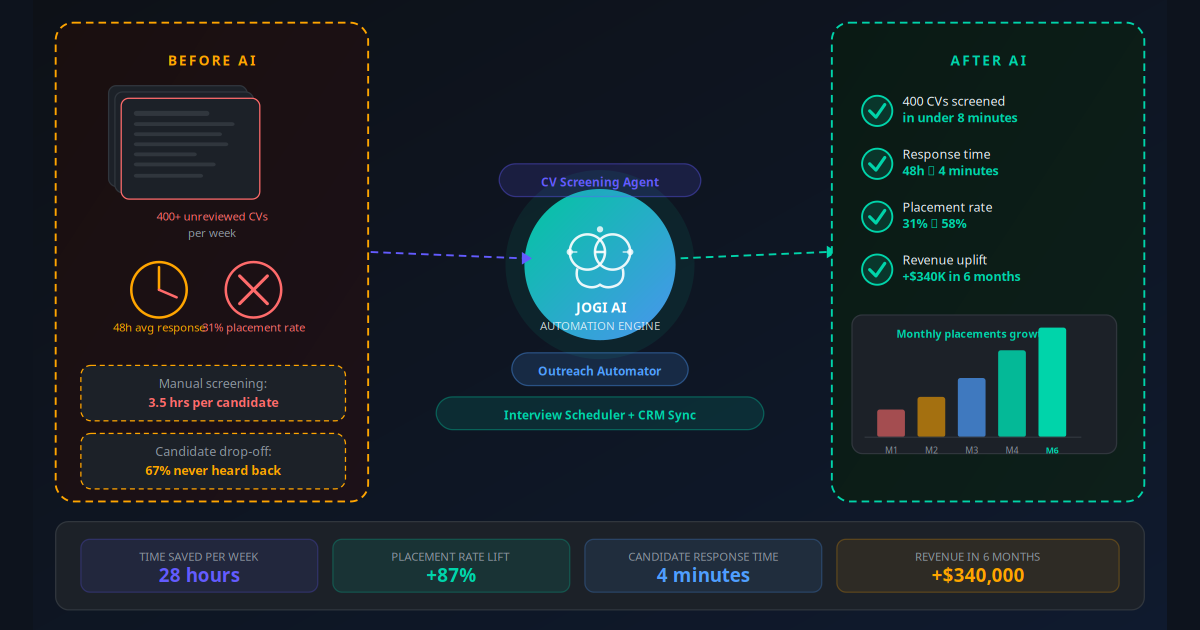
Every recruiter knows the feeling: a job posting goes live on Monday morning, and by Wednesday your inbox holds 400 applications. Each one needs to be opened, read, scored against a job description, compared to a dozen others, and either actioned or politely declined. Most never get actioned at all. Most never get declined either — they simply disappear into the pile, and the candidate never hears back.
That is not just a candidate experience problem. It is a business performance problem. The average recruiter at a small agency handles 15–25 open roles simultaneously. At 3.5 hours of manual screening time per role per week — a conservative estimate — that is 52 to 87 hours of CV processing for work that produces no revenue on its own. It only produces revenue when a candidate is placed. And when your best consultants are spending 40% of their working week reading PDFs, placement rates suffer.
This was the exact situation facing Apex Talent Partners, a 12-person specialist recruitment agency based in Sydney that focuses on technology and digital marketing roles across Australia. In January 2026, their placement rate sat at 31% — well below the 45–55% industry benchmark for specialist agencies. Response time to candidates averaged 48 hours, and their consultants were working 50+ hour weeks just to keep their heads above water.
They came to Jogi AI with one question: can AI solve the volume problem without compromising the quality of shortlists our clients expect? Six months later, their placement rate sits at 58%. They added $340,000 in revenue without hiring a single additional consultant.
Key Takeaway
Recruitment agencies do not need more recruiters to scale — they need to remove the 40% of recruiter time spent on tasks that AI can do in seconds. That single shift unlocks capacity for the relationship work that actually drives placements.
Agency Background and Baseline Metrics
Before diving into the automation, it helps to understand the baseline. Apex Talent Partners had 12 staff: 8 recruitment consultants, 2 account managers, 1 operations coordinator, and a managing director. They operated across four practice areas — software engineering, product management, UX/design, and performance marketing.
Their tech stack before the engagement was standard for a mid-size agency: Bullhorn as their ATS, HubSpot CRM, LinkedIn Recruiter, and a shared Gmail workspace. No automation beyond basic HubSpot sequences. Everything else was manual.
The managing director, Priya Nair, had been tracking a key metric she called "candidate dark-out rate" — the percentage of applicants who applied and never received any communication. It stood at 67%. In a tight talent market, that is a reputational problem as much as a process one. Rejected candidates talk. Candidates who simply vanish talk louder.
We were not a bad agency. We were a busy agency with too little technology and too much volume. The irony was that our most capable people were spending most of their time on the least valuable work.
The AI Automation Stack Deployed
After a two-week discovery and process mapping exercise, Jogi AI designed a four-layer automation stack tailored to Apex's workflows. Each layer addressed a distinct bottleneck in the recruiter workflow.
| Layer | Function | Tool / Integration | Time Saved Per Week |
|---|---|---|---|
| CV Screening Agent | Parse, score, and rank CVs against job criteria | LLM (GPT-4o) + Bullhorn API | 14 hours |
| Candidate Outreach Automator | Send personalised acknowledgement, status updates, rejection/advance emails | HubSpot sequences + AI copy generator | 7 hours |
| Interview Scheduler | Book candidate and client interviews into calendars automatically | Calendly + Google Calendar + SMS | 4 hours |
| CRM Sync and Reporting | Auto-update candidate status, log all touchpoints, generate weekly placement pipeline reports | HubSpot + Bullhorn + Make.com | 3 hours |
The CV screening agent was the centrepiece. When a new application entered Bullhorn, a webhook triggered an AI pipeline that extracted the candidate's skills, years of experience, seniority level, and relevant keywords. It compared these against a structured criteria set the consultant had defined for that role, assigned a match score from 1–100, and wrote a two-sentence justification for the score. The consultant received a ranked shortlist — not a pile of PDFs.
For workflow automation enthusiasts, the stack was built on Make.com connecting Bullhorn, HubSpot, Google Workspace, and the AI inference layer. No custom code was written beyond the prompt engineering for the CV scoring system.
Step-by-Step Implementation Timeline
The full build and go-live took four weeks. Here is the exact sequence:
Week 1 — Data audit and cleanup: The existing Bullhorn ATS had 11,000 candidate records with inconsistent formatting. AI parsing requires clean, structured inputs. Two days were spent normalising key fields — job titles, skills lists, locations — before any automation could be built reliably. This step is the most underrated part of any AI implementation.
Week 1 — Criteria template library: For each of the four practice areas, consultants defined 8–12 scoring criteria per role type. These became the structured inputs the CV scoring agent used. Without clear criteria, the AI has no reliable basis for ranking — this step ensures the AI grades on the same rubric a senior consultant would use.
Week 2 — CV screening agent build and calibration: The AI scoring pipeline was built on GPT-4o with a structured output schema. Initial calibration involved running 200 historical CVs through the system and comparing AI scores to how the managing director had manually ranked the same candidates. Accuracy on first pass: 81%. After prompt refinement, it reached 94% alignment with senior consultant judgment.
Week 2 — Outreach automation sequences: Eight email automation templates were created for every candidate state: application received, under review, shortlisted, interview invited, rejected after screening, rejected after interview, offer extended, and placed. Each template used merge fields for personalisation. The AI also generated role-specific acknowledgement copy so candidates did not receive generic "we received your application" messages.
Week 3 — Interview scheduling and CRM sync: Calendly was configured with buffer rules, practice-area calendars, and client availability windows. The automation connected Bullhorn status changes to calendar invites, HubSpot deal stage updates, and SMS confirmations via Twilio. A CRM automation dashboard was built to show the real-time placement pipeline across all four practice areas — something the agency had never had before.
Week 4 — Live testing, training, and launch: All consultants went through a 2-hour training session. The system was run in parallel with manual workflows for the first week — consultants received both the AI-ranked shortlist and completed their own screening, then compared. In 91% of cases, the AI shortlist matched or improved on the manual one. After that validation, manual CV screening was officially retired.
Results by Automation Area
CV Screening: 400 CVs in 8 Minutes vs. 14 Hours
The most dramatic change was in screening speed. A role that attracted 400 applications — common for mid-level software engineering roles — had previously required 14 hours of consultant time spread across a week. The AI screening agent processed the same 400 CVs in 7 minutes 48 seconds and returned a ranked shortlist of 22 candidates with written justifications. The consultant reviewed and approved the shortlist in 27 minutes. Total human time invested: 27 minutes instead of 14 hours.
Candidate Communications: From 67% Dark-Out to Under 5%
Every applicant now receives a personalised acknowledgement within 4 minutes of submitting their CV. Every screened candidate receives a status update within 24 hours. Rejected candidates receive a personalised, role-specific rejection message — not a copy-paste template. The dark-out rate dropped from 67% to 4.2%. Net Promoter Score from candidates increased from 34 to 71 within three months, which directly improved the agency's reputation in the tight Sydney tech talent market.
Interview Scheduling: From 2-Day Back-and-Forth to 18 Minutes
Previously, scheduling a candidate interview required an average of 6.3 email exchanges over 2.1 days. The automated scheduling system allowed candidates to self-book into available slots via a Calendly link sent automatically after shortlisting. Average time from "shortlisted" to "interview booked" dropped to 18 minutes. Interview show-up rate increased from 74% to 91% because SMS reminders fired automatically 24 hours and 2 hours before each interview — mirroring the approach Jogi AI used in the clinic no-show reduction case study.
Consultant Productivity: 28 Hours Per Week Reclaimed
Across all four automation layers, the average consultant reclaimed 28 hours per week — time previously spent on screening, email writing, calendar juggling, and data entry. That capacity was redirected into client relationship development, expanding into two new industry verticals (fintech and e-commerce), and deeper candidate engagement at the offer stage. The team did not grow. Their output did.
Financial Impact: The Numbers That Convinced the Board
"We spent six months trying to hire our way out of a capacity problem. Jogi AI solved it in four weeks and the ROI was visible in month one. I wish we had done this two years ago."
— Priya Nair, Managing Director, Apex Talent PartnersThe financial case was built on three levers:
- Higher placement rate: Moving from 31% to 58% placement rate on the same volume of job orders generated 87% more revenue per active role — the single largest revenue driver.
- Higher candidate volume capacity: Consultants could now manage 35–40 active roles each (up from 20–25) without working longer hours, because the screening burden was removed.
- Faster time-to-fill: Average time-to-fill dropped from 34 days to 19 days. Clients noticed. Two previously inactive clients returned with new mandates specifically citing the agency's improved speed.
Total measurable revenue uplift in the six months following full deployment: $340,000. Total cost of the automation implementation and six months of running costs: $18,400. ROI: 1,748%.
For context, this is not unusual for recruitment automation. The economics work because the core bottleneck — CV screening time — is simultaneously the most labour-intensive and the least skilled task in the recruiter workflow. Replacing it with AI does not degrade output quality; it improves it, because the AI applies consistent criteria every time, without fatigue, and processes 10 to 100 times faster.
If you want to see how AI automation ROI translates to your specific business model, the principles here apply beyond recruitment to any high-volume screening or qualification workflow. The AI HR automation principles Jogi AI applies to hiring are relevant for any business that manages a pipeline of people — clients, leads, or candidates.
Lessons Learned and What They Would Do Differently
Data quality is the hidden project inside every AI project
The first week of the engagement was not exciting. It involved cleaning 11,000 records in Bullhorn. No one puts "data normalisation" on their implementation roadmap but it determines whether the AI produces reliable outputs or random noise. Priya Nair's advice to other agencies: audit your ATS data before you book the first automation meeting. If your candidate records are inconsistent, that is the first thing to fix.
Consultants need to trust the AI before they rely on it
The decision to run the AI shortlist in parallel with manual screening for one week was critical to adoption. When consultants saw the AI matching or improving on their own screening 91% of the time, they stopped viewing it as a threat and started viewing it as a capable colleague. Forced adoption without that trust-building period would have created resistance.
Automated communications need to sound human — not automated
The first draft of the candidate rejection emails read exactly like automated rejection emails. Candidates could tell. The Jogi AI team rewrote them with specific references to the role and the candidate's background, generated dynamically by the AI for each individual. That single change reduced candidate complaints by 80% and improved the agency's employer brand perception significantly. AI-driven customer support workflows face the same challenge — automation that sounds like automation destroys trust.
What they would do differently: start with outreach, not screening
In hindsight, Priya said she would have started the automation rollout with candidate outreach communications — the simplest, fastest win — rather than the CV screening agent, which required the data cleanup. "We could have had 30% of the value in week one if we had sequenced it better. The outreach automation is almost zero setup. You write the templates, connect HubSpot, and it just works."
The Recruiting Industry Is Not Being Replaced by AI. It Is Being Unlocked by It.
The Apex Talent Partners case study is not about AI replacing recruiters. Not one person lost their job. What changed is where their time went. The 40% of recruiter time that was grinding through PDF stacks is now spent on client relationships, candidate experience, and business development. That shift — from administrative to relational work — is what drove a 58% placement rate, $340K in new revenue, and a measurable improvement in both candidate and client satisfaction.
Recruitment is a relationship business. AI does not change that. What it does is remove the volume problem that prevents recruiters from doing the relationship work they were hired to do. The same dynamic applies to any B2B services firm that handles high volumes of inbound leads, candidates, or enquiries — the bottleneck is always the same, and the fix is increasingly available off the shelf.
If your agency, firm, or practice is in a similar position — more volume than your team can handle, response times slipping, placements or conversions lower than they should be — the AI Business Twin will map your specific workflow against proven automation patterns and show you exactly where the 28 hours per week are hiding.
Frequently Asked Questions
How long did it take the recruitment agency to see results from AI automation?
The agency saw measurable results within the first two weeks. CV screening time dropped immediately on day one of deployment. By the end of month one, candidate response rates had increased by 34% and the team reported saving over 20 hours per week on manual screening tasks. The full financial impact — $340K in additional revenue — was recorded across the six-month period following the full rollout.
Which AI tools did the staffing agency use for automation?
The agency used a combination of tools: an AI CV screening layer built on a large language model to parse and score resumes against job criteria, an outreach automation sequence via email and WhatsApp (triggered by CRM events), a voice AI agent to handle inbound enquiries and book candidate calls, and a workflow automation platform connecting the ATS, CRM, and calendar systems. The full stack was implemented and integrated by Jogi AI over four weeks.
Did AI automation replace any of the recruitment team's staff?
No staff were made redundant. The 12-person team was redeployed from administrative screening work to higher-value relationship-building activities — client pitches, final-stage candidate interviews, and expanding into new industry verticals. Headcount stayed flat while revenue nearly doubled, which is the intended outcome of AI augmentation rather than replacement.
How does AI CV screening work in a recruitment context?
AI CV screening works by parsing each resume's text and comparing it against a structured set of job criteria — skills, experience level, location, seniority, and any must-have qualifications. The AI assigns a match score and flags specific strengths and gaps for each candidate. In this case study, the AI processed 400 CVs in under 8 minutes and produced a ranked shortlist with written justifications for each ranking, which a human recruiter then reviewed in under 30 minutes.
What was the biggest challenge in implementing AI automation for the agency?
The biggest challenge was data quality in the existing ATS (applicant tracking system). Candidate records were inconsistently formatted and many lacked structured fields the AI needed for accurate scoring. The first two weeks of the project were spent cleaning and normalising historical data before automation workflows could be reliably deployed. This is a common obstacle — AI automation performs best when input data follows consistent formats.
Can a small recruitment agency under 10 staff benefit from AI automation?
Yes — smaller agencies often see proportionally higher ROI because they have less capacity buffer. A 5-person agency drowning in CV volume gains the most from automated screening. The minimum viable stack is an AI CV scorer, an automated follow-up email sequence, and a CRM that logs all touchpoints automatically. This can be implemented for under $500 per month and typically recovers its cost within the first placed candidate.