AI in Hotel Operations: What Hospitality Staff Actually Asked For




There is a gap between what hospitality technology sells and what the people running hotels want help with. I wanted to know how wide that gap was, so we stopped reading vendor pages and started asking operators directly.
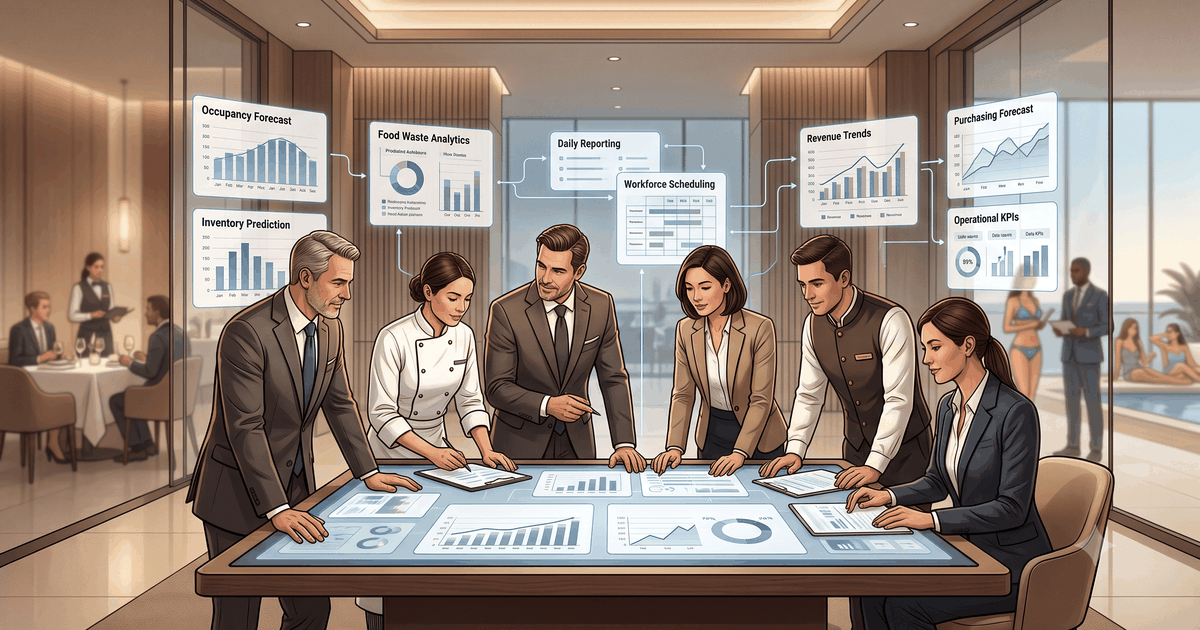
Over several weeks we spoke with hospitality professionals across Europe, the Middle East, North Africa and Latin America. General managers. Food and beverage directors. Revenue and reservations managers, front office leaders, bar managers, an in-room dining manager, an executive chef, an event producer. Some ran teams of four. One was responsible for more than four hundred. Properties ranged from four-star resorts and high-volume all-inclusives to Michelin-starred luxury hotels.
The answers were not what the conference-booth version of hotel AI would predict. They were more useful if you are deciding what to build or buy this year.
Everything below is aggregated. Responses were given in confidence, so nothing is attributed and no property is identifiable.
How we asked the question
We asked one deliberately narrow question:
Where in your day could AI act as your assistant, not your replacement?
That framing did most of the work. Ask hospitality people about "AI transformation" and you get press-release language back. Ask them which forty minutes of their Tuesday they would happily never spend again, and you get the truth.
I have run the same exercise inside client projects for years. Replace the abstract noun with a specific hour of a specific day and people stop performing, start describing. That one change is why this research surfaced things I have not seen written down anywhere.
Key Takeaway
The most requested AI use cases in hospitality are inventory forecasting and daily reporting. Both are back-of-house. Neither will ever appear in a brand campaign.
The demand is in the back office, not the guest room
Almost every AI product marketed to hotels right now points at the guest. Chatbots, booking engines, upsell engines, personalisation. If you judged the industry by its trade-show floor, you would conclude the great unsolved problem in hospitality is that guests cannot get answers fast enough.
That is not what the people doing the work said.
The two most-cited areas, by a clear margin, were inventory and waste forecasting, and daily operational reporting. Roughly a quarter of everyone we spoke to raised each one unprompted. Among those working in food and beverage specifically, closer to half named inventory as their single biggest manual burden.
Guest personalisation, the most heavily marketed AI use case in hospitality, was named as a priority by almost nobody. One revenue professional went further. In a four-star, tour-operator-dominated sales mix, he said, revenue is driven by contracted allotments and pricing, not by algorithmic guest personalisation, and the macro-level claims about AI personalising hospitality are mostly hype.
That is a striking thing to hear from someone whose job is revenue.
Guest-facing AI does work. We have deployed hotel chatbots for booking and guest support that measurably shift direct conversion, and I would still recommend one to most properties. The problem is proportion. The market has built four versions of the guest chatbot and roughly zero versions of the thing the F&B director asks for every morning.
Inventory and waste forecasting was the top request
What made this finding credible was not the volume of mentions. It was how specific they were.
One food and beverage director described his morning as a fixed list: eggs in shell, liquid egg, milk, flour, butter. Every day he estimates how much of each the buffet needs against expected occupancy. He already knows the ratio roughly. He simply has to redo the arithmetic every single day, forever. What he wanted was not intelligence. It was an automation that reads occupancy, establishes an average, and produces a number the executive chef only has to check. His reason: so the team can focus on creating experiences instead of restocking shelves. He added that the same logic would apply to the bars.
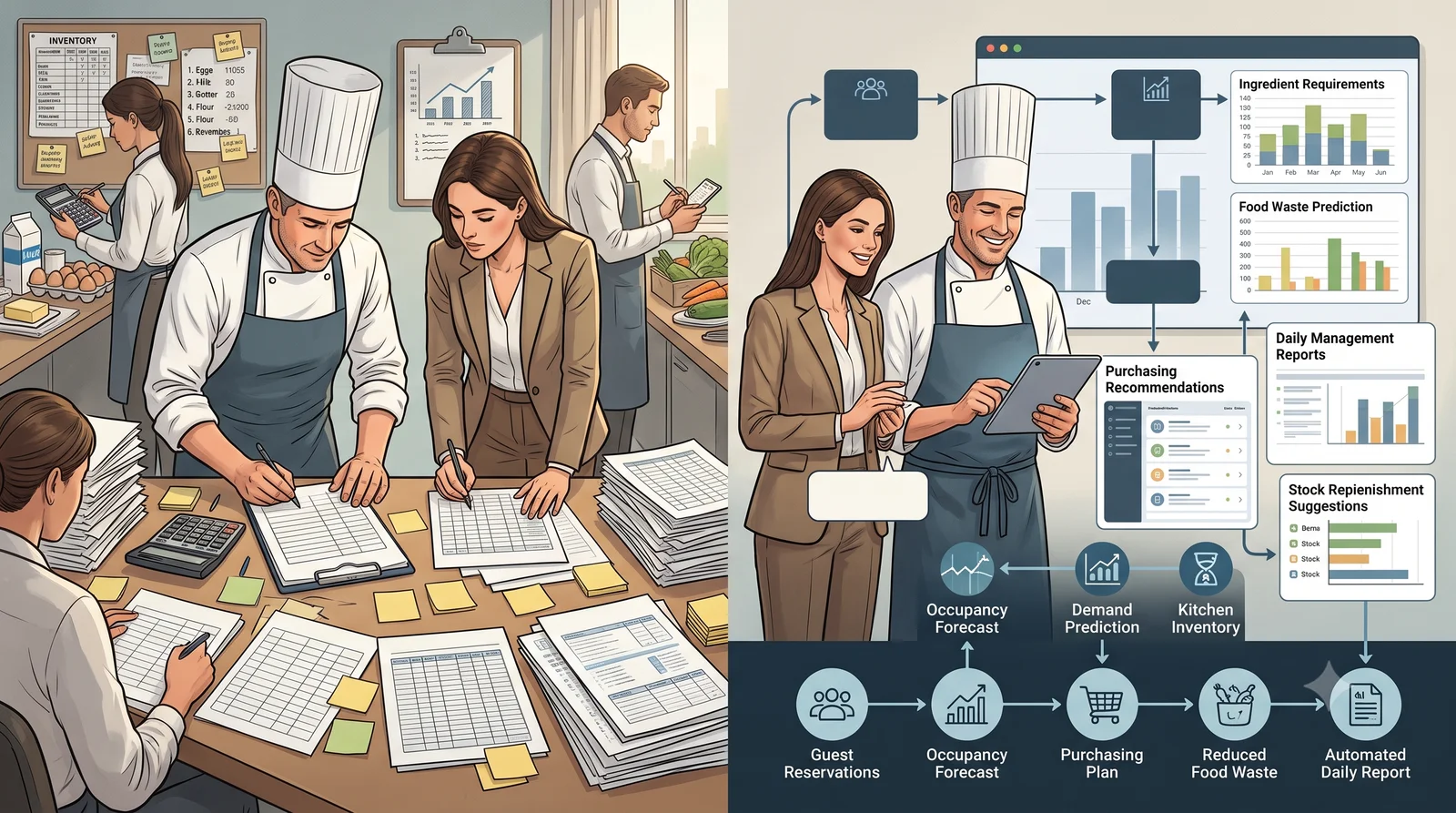
A bar manager described the identical loop from a different department. Daily stock control, waste tracking, predicting requirements from consumption patterns. Then he named the part that rarely gets said out loud: these manual processes are prone to human error. It is not only slow. It is wrong often enough to matter.
A director responsible for hundreds of staff named predictive inventory and food waste as the two processes still demanding the most manual effort at scale. A bar manager at a five-star property gave a two-word answer. Stock management.
Waste came up alongside inventory almost every time, and the two are the same problem from opposite ends. Order too little and someone is driving to a cash-and-carry at 6am. Order too much and money goes into a bin after service. The published economics back the operators up.
| Metric | Figure | What it means for your property |
|---|---|---|
| Food waste as share of food cost | 4–10% (around 8% in hotels) | On a $1.2M annual food spend, roughly $96,000 goes in a bin |
| Waste at a typical 300-room hotel | 150–200 tonnes/year | $180,000–$240,000 including disposal fees and lost revenue |
| Reduction from AI forecasting and portion control | 20–40% | $36,000–$96,000 recovered per property per year |
| Return per $1 invested in waste reduction | $7 average (WWF) | Payback measured in months, not years |
This is the strongest automation candidate for an unglamorous reason: the inputs already exist. Occupancy forecasts exist. Consumption history exists. The relationship between them is stable and learnable. Nobody is asking a machine to be creative. They are asking it to stop making them do arithmetic. The same pattern shows up in restaurant menu and kitchen automation, where prep forecasting off covers data follows exactly the same shape.
Daily reporting is an invisible tax on management time
Reporting came a very close second, and the workflow was almost identical across wildly different properties.
Every morning, someone extracts reports from the property management system. They pull additional numbers from other systems that do not talk to the first one. They reassemble those numbers into a template the hotel has used for years, because the general manager or the owner expects that exact format. Then they email it upward.
It is not hard work. It is not skilled work. It eats a chunk of a well-paid person's morning, every day. The HotelTechReport 2026 PMS Impact Study surveyed more than 450 global operators and found 89% of hoteliers save 2 to 10 hours a week once their systems do more of this lifting, and 17% save over 10 hours. That is more than 500 hours a year per property.
One operations specialist in luxury food and beverage described the broader version: collecting information from different systems, reports, guest profiles and emails to produce daily operational documents. Despite all that effort, mistakes still happen. His ask was precise, and it is the part most software gets wrong. Generate the documents while preserving predefined templates and formatting.
"Hotels do not want a beautiful new dashboard. They want their report, in their format, produced without a human assembling it by hand."
— The requirement that disqualifies most tools on the marketTwo details from that conversation are worth flagging. He asked us which tools reliably extract structured data from reports and PDFs without destroying an existing template. He had been looking. He had not found them. He had also already built his own spreadsheet automation for payroll at a previous employer, and it cut manual work and errors sharply.
That is the real state of hospitality automation. Capable operators quietly building their own tools in Excel because nothing off the shelf fits.
Reporting is so automatable for the same reason it is so tedious. It is entirely deterministic. There is no judgment in it. Someone is functioning as a data pipeline made of flesh. In our own workflow automation builds, this is the first thing we take off a manager's desk, because it is the fastest measurable win and it costs nobody their job.
What each department asked for
Repetitive guest communication came up about as often as reporting. Here is what the asks looked like, department by department.
Reservations: the same three requests, forever
A reservations manager listed what his team receives daily. A high floor. A particular view. Smoking or non-smoking. Every one gets the same reply: noted, and subject to hotel availability. It is a perfectly good answer. It is also an answer a human types dozens of times a week, and a textbook candidate for a retrieval-backed assistant that drafts the reply and waits for a yes.
Front office: stop retyping email into the PMS
A front office manager wanted guest requests arriving by email to flow straight into the property management system instead of being retyped by hand. No intelligence required. Just parsing, mapping, and a human confirming the write. The least glamorous integration in the building, and probably the highest-frequency one.
In-room dining: the same sequence all night
An in-room dining manager gave the most complete map of the problem. His team repeats one sequence every shift: take the order, confirm details, check allergies, recommend items, enter it into the POS, coordinate with the kitchen. He was not asking to remove the human from hospitality. He wanted the repetition handled so the team could spend attention on what actually creates value.
General management: emails and schedules
A general manager, asked which operational challenge takes more time than it should, answered simply: writing emails, and working with people. Pressed on what she would want automated, she named schedules, guest replies, and parts of the reservation process. Notice she did not name the people part. She named the typing part.
Restaurants in catering: processing feedback, not personalising it
A restaurant manager in a catering operation chose something different from everyone else. Collecting and acting on guest feedback and satisfaction. It was the only guest-facing answer in the whole set, and notably it was about processing feedback rather than generating personalised experiences. Even the guest-facing ask was an operations ask.
The theme is not that guest communication should be automated away. The repetitive portion of it, the noting and acknowledging and retyping between systems, is eating the time that should go to the interactions that genuinely need a person. Tools like email automation and WhatsApp Business automation already handle most of that shape well, provided a human still approves anything that reaches a guest.
The dirty data problem nobody demos
This came from fewer people, but it reframed everything else.
A revenue professional explained that his data is fragmented across the PMS, tour operator extranets, and channel managers. Each system speaks its own language. Before any real analysis, whether that is pace, season-over-season comparison, or spotting deviations across markets, he first has to reconcile, normalise and clean. Most of what looks like analysis is janitorial work in Excel.
Then he said the thing every hospitality AI vendor should be made to read aloud.
"Without clean, comparable data, an AI pricing recommendation is just a faster way to get it wrong."
— Revenue professional, four-star resort groupWe pushed him on what specifically breaks when merging sources. His answer is the most operationally useful material in this research, and I have not seen it written down anywhere.
| Failure mode | How often it breaks | Cost when it does |
|---|---|---|
| Room type mapping. Every tour operator uses its own naming and categorisation. Introduce a new category and someone must manually track how each partner maps old logic to new. | Constantly | Low. Loud and obvious, so it gets caught. |
| Date range mismatches. Rarely because dates are wrong. Internal booking-window cycles do not align one-to-one with tour operator rate-card tariff periods. | Often | Medium. Produces false deviations in pace unless both sides are brought onto a common timeframe first. |
| Cross-PMS consolidation. Two property management systems differ in column formats, in how net and gross are calculated, even in what counts as a "night" versus a "booking". | Rarely | High. Quietly distorts aggregated KPIs unless someone checks line by line before merging. |
Read those two right-hand columns together. Ranked by frequency, room type mapping is the worst. Ranked by cost, the order reverses completely. The thing that breaks least is the thing that will silently wreck your board pack. And room type mapping, as he pointed out, is not a technical problem at all. It is a communication one. You cannot fix it by re-running an extraction.
The fragmentation shows up in the tooling respondents named across a normal day. Property management systems, POS, materials control, table reservation platforms, finance software, tour operator extranets, channel managers. Several people worked across four or more daily, none of which reconcile automatically.
He also explained why this persists. Investment went to front-end technology, anything a guest can see. Back-end data hygiene is invisible and nobody demos it, so it has been neglected for years.
This is the uncomfortable part of the findings. Every valuable use case above depends on data that, in many hotels, is not currently in a fit state to use. If you are weighing up autonomous workflows for your hotel, budget for reconciliation before you budget for intelligence.
Rostering, payroll ratios and commercial work
Three areas came up less often but with unusual conviction from the people who raised them.
Rostering, driven by demand data you already hold
A restaurant general manager at a luxury property said the single best thing AI could do for managers is roster management. Daily changes, sick leaves, the small crises that arrive every morning. His idea was to integrate the roster with reservations, so decisions about calling in extra staff could be made faster. A director managing a very large team independently named demand-driven scheduling as one of his two biggest manual burdens. Same idea, opposite ends of the scale, and exactly the logic behind AI-assisted HR and scheduling workflows.
Payroll as a ratio, not a number
A food and beverage manager running a multi-million-pound operation named something nobody else did. Automating payroll forecasting into ratios for revenue optimisation. His observation was blunt: hospitality does not have such a system yet. Given that labour is the largest controllable cost in most properties, the absence is genuinely odd.
Commercial and CRM grind
A sales manager who had led a hotel through a full rebrand described the commercial workload precisely. Manual CRM updates, preparing proposals, following up with leads, qualifying opportunities, generating reports. Her ideal assistant would summarise client interactions, draft personalised follow-ups, update the CRM automatically, and remind the team of the next best action, so the team could spend its time building relationships instead of recording them. That is close to a literal spec for CRM automation. An event producer added the logistics version: cross-checking vendor contracts, tracking real-time supplier updates, and rebuilding schedules after last-minute changes across time zones.
None of these are exotic. All of them are pattern-matching against data the business already produces.
Where staff said AI should not go
We expected defensiveness about job security. Instead we got precise, thoughtful lines drawn around specific tasks.
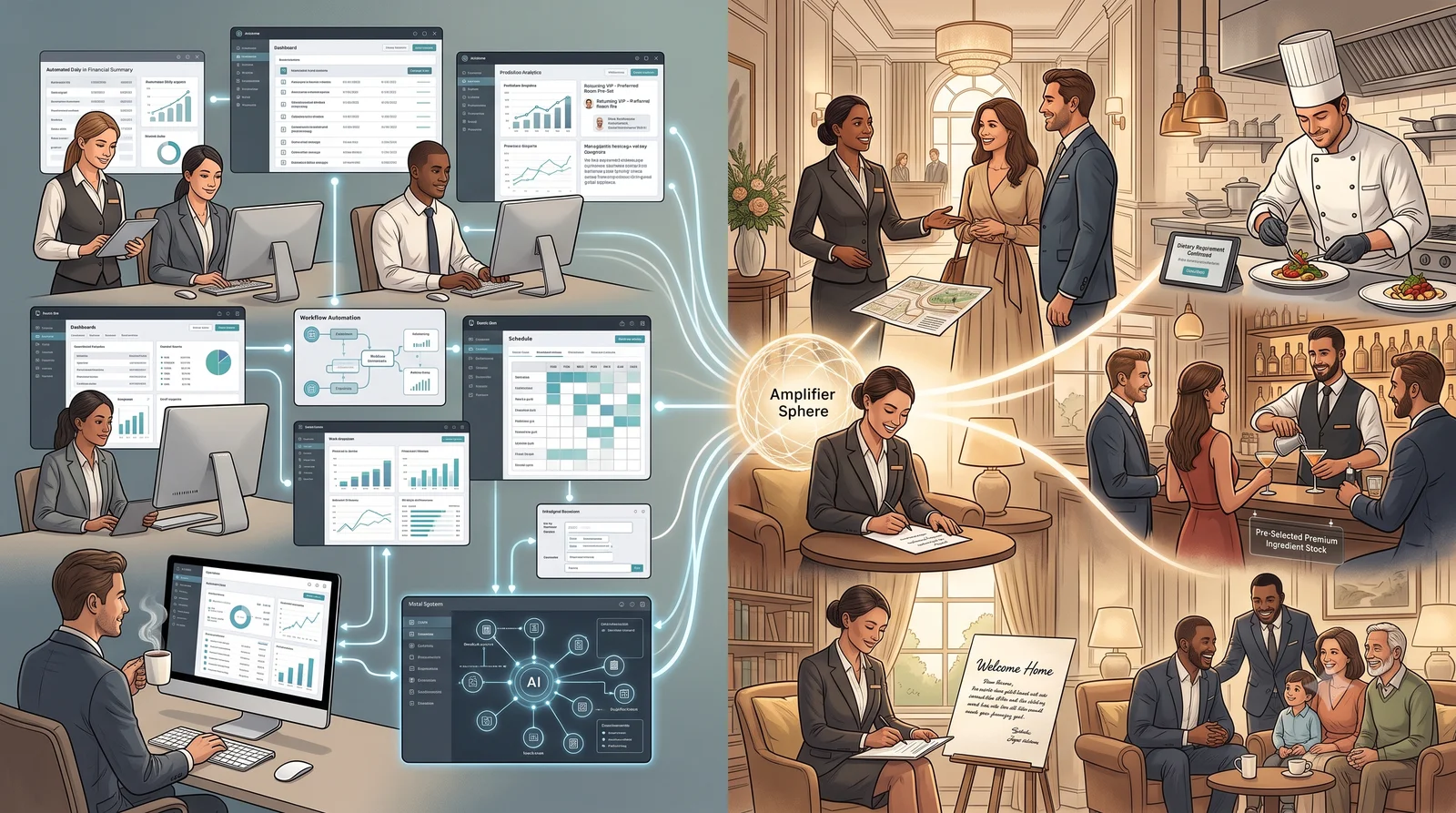
A guest relations professional writes handwritten letters to VIP guests every day. She was direct that AI cannot and should not do that in her place, and she is right. The value of that letter is that a person chose to spend fifteen minutes on it. Asked what else AI should take over, she thought about it and said nothing.
An event producer listed what she would hand over happily: tracking logistics, drafting compliance checks, schedule building. Then, unprompted, what she would never hand over. Creative strategy.
An executive chef reported his kitchen is not officially using AI in planning at all. A general manager, asked where AI could add value without compromising the guest experience, said she saw no such opportunity.
None of this is technophobia. It is an accurate instinct about where the value of the work sits. The tasks people wanted to keep are the ones where human attention is the product. The ones they offered up are transcription and arithmetic. Any system that gets this boundary wrong will be rejected, and rightly.
The AI is already in the building, just not officially
One pattern surprised me. Several respondents told us their organisation uses no AI at all, then described using it personally, that week.
A head chef uses it for admin and for building recipes around guest intolerances and allergies, a genuinely high-stakes task, while his kitchen has no official AI in its planning process. A guest relations agent uses it when she cannot think of a recommendation fast enough, including what to suggest on a rainy day.
So the picture is not a reluctant workforce waiting to be convinced. It is individuals already reaching for these tools privately to patch the gaps their systems leave, with no support, no standards, and no institutional learning from any of it. Any organisation claiming zero AI adoption should probably check.
"Not another system to manage"
The most important adoption constraint came from a luxury operations professional, and it governs everything above. Hospitality teams are already fully occupied delivering the guest experience, and in high-labour-cost markets there is no slack to implement new technology. Whatever AI does, it should simplify operations. It should not become one more platform to learn, log into, maintain and eventually resent.
This is where most hotel technology dies. Not from failing to work, but from asking a short-staffed head of department to adopt a new interface during service. The winning shape is probably not a dashboard at all. It arrives where the team already is, in email, in messaging, in the report they already send, and it asks for a yes or a no.
How to build this in your hotel
This is the sequence I would run at a single property. It is deliberately slow at the start.
Pick one report, not one department. Choose the single daily document that costs the most management time. Photograph the current version. That file is your specification and your acceptance test.
Trace every number to its source. For each cell, write down which system it comes from and who touches it. Expect to find two or three numbers nobody can fully explain. Resolve those before writing any code.
Fix room type mapping and tariff periods first. Build the reconciliation layer before the forecasting layer. Agree a common timeframe with each partner and a canonical room type table. This is a week of conversations, not a technical sprint.
Automate the report into the existing template. Same file, same format, same recipients. Nobody should have to learn anything. If a vendor insists you adopt their layout, that is a product limitation and not a technical constraint.
Run it in parallel for two weeks. Human and machine produce the report side by side. Compare line by line. You are buying trust here, and trust is what determines whether anyone uses it in month three.
Add inventory forecasting on the clean data. Now that occupancy and consumption reconcile, forecast the buffet list. Output a suggested order the chef approves or edits. Track the delta between suggestion and actual for four weeks to calibrate.
Put approvals where the team already is. Email or WhatsApp, not a new dashboard. Anything that spends money or reaches a guest requires a human yes. Anything that only moves data between systems can run unattended.
Measure two numbers and publish them monthly. Manager hours returned per week, and food cost variance against forecast. Skip this and the automation becomes invisible by month four, which is when the next budget cycle quietly kills it.
Five questions worth asking any hospitality AI vendor
Drawn directly from what operators told us, these five will separate serious tools from demos:
- Can it produce our existing report, in our existing template, or does it expect us to adopt its format?
- What happens when our room type codes do not match our partner's? Is that handled, or is it still a person's job?
- Where does it live? A new dashboard, or the email and messaging we already use?
- What does it do before it forecasts? If the answer is not reconciliation, be sceptical of the forecast.
- What does it do without asking permission? Anything that spends money or reaches a guest should require a human yes.
One obstacle worth naming
When we asked an F&B manager whether he could share a stock or waste log with the figures anonymised, the answer was that company policy prohibited it, even anonymised. He was interested in the project. He was willing in principle. The organisation said no.
A capable operator, personally motivated to solve a problem he had just described in detail, cannot supply the data required to solve it. Multiply that across an industry and you get the current situation: enormous appetite for operational AI, almost no route to build it against real operational data. If you want better tools, establish an internal path for sharing anonymised operational data. Not guest data. Consumption logs, report templates, roster structures.
Point the intelligence at the least glamorous work in the building
The build priority writes itself. Inventory and waste forecasting first: most requested, measurable in currency, inputs already exist. Automated daily reporting second: highest-frequency pain, entirely deterministic, provided you preserve the existing template. Repetitive guest communication third, with a human approval step. Data consolidation runs underneath all three. Rostering, payroll ratios and CRM follow-up sit one tier out.
The principles came directly from the people doing the work. Fix the data before trusting the intelligence. Preserve the formats and workflows that already exist. Keep a human approving anything that spends money or reaches a guest. Never touch the parts of the job where human attention is the whole point. And do not add another system to manage.
None of this is about artificial intelligence being clever. It is about pointing it at the least glamorous work in the building, and being honest that the data underneath usually needs cleaning first. The properties that get this right will not have a flashier guest app. They will have managers who got their mornings back and a food cost line that moved. Our boutique hotel case study breaks down where that revenue actually came from.
Use the AI Business Twin for a free personalised analysis in under 10 minutes. It maps your property's specific workflows and tells you which of the five priorities above would pay back fastest.
A note on what we are doing with this
We are building in this space, starting with the reporting and inventory forecasting pieces, because that is where the people we spoke to pointed. If you run hotel or F&B operations and any of the above sounds like your morning, I would like to hear where your experience differs. Disagreement is more useful to me than agreement.
And if you took part in this research: thank you. The findings are yours more than ours.
Frequently Asked Questions
What do hotel staff actually want AI to do?
In our interviews with hospitality professionals across Europe, the Middle East, North Africa and Latin America, the two most requested use cases were inventory and waste forecasting, and automated daily operational reporting. Roughly a quarter of respondents raised each one without being prompted. Among food and beverage staff specifically, closer to half named inventory as their single biggest manual burden. Guest personalisation, the most heavily marketed AI use case in hospitality, was named as a priority by almost nobody.
Why is inventory forecasting the top AI use case in hotels?
Because the inputs already exist and the maths is repetitive rather than difficult. Occupancy forecasts exist in the PMS. Consumption history exists in materials control. The relationship between the two is stable and learnable. A food and beverage director redoing the same arithmetic for eggs, milk, flour and butter every morning is not asking for intelligence. He is asking for a number he only has to check. Food waste also runs at 4 to 10 percent of total food cost, so the savings are measurable in currency.
Can AI generate our existing daily report in our own template?
Yes, and this is the requirement most hotel software gets wrong. Hotels do not want a new dashboard. They want their existing report, in their existing format, produced without a person assembling it by hand. Template preservation is a solved engineering problem: the automation reads from the PMS and other systems, maps the values into the exact cells or sections of your existing document, and outputs the same file the owner has received for years. If a vendor cannot preserve your template, that is a product limitation and not a technical one.
Do we need to fix our hotel data before using AI?
Usually yes, at least partly. A revenue professional we spoke to put it plainly: without clean, comparable data, an AI pricing recommendation is just a faster way to get it wrong. The three things that break most often when merging sources are room type mapping across tour operator extranets, date range mismatches caused by differing seasonality logic, and consolidation across two property management systems that calculate net and gross differently. Reconciliation should happen before forecasting, not after.
Will AI replace hotel staff?
The people we interviewed drew that boundary themselves, and they drew it well. A guest relations professional who writes handwritten letters to VIP guests said AI cannot and should not do that in her place. An event producer offered up logistics tracking and compliance checks, then said she would never hand over creative strategy. The tasks staff wanted to keep are the ones where human attention is the product. The tasks they wanted to hand over are transcription and arithmetic.
How long does it take to automate hotel daily reporting?
For a single property with a stable report template, two to four weeks is realistic. Week one is mapping where each number on the report comes from. Week two is building the extraction and the template fill. Weeks three and four run the automation in parallel with the human process so you can compare outputs line by line before anyone trusts it. The long pole is almost never the AI. It is getting reliable access to the systems the numbers live in.
What should we ask an AI vendor before buying hospitality software?
Five questions separate serious tools from demos. Can it produce our existing report in our existing template, or does it expect us to adopt its format? What happens when our room type codes do not match our partner's? Where does it live, a new dashboard or the email and messaging we already use? What does it do before it forecasts, and is reconciliation part of that? And what does it do without asking permission? Anything that spends money or reaches a guest should require a human yes.
Does this apply to independent hotels or only large groups?
The interview set ranged from four-star resorts and high-volume all-inclusives to Michelin-starred luxury hotels, and included teams of four people alongside one of more than four hundred. The pattern held at every size. Smaller properties have an advantage here, because fewer systems means less reconciliation work before a forecast can be trusted. An independent hotel running one PMS and one POS can usually get automated daily reporting live faster than a group juggling two property management systems and several tour operator extranets.