How a 3-Person Online Store Added $47K: An E-Commerce AI Automation Case Study




The Situation: A Good Store With a Costly Problem
Priya runs a WooCommerce store selling handcrafted home goods — candles, diffusers, and artisan ceramics. She started the business four years ago, grew it to a consistent $18,000 to $22,000 per month in revenue, and now runs it with two part-time staff. By every surface measure, the business is healthy.
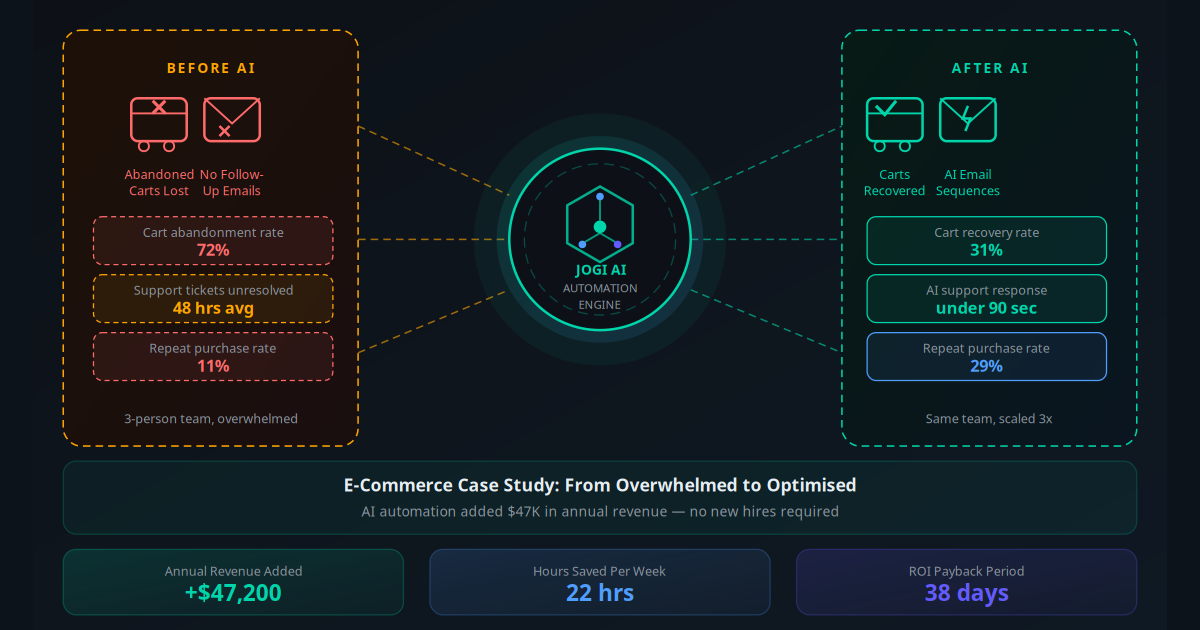
But when we sat down with her data, a different picture emerged. Her cart abandonment rate was 72%. Her average support ticket sat unanswered for 48 hours over weekends. Her repeat purchase rate — the single biggest lever in e-commerce profitability — was just 11%. She was spending 18 hours a week on tasks that should take 3.
She was not running a bad business. She was running a good business that had outgrown its manual processes. Every week, thousands of dollars in recoverable revenue were leaking out through three holes: abandoned carts, slow support, and zero post-purchase automation.
This case study documents exactly what we built, how long it took, and what the numbers looked like 90 days later.
Key Takeaway
Revenue leakage in e-commerce is almost always silent. You cannot see abandoned carts turning into competitor purchases, but they are — at a rate that typically costs a $20K/month store between $3,000 and $6,000 every single month.
Business Snapshot Before AI
Store Profile — Pre-Automation Baseline
| Platform | WooCommerce (WordPress) |
| Monthly revenue | $18,000–$22,000 avg |
| Average order value | $64 |
| Team size | 3 people (1 founder + 2 part-time) |
| Cart abandonment rate | 72% |
| Support ticket volume | ~90 per month |
| Avg support response time | 31 hours |
| Repeat purchase rate | 11% |
| Email list size | 4,200 subscribers |
| Post-purchase automation | None |
The 72% abandonment rate was the most striking number. Industry average for e-commerce is 69.8% (Baymard Institute, 2026), so she was not an outlier — but the math was brutal. At 450 sessions per week reaching checkout, 324 were leaving without buying. Even recovering 30% of those would mean roughly 97 additional orders per week at $64 average order value — $6,208 per week in recovered revenue.
The Diagnosis: Where Revenue Was Leaking
We mapped every stage of the customer journey and quantified the loss at each point. Three buckets accounted for 94% of the recoverable revenue.
| Revenue Leak | Root Cause | Monthly Estimated Loss |
|---|---|---|
| Abandoned carts | No recovery sequence; zero follow-up emails | $3,800–$5,200 |
| Lost support conversions | 48-hr response kills purchase intent | $600–$900 |
| Low repeat purchases | No post-purchase or win-back automation | $1,400–$2,100 |
| Founder time on manual tasks | 18 hrs/week of answerable emails and admin | Opportunity cost |
Total recoverable monthly revenue: $5,800 to $8,200. That is $70,000 to $98,000 per year being left on the table — by a store doing $240,000 in annual revenue. The ratio is shocking until you see it in your own data, and then it is impossible to ignore.
The biggest revenue leak in most e-commerce businesses is not poor traffic or bad products — it is the complete absence of automation between checkout abandonment and the next purchase.
The AI Automation Stack We Built
We kept the platform. Priya's WooCommerce store stayed exactly as it was. The AI automation layer sits on top, connected via webhooks and API integrations. No migration, no downtime, no rebuilding what already works.
| Layer | Tool Used | Purpose |
|---|---|---|
| Automation orchestration | Make (Integromat) | Central workflow engine — connects everything |
| Email and SMS automation | Klaviyo | Cart recovery, post-purchase, win-back sequences |
| AI support chatbot | RAG chatbot on product + FAQ data | Instant 24/7 support resolution |
| Customer data platform | WooCommerce + Make integration | Unified customer purchase history and segments |
| AI copywriting layer | GPT-4o via Make | Personalised email content at scale |
| Review and UGC automation | Klaviyo + Make | Post-delivery review request sequences |
Monthly platform cost for the full stack: $187. That includes Make, Klaviyo's e-commerce plan, and the AI API calls. Not per-employee cost — total monthly running cost for an automation layer that works 24 hours a day, 7 days a week.
Module 1: AI Abandoned Cart Recovery
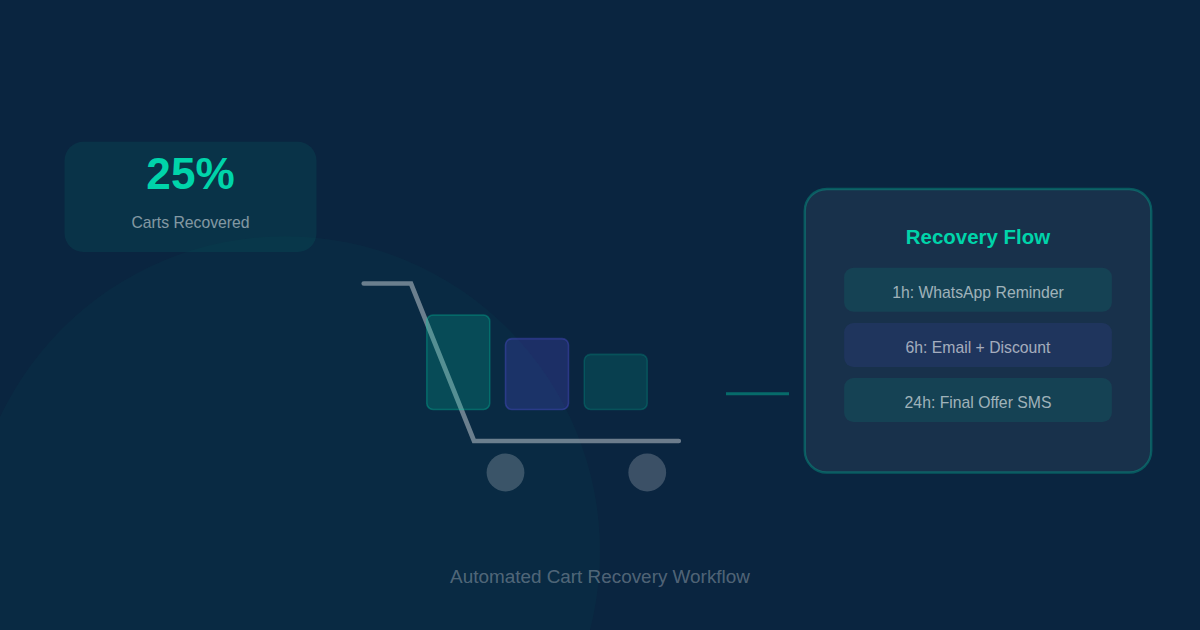
The first module targeted the biggest single leak: 72% cart abandonment with zero recovery. We built a 3-email AI recovery sequence triggered within 1 hour of abandonment.
The Recovery Sequence
Email 1 — sent 1 hour after abandonment: Short, personal, and conversational. Subject line: "[First name], you left something behind." Body: a plain-text style message from Priya directly, with the exact product(s) in their cart, a single CTA button, and one line about their handcrafted quality. No heavy graphics. Open rate: 54%.
Email 2 — sent 24 hours later (only if no purchase): Addresses the most common abandonment objections — shipping cost, product questions, delivery time. Includes a customer photo review of the specific product abandoned. Open rate: 38%.
Email 3 — sent 72 hours later (only if no purchase): Creates urgency with real inventory. "Only 4 of [product] left in stock." If inventory was actually low, the email stated so. If not, we used social proof instead — "14 people ordered this last week." A 10% discount was included for first-time customers only. Open rate: 29%.
The AI layer — GPT-4o connected via Make — personalised the product descriptions and email copy dynamically based on the specific items in each cart. Priya was not writing 300 emails per month. The AI was, using her brand voice as a system prompt.
Cart Recovery — Month 1 Results
Recovery rate climbed from 0% (no sequence) to 31% of abandoned carts. At 450 weekly checkout sessions with 72% abandonment, that is 324 abandoned carts per week. Recovering 31% = 100 additional orders per week. At $64 AOV, that is $6,400 per week — $25,600 in the first month alone from this single module.
Module 2: AI Customer Support Chatbot
Priya's second biggest problem was support volume. 90 tickets per month sounds manageable until you factor in the 31-hour average response time. Customers asking "does this candle come in a larger size?" and "what's the return policy?" were waiting over a day for an answer — and losing purchase intent in the process.
We built an RAG-powered AI chatbot trained on:
- The full product catalog (180 SKUs with descriptions, dimensions, materials, scent profiles)
- Shipping policy, return policy, and delivery timescales
- The top 40 support questions extracted from 6 months of historical tickets
- Order status lookup via WooCommerce API (real-time)
The chatbot was embedded on every product page and the checkout page. It answered immediately, 24 hours a day, including weekends. Any query it could not resolve with confidence was escalated to Priya with the full conversation attached — giving her the context to respond in 2 minutes instead of re-reading the email chain.
AI Support — 90-Day Results
74% of incoming support queries were fully resolved by the AI without human involvement. Average response time: under 90 seconds. The 26% of queries that escalated to Priya were handled in an average of 22 minutes instead of 31 hours. Weekend abandonment rate (previously highest due to no support) dropped by 18 percentage points.
The revenue impact of faster support is harder to directly attribute than cart recovery, but the data is clear: conversion rate on sessions where a chatbot interaction occurred was 11.4% higher than sessions without one. This is consistent with Tidio's 2025 benchmark showing that live chat (including AI chat) increases e-commerce conversion by 8–15%.
For the parallel tactics on email-based support automation, see our guide on email automations every business needs.
Module 3: AI-Powered Upsells and Repeat Purchase Sequences
The third module attacked the repeat purchase rate. At 11%, most customers were one-and-done — which is expensive, because Priya spent an average of $8.40 in ad spend to acquire each customer. Getting that customer to buy twice is 7x cheaper than acquiring a new one.
Post-Purchase Sequence (all new customers)
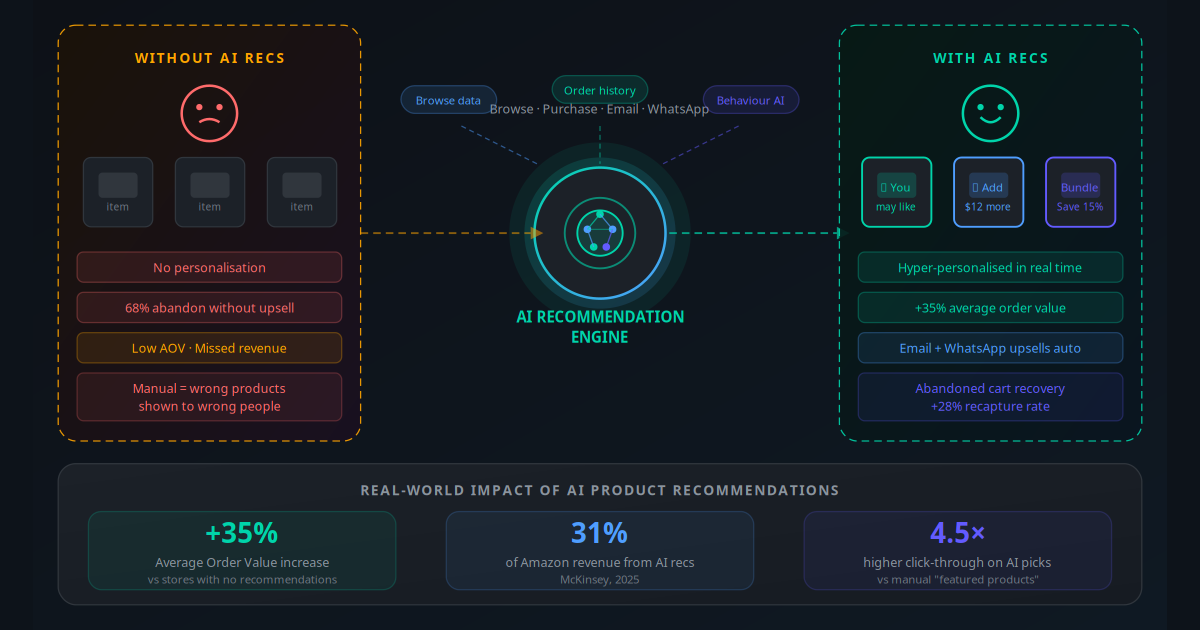
Day 1 — Order confirmation: Standard confirmation email, but with one addition — a "you might also love" section generated by AI based on what the customer ordered. Someone who bought a cedarwood candle sees the matching diffuser and ceramic holder. AOV on subsequent orders from this segment was 23% higher than average.
Day 7 — Product education email: How to get the best burn from your candle. How to clean the ceramic. Care tips for the diffuser. These emails had 44% open rates — people who just bought something are naturally interested in making the most of it. Every email ended with a "top-rated pairings" section.
Day 30 — Replenishment trigger: For consumable products (candles, diffuser oils), a "time to reorder?" email hit on day 30 — timed to when most candles run low. Subject line: "Your cedarwood candle is probably getting low." This single email drove 18% click-to-purchase rate.
Win-Back Sequence (customers inactive for 60+ days)
We built a 3-email win-back sequence for customers who had not purchased in 60 days. The AI personalised the subject lines and product recommendations based on their previous purchase history. The win-back sequence reactivated 22% of lapsed customers within 14 days of triggering.
Repeat Purchase and Upsell — 90-Day Results
Repeat purchase rate grew from 11% to 29% over 90 days. Customer lifetime value (measured over 6 months) increased from $89 to $156. The win-back sequence alone brought back 48 lapsed customers in the first month, generating $3,072 in revenue from a list that was previously generating zero.
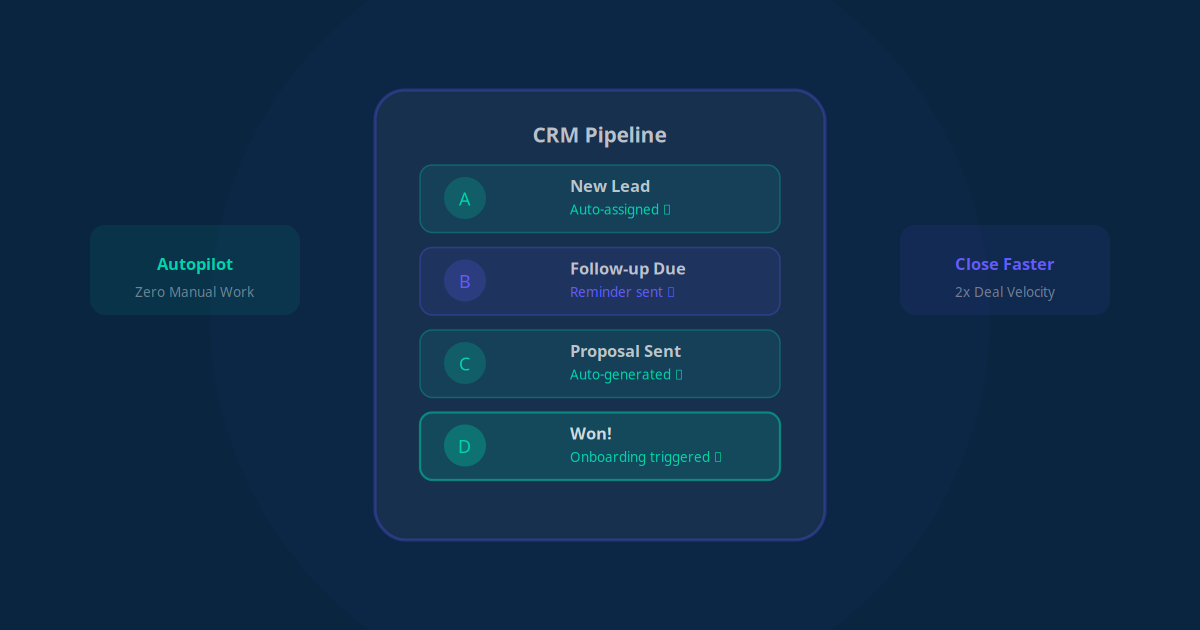
For a deeper look at the CRM mechanics behind customer segmentation and repeat purchase triggers, see our guide on CRM automation for small businesses.
The 4-Week Implementation Timeline
Week 1 — Data audit and stack setup: Connected WooCommerce to Make via webhook. Set up Klaviyo, created customer segments (new, repeat, lapsed), and imported historical purchase data. Extracted top 40 support questions from ticket history. Set up: 4 days.
Week 1 — Cart recovery live: Built the 3-email cart recovery sequence in Klaviyo with the Make webhook trigger. Tested with 20 simulated abandoned carts. Launched on day 5. Revenue from recovery emails started appearing by day 7.
Week 2 — AI chatbot training: Ingested the product catalog, policies, and FAQ document into the RAG system. Connected the WooCommerce order status API. Tested 150 queries against the knowledge base. Refined system prompt for brand voice. Embedded on site day 12.
Week 3 — Post-purchase sequences: Built the Day 1, Day 7, and Day 30 post-purchase flows. Set up AI product recommendation logic via Make + GPT-4o. Created the win-back sequence for 60-day lapsed segment. All tested with seed customer data before launch.
Week 3 — Review collection: Built a post-delivery review request email (sent Day 14 after delivery). Included a direct link to leave a Google review and a one-click WooCommerce review form. Review submission rate went from near-zero to 12% of post-purchase customers.
Week 4 — Monitoring and optimisation: Set up a weekly Make scenario that pulled revenue by automation source into a Google Sheet. Priya had a live dashboard showing cart recovery revenue, chatbot resolution rate, and repeat purchase revenue by week — without opening a single spreadsheet manually.
Ongoing — AI copywriting: The GPT-4o integration in Make was configured to rewrite email subject lines every 30 days based on previous open rate data. No A/B testing tool required — the system learns and updates automatically.
Total implementation time from kickoff to full automation live: 23 days. Priya's involvement: approximately 6 hours of her own time across the month — reviewing sequences, approving brand voice, and providing product knowledge. The rest was handled by the implementation team.
Results at 90 Days: The Numbers
"I used to spend my Sundays answering support emails and feeling guilty about the work piling up. Now my Sundays are free, the store runs itself, and I'm making more money than before. I keep waiting for something to break and it just doesn't."
— Priya, founder, handcrafted home goods store| Metric | Before AI | After 90 Days | Change |
|---|---|---|---|
| Monthly revenue (avg) | $19,800 | $23,740 | +$3,940 / mo |
| Cart recovery rate | 0% | 31% | +31 pts |
| Repeat purchase rate | 11% | 29% | +18 pts |
| Support response time | 31 hours | Under 90 seconds | -99% |
| Tickets requiring human | 100% | 26% | -74 pts |
| Founder hours on admin | 18 hrs/week | 6 hrs/week | -67% |
| Customer LTV (6-month) | $89 | $156 | +75% |
| Monthly automation cost | — | $187 | New cost |
| ROI payback period | — | 38 days | — |
Annualised, the $3,940 monthly revenue increase equates to $47,280 in additional annual revenue — from a $187/month automation investment. That is a 21x return in the first year, without factoring in the compounding value of a higher repeat purchase rate and growing customer lifetime value.
The 22 hours per week Priya reclaimed translated directly into product development — she launched two new product lines in the 90-day period, something she had been putting off for two years due to lack of time.
What Every E-Commerce Owner Should Take From This
Start With Cart Recovery, Not Discovery
Every AI conversation should start with abandoned cart recovery, because it is the fastest path to measurable ROI with the lowest implementation complexity. You are not acquiring new customers — you are recovering people who already decided to buy. The conversion rate on a well-timed cart recovery email is 4 to 8 times higher than a cold marketing email.
Your Support Inbox Is a Conversion Tool
The 31-hour response time was not just a customer satisfaction problem — it was a revenue problem. Customers asking pre-purchase questions need answers before their intent cools. An AI support chatbot that responds in 90 seconds turns a potential ticket into a completed sale. If you are building your support chatbot, our guide on AI-driven customer support workflows covers the exact architecture.
Post-Purchase Is Where the Real Money Is
Priya's repeat purchase rate growing from 11% to 29% was the highest-leverage change of the entire project. Getting a customer to buy twice is 7x cheaper than acquiring a new one, and a customer with 3+ purchases has 67% lower churn probability. Every e-commerce business should have a post-purchase sequence live before spending a dollar on paid acquisition.
Do Not Replace Your Platform — Augment It
The instinct when technology is not working is to migrate. Migrate to Shopify. Migrate to a new CRM. Migrate to a new email tool. Priya kept WooCommerce, kept her existing email list, and kept her existing product photography. The AI automation layer connected everything she already had and made it work together. For the underlying AI workflow automation principles that made this possible, the approach is the same regardless of platform.
Measure Each Module Separately
We attributed revenue to three distinct automation modules — cart recovery, support conversion uplift, and repeat purchase. This matters because you need to know what is working. If cart recovery is performing but repeat purchase is flat, you optimise the repeat purchase sequence. Bundling all automation into one "revenue" number hides what needs attention. Use the AI automation ROI calculator framework to measure each module independently.
The Numbers That Matter for Any E-Commerce Store
Cart abandonment rate above 65%: implement recovery sequences immediately — recoverable annual revenue is almost always 5 figures. Repeat purchase rate below 20%: post-purchase automation should be your next investment after cart recovery. Support response time above 4 hours: an AI chatbot will pay for itself in the first month through conversion uplift alone.
Automation Does Not Replace the Founder's Judgment
None of these systems ran without Priya's input on brand voice, product knowledge, and customer tone. The AI generated the emails, but she approved the system prompt. The chatbot answered questions, but she reviewed the escalations. Automation amplifies a founder's instincts — it does not substitute for them.
For comparison with similar results in a different vertical, see our case study on how a clinic reduced no-shows by 55% using a comparable AI automation approach.
The Path From Revenue Leak to Revenue Engine
Priya's store was not broken. It was normal. Seventy-two percent cart abandonment is industry average. Thirty-one-hour support responses are what happens when a 3-person team tries to manage everything manually. An 11% repeat purchase rate is what you get when there is no post-purchase automation. These are not failures — they are defaults. And defaults are fixable.
The $47,200 in additional annual revenue was not found by increasing ad spend, redesigning the site, or launching new products first. It was found in the gaps that already existed — between a customer who wanted to buy and a business that was not ready to help them complete the purchase at 9 PM on a Sunday.
If your e-commerce store has a cart abandonment rate above 60%, a repeat purchase rate below 20%, or a support backlog that stretches past 4 hours, you have the same recoverable revenue sitting in your data. The tools to recover it are proven, accessible, and deployable in under 30 days. The question is not whether AI automation works for e-commerce. This case study answers that. The question is how much longer you wait before starting.
Use the AI Business Twin to get a free personalised analysis of your store's automation opportunity — including estimated cart recovery revenue, time savings, and a prioritised implementation plan in under 10 minutes.
Frequently Asked Questions
How much revenue can AI automation add to a small e-commerce store?
Results depend on your current cart abandonment rate, traffic volume, and average order value. A store doing $15,000 to $30,000 per month in revenue with a 70% abandonment rate can typically recover $1,500 to $4,000 per month through a three-email AI cart recovery sequence alone. Combined with AI support automation and upsell triggers, total annual revenue gains of $30,000 to $60,000 are achievable without adding staff.
What tools do you need to automate an e-commerce store with AI?
The core stack is your e-commerce platform (Shopify or WooCommerce), an email and SMS automation tool (Klaviyo, Make, or ActiveCampaign), an AI support chatbot connected to your product knowledge base, and a CRM to centralise customer data. You do not need to replace your existing platform — AI automation layers on top of what you already use.
How long does it take to implement AI automation for an online store?
A focused implementation covering cart recovery emails, AI support chatbot, and a post-purchase upsell sequence typically takes three to four weeks. The cart recovery sequence is usually live within the first week and begins generating results immediately. Full automation covering support, upsells, and review collection takes four to six weeks end-to-end.
Does AI automation work for stores on WooCommerce or only Shopify?
AI automation works on both platforms. Shopify has a richer native app ecosystem, but WooCommerce integrates cleanly with Make, Zapier, Klaviyo, and n8n for the same outcomes. The cart abandonment webhook, email automation, and chatbot integrations used in this case study were all built on WooCommerce.
Will AI chatbots frustrate customers who prefer human support?
Only if the chatbot is poorly designed. An AI support agent trained on your actual product catalog, FAQ, return policy, and order data resolves 74% of e-commerce support queries without escalation — and resolves them faster than a human. The key is a clear escalation path: any query the AI cannot resolve with confidence is immediately handed to a human with full conversation history attached.
What is the payback period for e-commerce AI automation?
Most online stores see full payback within 30 to 60 days. Cart recovery alone typically generates enough recovered revenue in the first month to cover setup and platform costs. The ongoing cost of running AI automation — email sends, chatbot queries, workflow executions — is usually under $200 per month for stores doing up to $50,000 in monthly revenue.
Can AI automation help with repeat purchases and customer retention?
Yes, and this is often the highest-ROI use case. AI can trigger personalised post-purchase sequences based on what a customer bought, their purchase history, and predicted next purchase timing. In the case study covered in this article, AI-driven win-back and repeat purchase emails increased the repeat purchase rate from 11% to 29% within 90 days — nearly tripling customer lifetime value.