AI Proposal & Quote Automation: Win More Deals in Less Time




The Proposal Bottleneck Killing Your Close Rate
A prospect calls your agency on Monday. They are interested, they have budget, they need a solution. You say: "Let me put together a proposal and send it over by end of week." By Friday, you send it. By the following Monday, you follow up. You hear nothing. By Wednesday, the prospect signs with your competitor — who sent a proposal within four hours of the initial conversation.
This is not a hypothetical. Research from Proposify's State of Proposals report found that proposals sent within 24 hours of an initial conversation have a 31% higher win rate than those sent after 48 hours. The gap compounds: a proposal with no follow-up sequence has a close rate of 27%. The same proposal with three timed follow-ups has a close rate of 49%.
The problem is not the quality of your work. It is the process around the proposal. Writing a custom proposal takes 2 to 5 hours per prospect. Following up manually requires discipline that most busy founders and salespeople cannot sustain. Tracking which prospects viewed the proposal requires a tool most businesses do not use. The result: your pipeline is full of proposals that are slowly dying — without you even knowing it.
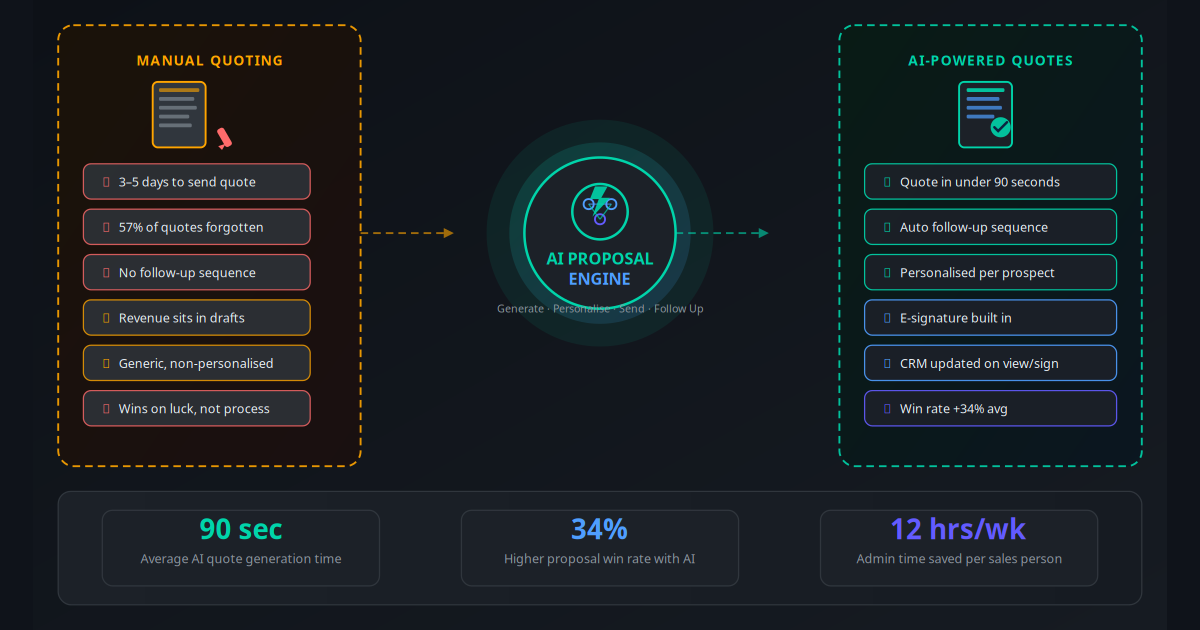
AI proposal and quote automation solves this by handling every step from request to signed contract without manual effort. The prospect fills in an intake form. The AI generates a personalised, branded proposal in under 90 seconds. The system sends it automatically, monitors engagement, and fires timed follow-ups. When the prospect signs, the CRM updates, the invoice fires, and the onboarding sequence begins — all on autopilot.
Key Takeaway
Proposals sent within 24 hours have a 31% higher win rate. AI proposal automation makes same-day delivery the default — for every prospect, every time, with zero extra effort from your team.
What Is AI Proposal and Quote Automation?
AI proposal automation is the use of large language models, workflow automation, and proposal software to generate, personalise, send, and follow up on sales proposals without manual work. It replaces a multi-hour human task with a sub-two-minute automated process.
A fully automated proposal pipeline typically involves four connected systems working together:
- Intake layer: A structured form (embedded on your website, sent via WhatsApp, or triggered by a CRM stage) collects the prospect's requirements, budget, timeline, and goals.
- AI generation layer: A language model (usually GPT-4o or Claude) processes the intake data alongside your service library, pricing logic, and past winning proposals to generate a complete, personalised document.
- Proposal delivery layer: A proposal platform (PandaDoc, Proposify, Better Proposals, or Qwilr) hosts the document, handles e-signature, and tracks opens, time-spent-per-section, and views.
- Follow-up and CRM layer: Automation tools (Make, n8n, or Zapier) connect proposal events — opened, viewed 3+ times, signed, declined — to CRM actions and multi-channel follow-up sequences.
This is distinct from a simple proposal template. The AI does not fill in blanks — it reads the prospect's context and writes copy specific to their industry, their stated pain points, and their business size. A marketing agency in the healthcare sector and a marketing agency in the retail sector will receive structurally similar but meaningfully different proposals from the same system.
The Data: Why Speed and Personalisation Win Deals
| Metric | Manual Process | AI-Automated Process | Improvement |
|---|---|---|---|
| Time to send proposal | 2–5 days | Under 90 minutes | 95% faster |
| Proposal win rate | 27–33% | 42–49% | +34–49% |
| Follow-up compliance | 42% of reps follow up 3+ times | 100% automated | Universal |
| Sales rep time on proposals | 10–15 hrs/week | 1–2 hrs/week (review only) | 12 hrs/week saved |
| Proposal personalisation | Generic templates | Industry and persona-specific | Meaningful difference |
| CRM data accuracy post-send | 61% manually updated | 100% automated | Full pipeline visibility |
Research shows that 80% of sales require five or more follow-ups to close — yet 44% of salespeople give up after just one follow-up attempt. Automation removes the human compliance problem entirely.
The 5 Core Components of an AI Proposal System
1. Smart Intake Forms
The AI can only personalise as well as the data it receives. A great intake form asks: What is the prospect's primary goal? What is their current challenge? What does success look like in 90 days? What is their approximate monthly budget? What industry are they in? The more structured and specific your intake, the more targeted and compelling the generated proposal. Forms can live on your website, be sent as a Typeform or Jotform link, or be collected conversationally by a chatbot connected to your CRM automation system.
2. AI Generation Engine
The AI generation layer uses a carefully crafted system prompt that instructs the model on your brand voice, your service offerings, your pricing structure, and the sections required in a winning proposal. You feed it the intake data, your service library, and optionally a few winning past proposals as context. The model outputs a structured JSON or markdown document that maps to your proposal template. This is where specificity matters: vague prompts produce generic proposals; detailed prompts produce proposals that read as if a senior team member wrote them.
3. Proposal Platform with Engagement Tracking
The AI-generated content is pushed into a proposal platform that renders it as a beautifully formatted, interactive document. Critically, these platforms track engagement: they tell you when the prospect opened the proposal, how long they spent on each section, how many times they viewed it, and from which device. This engagement data is gold. A prospect who opens the pricing page six times is sending a clear signal — and your AI can act on it automatically. These tools also handle e-signature, removing friction from the close. For businesses that already have workflow automation in place, this integrates cleanly with existing AI workflow automation stacks.
4. Automated Follow-Up Sequences
The follow-up sequence is where most businesses leave the most money. Your AI system monitors proposal status and fires messages based on specific triggers. The first follow-up goes 24 hours after sending if no open is detected. The second goes 48 hours after the first open, referencing the proposal by name. A third, softer check-in fires on day 7 if no response. Each message is personalised — referencing the prospect's stated goals and the specific solution outlined in their proposal. Sequences can run across email automation, WhatsApp, and SMS in parallel.
5. CRM and Post-Signature Automation
When a proposal is signed, the pipeline does not end — it accelerates. A signed proposal should trigger: deal won status in CRM, an invoice or deposit request to the client, a welcome email with onboarding instructions, and a task assigned to the delivery team. AI handles all of this in seconds. For lost proposals, the system can trigger a re-engagement sequence 30 days later, surfacing updated pricing or a new case study relevant to the prospect's industry. This closing loop connects to your broader AI sales funnel automation.
Industry Use Cases: Who Benefits Most
Digital Marketing and Creative Agencies
An agency handling 40 proposals per month spends roughly 120 hours on proposal writing alone — the equivalent of three full working weeks per month. With AI automation, an intake form triggers proposal generation in 90 seconds, the document is reviewed and sent within 15 minutes, and a five-touchpoint follow-up sequence runs automatically. One mid-sized agency reported a 38% increase in close rate and reclaimed 95 hours per month within 60 days of deployment.
IT Services and Managed Service Providers
MSPs often lose deals not because of price or quality, but because a competitor responded faster with a clearer scope. AI generates a proposal that maps each prospect's stated pain points (downtime, security concerns, compliance) to specific service tiers and SLA commitments. The system pulls relevant compliance case studies from the knowledge base. One MSP with 8 salespeople reduced average proposal time from 4 hours to 25 minutes, freeing 240 hours per month for client work. For more on building intelligent, context-aware systems, see our guide on RAG-powered AI knowledge bases.
Accounting and Bookkeeping Firms
Accounting firms have highly predictable service packages — monthly bookkeeping, tax preparation, payroll, advisory retainers — that map naturally to AI-generated fixed-fee proposals. The AI reads the prospect's business type, revenue range, and number of employees to recommend and price the appropriate service bundle. Post-signature, it triggers an onboarding document request sequence and sets up recurring billing. Accounting practices using this approach have seen proposal time drop from 3 hours to 12 minutes per prospect. For the broader picture of AI adoption in this sector, see our article on AI for accountants and CPA firms.
Construction and Home Services Contractors
Contractors sending written quotes for renovation, installation, and maintenance jobs face intense competition on response speed. A homeowner who requests three quotes typically signs with the first contractor to respond with a clear, professional document. AI generates a branded quote with itemised line items, material costs, and timeline — from a simple intake form completed on-site or via WhatsApp. One electrical contractor reduced average quote turnaround from 2 days to 4 hours and increased win rate by 29%.
Recruitment and Staffing Agencies
Recruitment agencies send commercial proposals to clients outlining their fee structure, search methodology, and guarantee terms. These documents are highly repeatable but require personalisation per sector and role type. AI maps the client's hiring needs to agency specialisations, generates a customised fee proposal, and follows up with relevant placement case studies. The AI handles client communications while recruiters focus on candidate sourcing — a direct parallel to how AI customer support workflows free teams from repetitive communication tasks.
How to Build Your AI Proposal Pipeline in 8 Steps
Audit your current proposal process: Document every step from initial prospect inquiry to signed contract. Identify where time is lost and where follow-ups fail. This audit shapes your automation priorities — most businesses discover 80% of the time loss is in generation and follow-up, not review.
Build your service library: Create a structured document listing every service you offer, its pricing model (fixed, hourly, retainer), typical deliverables, timelines, and which type of client it suits. This is the source of truth the AI draws from when building proposals. The more detailed this document, the more accurate and relevant the output.
Design your intake form: Build a 6 to 10 question intake form that captures everything the AI needs to personalise the proposal. Include industry, company size, primary goal, current challenge, budget range, and desired start date. Deploy it on your website's contact page, send it as a pre-qualification step via your CRM pipeline, or integrate it into your chatbot.
Engineer your AI generation prompt: This is the highest-leverage step. Write a detailed system prompt that instructs the AI on your brand voice, proposal structure (executive summary, problem analysis, solution, pricing, next steps), and how to map intake data to specific services. Include 2 to 3 anonymised winning proposals as few-shot examples. Test with 10 different prospect profiles before deploying.
Choose and configure your proposal platform: Select the tool that matches your volume and needs (see the comparison table below). Import your brand assets, configure your proposal template sections, and test the API connection from your automation layer. Ensure e-signature is enabled and that webhook events (opened, signed, declined) are configured to fire to your automation tool.
Build the automation workflow: In Make or n8n, create the workflow that: (a) receives intake form data, (b) calls the AI API with the generation prompt, (c) pushes the output to your proposal platform via API, (d) sends the proposal link to the prospect, and (e) creates or updates the deal record in your CRM. This workflow should run end-to-end in under 2 minutes.
Configure your follow-up sequences: Set up trigger-based follow-up workflows in your CRM or automation tool. Map each proposal status (not opened, opened, viewed multiple times, signed, declined) to the appropriate follow-up action. Use multi-channel sequencing — email for the first follow-up, WhatsApp or SMS for the second — to maximise response rates without being intrusive.
Run a 30-day pilot and optimise: Deploy the system with your next 20 proposals. Track open rate, win rate, time-to-send, and follow-up response rate. Review every proposal the AI generates during the first two weeks to catch hallucinations or off-brand copy. Refine the generation prompt based on real-world results. Most businesses see measurable win rate improvement within the first 30 days.
AI Proposal Tools Compared: 2026 Edition
| Tool | Best For | AI Generation | E-Signature | Starting Price |
|---|---|---|---|---|
| PandaDoc | Mid-market, CRM-heavy teams | Built-in AI assist + API | Yes | $19/user/month |
| Proposify | Agencies and creative firms | Native AI + API | Yes | $49/user/month |
| Better Proposals | Freelancers and small firms | Via Zapier/Make + GPT | Yes | $19/month |
| Qwilr | Interactive web-based proposals | Built-in AI blocks | Yes | $35/user/month |
| Custom (Make + GPT-4o + DocuSign) | Maximum control, any CRM | Full AI customisation | Yes (DocuSign) | Infrastructure only |
For businesses already using an automation platform like Make, Zapier, or n8n, the custom approach offers the highest flexibility — you can use any proposal tool and connect it to any CRM or communication channel you already rely on.
ROI and Real Results Businesses Are Seeing
"We were sending 30 proposals a month and winning 8. Now we win 14 with the same pipeline. The AI generates the first draft in 90 seconds, I review for 5 minutes, and it sends itself. That is 45 hours of writing time I get back every month."
— Founder, digital marketing agency, 12-person teamAcross businesses that have deployed AI proposal automation in 2025 and 2026, the consistent results are:
- Time-to-proposal: From 2 to 5 days down to 90 minutes or less (98% reduction in delay)
- Proposal win rate: Average improvement of 28 to 41% within 90 days
- Follow-up consistency: From 42% manual compliance to 100% automated execution
- Sales rep capacity: Each rep handles 60 to 80% more active proposals without additional time investment
- Proposal quality: 91% of business owners rate AI proposals as "equal to or better than" their best manual proposals after prompt refinement
- Revenue recovered: Businesses report 15 to 25% more revenue from deals that previously died in their pipeline due to slow or absent follow-up
The financial model is straightforward. If your average deal value is $5,000, your monthly proposal volume is 20, and your current win rate is 30%, you close 6 deals per month — $30,000 in revenue. A 34% win rate improvement brings you to 8 deals — $40,000. That is $10,000 in additional monthly revenue from process alone, not from generating more leads or improving your service. The automation stack costs $100 to $200 per month to run. The payback period is measured in days.
Common Mistakes That Undermine Proposal Automation
Skipping the Intake Form Design Step
The quality of AI-generated proposals is directly proportional to the quality of the intake data. Businesses that use a generic "tell us about your project" text field get generic proposals. The intake form is the most important element in the system. It should require specific, structured answers — not open-ended paragraphs — so the AI has clear variables to work with. Invest at least a full day designing and testing this form before building anything else.
Sending Proposals Without Human Review for the First 30 Days
Even a well-engineered AI prompt will occasionally hallucinate a service you do not offer, quote a price outside your range, or include a case study that does not match the prospect's industry. In the first 30 days, every AI-generated proposal should be reviewed by a human before sending. After 30 days of refinement, most businesses can move to a spot-check model — reviewing every fifth proposal rather than every one.
Treating the Follow-Up Sequence as One-Size-Fits-All
A prospect who opened your proposal 11 times in 48 hours and spent 4 minutes on the pricing page is in a very different state than a prospect who never opened it. Your follow-up sequences should branch based on engagement behaviour. The highly engaged prospect needs a call invite and urgency nudge. The non-opener needs a re-send with a different subject line. Engagement-triggered branching is what separates good proposal automation from great proposal automation.
Ignoring the Post-Signature Automation
Most proposal automation guides end at the signed contract. But the signed contract is the beginning of the customer relationship, not the end of the sales process. When a proposal is signed, your system should immediately: send a welcome email, request any required onboarding information, generate and send an invoice or deposit request, and notify the delivery team with job details. Businesses that automate this step report 41% faster project kick-offs and significantly higher early client satisfaction scores. This connects directly to your AI customer onboarding automation flows.
Using a Single Pricing Option
Research consistently shows that proposals with three pricing tiers close at a higher rate than proposals with a single price. The middle tier is chosen 60 to 70% of the time. Your AI proposal system should always generate three options — a foundational tier, a recommended tier, and a premium tier — with clear differentiation in scope and outcome. This anchoring effect works regardless of industry and adds minimal complexity to the generation prompt.
Not Measuring Win Rate Before and After Automation
You cannot improve what you do not measure. Before deploying AI proposal automation, calculate your baseline win rate, average time-to-proposal, and follow-up compliance rate. After 60 days of running the automated system, compare. Without this data, you cannot make informed decisions about which prompts to refine, which follow-up sequences to adjust, or which intake questions to add. Connecting these metrics to your AI automation ROI calculator gives you a clear financial picture of the system's impact.
Your Competitors Are Already Closing Faster
Proposal automation is not a competitive advantage for much longer — it is becoming the baseline. Businesses that automate their proposal pipeline today are winning deals that should belong to you, not because their services are better, but because they respond faster, follow up consistently, and present a more polished, personalised document. Speed and process beat quality when quality is roughly equal.
The technology is accessible. A functional AI proposal system can be built in a weekend with off-the-shelf tools. The investment is $100 to $200 per month. The payback — measured in recovered deals, saved time, and reclaimed sales capacity — typically arrives within 30 days. For a business sending 20 proposals per month with an average deal value of $3,000, a 30% win rate improvement means $18,000 in additional annual revenue from process optimisation alone.
The question is not whether to automate your proposals. It is how fast you can build the system and start recovering the deals your manual process is currently letting go. Use the AI Business Twin for a free personalised analysis of where proposal automation would have the highest impact in your specific business — in under 10 minutes.
Frequently Asked Questions
How fast can AI generate a business proposal?
A well-configured AI proposal system generates a fully formatted, personalised proposal in 60 to 90 seconds after receiving the prospect's inputs. This compares to 2 to 5 hours for a manual draft. The AI pulls from your service library, previous proposals, and prospect data in your CRM to create a document that is specific to the client's industry, budget, and stated goals.
Does AI proposal automation work for service businesses without standard pricing?
Yes. Even for custom-scoped projects, AI can generate a structured proposal template with variable pricing tiers and editable line items, dramatically reducing the time spent on formatting and boilerplate. The business owner or sales person reviews and adjusts the numbers before sending. Most agencies and consultants report this cuts proposal prep time by 70 to 80 percent even for bespoke projects.
What happens after the AI sends a proposal?
The AI monitors prospect engagement in real time. When a prospect opens the proposal, the system logs the view in your CRM and triggers a personalised follow-up message — typically a WhatsApp or email — within minutes. If there is no response after 48 hours, a second follow-up fires automatically. If the prospect opens the document multiple times without signing, the AI can notify the sales person to call. The entire follow-up sequence runs without any manual action.
Can AI proposals include e-signatures?
Yes. Platforms like PandaDoc, Better Proposals, Proposify, and Qwilr all include built-in e-signature functionality. When integrated with an AI generation layer, the proposal is sent as a branded, interactive document with a one-click sign button. Once signed, the CRM is updated, an invoice or deposit request fires automatically, and the onboarding sequence begins. The entire quote-to-contract process can run without a single manual step.
How much does AI proposal automation cost?
The tools vary. Proposal platforms like PandaDoc or Proposify cost $19 to $49 per user per month. AI generation layers built on GPT-4o cost roughly $0.005 to $0.02 per proposal in inference costs. CRM integration and automation workflow tools like Make or n8n add $10 to $50 per month depending on usage. Total cost for a complete AI proposal stack is typically $50 to $150 per month — compared to the 10 to 15 hours per week a salesperson spends on manual proposal work.
Which types of businesses benefit most from proposal automation?
Any business that sends quotes or proposals as part of its sales process benefits significantly. The highest-ROI use cases are: digital marketing agencies, IT services and managed service providers, accounting and bookkeeping firms, legal services, construction and home improvement contractors, consulting firms, recruitment agencies, and any B2B service business with a pipeline of more than 10 deals per month.
Will AI-generated proposals feel impersonal to prospects?
Not if configured correctly. Modern AI proposal systems pull the prospect's name, company, industry, pain points stated in the intake form, and relevant case studies from your knowledge base to create a document that reads as if it was written specifically for them. The key is building a rich intake form and a detailed prompt that maps prospect data to proposal sections. Many businesses find their AI-generated proposals are more thorough and better structured than their manual equivalents.
How long does it take to set up AI proposal automation?
A basic setup — AI generation connected to a proposal tool and a CRM with automated follow-up emails — takes 2 to 3 days with a pre-built workflow. A full end-to-end system with e-signature, automated invoicing on signing, onboarding sequence triggers, and multi-channel follow-up takes 1 to 2 weeks to build and test. Most businesses start with the generation and basic follow-up layer and add components over time.